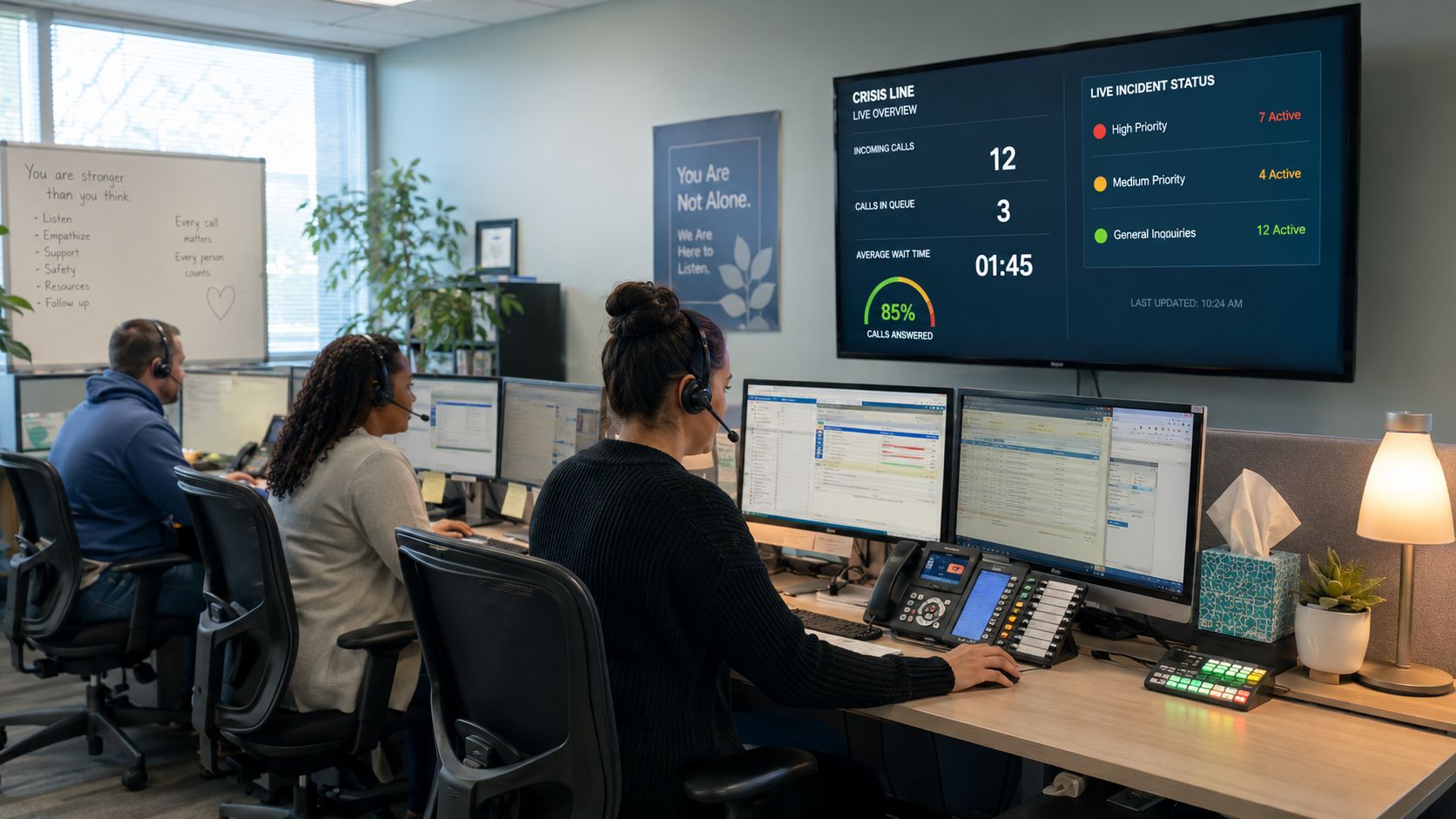
The phone starts ringing before the statement is finished. A nonprofit, retailer, school, or local agency publishes a cautious first notice about a data incident, evacuation, recall, or safety complaint, then the inbox fills, the media calls, and people want a live human who can tell them what happens next. That is where crisis phone lines earn trust or lose it fast.
The common mistake is treating the line as a side project. In practice, it sits inside the organization's public response, which means the people answering calls, the words they use, the routing behind the scenes, and the disclosures at the top of the call all shape whether the organization looks prepared or evasive.
Table of Contents
- Why Your Organization Needs a Crisis Phone Line
- Choosing IVR, Call Routing, and Overflow Technology
- Sample Scripts and Phone Tree Templates
- Escalation Protocols and Incident-Command Handoffs
- Staffing, Rostering, Training, and Quality Assurance
- Privacy, Legal, and Compliance Considerations
- 30-Day Launch Checklist and Common Pitfalls
Why Your Organization Needs a Crisis Phone Line
A mid-sized nonprofit gets hit with a data incident on a Friday afternoon. The first statement goes out, the media wants confirmation, supporters want reassurance, and staff are suddenly forwarding the same questions to five different people. Without a dedicated voice channel, the organization burns time repeating the same answers and still leaves callers stranded.
A crisis line changes that pattern. It gives the public one place to reach a trained responder, and it gives the comms team a real-time read on what people are worried about, which is often more useful than social listening alone. The result is not just convenience, it is a faster path to credible, coordinated response.
Start with scope before technology
The first week should settle four questions, and they need answers before anyone compares vendors.
- Who the line serves. Customers, employees, media, members, patients, donors, or the general public all need different scripts and escalation paths.
- What the line handles. Incident updates, intake, emotional support, claims, safety guidance, or referral to another team should be defined in writing.
- When it runs. 24/7 availability is a strong benchmark for crisis-style services, and crisis-center guidance for 988-style operations expects continuous coverage. For many organizations, business hours plus an on-call escalation plan is more realistic.
- What it does not do. The line should not promise legal advice, clinical care, or law-enforcement outcomes unless those functions are formally in place.
A short steering group should include communications, operations, legal, HR if employees may call, and whoever owns the incident command structure. The most useful early document is a plain-language terms-of-use statement that sets expectations and says what happens when the call needs to move elsewhere. That is the kind of clarity that reduces liability later.
Practical rule: if the public-facing statement sounds broader than the hotline can actually support, the organization has already created a trust problem.
The best press teams also treat the line as part of the media response. A well-written crisis statement answers what is known, what is being done, and where to get help. A live line handles the questions the statement cannot, which is why the relationship between the two needs to be planned, not improvised. The internal framing in what is crisis communications helps teams align that message architecture.
A useful analogy comes from high-volume service coverage. The tax season call coverage guide shows how predictable surges force teams to think about staffing, overflow, and message consistency before the rush starts. Crisis work is less predictable, but the operational logic is the same.
Choosing IVR, Call Routing, and Overflow Technology
The wrong system design fails in obvious ways. Callers hit busy signals, menus loop too long, or a single carrier issue takes the whole line down. The right design is simpler than vendor decks suggest, because crisis callers need speed, not a maze of features.
Pick for failure modes, not feature lists
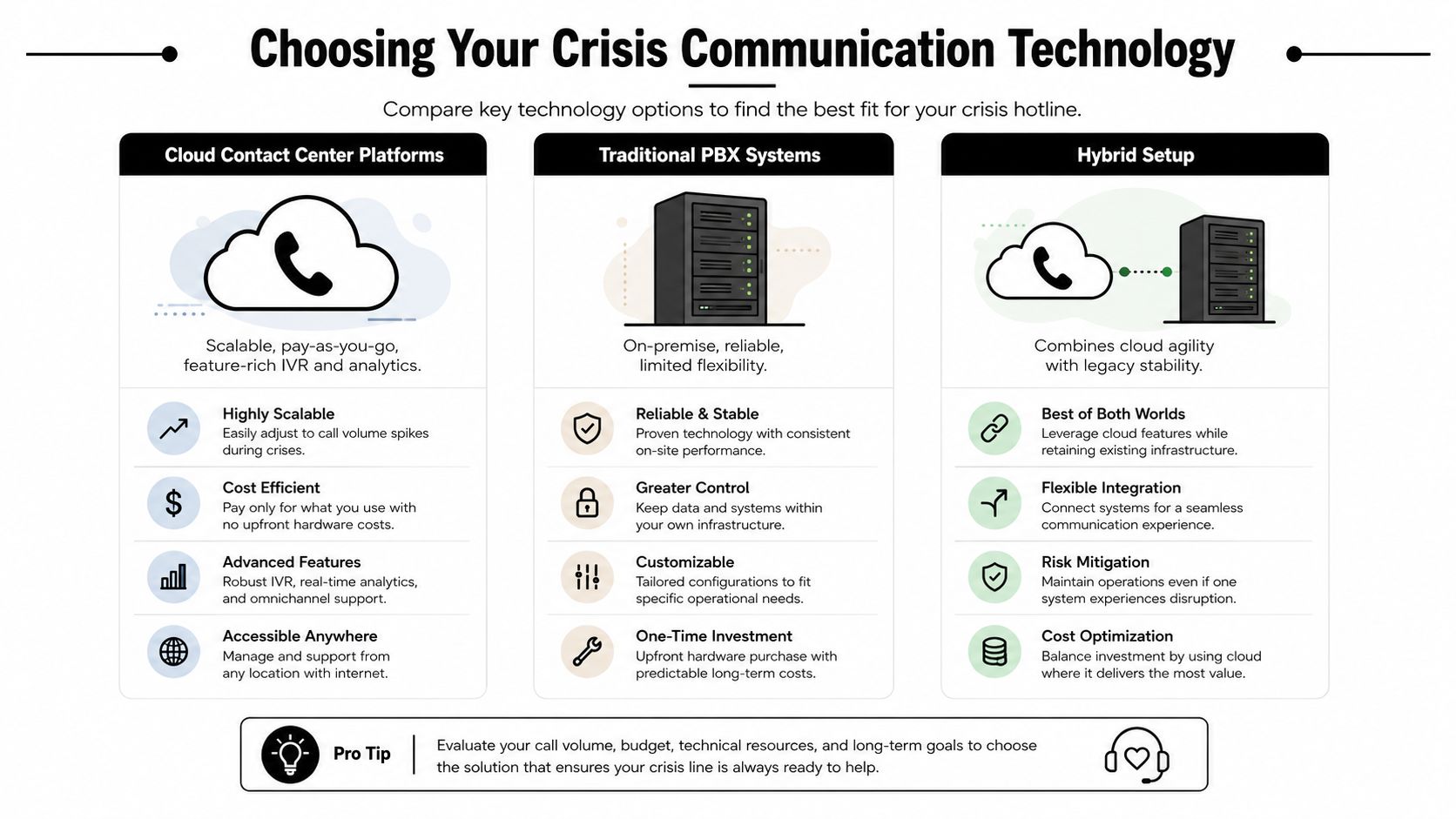
Cloud contact center platforms work well when the organization needs flexibility, remote agents, and quick changes to routing. Traditional PBX setups can still be dependable on-site, but they are less adaptable when call volume spikes or staff relocate suddenly. Hybrid setups give many teams the cleanest balance, because they can preserve a stable core while adding cloud overflow and remote access.
The key issue is not the brand of the platform, it is the failure path. Single-carrier designs are fragile, because if the network path breaks, callers never even enter queue. The guidance on crisis infrastructure warns against underprovisioned trunks and single-path dependence for exactly that reason.
A sensible SLA should include three operational terms, all of them measurable in plain language.
- Service level. The percentage of calls answered within a defined wait threshold.
- Answer time. The elapsed time before a live person picks up.
- Blockage. Callers who cannot enter queue because the line system is saturated.
The Washington crisis-contact-center guidance cites a NENA benchmark of 90% of 911 calls answered within 10 seconds during busiest hours and 95% within 20 seconds at other times. That is an urgency reference point, not a literal crisis-line law, but it is a useful staffing and routing target when a line must feel responsive under pressure.
Test overflow before the incident does it for you
Overflow should be designed, contracted, and rehearsed before launch day. That means simulated busy periods, carrier failover checks, and live tests of every route a caller might hit, including text, chat, and voicemail handoff if those channels exist. If the team cannot see how the call behaves when the main queue is full, the system is not ready.
If a vendor only demonstrates the happy path, the vendor has not demonstrated the system.
The technical benchmark in emergency voice systems also points to practical constraints, including support for 2 to 8 outstation lines, 1 x 2-core 1.5 mm cabling, and a maximum distance of 500 m node-to-node in one specification. Those details matter less for marketing than for survivability planning, because they remind operators to think about redundancy, line saturation, and power continuity instead of assuming cloud alone solves resilience.
Sample Scripts and Phone Tree Templates
Good scripts do two things at once. They calm the caller and they keep the agent from freelancing in the worst possible moment. The right template sounds human, but it also narrows the range of answers to what the organization can support.
A copy-ready opening that stays inside the lane
A practical greeting for a crisis line can be short enough to remember and specific enough to protect the organization.
“Thank you for calling. This line is for questions about the incident and for help getting to the right support. If you are in immediate danger, call emergency services now.”
That opening works because it does not overpromise. It tells callers the purpose of the line, it flags urgent safety exceptions, and it gives the responder room to route appropriately without sounding cold.
A strong phone tree should separate three call types early.
- Information seekers. People asking for hours, claim status, event logistics, or service updates.
- Distressed callers. People who need calm, de-escalation, and a handoff to a senior responder.
- Escalations. Media, legal issues, imminent-harm claims, or situations that need command-team attention.
Routine inquiries can move through a lighter script. Distressed calls need slower pacing, shorter sentences, and a repeat-back to confirm what was heard. The handoff line should be plain: “I'm bringing in a senior responder now so you don't have to repeat yourself.”
Use language that does not box the team in
The most damaging words are usually the ones that sound reassuring but close off options. Agents should avoid promises like “we'll definitely fix this today” unless the team has a verified service commitment. They should also avoid speculation, because a crisis line should never guess at facts that belong in the next press release.
A good FAQ-style flow for the first 60 seconds often includes five questions: what happened, who is affected, whether the caller is safe, what they need right now, and whether the issue belongs with another service channel. That structure keeps the conversation practical and gives the communications lead a cleaner view of recurring themes.
For teams that already use a crisis communications playbook, the crisis communications plan template can help align hotline language with approved message blocks, so the phone script and the public statement do not drift apart.
Escalation Protocols and Incident-Command Handoffs
A hotline fails when every caller gets treated as a routine call. It also fails when every call gets escalated. The point is to define the triggers that move the conversation from front-line support to a senior responder, then to the on-call specialist, then to incident command.
Build the chain before the phones light up
The escalation chain should be visible to every agent and short enough to use under stress.
The chain works best when each handoff has a defined purpose.
- Front-line agent. Gathers the facts, stabilizes the caller, and logs the case.
- Senior responder. Handles complex questions, emotional intensity, or conflicting information.
- On-call liaison. Pulls in legal, clinical, safety, or public-affairs guidance.
- Command center. Decides what becomes part of the active incident record and what needs a statement update.
The cleanest escalation triggers are easy to spot: explicit threats, claims of imminent harm, media inquiries, requests that involve regulated advice, and any call that reveals a gap between the current public statement and the caller's lived reality. The hotline log then becomes one of the best early-warning systems for the comms lead, because it shows what people are confused about before the confusion metastasizes on social channels.
A useful call flow for the first ten minutes of a chemical-spill hotline during a regional evacuation would start with safety status, location, exposure concerns, immediate shelter guidance, and whether the caller needs a transfer to local authorities or an internal response lead. The staff member answering the call should not improvise beyond the approved protocol. The handoff matters more than the speech.
Staffing, Rostering, Training, and Quality Assurance
The most elegant routing plan still collapses if the people staffing it are tired, unprepared, or never tested under pressure. Hotline work is a people system first, and a technology system second.
The roster has to survive real-world fatigue
A small team can cover a crisis line if the schedule is designed for continuity, not heroics. The checklist embedded in many crisis-contact-center operations is simple enough to borrow, keep a small roster, recruit surge agents in advance, and train every responder on the same escalation rules. That is especially important when an incident stretches beyond a single shift cycle.
Hiring and pre-vetting matter more than people expect. For nonprofits and community organizations, a resource like background checks for nonprofits is useful because surge staffing should not start with a scramble for trustworthy coverage after the incident has begun. Pre-clearance saves time, and time is the rarest asset during a live response.
A realistic staffing example often looks like this: one agent fields routine calls, one senior responder floats, and one supervisor monitors tone, backlog, and escalation volume. When volume rises, the line should rotate out tired staff before their judgment slips. That is not softness. It is risk control.
Training needs to be short, specific, and repeated
The minimum training should cover empathy basics, the organization's own escalation triggers, privacy language, and how to write notes that are useful without being nosy. A four-hour core module is a workable starting point for surge responders when the content is focused and the role is narrow.
Quality assurance has to be active, not ceremonial. Recorded-call review, weekly debriefs, and mystery-shopper drills catch script drift quickly, especially when multiple departments are feeding the hotline. Those reviews should look for tone, accuracy, handoff timing, and whether the agent asked the caller what they needed before steering them elsewhere.
For teams formalizing the people side, the crisis communications training resource helps separate polished sounding answers from answers that actually survive a high-stakes call. That distinction matters because callers remember whether they felt heard long after they forget the exact script.
Operational truth: the first agent is rarely the one who solves the hardest call, but that agent often decides whether the caller stays engaged long enough for the right person to help.
Privacy, Legal, and Compliance Considerations
The easiest legal mistake is assuming a crisis line can operate on goodwill alone. It cannot. If callers are recorded, logged, contacted later, or routed into another system, the organization needs to say so clearly and handle that data under one policy, not five separate habits.
Disclose early and keep the promise simple
The first 30 seconds should cover the essentials. Callers need to know whether the line is recorded, what information is collected, whether the data is used for quality or follow-up, and what happens if they disclose urgent safety concerns. If minors may call, the organization needs a separate rule for consent, escalation, and when a guardian or outside authority becomes involved.
Operational analytics and call-content analytics should not be treated as the same thing. Queue stats tell the team how the line performs. Transcripts and recordings tell the team what callers said. Both require retention rules before the first call comes in, because a well-meaning team can create a retention mess very quickly if logs and recordings are stored inconsistently.
A compliance-minded team also needs a narrow policy for follow-up. If the line will call people back, text them later, or hand them to a local provider, the consent language has to cover that handoff. That is where legal counsel should be involved before launch, not after the first complaint.
Let the data shape the message
The most useful hotline metrics are not fancy. They are the ones that help communications decide what to say next.
- Answer time. If callers wait too long, the public-facing statement needs to acknowledge access friction.
- Abandonment rate. If people hang up before speaking, the system may be signaling a routing or staffing problem.
- Peak concurrent callers. This helps the team size overflow and decide when to switch public messaging.
- Top call reasons. Repeating questions show where the landing page or press release needs clarification.
- Sentiment flags. A spike in confusion or anger tells the comms team that reassurance alone is not enough.
- Escalation counts. A rise in escalations means the public statement may be too vague for the moment.
If callers keep asking “What happened?”, the next release should lead with confirmed facts and avoid filler. If callers keep asking “How do I file a claim?”, the landing page needs a direct FAQ path, not another paragraph of narrative.
The broader compliance lens from the compliance guide for collections is useful because it reinforces the same discipline crisis teams need, say what is collected, say why it is collected, and keep the workflow aligned with the words in the disclosure.
30-Day Launch Checklist and Common Pitfalls
A line is ready when it can take a real call without surprising the people behind it. The fastest path is a four-week launch plan that finishes with testing, not optimism.
What the month should look like
Week one should lock scope, audience, hours, escalation triggers, and legal review. Week two should finalize the routing design, overflow partner, and backup path. Week three should train staff, rehearse scripts, and test the handoff to incident command. Week four should run live drills, confirm metrics, and publish the public-facing contact language.
The biggest mistakes are predictable. Teams promise 24/7 coverage without backup staffing, they brief legal too late, they build a line that cannot fail over cleanly, they over-script agents into sounding robotic, or they treat the hotline as a separate island instead of part of the broader crisis communications playbook.
The clearest readiness signals are also plain. Calls are being answered quickly enough to feel human, escalation triggers are being used consistently, and the hotline data is already changing the next statement, FAQ, or press release in near real time. That loop is the true test, because crisis phone lines do not exist to prove the organization has a number. They exist to prove the organization can respond.
Press Release Zen helps teams build the message side of that response with practical guides, templates, and crisis communications resources that fit real operations. For organizations standing up crisis phone lines, that means less guesswork when the first call lands and the statement has to hold up under pressure. Visit Press Release Zen to tighten the link between your hotline, your press release, and the public trust both depend on.