At 2:14 a.m., a security alert lands in the wrong inbox, a journalist starts asking questions, and the executive who approves public statements is unreachable. The communications team can have a polished crisis manual on the intranet and still lose control if the contact tree is stale, the approval path hasn't been tested, or nobody knows who owns the facts.
A crisis communications checklist exists for that moment. It turns pressure into assigned actions, separates confirmed information from assumption, and gives leaders a defensible way to move quickly without sacrificing accuracy. The strongest checklists aren't collections of templates. They're operational systems that people rehearse, audit, and use to coordinate decisions when normal working conditions have disappeared.
Table of Contents
- Why a Crisis Communications Checklist Protects Your Organization
- Building Your Pre-Crisis Foundation
- Activating Your Response in the First 48 Hours
- Managing Misinformation and Social Platform Speed
- Fixing the Human Readiness Gaps That Sink Most Plans
- Running a Structured Post-Crisis Review
- Your Complete Crisis Communications Checklist Reference
Why a Crisis Communications Checklist Protects Your Organization
A crisis rarely arrives in a convenient sequence. A cyber incident may begin with an internal alert, become a customer concern, and reach a journalist before the response team has agreed on the first sentence. A product issue, workplace accident, leadership controversy, or service outage creates the same underlying problem: several audiences need reliable information while the organization is still establishing what happened.
Without a tested process, people fill gaps with assumptions. One executive calls a reporter before legal review. Customer service uses an outdated FAQ. Employees learn about the incident from social media. A spokesperson promises an update that the technical team can't support. Each mistake makes the next decision harder because the organization loses its shared source of truth.
The CDC's Crisis and Emergency Risk Communication first 48 hours checklist formalizes rapid actions such as notifying the chain of command, issuing an initial statement, monitoring misinformation, and briefing stakeholders. That matters because speed, accuracy, and credibility become operating requirements, not general principles that someone remembers under stress.
A checklist also protects decision quality. It tells the team who confirms the facts, who approves language, who briefs employees, who monitors coverage, and who records decisions. The document doesn't replace judgment. It prevents the team from wasting judgment on avoidable coordination questions.
The financial and reputational exposure
Crisis communication has a business consequence, not just a public-relations consequence. A 2026 analysis of major corporate crises identified more than $266 billion in excess market-capitalization losses across nine crises, and companies that responded quickly and transparently experienced about 4.7 times less market-cap loss than slower, less transparent peers, according to the 5WPR analysis of the crisis tax. The comparison doesn't mean every incident will produce the same outcome. It does show why response discipline belongs in executive risk planning.
Preparedness remains uneven. The same source cites 2024 industry survey data showing that 49% of U.S. companies had a formal crisis communications plan, 28% had an informal plan, and nearly 23% had none. A plan that exists only as an untested file offers limited protection when the first call comes after hours.
| Metric | With Checklist | Without Checklist |
|---|---|---|
| Initial activation | Assigned trigger, contact path, and incident owner | Informal calls and uncertain responsibility |
| First statement | Fact-checked holding language with approval gates | Delayed, speculative, or contradictory wording |
| Stakeholder handling | Prioritized audiences and documented outreach | Employees, customers, and media receive uneven information |
| Misinformation response | Monitoring, verification, and escalation rules | Rumors are discovered late or answered inconsistently |
| Recovery | Recorded decisions and assigned improvements | Lessons remain informal and failures recur |
For practical guidance on message discipline and response planning, teams can also consult these crisis communication best practices. The central principle is simple: the checklist protects control before it protects reputation. It gives people a reliable operating rhythm while facts are still developing.
Building Your Pre-Crisis Foundation
Preparation should begin with the parts of the plan most likely to fail. A holding statement can be updated during an incident. A missing phone number, unavailable approver, or locked communication platform can stop the response before the first draft exists.
Audit the people and the path
Start with a contact tree that names the primary and alternate owner for every critical function. Include communications, executive leadership, legal, information security, human resources, customer support, operations, the external agency, and relevant authorities. Store phone numbers, email addresses, backup channels, availability expectations, and escalation authority in a controlled document that remains accessible if corporate systems are unavailable.
The GCS PRIMER emergency planning framework organizes crisis checklist work into Plan, Rehearse, Implement, Maintain, Evaluate, and Recover. Its guidance calls for a verified out-of-hours chain of command, stakeholder directories, trained spokespeople, and regular testing. Those requirements expose a common weakness: a contact list isn't complete because every row has a name. It's complete when the team has recently confirmed that the person answers, understands the role, and has a working alternate.
The approval chain needs the same treatment. Document who drafts, who checks legal and regulatory exposure, who validates technical facts, who approves the final wording, and who can act when the designated approver is unavailable. Pre-authorize low-risk actions, such as acknowledging an incident without assigning cause, while reserving admissions, liability language, and major operational commitments for the appropriate review.
Build usable materials and channels
Holding statements should support the first response, not pretend to solve the entire crisis. Prepare scenario frameworks for likely incidents, then leave clear fields for confirmed facts, affected audiences, protective actions, contact details, and the next update commitment.
Map each audience to a channel. Employees may need an internal alert and manager briefing. Customers may need email, a status page, or a helpline. Journalists need a media contact and a public statement. Investors, regulators, partners, and local communities may require targeted briefings. The crisis communications plan template can help teams structure these elements without confusing a document with an operating capability.
Monitoring should cover news, social platforms, customer channels, and relevant technical signals. The plan should identify who watches each source, what keywords trigger escalation, how screenshots and links are archived, and who verifies an apparent claim before a response is drafted.
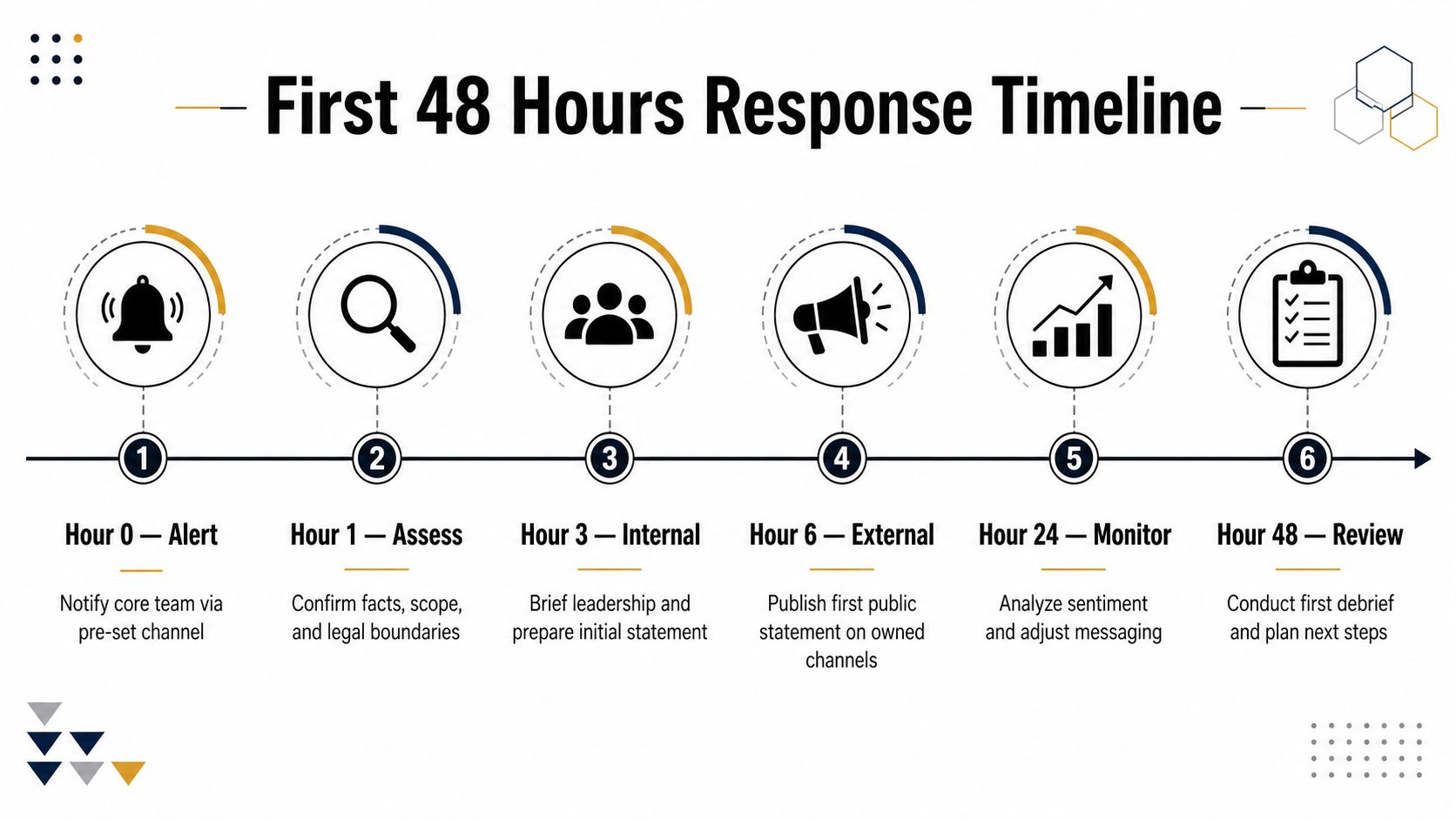
The CDC checklist explicitly frames response around the first 48 hours, with actions including chain-of-command notification, an initial statement, misinformation monitoring, and stakeholder briefings. Teams should rehearse those actions in a tabletop exercise, including an after-hours activation, an unavailable executive, a legal disagreement, and a false social post. A drill that only tests whether people can find the plan doesn't test crisis readiness.
Activating Your Response in the First 48 Hours
The first response should create order before it creates volume. A team that publishes quickly without confirming the incident, assigning ownership, or defining the next update may appear active while making the situation harder to manage.
Hour zero through hour one
Confirm the alert through a designated fact owner. That person doesn't need every answer, but must establish what is known, what is unverified, what evidence exists, and which technical or operational lead can close each gap.
Activate the core team through the pre-set channel, then issue an internal hold message to the people who need to know immediately. The message should state that an incident is under assessment, identify the incident owner, prohibit unsanctioned external commentary where appropriate, and explain when the next internal update will arrive.
The initial gate is activation, not publication. The communications lead should confirm that the right functions are present or that alternates have taken over. Legal, security, operations, HR, and customer teams may not need identical information, but they need a shared fact base.
Hours one through twelve
Open a war-room record, assign a single spokesperson, and start a decision log. The log should capture the time, decision, evidence considered, approver, unresolved question, and next action. This prevents the team from reopening settled issues and preserves accountability for the post-crisis review.
Draft a holding statement that acknowledges the situation without guessing at cause, impact, or responsibility. It should explain what the organization is doing, provide a channel for affected people, and state when the next update will be issued. The first external message should pass through the documented legal, technical, and executive gates, but the team should also know which language has been pre-approved for immediate use.
The United Nations toolkit described in the verified data includes distinct control points for media and social monitoring, agreed and briefed spokespeople, approved materials, logged enquiries, website updates, and regular stakeholder communication. Treating these as separate checklist items prevents a team from assuming that one public post covers every obligation.
The team can use this review of ContentRemoval.com strategy when an incident includes harmful or misleading content that may require a platform, search, or reputation-management response. Removal isn't a substitute for correcting the record, but it can form part of an escalation path when content violates platform rules or exposes affected people to further harm.
Hours twelve through forty-eight
Move from acknowledgment to a substantive update as confirmed facts mature. Brief priority stakeholders directly, tailor the information to their decisions, and keep the public update cadence realistic. A promise that cannot be met damages confidence more than a clear statement that an investigation is still under way.
Escalate when the incident expands in scope, affects safety or privacy, reaches a new jurisdiction, attracts sustained media attention, or generates credible misinformation that could change behavior. By the end of the initial cycle, the team should have a documented response record, an updated message map, and a decision about whether to remain in crisis mode or move into recovery communication.
Managing Misinformation and Social Platform Speed
A traditional checklist often says, “Monitor social media.” That instruction is too broad for an environment where a fabricated executive video, a cropped internal screenshot, or an AI-generated claim can circulate before a conventional approval chain finishes its first review.
A 2025 systematic review of AI in crisis communication found fragmented research, with only about one-fifth of studies using explicit theoretical frameworks, and reported that the literature emphasizes detection and classification more than trust-building, transparency, fairness, and accountability, as summarized in the systematic review on AI in crisis communication. The operational lesson isn't that teams should avoid AI. It is that listening automation can't become an unreviewed publishing system.
Separate detection from verification
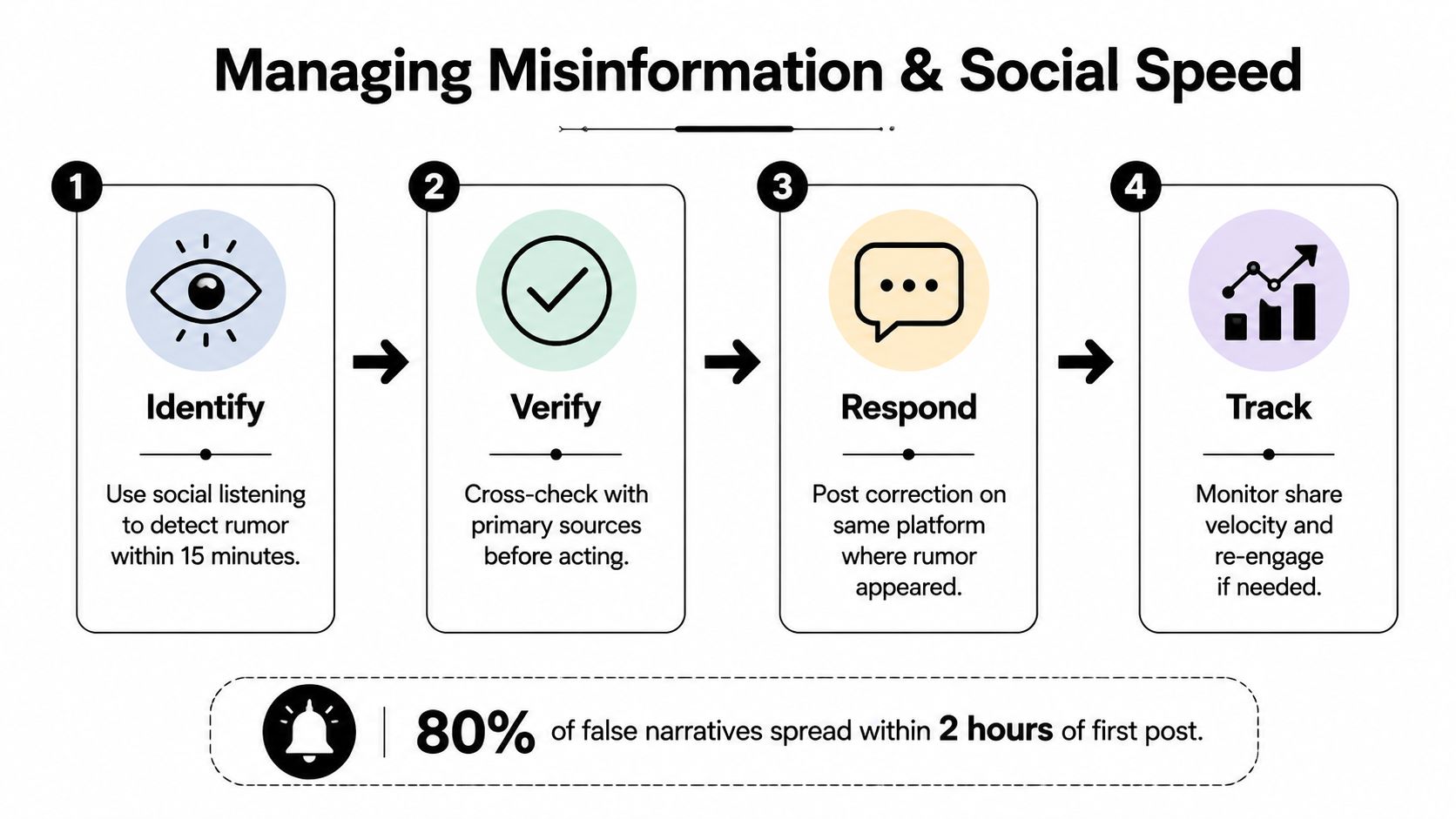
Use social listening to identify claims, not to establish truth. The monitoring owner should capture the original post, propagation context, apparent source, affected audience, and claim wording. A verification owner then checks primary records, technical logs, executive availability, customer-service data, or official third-party information before recommending a response.
Not every false claim deserves a public reply. A response can give a minor rumor more visibility, especially when the organization repeats the allegation in a headline or graphic. The decision should consider reach, credibility of the source, potential harm, likelihood of behavioral impact, and whether the audience already knows where to find the correction.
Practical rule: Correct the claim that could change behavior, protect the audience that could be harmed, and avoid repeating content that has no meaningful audience or consequence.
Pre-authorize the fast lane
Legal review remains essential, but every claim can't wait for a full approval meeting. The checklist should define response categories that allow a trained communicator to act quickly, such as directing people to an official status page, confirming that a fake account isn't an official channel, or stating that a claim is under verification. Higher-risk responses should trigger legal, security, privacy, or executive review.
AI tools can support listening, clustering, translation, and anomaly detection. Human reviewers must assess context, sarcasm, manipulated media, cultural meaning, and the risk that an automated system has mistaken repetition for credibility. The team should also document when AI assisted analysis and who approved the resulting message.
The crisis communications and social media guidance should sit beside the monitoring protocol, not in a separate marketing document. Platform escalation contacts, evidence-preservation steps, impersonation procedures, and correction rules belong in the same operational workflow.
Fixing the Human Readiness Gaps That Sink Most Plans
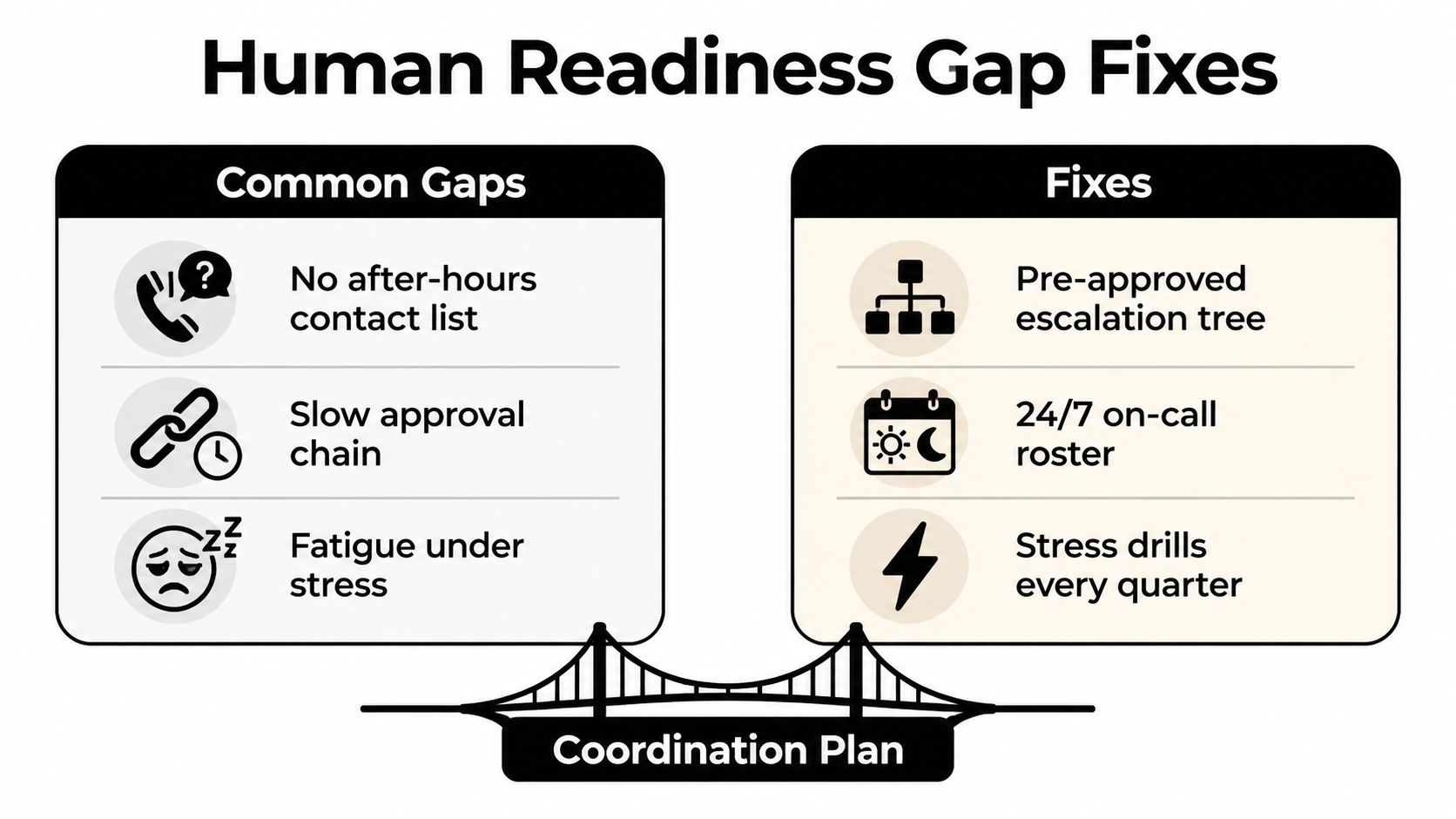
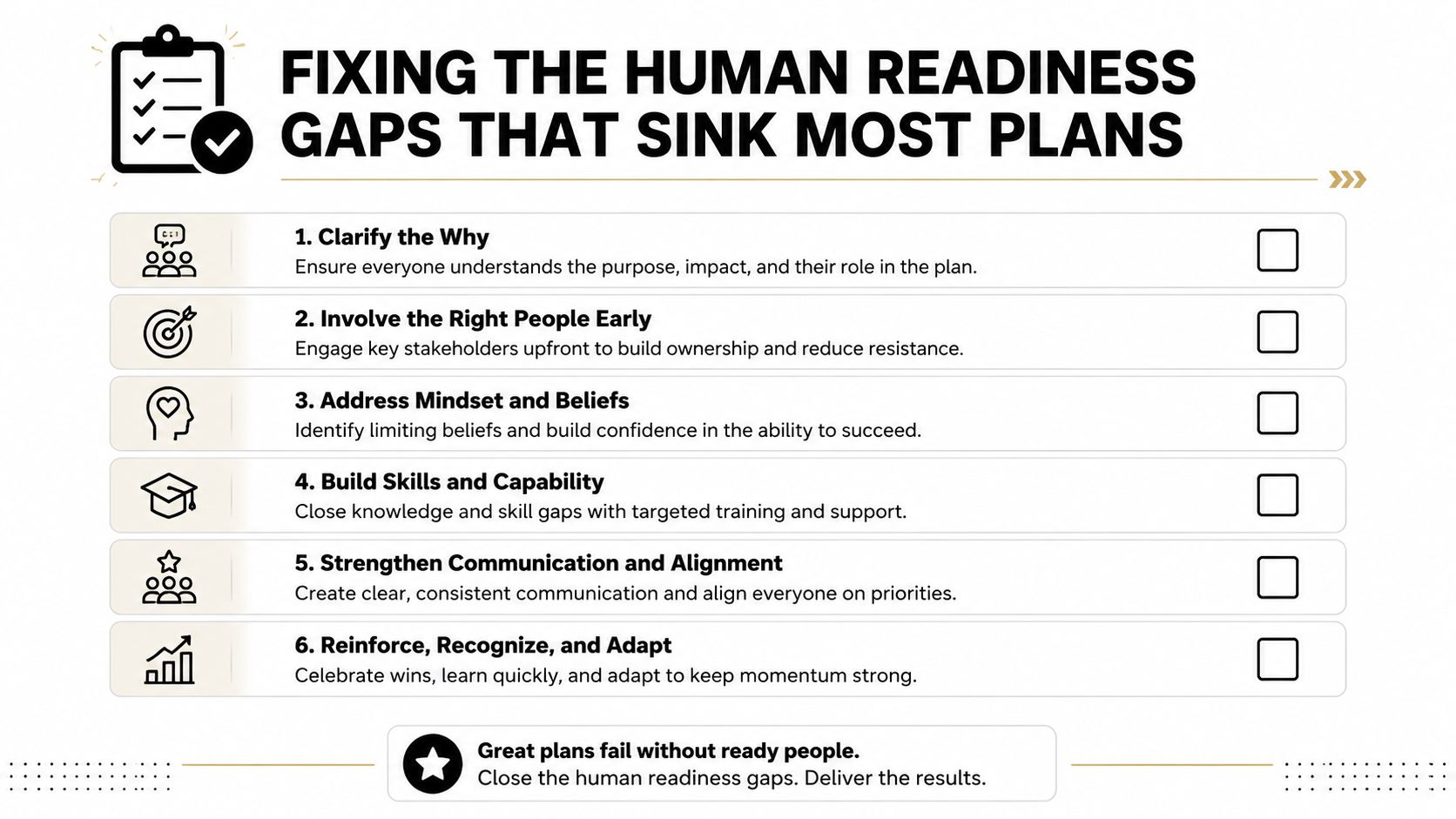
Most failed crisis plans don't fail because nobody can write a sentence. They fail because the right people can't connect, the available people don't know who has authority, or exhausted responders keep routing every decision through a person who isn't answering.
The Business Continuity Institute identifies lack of staff response as the leading cause of plan failure, with outdated contact information and weak coordination also cited as major barriers, according to its survey on digital solutions and crisis communications. The same survey reports dissatisfaction with tools because of limited functionality, poor integration, and budget constraints. Those findings point toward a practical correction: test the people and systems together, rather than reviewing the document in isolation.
Treat contact accuracy as a control
A quarterly contact audit is more useful than an annual plan review if the annual review doesn't verify live reachability. The communications coordinator should ask every role holder to confirm contact details, preferred after-hours channel, alternate contact, location or time-zone constraints, and authority limits. Former employees should be removed immediately, not during the next scheduled update.
Each critical role needs coverage. A primary spokesperson should have an alternate. The fact owner should have a technical deputy. The communications lead should have someone who can run the log, manage media enquiries, or update owned channels. Redundancy doesn't mean everyone can approve everything. It means a single absence won't freeze the process.
Rehearse disagreement and fatigue
A tabletop exercise should force realistic friction. Legal may advise caution while communications argues that silence will leave a vacuum. Operations may have incomplete information while customer support needs usable answers. A remote team may be working across different time zones, with no shared understanding of who is awake and authorized.
The exercise should test those conditions, including a tired spokesperson, an unreachable approver, a contradictory internal report, and a platform outage. After the drill, the team should record which decisions stalled, which roles overlapped, and which instructions were too ambiguous to follow.
The shortest checklist that proves people can execute will usually outperform the longest checklist that only describes intentions.
Decision fatigue also requires structural support. Rotate extended monitoring duties, appoint a documentation owner who isn't drafting every message, and use a visible status board showing open questions, owners, deadlines, and approval state. The goal is not to remove human judgment. It is to preserve that judgment for decisions that need it.
Running a Structured Post-Crisis Review
A crisis review should produce operational changes, not a polite conversation about how hard the situation was. The best time to begin is while the sequence remains clear, but the meeting must be structured so that people can identify process failures without turning the session into a search for someone to blame.
Start with the incident timeline. Compare the first alert, activation, fact confirmation, internal briefing, first public statement, stakeholder notifications, updates, and recovery decision. Then compare planned actions with observed actions. The gaps matter more than the narrative.
A validated pandemic crisis-communication assessment tool uses a 30-item checklist covering preparation, response, and recovery criteria, as described in the peer-reviewed crisis communication assessment research. Teams can apply the same logic beyond a pandemic by making every control observable and time-stamped. “Monitoring was active” is weaker than a record showing when monitoring began, who reviewed it, and which decision it informed.
| Review Dimension | Key Metrics | Improvement Actions |
|---|---|---|
| Preparation | Contact accuracy, role coverage, drill completion | Refresh the tree, appoint alternates, schedule the next exercise |
| Activation | Time from alert to team activation, fact-owner assignment, incident-log opening | Remove unclear triggers and simplify the activation route |
| Message control | Approval time, confirmed-fact ratio, consistency across channels | Pre-approve response categories and improve the message map |
| Stakeholder reach | Notification completeness by audience, unanswered enquiries, update delivery | Add missing groups, owners, channels, and escalation rules |
| Misinformation handling | Detection-to-verification interval, correction approval, evidence record | Define response thresholds and human-review requirements |
| Recovery | Debrief completion, assigned owners, implementation evidence | Set deadlines and verify changes in a later audit |
The review owner should assign each improvement to a named role with a due date and proof requirement. “Update contacts” needs evidence of confirmation. “Improve monitoring” needs a documented workflow or completed test. Leadership transitions are less damaging when the review record explains why each control exists, not merely what someone intended to do.
Your Complete Crisis Communications Checklist Reference
A usable reference should fit beside the incident log and remain readable when the team is tired. Each item needs an owner, a completion point, and a clear escalation condition.
Before an incident
- Communications lead: Define crisis triggers, authority limits, and the core response team. Review during each plan maintenance cycle.
- Crisis coordinator: Verify primary and alternate contacts, after-hours channels, and stakeholder directories. Audit quarterly.
- Executive sponsor: Confirm final approval authority and the alternate approver.
- Legal lead: Review holding-statement frameworks, regulatory boundaries, privacy restrictions, and escalation language before an incident.
- Technical or operations lead: Assign a fact owner and deputy for each major scenario.
- Monitoring owner: Document media, social, customer, technical, and relevant external monitoring.
- Spokesperson lead: Train primary and alternate spokespeople and record availability.
- Training owner: Run tabletop exercises that test unreachable contacts, approval delays, conflicting facts, and platform disruption.
- Communications manager: Store the current plan, templates, channel credentials, stakeholder map, and decision-log format in accessible primary and backup locations.
During the first response
- Incident owner: Confirm the alert and open the incident log.
- Crisis coordinator: Activate the team through the designated channel and record acknowledgments.
- Fact owner: Separate confirmed facts, unknowns, assumptions, and evidence sources.
- Communications lead: Set the initial audience order and appoint one spokesperson.
- Legal and technical reviewers: Approve the holding statement within the defined authority limits.
- Internal communications owner: Brief employees and managers before external publication where circumstances permit.
- Channel owner: Publish through the selected official channel and preserve the final version.
- Monitoring owner: Capture emerging claims, verify priority misinformation, and escalate credible harm.
- Documentation owner: Record decisions, approvers, unresolved questions, and next-update commitments.
During ongoing response
- Spokesperson: Use the approved message map and avoid speculation.
- Stakeholder owners: Brief customers, partners, regulators, investors, employees, and media according to priority.
- Monitoring owner: Report meaningful changes in coverage, sentiment, questions, and false claims.
- Crisis lead: Reassess scope and escalation triggers as facts change.
- Communications lead: Maintain a reliable update cadence and correct material inaccuracies.
- Operations lead: Confirm that public instructions match actual service, safety, or remediation capability.
After the incident
- Review owner: Build the event timeline and convene a blameless debrief.
- Crisis team: Evaluate preparation, activation, message accuracy, stakeholder reach, monitoring, and recovery.
- Leadership: Assign improvements to named owners with deadlines and evidence requirements.
- Plan administrator: Update contacts, approval paths, templates, and escalation rules.
- Training owner: Test the revised process in a later drill.
- Executive sponsor: Review completion evidence and keep the checklist as a living operational record.
The checklist earns its place when teams test it, revise it, and prove that each critical role can execute. Press Release Zen offers planning resources, templates, and guidance for organizations building press and crisis communication workflows. Visit Press Release Zen to equip the communications team with practical tools before the next incident puts the plan under pressure.