A launch date is on the calendar. The embargo is set. A small communications team has a spreadsheet of journalists, but the list still needs cleaning, the contact details need checking, and dozens of newsrooms must receive the announcement before the morning news cycle begins. Sending each email one by one creates a race against time, while sending a generic blast risks poor targeting and weak follow-up.
That's the situation a press release wire service is designed to solve. It gives one announcement a standardized route into a network of newsrooms, aggregators, databases, and indexed publishers. It doesn't guarantee that journalists will cover the story, and it won't turn routine company news into national news. Its value comes from solving a specific distribution problem: getting credible, time-sensitive information to many recipients at once while creating a documented public record.
The practical question for small and midsize organizations isn't whether wire services exist. It's when the reach, speed, and documentation justify the spend over email outreach or direct pitching. The answer depends on the announcement, the audience, and what the communications team needs after publication.
Table of Contents
- The Moment a Wire Service Actually Matters
- What a Press Release Wire Service Actually Does
- The Three Types of Wire Services Explained
- How Wire Distribution Affects Media Pickup and SEO
- When a Wire Service Is Worth Paying For
- Running a Wire Send Without Leaving Value on the Table
- Common Misconceptions That Cost Teams Real Money
The Moment a Wire Service Actually Matters
At 8:15 in the morning, a one-person communications manager has three tasks competing for attention. The final release needs approval, the spokesperson needs a briefing, and journalists covering the announcement still need to be contacted. The team has identified relevant outlets, but manually sending the same news to every newsroom could consume the entire morning.
A wire service removes that delivery bottleneck. The communicator submits one approved release, selects the appropriate geographic and industry distribution, confirms the timing, and lets the platform route the material through its network. The model originated with the commercial launch of PR Newswire in 1954, described in a historical account as the first commercial press release distribution service. Its teletype-based system sent an issuer's announcement simultaneously to a defined list of subscribing newsrooms using authenticated source material, and that operating model shaped wire distribution for roughly 70 years according to this history of PR Newswire.
The historical problem was simple. Public companies, investment banks, and corporate communications teams needed to deliver one announcement to many outlets without relying on separate one-to-one pitches. A wire created a shared delivery route, much like a central post office that accepts one envelope and forwards copies through an established network.
Practical rule: A wire is a delivery mechanism, not a magic amplifier.
That distinction matters on launch day. A wire can improve speed, consistency, formatting, and documentation. It can make a release available to aggregators and publishers that monitor syndicated feeds. It can also provide a hosted release page and reporting on distribution or pickup. But editorial coverage still depends on news value, timing, relevance, and a journalist's decision to pursue the story.
A regulatory announcement, transaction, funding event, or urgent corporate disclosure may justify the expense because many stakeholders need the same factual information quickly. A minor website update, routine hire, or small feature adjustment usually won't. Email outreach and direct pitching often win when the story depends on a specific journalist's beat, a personal relationship, or a nuanced narrative.
What a Press Release Wire Service Actually Does
A press release wire service works like a postal mailing system for company news. A communications team hands one approved “envelope” to a central service. The service processes the release, applies distribution settings, and forwards copies through its network instead of requiring the team to contact every recipient individually.
The process usually follows a practical sequence:
- Submission: A team uploads the release through a web form or API, adds company details, selects timing, and supplies supporting assets.
- Review: The service checks the material for formatting, source identification, prohibited content, and style requirements. Review doesn't turn the release into independent journalism. It confirms that the submission fits the service's publishing rules.
- Classification: The release receives geographic and industry tags so relevant databases, feeds, and recipients can identify its subject.
- Distribution: The platform routes the announcement to selected newsrooms, aggregators, media databases, and publisher feeds.
- Indexing and hosting: Search engines may discover syndicated copies, while the service hosts a permanent release page on its own domain or in a paid archive.
- Reporting: The customer receives information such as the publication timing, pickup locations, link lists, or other available distribution reports.

Infrastructure and recipients are different
The wire is the infrastructure. It handles submission, processing, formatting, scheduling, routing, hosting, and reporting. The distribution network is the collection of recipients and downstream publishers connected to that infrastructure.
That distinction prevents a common misunderstanding. Buying access to a network doesn't mean buying the attention of every journalist in it. Some recipients may ingest releases automatically. Some may publish a copy on an aggregator page. A newsroom may monitor the feed without ever assigning a reporter.
The customer usually receives an embargo lift or publication timestamp, a hosted release page, and reporting about where the material appeared. Depending on the service and package, the release may also flow into RSS systems, news databases, sector feeds, or publisher archives.
The wire's strongest practical role is repeatable distribution and documentation. A company can show when it issued a statement, preserve the approved wording, and make the announcement available to stakeholders who need a stable reference. That helps investor relations, compliance teams, public affairs staff, and PR managers report what was distributed, even when no major outlet produces an independent article.
The Three Types of Wire Services Explained
Buyers commonly encounter three broad categories. The differences matter less as labels than as trade-offs involving audience relevance, journalist-list quality, pickup reliability, cost, and the value of any resulting links.
| Criteria | National Legacy | Industry-Niche | Low-Cost Mass |
|---|---|---|---|
| Cost per release | Generally the highest | Varies by sector and reach | Generally the lowest |
| Audience relevance | Broad national or regional reach | Narrow, subject-specific reach | Broad but often less targeted |
| Journalist-list quality | Established databases and newsroom relationships | Strongest where the niche is well defined | Frequently built around automated syndication |
| Pickup reliability | Distribution is reliable, editorial pickup is not guaranteed | Can be useful for trade visibility, but depends on the sector | Copies may appear widely without meaningful coverage |
| Link equity | Links shouldn't be treated as a ranking strategy | Relevant mentions may support discovery | Many placements have limited authority or SEO value |
National legacy providers
Services such as PR Newswire, Business Wire, and GlobeNewswire are built for organizations that need broad distribution, formal disclosure support, or a recognizable infrastructure layer. They can make sense when a company must reach investors, business media, regional outlets, and databases at the same time.
The trade-off is cost. A large network is wasteful when the actual audience consists of a small group of trade editors or specialist reporters.
Industry-niche services
A specialty wire focuses on a defined vertical, such as financial services, healthcare, real estate, or technology. Its narrower footprint can be more useful than a national blast when the announcement uses technical language or matters mainly to a particular professional audience.
A healthcare company announcing a regulatory development may gain more from relevant medical and business contacts than from thousands of unrelated publisher copies. The buyer should examine the actual recipient list rather than assuming that “industry” automatically means “journalist.”
Low-cost mass platforms
Low-cost mass-distribution platforms emphasize volume and affordability. They can create a broad online footprint, but a large number of copies doesn't equal meaningful editorial attention. Teams should inspect where releases appear, whether the outlets have real audiences, and whether the service promises distribution rather than coverage.
Free press-release hosts belong in a separate category. They provide a public page, but they're not really a wire service because they don't necessarily provide a professional syndication network or structured newsroom delivery. A useful buyer comparison appears in this guide to wire services and pricing.
How Wire Distribution Affects Media Pickup and SEO
Wire distribution creates two outcomes that teams often confuse: media pickup and search visibility. They're related, but they're not the same result.
Media pickup occurs when a journalist, editor, publisher, or newsroom uses the release as a source and produces or republishes coverage. Pickup depends on the announcement's newsworthiness, the journalist's editorial calendar, the relevance of the subject, and the usefulness of the supplied material. A clear quote, accurate contact information, embargo handling, and strong multimedia can make follow-up easier, but none of those elements guarantees an article.
Syndication is different. An aggregator or publisher may reproduce the release automatically without assigning a journalist to report it. That creates distribution and a searchable record, but it isn't earned media.
| Dimension | Media Pickup | SEO Footprint |
|---|---|---|
| Who creates the outcome | A journalist, editor, or independent publisher | The wire, syndication partners, and search systems |
| What it provides | Reporting, context, attribution, and potential audience trust | Indexed copies, brand mentions, and discoverability signals |
| Main driver | News value and editorial relevance | Clarity, crawlability, distribution, and owned-page quality |
| What it doesn't guarantee | Publication by a major outlet | Ranking improvements from distributed links |
| Best measurement | Relevant coverage and journalist responses | Branded search, referral activity, indexed mentions, and owned-page performance |
Why the SEO benefit is indirect
Syndicated copies can expand the number of places where a company name, executive, product, or announcement appears. However, paid wire links are generally nofollowed or treated that way algorithmically. A cited industry analysis reported that only 3.4% of wire-syndicated backlinks from domains with a domain rating above 50 were dofollow, as discussed in this analysis of press release SEO.
That makes the wire a poor substitute for editorial links, useful owned content, or a well-structured newsroom. The strongest SEO practice is to publish the canonical version on a company-controlled page, link to that page from the release, and treat syndicated copies as supporting references rather than authority-building assets.
The broader distribution data shows why the model remains active. A 2019 sample of 37,748 press releases found that 60.74% were sent through a wire service, while nearly 14% were sent by agencies. The top three services in that sample were PR Newswire, PRWeb, and Business Wire in this press-release distribution analysis.
Teams should therefore evaluate retrieval and visibility, not vanity placement counts. Useful signals include relevant pickup, branded-search activity, referral traffic, accurate syndicated copies, and whether the owned announcement page becomes the stable source that journalists and search systems can revisit.
When a Wire Service Is Worth Paying For
A useful decision starts with the announcement, not the vendor. Three questions usually settle the choice: How urgent is the news? Who needs to see it? What kind of response does the team need?
A wire is most defensible when the announcement is factual, time-sensitive, and broadly relevant. Regulatory news and formal disclosures need controlled timing and a documented distribution record. Funding announcements may interest investors, business reporters, partners, and customers at the same time. A consumer-facing product launch can justify broader reach when the company has a real audience beyond a specialist trade.
The 2026 retrieval study adds an important qualification. It reported stronger retrieval for M&A announcements at 40% and regulatory filings at 30%, while product launches produced weaker editorial pickup at 14% in this 2026 press-release retrieval study. The figures don't mean every transaction will perform well or every launch will fail. They show that announcement type changes the likely value of syndication.
Use email outreach for narrow relevance
Direct email outreach is usually stronger when the story matters to a defined group of trade journalists. A niche healthcare development, a founder's industry perspective, or a customer story may need context that a standardized release can't provide. A short, personalized pitch can explain why the news fits a particular reporter's beat and offer access to the right spokesperson.
Use direct pitching for narrative stories
A journalist who needs a human angle, exclusive access, or a timely opinion is unlikely to be persuaded by broad distribution alone. Direct pitching gives the communicator room to tailor the angle, answer questions, and build a relationship that can produce coverage beyond the release itself.
A wire helps a fact travel. A pitch helps a story take shape.
Verdict for budget holders: Choose a wire for urgent, broadly relevant, documentation-heavy news. Choose email outreach or direct pitching when relevance and relationship matter more than scale.
Running a Wire Send Without Leaving Value on the Table
A wire send becomes expensive when the team treats publication as the finish line. The highest-return work usually happens before the submission and immediately after the release goes live.
Before distribution
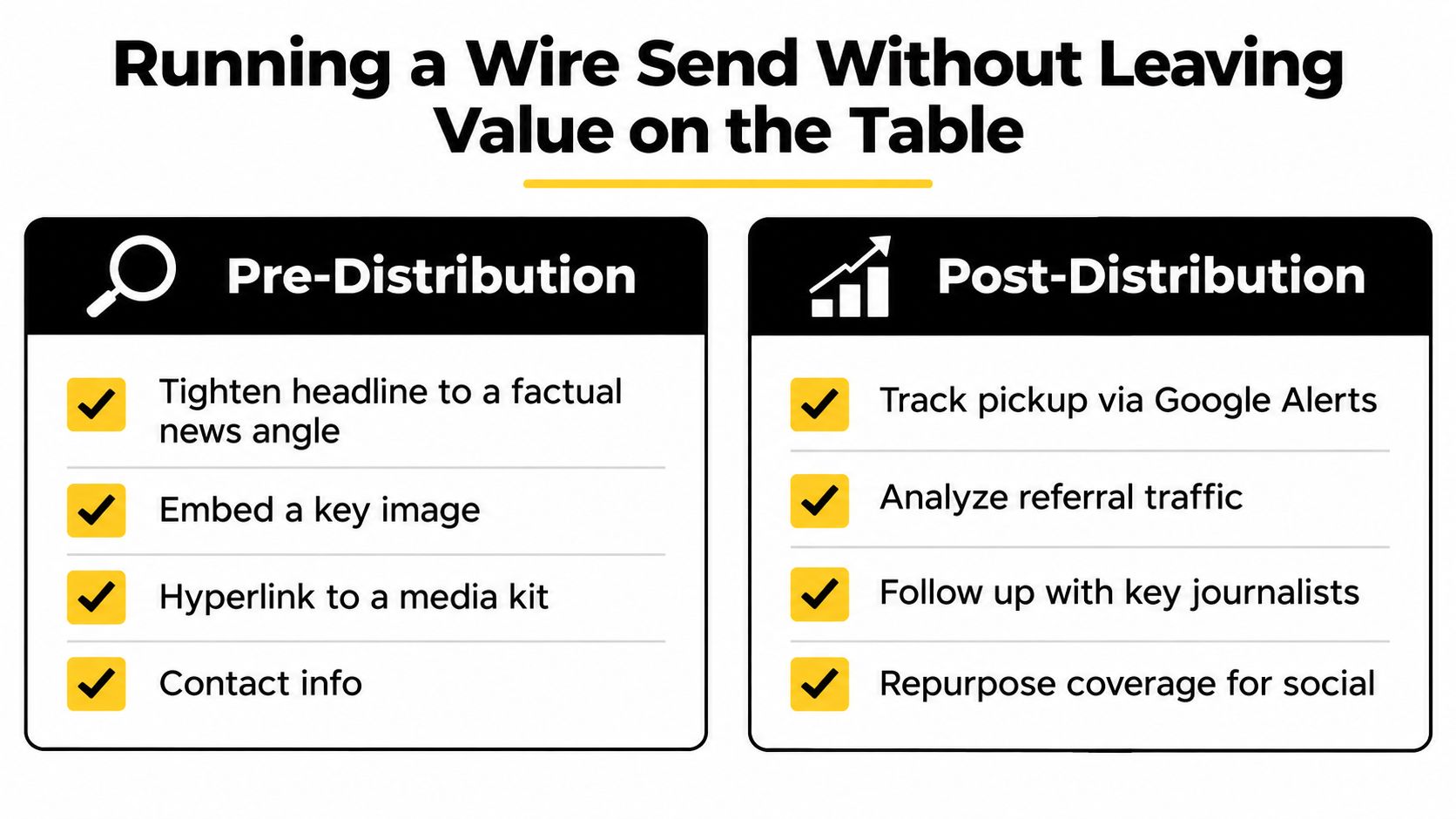
The headline should state the factual news angle rather than repeat a slogan. The opening should answer what happened, who it affects, and why the information matters. A journalist-grade quote adds interpretation, but it shouldn't replace concrete facts.
The team should also prepare a media kit or newsroom page before distribution. That page can hold executive biographies, product images, logos, fact sheets, contact details, and the canonical version of the announcement. The release should point readers toward that controlled source instead of making the wire-hosted copy the only destination.
The most valuable preparation steps are usually these:
- Confirm the news angle: Remove promotional language that obscures the actual announcement.
- Prepare useful assets: Include a key image, downloadable materials, spokesperson details, and a media-kit URL.
- Set the timing correctly: Review the embargo date, time zone, and approval chain before submission.
- Match the footprint: Select geographic and industry distribution that reflects the audience rather than choosing every available region.
- Check the spokesperson route: Make sure a real person can answer journalist questions after publication.
After distribution
The first follow-up period should focus on evidence, not excitement. Monitor pickup, save relevant copies, record journalist questions, and identify which outlets produced independent coverage rather than automated syndication. Google Alerts can help surface mentions, while analytics can reveal referral traffic from published copies.
UTM parameters on links to the owned newsroom or media kit make referral activity easier to attribute. If a syndicated copy contains a factual error or a broken destination, the team can contact the publisher or service and request a correction where appropriate.
A stretched team doesn't need a complicated measurement program. It needs a small record of the release URL, pickup locations, journalist inquiries, referral activity, and follow-up outcomes. This guide to distributing a press release provides a practical framework for coordinating those steps.
Common Misconceptions That Cost Teams Real Money
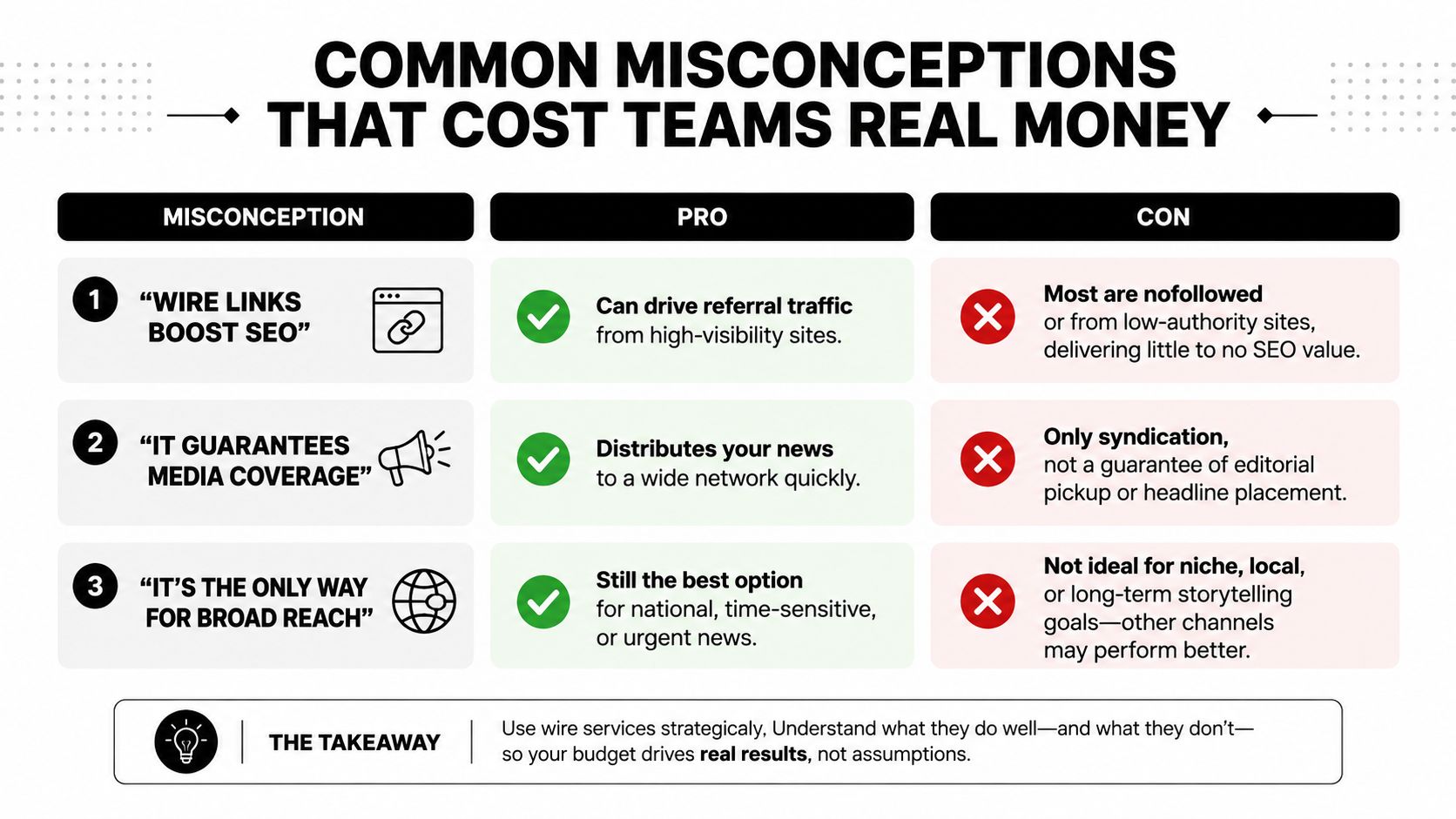
The first costly belief is that wire-distributed links automatically improve Google rankings. Most syndicated links carry little or no ranking authority, so a company shouldn't buy a distribution package as a backlink campaign. The more durable approach is to publish a clear canonical announcement on an owned page, pursue independent coverage, and measure whether the release supports discovery of the brand and its factual claims.
The second misconception is that every announcement deserves a wire. A routine hire, a minor product tweak, or an internal milestone rarely needs broad distribution unless a specific audience has a compelling reason to care. A SaaS company issuing releases for every small feature update may spend money creating copies that no journalist wants to read. A focused customer email, product update, or direct pitch could communicate the change more effectively.
Bigger distribution isn't automatically better
A startup announcing a seed round to a narrow investor community may not need the largest national package. A team whose buyers read three specialist trade publications could waste budget on a vast network while missing the editors who influence actual decisions.
Broad syndication helps when stakeholders are geographically dispersed or the timing matters across multiple audiences. It adds less value when the target is small, known, and reachable through personalized outreach. The distribution footprint should follow the announcement's audience, not the provider's largest package.
A 2025 industry report found 71% of practitioners dissatisfied with legacy newswire services, citing pricing, quality, and effectiveness concerns in this industry coverage of current market research. That dissatisfaction reinforces the need for a decision framework, not automatic renewal.
The wire can still support a wider content system. A separate 2025 global report found 91% of communicators reuse press release content elsewhere, and 57% said releases increased visibility, as reported in the same industry source. Those findings point to a sensible role for the release: it can supply verified source material for the newsroom, social channels, sales enablement, investor communications, and targeted outreach.
Press Release Zen offers practical guides, comparisons, templates, and distribution advice for teams deciding whether a wire service fits an announcement. Review the Press Release Zen resources before the next send, then match the channel, audience, and follow-up plan to the news instead of paying for reach that won't produce useful attention.