A reporter asks for the founding year, the current leadership team, and a plain-English description of what the organization does. The communications team sends a backgrounder, then discovers that the document contains an old executive bio, an unverified market claim, and a headcount nobody can date. The file looked polished, but it created more work than it removed.
That failure is common because teams treat a backgrounder as an “about us” document. A useful backgrounder does something more demanding. It gives a journalist a fast, trustworthy way to verify facts, understand context, and pull accurate language into coverage without reconstructing the organization's history from scattered sources.
Table of Contents
- What a Backgrounder Is For
- Backgrounder vs Press Release
- The Modular Structure That Works
- Sourcing Facts and Writing in AP Style
- From Research to Draft
- Keeping the Document Alive
- Template, Checklist, and Distribution
What a Backgrounder Is For
A journalist checks the founding date, leadership title, or product description while preparing a story, often after the interview has ended. A backgrounder is a verification document built for that moment. It supports the news hook by showing who the organization is, how it reached its current position, what it does, and which wording the communications team has verified.
A reporter may scan it while checking a quote. A producer may use one section for a sidebar, while an analyst consults it for an organization profile. These readers rarely follow a first-to-last reading path. They look for a particular fact, its context, and enough evidence to use it safely. Retrievability and evidence therefore matter more than polished narrative.
The file usually sits in a press kit, media folder, or spokesperson briefing package. Its value should continue after the announcement leaves the news cycle. It is one component of a press kit versus media kit, not the entire media resource. Its narrower responsibility is organized institutional context that journalists can check quickly.
The verification test
Every sentence should hold up under review by someone who was not involved in writing it. A founding date needs a reliable record. A leadership title needs current confirmation. A product description needs language the organization can defend without turning the document into a sales presentation.
Start with the editorial question the document must answer. Gather only facts that serve that question, label verified information separately from claims, and arrange the material in sections, bullets, timelines, or tables. This structure reduces the chance that a journalist mistakes an assertion for an established fact.
Content Grip's backgrounder guidance emphasizes assigning one owner to maintain dates, biographies, data points, and press-kit links. That owner should also record when key facts were checked and who approved changes. Without ownership, a backgrounder becomes stale even when its layout remains polished.
Practical rule: If a reporter must email the communications team to confirm a basic fact, the backgrounder has not finished its job.
Keep the document factual and neutral. Public-relations training guidance describes backgrounders as materials covering historical context, current circumstances, and possible developments without becoming persuasive or personalized. The PR specialist playbook offers a useful starting point for connecting media preparation with repeatable communications processes.
Backgrounder vs Press Release
A press release and a backgrounder may live beside each other in the same media folder, but they perform different newsroom tasks. The release is announcement-driven. It presents one news hook, usually in an inverted-pyramid structure, and gives the reader the essential development early, followed by quotes, supporting details, boilerplate, and a next action.
A backgrounder is reference-driven. It doesn't need to persuade a reporter that today's announcement matters. It needs to make the organization understandable and its facts easy to check. That changes the writing pattern, the tone, and the way information is sourced.
The press release usually has a linear reading path. The backgrounder has a modular one. A journalist may skip directly to leadership, history, products, or key facts, so each block must make sense without a long lead-in.
| Attribute | Backgrounder | Press Release |
|---|---|---|
| Primary job | Provide context and verifiable reference material | Announce a specific development |
| Time horizon | Evergreen, subject to scheduled updates | Tied to a news cycle or event |
| Structure | Modular sections, bullets, Q&A, or chronology | Inverted pyramid with a clear news lead |
| Tone | Factual, neutral, and restrained | Informative, with approved quotes and announcement framing |
| Sourcing | Named sources, records, dates, and approved facts | Spokesperson quotes, announcement details, and boilerplate |
| Reading pattern | Nonlinear scanning | Mostly linear reading |
| Common failure | Marketing language disguised as context | Too much background before the news |
Where teams go wrong
The most common mistake is turning the backgrounder into a longer press release. That produces a document full of promotional adjectives, repeated quotes, and announcement language that becomes stale as soon as the news event passes. The opposite mistake is also costly. A backgrounder with no clear history, leadership, or fact snapshot forces journalists to search elsewhere.
A second mistake is using the same sourcing standard for both documents. A press release can identify a spokesperson who is making a stated claim. A backgrounder should make it easier to distinguish a documented fact from an executive opinion or positioning statement.
A release can say that a company is launching a service and include an approved quote about its purpose. The backgrounder should explain what the company does, who runs it, when it was founded, and which descriptions are supported by records. Treating the documents as interchangeable is why backgrounders often get rejected as marketing collateral.
The Modular Structure That Works
A backgrounder works best when a journalist can lift one block without losing its meaning. A practical structure has five core blocks, followed by a visible update record:
- Company history and founding context
- Key facts snapshot
- Leadership
- Products or services
- Contact and boilerplate
A history block should establish origin and meaningful milestones without turning into a brand story. For example:
History: Northline Analytics was founded in 2018 to help regional manufacturers interpret production data. The organization later expanded its services to include operational dashboards and data-training programs.
The wording stays in third person, uses specific years where they're known, and avoids claims such as “revolutionized manufacturing” unless the document can support them.
Build each block for scanning
The key facts block should answer the questions a reporter is most likely to ask:
- Founded: 2018, with the founding record identified in the source notes.
- Headquarters: City and country, verified against the current corporate record.
- Markets served: The industries or regions the organization serves.
- Employees: Current figure, with the date and source stated.
- Ownership or funding: Only when documented and approved for publication.
Professional guidance commonly recommends four to six key facts with named sources and years. Easy PR Wire's backgrounder template guidance also connects the fact snapshot with a concise company history, founding dates, milestones, and mission evolution. The point isn't to fill a quota. It's to give editors a compact set of facts they can verify quickly.
Leadership bios should use a consistent format. Start with the person's name and current title, then add relevant background, responsibilities, and a source or approval status. Don't bury the leadership team in a narrative paragraph. A journalist looking for the chief executive shouldn't have to search through a company history.
The product block needs one-line descriptions that explain the function and audience. “Northline provides production dashboards for regional manufacturers” is more useful than “Northline delivers solutions for modern industry.” The first sentence tells a reporter what the organization does. The second asks the reporter to accept a claim.
Make the document maintainable
Use clear H2 and H3 headings, bold lead-ins, short paragraphs, and bullets. Add an updated date, the document owner, and a version note near the top. A backgrounder without a last-verified date looks complete while giving readers no way to judge its freshness.
A compact backgrounder often fits within two to six pages, depending on the assignment, according to QUT public-relations style guidance. Length matters less than whether the document stays factual, neutral, referenced, and easy to scan.
Sourcing Facts and Writing in AP Style
A reporter opens a backgrounder before deciding whether its facts deserve space in a story. Each block should therefore have a small evidence record. Connect every material statement to a named source, year, public filing, dated announcement, or approved internal record. A practical working set is four to six key facts, each traceable to its source.
Keep that record out of the public-facing copy when necessary. Store it in an editorial note, source register, or internal file. The communications team should still answer three questions quickly: Who supplied this fact? When was it checked? Is the source authorized for publication? Those answers give an editor a basis for updating, challenging, or removing a sentence.
Use AP style as a control system
AP style gives the document conventions that newsroom readers recognize. The Associated Press has published a stylebook since 1953, building on an internal guide from 1909. The Associated Press Stylebook continues to provide guidance on precise reporting, self-editing, and changing subjects, including artificial intelligence and criminal justice coverage.
Apply the rules where they improve verification and scanning:
- Dates: Use specific years for founding events and milestones instead of phrases such as “several years ago.”
- Numbers: Spell out numbers under 10 in ordinary prose. Use figures when clarity or formal data presentation calls for them.
- Percentages: Use figures with the percent sign when a percentage forms part of a verified claim.
- Money: Use consistent AP-style construction for financial figures and identify the underlying source.
- Descriptions: Remove “leading” and similar promotional terms unless the document provides evidence and attribution.
- Punctuation: Apply comma treatment consistently. Cut decorative wording that slows a journalist's scan.
Teams that maintain a backgrounder alongside a release can consult this guide to AP style for press releases. The documents may share conventions, but they serve different editorial jobs. Correct style cannot support an unsupported claim.
Reject shortcuts that create doubt
Anonymous attribution weakens a reference document. If a fact is not public, identify its source internally with a name, title, contact, and authorization status. Leadership bios require the same approval. A polished third-person bio can still misstate a role, omit a current responsibility, or use language the executive has not approved.
Unsupported market language creates another verification problem. “The company serves a significant share of the market” gives a journalist no defined basis. If the organization cannot provide the basis, date, and source, make the sentence qualitative or remove it.
Evidence standard: A fact that cannot be dated, sourced, and approved belongs in the claims file, not the final backgrounder.
From Research to Draft
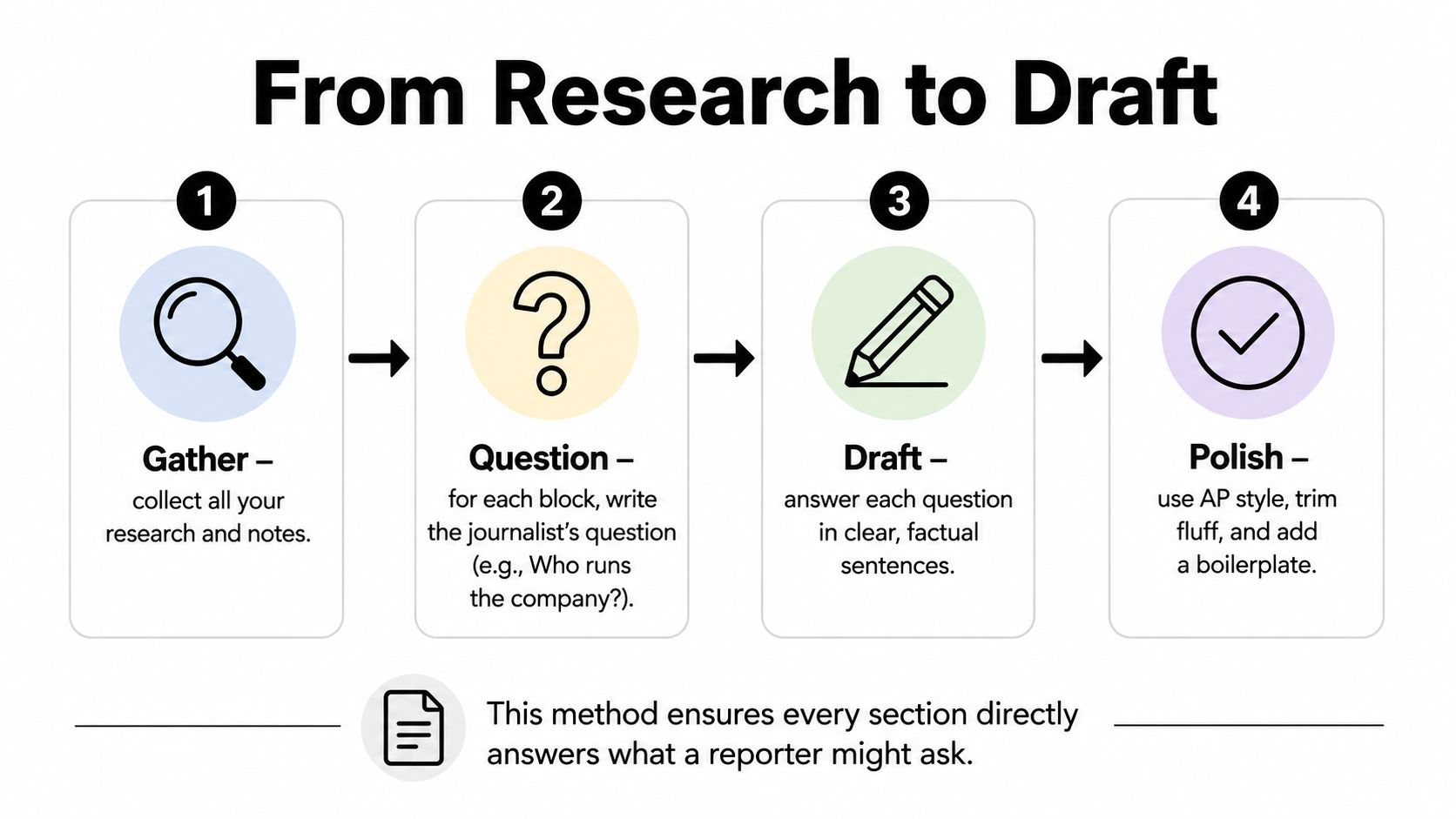
The fastest route from scattered notes to a usable draft is to write the journalist's question before writing the answer. Each section should solve a practical information need:
- Who runs the organization?
- What does it sell, and to whom?
- When was it founded?
- How did the mission change?
- What context does a reporter need to understand the current announcement?
The question becomes the heading or the internal drafting prompt. It prevents the writer from filling space with corporate history that doesn't answer a newsroom need.
Separate facts from claims
Research should be divided into two columns. The first contains verified facts, such as public filings, on-record interviews, dated announcements, and approved organizational records. The second contains claims, including opinions, projections, competitive positioning, and descriptions that depend on interpretation.
Those columns should not receive identical treatment. Verified facts can form the backbone of the backgrounder. Claims need attribution, careful wording, or exclusion. “The chief executive says the service reduces administrative complexity” identifies a viewpoint. “The service reduces administrative complexity” presents the statement as established fact and requires stronger evidence.
Match the format to the question
Use bullets when the reader needs a fast company snapshot. Use Q&A when the product or service is technical and a journalist needs plain-language answers. Use chronological prose for history and milestones, where order matters more than rapid comparison.
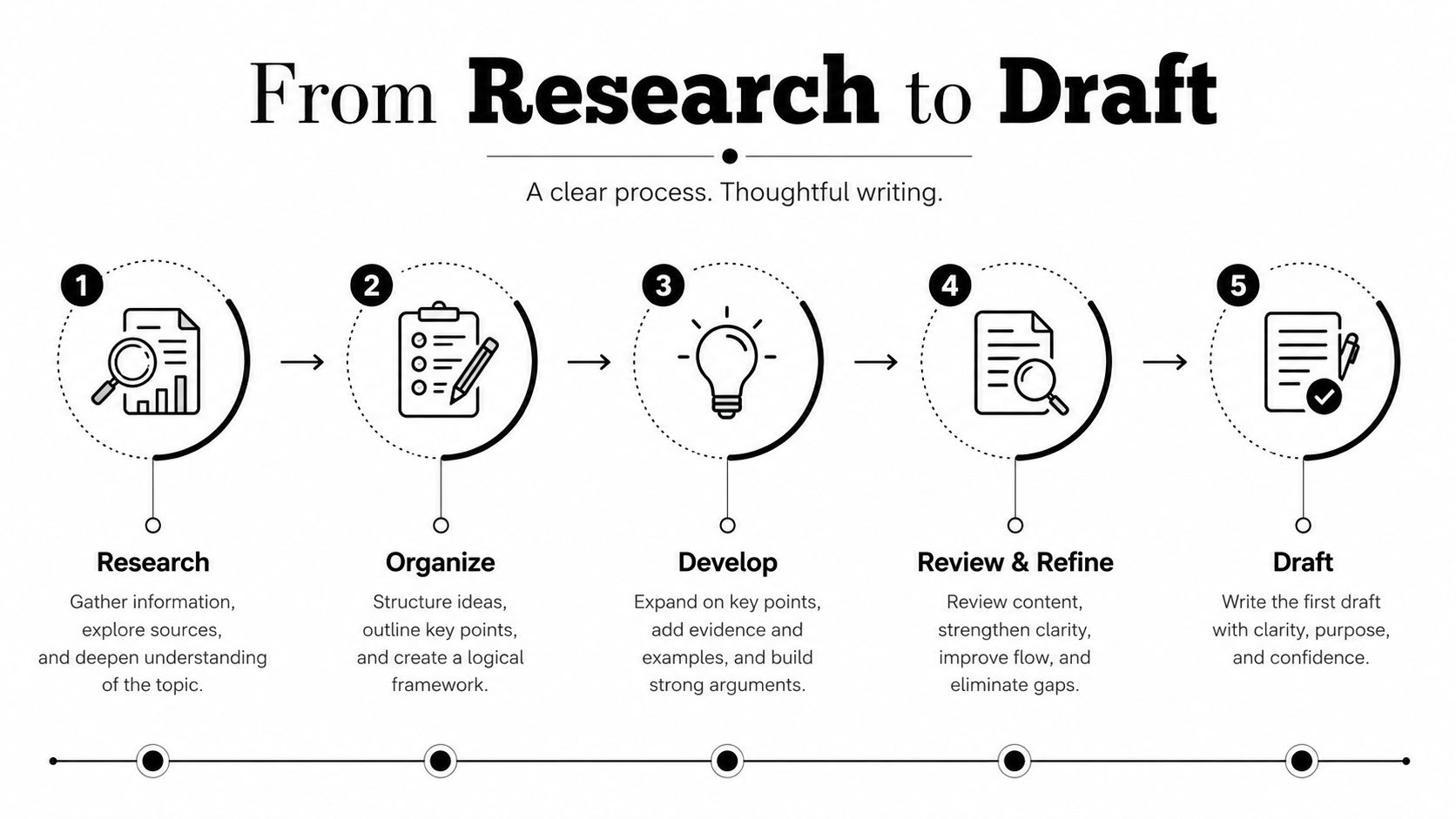
A first draft should answer each editorial question in clear, factual sentences. The final edit should remove every word a journalist would need to re-verify before printing. That includes unsupported superlatives, unclear time references, unexplained acronyms, and claims that depend on an unnamed internal source.
A useful final pass asks whether each block can stand alone. If a reader copies the leadership paragraph without the history section, will the title and role remain clear? If a producer uses the product description in a sidebar, will it still explain the audience and function? Those tests reveal whether the document is modular or merely divided into headings.
Keeping the Document Alive
A backgrounder shouldn't be treated as “finished” when the PDF is uploaded. An old document can mislead reporters every time a team reuses it, especially when leadership, products, funding, staffing, or market descriptions change.
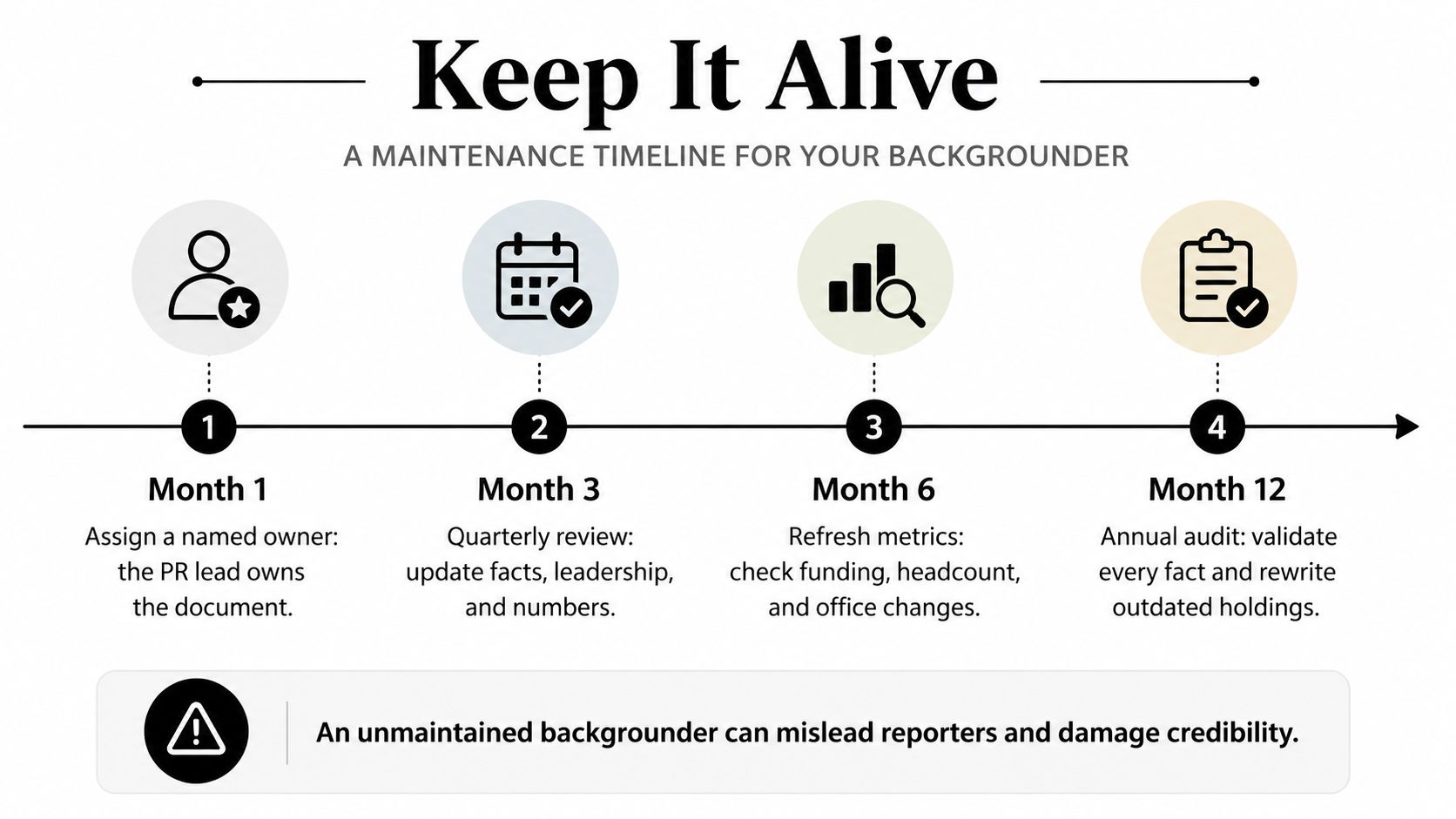
Every backgrounder needs a named owner, usually a communications lead or PR director. A shared inbox isn't ownership. The owner should control the source file, maintain the version log, request approvals, and know which facts require a fresh check.
Create a refresh trigger
The owner should review the document on a defined cadence and refresh it whenever a material change occurs:
- Leadership changes: Update titles, responsibilities, and approved biographies.
- Product changes: Add new services and remove offerings that have ended.
- Corporate events: Recheck funding, ownership, office locations, or organizational structure.
- Market shifts: Revisit positioning claims and remove language competitors or public records have made inaccurate.
- Metric changes: Date and verify headcount, revenue, pricing, or other time-sensitive figures.
High-velocity organizations may need quarterly reviews. Stable organizations can choose a less frequent schedule, provided the document has a clear owner and an immediate-update rule for major changes. The cadence should match how quickly facts move, not how often the team remembers the file exists.
Place a version log near the top: updated date, editor, changes made, and outstanding approvals. A journalist should be able to see whether the material is current without opening a separate administrative system.
A backgrounder earns repeat use when a reporter can cite it without wondering whether the facts have expired.
Template, Checklist, and Distribution
A backgrounder earns attention when it answers a reporter's first questions without creating new verification work. Build the file around blocks that can move into a media kit, pitch email, or article draft:
- Organization overview: What the organization does and whom it serves.
- Key facts: Founding year, location, leadership, markets, and other verified essentials.
- Leadership: Approved names, titles, responsibilities, and relevant background.
- Products or services: One-line descriptions for readers outside the field.
- Boilerplate: A restrained description suitable for media reference.
- Updated date and owner: The person responsible for maintenance.
- Sources and approvals: Records, contacts, dates, and permissions supporting the material.
Distribution requires judgment about timing and placement. Put the current backgrounder in the press kit or media folder before outreach begins, so a journalist can review context while assessing the pitch. Attach it when the story depends on organizational history, executive background, product context, or terminology that a release cannot explain efficiently.
The pitch email should state why the recipient is receiving the document, identify the relevant section, and connect that information to the proposed story. Keep the request specific. A reporter covering an executive appointment needs the approved biography and organization overview. A product reporter may need the service description, company history, and a spokesperson's contact details. Do not bury those details beneath a general company introduction.
Send the backgrounder with the announcement when it provides immediate context, then keep the same current file available for follow-up requests. Teams can coordinate it with the wider release process by using a practical guide to distributing a press release. Keep the backgrounder clearly dated and separate from time-sensitive announcement copy, so a reporter does not mistake background material for news.
A maintained document reduces repeated questions, gives spokespeople a consistent reference, and makes outreach more useful. Press Release Zen provides planning guides, templates, and distribution advice for teams assembling a coordinated media package around that backgrounder. The organization's Press Release Zen resources can support planning for the release, supporting context, and outreach workflow.