A startup lands a funding round, closes a major partnership, launches a product, or hires a known operator. The instinct is immediate. Write a press release, push it out, and hope the coverage follows.
That instinct isn't wrong. It's just incomplete.
A press release for startups still has a place, but it's no longer the automatic first move for every announcement. Founders are competing for attention in a media environment where journalists scan fast, social platforms break news first, and weak claims get ignored. The startups that get traction usually treat the release as one asset inside a broader launch system, not the whole strategy.
Table of Contents
- Is a Press Release Your Startup's Best Move?
- The Startup Press Release Blueprint and Budget
- Crafting Your Story From Headline to Boilerplate
- Press Release Formatting and a Real-World Example
- Smart Distribution for Every Startup Budget
- Measuring Success and Using AI Safely
Is a Press Release Your Startup's Best Move?
Not every milestone deserves a release. Some deserve a blog post. Some deserve a short founder post on LinkedIn or X. Some deserve a direct pitch to a handful of reporters with supporting material attached. The mistake is treating every piece of company news like it belongs on a wire.
That matters more now because audience behavior has shifted. The Reuters Institute's 2025 Digital News Report, cited in Agility PR's analysis of startup press releases, notes that 39% of audiences use social media as a regular news source, and publishers increasingly favor formats that are easy to verify quickly. For startups, that means a release on its own is often too thin. A better package includes screenshots, founder bios, product visuals, customer proof, and basic facts a reporter can lift without extra back-and-forth.
A useful test is simple. If the announcement changes how customers, investors, partners, or hires should view the company, a press release may help. If it's mostly internal excitement, a release probably won't.
A startup doesn't need more announcements. It needs fewer, stronger ones.
Founders who are still shaping the company story should tighten the strategy before drafting copy. A practical way to do that is to map the problem, audience, and advantage first. A concise planning tool like Bulby's Lean Canvas guide helps clarify whether the news supports the business narrative or distracts from it.
There's also a cost question, not just a messaging question. If the release won't create a clear outcome, the time is better spent on direct outreach or an owned-content launch. Founders weighing that trade-off can use this breakdown of whether press releases are worth it in 2026 to decide where a release fits and where it doesn't.
The Startup Press Release Blueprint and Budget
A release works best when it starts with judgment, not formatting. Before writing anything, a founder or comms lead should decide two things: is the news genuinely worth covering, and is the team willing to support it with time, proof, and distribution?

What counts as newsworthy startup news
Most weak startup releases have the same problem. They announce activity, not significance.
Reporters usually care about the move behind the move. A product launch is only interesting if it opens a new category, solves a visible problem, lands a meaningful customer, or marks a shift in market position. A partnership matters when it expands access, distribution, or credibility. A hire matters if that person changes the company's ability to execute.
Good startup announcement angles usually look like this:
- Funding with context: The round matters because it changes what the company can build, who it can serve, or how it competes.
- Launches with evidence: The product is live, usable, and tied to a clear use case.
- Partnerships with consequence: The partner adds reach, legitimacy, or technical advantage.
- Major customer or user milestones: The milestone signals adoption, not vanity.
- Leadership changes with a story: The new hire fills a real strategic gap.
A simple filter helps. If the team can answer “why should anyone outside the company care right now?” in one sentence, the story is usually viable. If that answer turns into a paragraph of throat-clearing, it isn't ready.
Practical rule: Lead with the event only if the event is the story. Otherwise, lead with the market implication.
How to budget without wasting money
Budgeting for a press release for startups should be tied to goals, not habit. One industry write-up citing Clutch research says successful startups typically allocate 3% to 7% of their marketing budget to PR, and notes that practical release costs can range from $50 for a basic DIY release to more than $5,000 for a larger campaign. The same source says common quarterly budgets often fall between $200 and $800. Those figures appear in Viral Impact's press release cost breakdown.
That range tells founders something important. Press releases aren't necessarily expensive. Waste comes from paying for distribution before the story is strong enough, or buying broad reach when only targeted outreach would matter.
For most startups, budgeting works better when broken into parts:
- Writing and editing: Internal draft, outside editor, or freelance PR support.
- Creative assets: Logo files, founder headshots, product images, screenshots, short video.
- Distribution: Manual outreach, low-cost platform, or premium wire.
- Follow-up: Time for email pitching, replies, and asset sharing after launch.
A lean team should start with a simple question: does this news need syndication, or does it need precision? If it needs precision, money belongs in list-building and outreach. If it needs broad visibility for investor, hiring, or brand reasons, then paid distribution may make sense. Teams comparing vendors can check how much Distribute.you costs before choosing between a lower-cost platform and a full wire.
A release schedule also keeps spending under control. Quarterly milestone updates can work. Event-driven releases can work better. Monthly releases usually become noise unless the company is producing news that offers true distinction each time.
Crafting Your Story From Headline to Boilerplate
Most startup releases fail in the first few lines. They open too broadly, hide the actual news, or sound like ad copy. A journalist shouldn't have to hunt for the point.
PR Newswire's startup guidance recommends an attention-grabbing headline, a lead paragraph that answers the who, what, when, where, and why, and supporting details such as funding amounts or market growth figures to make the story newsworthy. It also notes that an effective startup press release is typically 400 to 500 words. That guidance appears in PR Newswire's startup press release article.
Write the headline and lead first
The headline does one job. It tells a busy reader what happened and why it matters. It doesn't try to be clever. It doesn't stuff in every keyword. It doesn't read like homepage copy.
A useful startup headline usually includes three pieces:
- Who is making the move
- What happened
- Why it matters now
Examples of stronger framing:
- B2B startup launches compliance platform for mid-market healthcare teams
- Fintech startup expands into Canada through bank partnership
- AI support company names former Stripe executive as COO
The lead paragraph then closes the gap. In one compact paragraph, it should answer the five W's and establish the significance. If the key fact sits in paragraph three, the release is already losing.
A quick gut check helps:
- Can a reporter understand the news from the headline and first paragraph alone?
- Can a prospect understand whether this affects them?
- Can an investor or partner see why the company is moving now?
If the answer is no, rewrite before touching the body.
Build proof into the body
The middle of the release is where startups often drift into filler. Long origin stories, generic product language, and inflated claims slow everything down. The body should prove the lead, not repeat it.
Strong body paragraphs usually include some mix of:
- Specific context: What problem the company addresses and for whom.
- Verifiable evidence: Funding amount, launch date, named partner, named market, or other concrete details when available.
- A quote with actual meaning: Not “we're thrilled,” but a sentence that explains the strategic move.
- Useful next step: Demo request, sign-up page, waitlist, event registration, or media contact.
Quotes are where credibility often drops. Most founder quotes are loaded with adjectives and empty ambition. A better quote adds one thing the rest of the release does not. It can explain why the company made the move now, what customer pain triggered it, or what change in the market made the announcement timely.
If a quote could be pasted into any other startup's release without anyone noticing, it should be cut.
The body also needs restraint. Startups often try to include every feature, every customer segment, and every future plan. That hurts scanability. One announcement should carry one core message.
For teams that need help tightening the company description at the bottom, this guide to writing a press release boilerplate with examples and templates is a practical reference.
Finish with a boilerplate that does its job
The boilerplate isn't where branding gets poetic. It's the company's standard identity block.
A clean boilerplate answers a few basics:
- What the company does
- Who it serves
- Where it's based
- What makes it distinct
- Where to learn more
Keep it stable across releases unless the company position has genuinely changed. That consistency helps reporters, partners, and investors understand the business quickly.
Bad boilerplates try to sound visionary. Good boilerplates sound usable.
Press Release Formatting and a Real-World Example
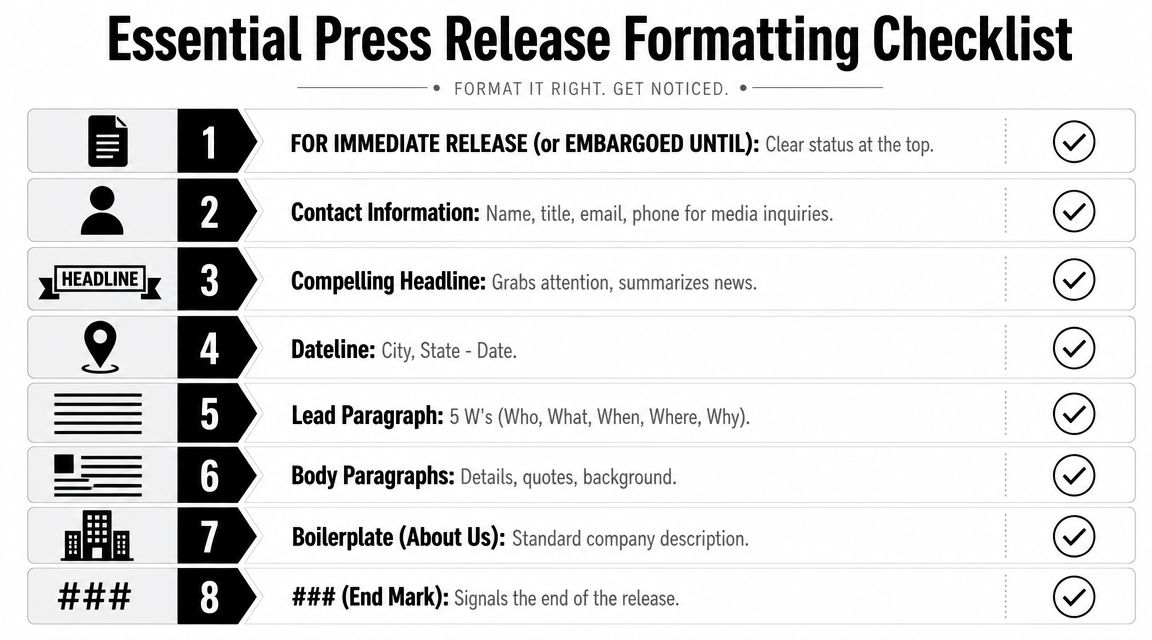
Formatting affects whether a release feels professional before anyone reads the substance. A clean structure tells a journalist the company understands how media workflows work. A sloppy structure suggests more effort will be required than the story is worth.
The formatting signals that matter
One startup-focused PR guide warns that a common mistake is burying the key point below the fold and skipping essentials like the boilerplate and contact information, which reduces the chance of journalist follow-up. It also notes that a well-structured release is easier to scan and repurpose. That guidance appears in Leverage With Media's startup public relations guide.
The essential elements are straightforward:
- Release status at the top: “FOR IMMEDIATE RELEASE” if it's ready to publish.
- Contact details: Name, role, email, and phone if media inquiries are expected.
- Clear headline: Short, direct, factual.
- Dateline: City and date.
- Lead paragraph: The main point immediately.
- Body paragraphs: Details, quote, proof, CTA.
- Boilerplate: Standard company summary.
- End mark: ###
A sample startup release
Below is a fictional example that shows the structure in practice.
FOR IMMEDIATE RELEASE
Media Contact
Alex Morgan
Head of Communications
alex@northstack.ioNorthStack Launches Procurement Platform for Independent Restaurant Groups
Chicago, Illinois, May 23, 2026, NorthStack today announced the launch of its procurement platform designed to help independent restaurant groups manage supplier orders, approvals, and inventory workflows from a single dashboard. The platform is available immediately to operators across the United States.
Restaurant groups often manage purchasing across email threads, spreadsheets, and supplier portals, which slows ordering and makes spend harder to track. NorthStack brings purchasing requests, vendor communication, and inventory visibility into one system intended for multi-location operators.
“Independent restaurant teams are expected to run with enterprise-level discipline, but most are still stitching together basic purchasing workflows,” said Maya Chen, CEO of NorthStack. “This launch gives operators one place to control the process without adding more admin work.”
The company said the platform includes approval routing, order tracking, supplier records, and reporting tools for finance and operations teams. Prospective customers can request a demo through the company website.
About NorthStack
NorthStack is a software company that builds procurement tools for independent restaurant groups. Based in Chicago, the company helps operators manage purchasing workflows, supplier coordination, and spending visibility across multiple locations. Learn more at northstack.io.
Why this works:
- The headline says what happened.
- The first paragraph gives the news immediately.
- The quote adds context instead of hype.
- The CTA is specific.
- The boilerplate is plain and useful.
Smart Distribution for Every Startup Budget
Distribution is where many startup teams burn time or money. They either blast the release too widely and get nothing useful back, or they spend hours hand-sending emails with no targeting. The right path depends on the story, the audience, and the team's capacity to follow up.

Three ways startups distribute releases
The first route is direct outreach. This is usually the best option when the startup has a specific story for a specific set of reporters. It takes more effort, but the message can be customized, the assets can be attached, and follow-up can be personal.
The second route is budget distribution platforms and directories. These can help with visibility and syndication, especially when the startup wants a public record of the announcement. Results vary a lot. Some are useful for footprint and convenience. Others mostly create duplicate pages.
The third route is premium wire services or outside PR support. This makes more sense when the company needs broader business visibility, formal distribution, or extra execution help around launch.
A practical direct-outreach workflow looks like this:
- Build a tight media list: Focus on reporters who already cover the market, customer problem, or deal type.
- Write a short pitch email: One paragraph on the news, one sentence on why it matters to that reporter's audience.
- Attach proof assets: Founder headshots, screenshots, product demo, FAQ, background notes.
- Follow up once: If the story is relevant, one nudge is enough.
Send fewer emails with better targeting. Generic spray-and-pray outreach rarely earns useful coverage.
Teams comparing tools and wires can use this roundup of the best press release distribution services to sort options by budget and use case.
Press Release Distribution Options for Startups
| Approach | Cost | Effort | Best For |
|---|---|---|---|
| Direct email outreach | Low | High | Niche stories, founder-led outreach, targeted trade or tech coverage |
| Free distribution services and directories | Low | Low to medium | Public posting, basic visibility, lightweight SEO footprint |
| Paid wire services | Medium to high | Low to medium | Broader syndication, formal announcement distribution, investor-facing news |
| PR agencies and consultants | High | Low for internal team | Complex launches, executive announcements, multi-asset campaigns |
The trade-off is simple. Manual outreach buys relevance. Wires buy scale. Agencies buy time and experience. Startups should choose the one that matches the story, not the one that feels most official.
Measuring Success and Using AI Safely
Once the release is out, the useful work starts. Startups that only ask “did we get coverage?” miss most of the value. The stronger question is whether the announcement moved the business in a meaningful way.

What success actually looks like
Coverage is one outcome, not the only one. A startup release can also produce investor interest, partner conversations, inbound job candidates, backlinks from relevant sites, referral traffic to a demo page, or stronger social proof for sales conversations.
The cleanest way to evaluate a release is to check four buckets:
- Media response: Did relevant reporters reply, ask questions, or reference the company?
- Owned-channel lift: Did the linked blog post, landing page, or demo page get meaningful referral traffic?
- Commercial signals: Did prospects mention the announcement on calls, forms, or replies?
- Reusable assets: Did the company end up with a stronger FAQ, founder quote set, screenshots, and launch content for future use?
This is why a release should be tied to an actual campaign. If the team can't tell what behavior it wanted to create, it won't be able to judge whether the release worked.
A simple post-launch review helps:
- What angle got the most response?
- Which asset got reused most often?
- Which objections or questions came back from journalists or prospects?
- What would be removed next time?
How to use AI without damaging trust
AI can speed up startup PR. It can help brainstorm headlines, summarize product notes, turn call transcripts into draft language, and generate first-pass media lists. Used well, it shortens the path to a strong draft. Used badly, it floods the market with vague copy and unsupported claims.
Cision's 2024 data shows 96% of journalists have used AI, but 72% worry about AI-generated misinformation and 75% want clear disclosure when AI is used in PR materials, as reported in Cision's article on startup press releases and limited resources. That's the practical line startups need to respect. Speed is fine. Sloppy automation is not.
A safe workflow looks like this:
- Use AI for structure, not truth: Let it suggest outlines, subject lines, or headline variations.
- Keep humans on verification: Every company fact, quote, date, title, and claim should be checked by someone accountable.
- Cut generic language aggressively: AI tends to produce polished filler. Journalists spot that quickly.
- Disclose when appropriate: If AI materially helped draft PR materials, transparency is safer than pretending otherwise.
Editorial standard: AI can assist the draft. It cannot be the source of record.
Founders and lean marketing teams that want a broader operating framework can review this complete 2026 guide to AI marketing for ideas on where AI helps and where human judgment still carries the load.
A strong press release for startups is still useful in 2026. It just works best when the team treats it as a sharp, verified, strategically timed asset. Not a ritual. Not a box to check. Not a substitute for actual outreach.
Need help turning a startup milestone into a release that journalists can scan, trust, and act on? Press Release Zen offers practical guides, templates, and distribution advice to help teams write better announcements and avoid the mistakes that kill pickup.