A familiar problem plays out in tech companies every week. The product team ships something useful, leadership expects attention, and then almost nothing happens. A few polite LinkedIn likes appear, maybe one low-value mention lands, and the people who should care, buyers, journalists, analysts, partners, or investors, never really understand why the launch matters.
That gap is where PR in technology either becomes a growth function or a wasteful activity. Strong tech PR doesn't just push announcements out. It builds a communication engine that connects business goals to the right audiences, gives each audience a reason to care, chooses channels that fit how they consume information, and measures whether the story changed anything that matters.
Table of Contents
- Why Great Technology Needs Great PR
- The Core Mission of PR in Technology
- Identifying Your Key Tech Audiences
- Essential Channels and Tactics for Tech PR
- Crafting and Timing Your Big Announcement
- Measuring the Real Impact of Your Tech PR
- Common Tech PR Pitfalls and How to Avoid Them
Why Great Technology Needs Great PR
A better product doesn't automatically become a better-known product. In crowded categories like SaaS, AI, cybersecurity, telecom, and developer tools, buyers rarely evaluate every option from scratch. They narrow the field based on what they've heard, what they can quickly understand, and which companies seem credible before the first sales call even happens.
That's why PR in technology matters. It gives the market language for understanding a company's value. It helps journalists decide whether something is newsworthy, helps analysts place a company in the right category, and helps prospects feel that a vendor is established enough to trust with budget, data, or operational risk.
The market has already signaled how important this has become. Roughly 19% to 20% of PR firms identify the technology sector as a top growth opportunity, placing it among the leading verticals for PR investment, according to industry data summarized here. That's a practical indicator, not just a trend line. Teams are putting resources into tech communications because the need is persistent and the outcomes are critical.
Three realities usually sit underneath that investment:
- Complex products need interpretation. A product spec sheet rarely persuades anyone outside engineering.
- New categories need education. If the market doesn't understand the problem, it won't understand the solution.
- Trust compounds before purchase. Earned visibility often shapes who gets shortlisted.
A startup founder looking for outside support can compare options through this overview of technology PR companies. The useful question isn't “How do we get coverage?” It's “What story will move the right audience one step closer to action?”
Good technology can stay invisible for months. Clear positioning fixes that faster than louder promotion.
The Core Mission of PR in Technology
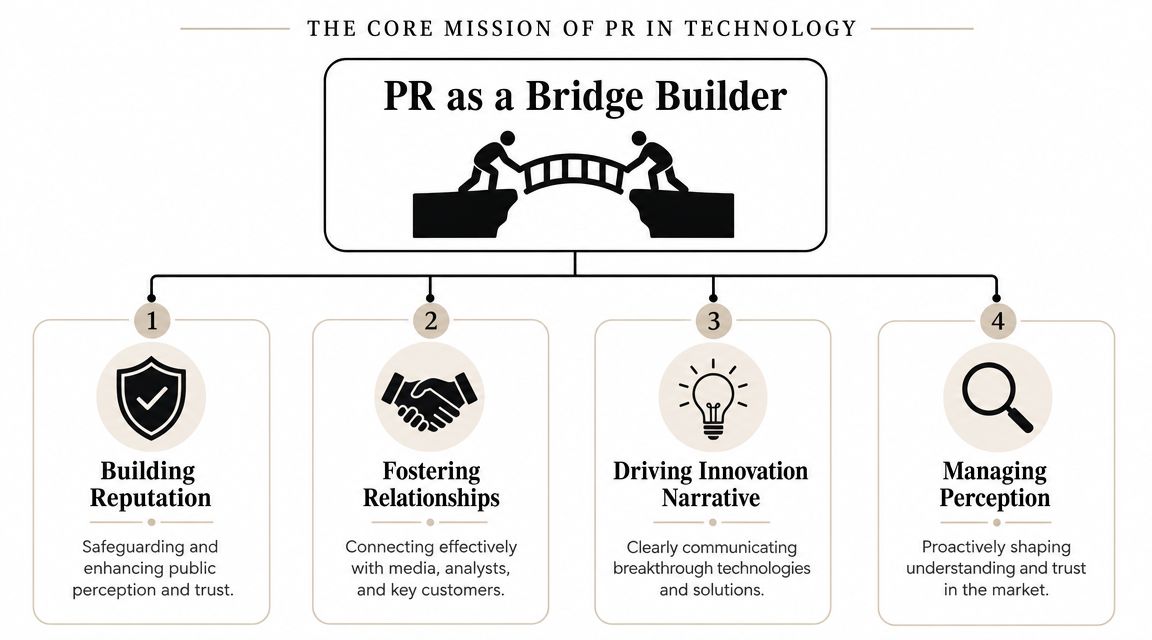
PR in technology is often misunderstood as a launch mechanism. It's closer to a translation system. Product teams build capabilities. PR turns those capabilities into claims the market can understand, test, repeat, and trust.
PR translates complexity into relevance
The hardest part of tech PR isn't writing. It's deciding what a feature means to a specific audience without oversimplifying it. Expert guidance on tech communications notes that the core technical challenge is translation and that journalists reject vague “AI” or “innovation” language when it isn't tied to measurable business results, as outlined in this guide to PR for tech companies.
That single point changes how good teams work. They don't start with adjectives like “pioneering,” “next-generation,” or “cutting-edge.” They start with questions such as:
- Who experiences the problem most sharply?
- What changed because this product exists?
- What proof can the company show immediately?
- Why does the change matter now?
A storage platform doesn't need “AI-powered orchestration” in the headline unless that phrase matters to the audience. A stronger story might be faster incident recovery, fewer manual steps for infrastructure teams, or simpler compliance workflows. The technical mechanism matters, but the operational consequence gets attention.
For teams refining their communications basics, this explainer on what PR stands for in business is useful because it frames PR as a business function, not just a media task.
The four missions that matter most
A capable tech PR program usually serves four missions at once.
- Reputation building. The company needs a trustworthy public identity. That means consistent language, credible proof, and disciplined responses when claims are challenged.
- Relationship development. Reporters, analysts, conference organizers, customers, and partners all need different kinds of contact. PR manages those relationships over time rather than treating them as one-off asks.
- Narrative creation. Sometimes the company isn't merely selling a product. It's trying to define a category, reframe an old problem, or position a new way of working.
- Perception management. Markets form opinions quickly. PR helps shape what people believe before competitors, critics, or generic category language do it first.
Some teams are also adapting this work for AI-era visibility. The discussion around Algomizer GEO research is useful because it pushes communicators to think beyond publication alone and toward how messaging gets surfaced and repeated in search-driven and answer-driven environments.
The strongest tech PR message can survive three tests at once. A journalist can quote it, a buyer can understand it, and a technical stakeholder won't dismiss it as fluff.
Identifying Your Key Tech Audiences
One message for everyone usually lands with no one. PR in technology works when the company recognizes that each audience evaluates risk, relevance, and proof differently. The same announcement can sound compelling to an investor, shallow to a developer, and too technical for a business editor.
Trade media and analysts
Trade reporters and industry analysts care about specificity. They want category context, product differentiation, customer relevance, and proof that the company isn't just recycling broad market language.
A weak approach gives them feature lists and inflated claims. A stronger one gives them a sharp angle: what changed, who it affects, what evidence supports the claim, and how this compares with existing alternatives. If the company has benchmarks, customer validation, or a clear deployment use case, this audience wants it early.
For teams building a relevant media list, this roundup of software development publications and journalists helps identify where technical stories are more likely to resonate.
Business media
Mainstream business media usually needs a broader frame. They want to know why this company, product, or shift matters to an industry, a market trend, or a business problem larger than the feature itself.
They often care less about architecture and more about consequence. Is the company changing how businesses manage costs, risk, productivity, privacy, or adoption? Can the story connect to a trend readers already recognize? A technical product can still work here, but the story has to zoom out.
Business reporters rarely need every implementation detail. They need enough detail to trust the claim and enough context to explain why readers should care.
Developers and technical communities
This audience punishes hype fast. Developers, technical operators, and open-source communities tend to respond well to transparency, documentation, demos, and candid trade-offs. They often distrust polished campaign language if it's not backed by working examples.
That means PR has to coordinate closely with product marketing, DevRel, engineering, and support. The public story must match the product reality. If onboarding is still rough or compatibility is limited, the team should say so clearly and explain the roadmap transparently. Technical communities will often forgive an incomplete product faster than they forgive inflated claims.
Investors and board stakeholders
Investors evaluate narrative through a different lens. They want to know whether market visibility supports strategic confidence. A company doesn't need endless coverage. It needs coherent positioning that signals relevance, momentum, leadership maturity, and category clarity.
For this audience, PR materials should answer questions like these:
- Market position. Is the company defining a space or reacting to one?
- Leadership signal. Do executives communicate with credibility, discipline, and consistency?
- Risk management. Can the company handle scrutiny around product claims, regulation, security, or adoption barriers?
- Commercial linkage. Does public messaging support pipeline, partnerships, or long-term enterprise trust?
Audience messaging matrix
The communication differences are easier to manage when they're documented.
| Audience | What They Value | Primary Channels | Message Focus |
|---|---|---|---|
| Trade media and analysts | Specificity, proof, market differentiation | Briefings, targeted pitches, analyst calls, trade outlets | Technical relevance tied to business outcomes |
| Business media | Broader business significance, trend relevance | National business outlets, executive interviews, op-eds | Industry impact and strategic importance |
| Developers and technical communities | Authenticity, demos, documentation, honesty | GitHub, docs, community forums, developer events, technical blogs | How it works, where it helps, where it doesn't |
| Investors and board stakeholders | Strategic clarity, credibility, leadership strength | Investor updates, executive media, keynote appearances, board communications | Market position, confidence, and long-term story |
A final audience often gets ignored in standard playbooks. Equity-focused, health-tech, and public-interest communicators can't assume everyone is media-savvy or digitally connected. Guidance on health equity communications notes that many technology PR guides overlook how messaging and channel choice must change when the primary issue is access and trust, as discussed in this article on PR and health equity. In those cases, plain language, captions, translated materials, print formats, and community-centered outreach aren't optional refinements. They're part of whether communication works at all.
Essential Channels and Tactics for Tech PR
A modern tech PR program needs more than a press release calendar. It needs a mix of earned, owned, and relationship-driven tactics that reinforce the same core story from different angles.

One major change is operational. 64% of PR professionals already use AI-powered writing tools in 2025, and 61% of press releases are written or assisted by AI, according to recent PR industry reporting. That doesn't mean AI replaces judgment. It means drafting, monitoring, summarizing, and optimization are moving faster, while strategic decisions still depend on human judgment.
Press releases that earn attention
Press releases still matter in tech PR, but not as standalone assets. Their job is to create a clean public record, support outreach, and give search systems and journalists a clear source document.
What works:
- A real news angle. New funding, a product launch, a major partnership, executive move, certification, or research finding.
- A headline with consequence. Readers need the result, not just the feature.
- Fast proof. Include a customer example, benchmark, validation, or implementation context when available.
- Quoted material that sounds human. Generic executive praise gets skipped.
What doesn't work is the bloated release that tries to say everything. If the product team wants every feature included, the result usually reads like packaging copy. For drafting help, these press release tips and templates are a useful practical resource because they keep teams focused on structure and clarity.
Thought leadership and contributed content
Many tech companies push thought leadership too early. They want the CEO in top-tier outlets before the company has a clear point of view worth publishing. That approach usually produces bland articles about “the future of AI” or “digital transformation,” which editors have seen countless times.
Better thought leadership has three traits:
- It stakes out a position.
- It reflects operational knowledge, not recycled trend talk.
- It connects category insight to the company's area of authority.
A cybersecurity leader might write about what security teams still misunderstand about third-party risk. A data infrastructure executive might address why governance breaks down during rapid AI adoption. Those angles work because they're rooted in lived category problems.
Contributed content should sound like it came from someone who has made hard decisions, not someone who just read the same headline everyone else saw.
Events, conferences, and live moments
Conferences can justify a PR push, but the event itself is rarely the story. The useful question is whether the company has something timely and defensible to announce around the event.
Live moments work best when teams coordinate:
- Media outreach before the event
- Executive availability during the event
- Owned content ready to extend the message after the event
- A simple meeting strategy for analysts, customers, and partners
Without that coordination, booths become expensive decor and speaking slots disappear into the conference noise.
Community, DevRel, and owned credibility
Some of the strongest reputation-building in tech doesn't begin with media outreach at all. It starts in product docs, engineering blogs, GitHub repositories, webinars, office hours, Slack groups, Discord communities, and support forums.
These channels matter because they create durable proof. They show whether the company can teach, not just promote. For developer-facing products especially, community engagement often produces the credibility that media coverage alone can't create.
A balanced program treats these tactics as connected. The release formalizes the news. The pitch personalizes it. The contributed article broadens it. The event amplifies it. The community work proves it.
Crafting and Timing Your Big Announcement
Launches fail when teams mistake publication for momentum. A big announcement needs sequencing, not just enthusiasm. The quieter preparation before launch day often matters more than the blast itself.

Before launch day
A disciplined pre-launch period usually includes message testing, spokesperson prep, asset review, and selective outreach under embargo when appropriate. The team should know exactly which claim leads, what proof supports it, and which questions journalists are likely to ask.
A simple internal checklist helps:
- Tight narrative. One primary story, two supporting points, and proof for each.
- Spokesperson discipline. Executives should answer likely objections without drifting into jargon.
- Asset readiness. Release, FAQ, demo, screenshots, customer references, and landing page should align.
- Priority outreach. High-fit reporters, analysts, customers, and partners need customized communication.
For teams planning the operational side of a launch, this product launch checklist from Saaspa.ge is a practical companion because it helps prevent missed dependencies that weaken the announcement.
What launch day should look like
On launch day, the goal isn't volume for its own sake. It's coordinated clarity. The press release should publish when the team is ready to respond, not at a random hour chosen only for convenience. Outreach should be personalized. Social posts should reinforce the same message, not introduce five extra ones. The sales team should know how to talk about the news the same day it goes live.
A common mistake is overloading the release and underpreparing follow-up. Reporters often care less about the release itself than whether someone can quickly answer, “Why now?” and “Can you prove that?”
The pitch that works and the one that doesn't
A weak pitch sounds like internal excitement. A stronger pitch sounds like a useful story for that specific reporter.
Weak pitch: “We're excited to announce our innovative AI-native platform featuring advanced orchestration, seamless integration, and a next-generation user experience for modern enterprises.”
Stronger pitch: “Enterprise IT teams still lose time stitching together incident data across fragmented systems. This launch gives operations teams a single workflow for triage and response, with customer-ready proof on implementation and results. If you're covering how infrastructure teams are adapting operations around AI-era complexity, this offers a concrete example.”
The difference is simple. The stronger version names the problem, identifies who has it, and explains why the story belongs in a reporter's beat.
After the announcement
The release shouldn't be treated like the finish line. Good post-launch work extends the life of the news.
- Follow up selectively. Not every non-response needs another email. Prioritize the contacts most likely to engage.
- Repackage the angle. Turn launch material into executive commentary, customer explainers, technical walkthroughs, or analyst updates.
- Watch reactions closely. Questions from customers, reporters, and internal teams often reveal which part of the message landed and which part didn't.
- Preserve discoverability. Keep landing pages current, make the release easy to find, and align metadata and on-page copy with how people search for the topic.
A launch that produces one publication and then disappears wasn't fully developed. A better launch creates material the company can keep using for weeks.
Measuring the Real Impact of Your Tech PR
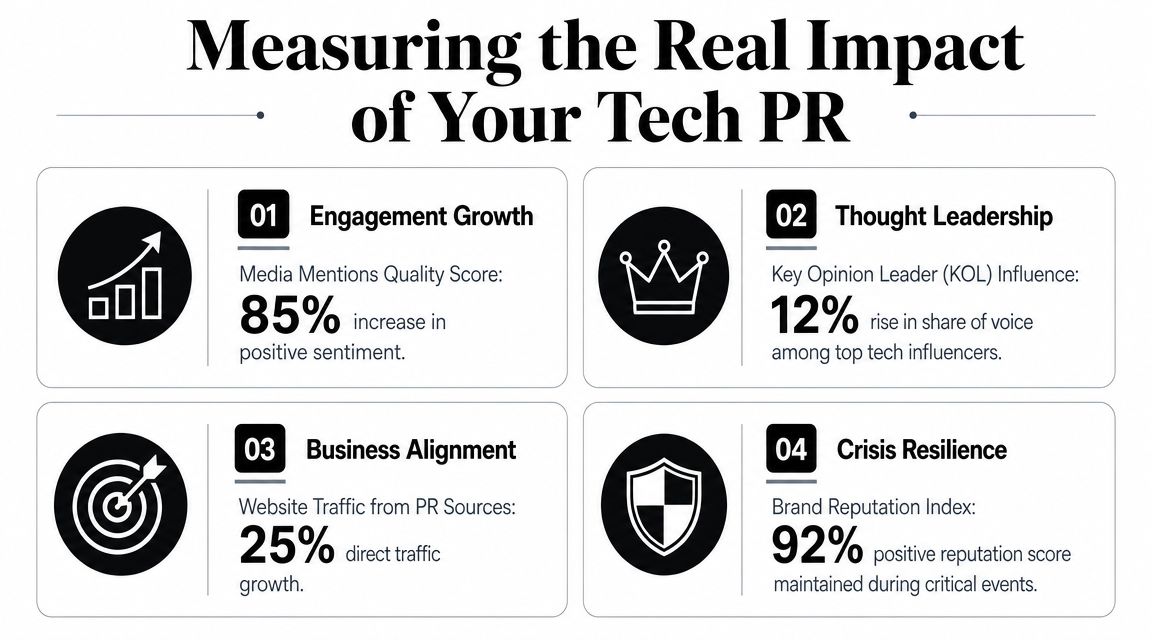
The old reporting model in PR rewarded activity. Count the clips, total the impressions, circulate a glossy report, and call it success. That model doesn't hold up well in modern tech communications, especially when search and AI systems increasingly shape what people find, summarize, and repeat.
Stop reporting vanity totals
Recent guidance for tech brands argues that when AI search reduces the value of traditional clipping counts, teams should focus more on share of voice, keyword placement, and message pull-through to judge whether coverage is shaping discoverability in search and AI results, as discussed in this PR measurement discussion.
That advice matters because a long list of low-quality mentions can look busy while doing very little for the business. One well-placed article that uses the company's preferred category language and frames the problem correctly may matter more than many scattered mentions that don't reinforce the story.
A useful internal question is this: did coverage merely mention the company, or did it help the market understand the company the way leadership intended?
Coverage has more value when it teaches the market the right language to associate with the company.
A practical dashboard for leadership
A leadership-ready PR dashboard should connect communications activity to business relevance. It doesn't need to be complicated, but it does need to be disciplined.
Consider tracking a mix like this:
| Metric | What it reveals | Why leadership should care |
|---|---|---|
| Share of voice | Whether the company is appearing in the right category conversations | Indicates competitive visibility |
| Message pull-through | Whether key claims appear in coverage accurately | Shows narrative control, not just mention volume |
| Sentiment | Whether coverage and conversations reinforce trust | Helps identify reputation risk or strength |
| Referral traffic from earned media | Whether articles send interested visitors to owned properties | Connects PR activity to measurable audience behavior |
| Branded search movement | Whether visibility is increasing direct market interest | Suggests stronger awareness and recall |
| AI citation presence | Whether company language appears retrievable in answer-driven environments | Reflects future-facing discoverability |
What shouldn't dominate reporting is ad value equivalency or raw clip counts with no context. Those numbers can create false confidence. Leadership usually needs a sharper answer: did PR strengthen market understanding, support pipeline conversations, improve category association, or increase trust with the audiences that matter most?
When PR in technology is measured properly, it stops looking like a soft function. It starts looking like market influence with evidence.
Common Tech PR Pitfalls and How to Avoid Them
The biggest PR mistakes in tech usually don't come from lack of effort. They come from poor judgment about what makes something credible, newsworthy, or useful to an outside audience.
The mistakes that quietly kill momentum
Some errors show up repeatedly:
- Jargon dumping. Teams load releases and pitches with product language that only internal staff understand.
- Feature confusion. They present a product update as if the update is automatically a story.
- Narrative thinness. They can describe what the product does, but not why the market should care now.
- Misaligned goals. PR runs on a separate track from sales, product marketing, executive messaging, or investor communication.
Another common issue is inconsistency. The website says one thing, the spokesperson says another, and the pitch says something else entirely. That breaks trust faster than many realize.
What disciplined teams do instead
The fix is usually straightforward, but it requires restraint.
- Translate before promoting. Explain the business consequence of the feature in plain language.
- Pressure-test the angle. Ask whether an informed outsider would see this as news, not just progress.
- Build one core narrative. Then tailor it for media, customers, developers, and investors without changing the substance.
- Tie activity to outcomes. Every campaign should support a business need such as category education, enterprise trust, product adoption, or executive credibility.
Good tech PR isn't louder than bad tech PR. It's clearer, better timed, better evidenced, and far more aligned with how real audiences decide what matters.
Press Release Zen helps teams turn that kind of discipline into repeatable execution. Its guides, templates, and distribution resources are useful for founders, in-house communicators, and agencies that want cleaner releases, better outreach, and stronger campaign planning. Explore Press Release Zen for practical help with writing, structuring, and distributing announcements that support real business goals.