You launch a product you believe in. The team posts on social media, sends a few emails, maybe even publishes a website announcement. Then almost nothing happens. No reporter replies. No partner reaches out. Customers who do notice the launch don't quite understand why it matters.
That gap between what you meant to say and what the public hears is where PR lives.
For a nonprofit, the problem looks different but feels the same. You have a worthy mission, a fundraiser, a new program, or an urgent community issue, yet your message gets buried under louder, faster, more sensational stories. You don't just need attention. You need the right people to understand you, trust you, and repeat your story accurately.
Beyond the Hype What a PR Specialist Really Does
A PR specialist is not just the person who writes a press release and hopes for coverage. A strong one acts more like a reputation architect. They decide what story the public should hear, who needs to hear it, when it should be told, and how to respond if the story gets distorted.
That distinction matters. Many people still think PR means publicity only. Publicity is one output. PR is the broader system behind it. It shapes perception across journalists, customers, donors, investors, employees, and online communities.
For a small business, that might mean turning a product launch into a credible business story instead of a sales pitch. For a nonprofit, it might mean helping a local reporter understand why a program's impact matters right now, not someday. For a founder, it could mean preparing talking points before a podcast interview so one awkward answer doesn't define the brand.
A good PR specialist doesn't ask, "How do we get mentioned?" They ask, "What do people need to believe about us after this is over?"
They also work far beyond traditional media. If your brand is being discussed on Instagram, Reddit, LinkedIn, review platforms, or local Facebook groups, that conversation is part of your public reputation. If you're trying to understand that side of the job, this social media reputation management guide offers a useful companion view of how online perception changes in public.
A lot of confusion starts with the initials themselves. If you're still sorting out the terminology, this plain-English explanation of what PR stands for in business is a helpful starting point.
What does a pr specialist do, then? At the highest level, they help an organization earn trust at scale. They create the message, pressure-test it, deliver it to the right audiences, and protect it when conditions change.
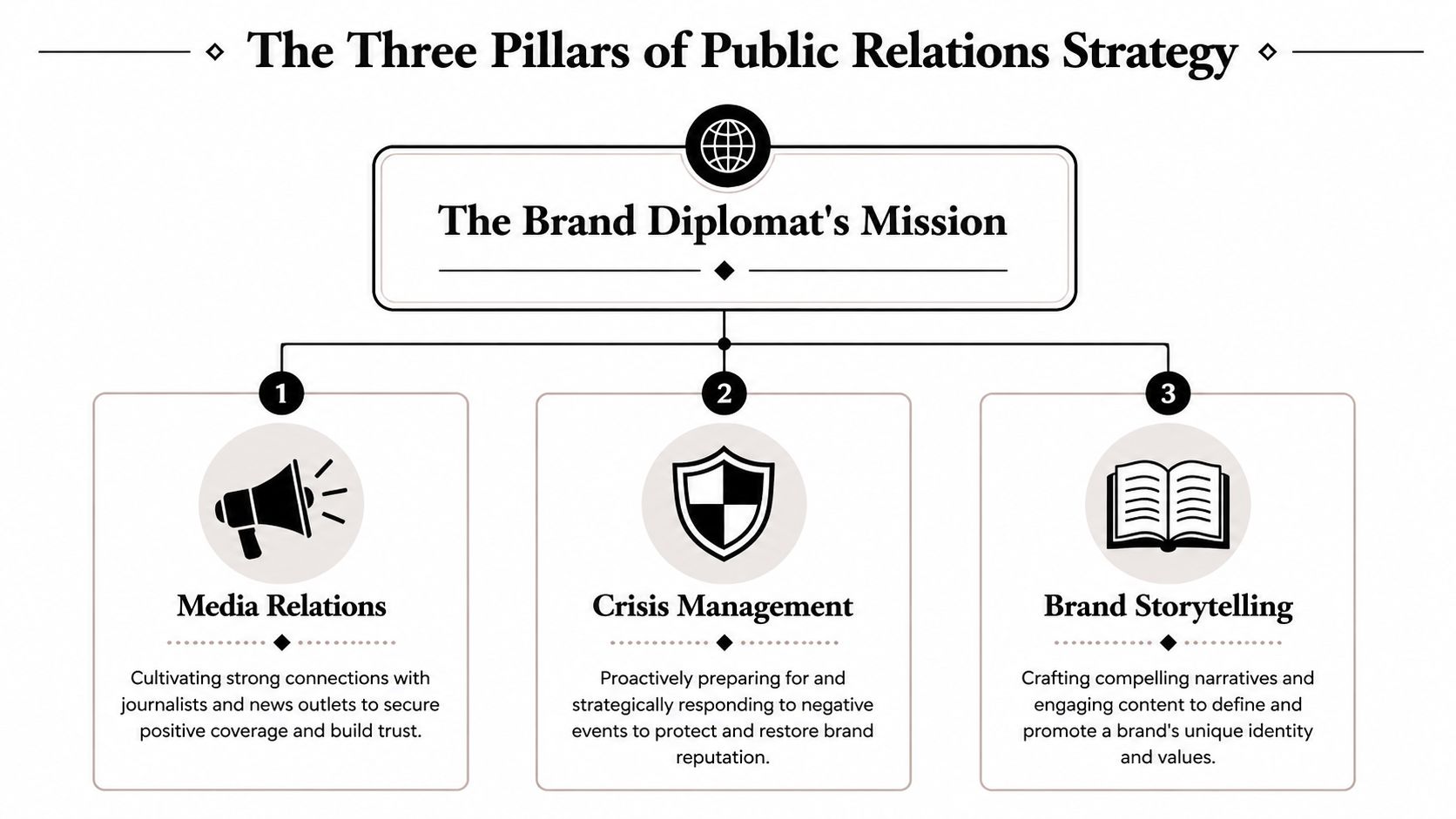
The Three Pillars of Public Relations Strategy
The easiest way to understand PR is to think of the specialist as a brand diplomat. A diplomat represents an institution, builds relationships, manages delicate situations, and chooses words carefully because words have consequences.
That is PR in practice.
Strategic communication
This pillar answers one question. What are we trying to make people understand and remember?
A PR specialist turns scattered company facts into a clear message. Instead of saying ten things poorly, they help the organization say three things consistently. They shape headlines, executive talking points, quote language, campaign themes, and the tone used across announcements.
That sounds simple until you try it. Most organizations know too much about themselves. They use internal language, product jargon, and assumptions the audience doesn't share. A PR specialist translates. They turn "we launched an integrated workflow environment" into "we built a tool that helps finance teams close the books faster."
Brand storytelling comes into play. Not storytelling in the fluffy sense. Storytelling in the practical sense of deciding what conflict, change, proof, and relevance belong in the narrative.
A few signs strategic communication is weak:
- Mixed messages: Your website says one thing, your founder says another, and your sales deck says something else.
- No news judgment: Every update gets treated like a major announcement, so real milestones lose weight.
- Audience confusion: Customers, donors, or reporters ask basic questions that your messaging should've answered already.
Relationship management
PR works through people. Journalists, editors, creators, community leaders, partners, and internal stakeholders all influence how your reputation forms in public.
A PR specialist builds those connections patiently. They don't blast generic pitches to everyone. They match stories to the right person, in the right format, with the right timing. That's the heart of media relations work.
Relationship management also includes internal alignment. A specialist often has to pull useful information from leaders who are busy, cautious, or too close to the subject. If legal, product, customer support, and the executive team aren't aligned, public messaging falls apart.
Practical rule: Media relationships are built before you need them. If you only contact people when you want coverage, you're not building a relationship. You're making a request.
A useful way to picture this pillar is as a bridge. One side is your organization. The other side is the public. The bridge is made of trust, relevance, and reliability.
Reputation oversight
This pillar is part prevention, part response.
A PR specialist watches for signals that perception is shifting. That could be a negative customer thread gaining traction, a journalist asking pointed questions, confusion around a leadership change, or a campaign message landing badly. The point isn't paranoia. The point is early detection.
When things are stable, reputation oversight looks like monitoring sentiment, checking whether key messages are landing, and preparing response plans. When something goes wrong, it becomes crisis communication. Who speaks first. What gets acknowledged. What gets documented. What should wait until facts are confirmed.
Here is the connection many people miss:
| Pillar | Core question | Typical output |
|---|---|---|
| Strategic communication | What should people understand? | Messaging, talking points, announcements |
| Relationship management | Who can help carry or challenge that message? | Media outreach, stakeholder contact, influencer coordination |
| Reputation oversight | How is the message being received? | Monitoring, response plans, corrections, crisis statements |
If one pillar is weak, the others suffer. Great messaging without relationships goes unheard. Strong relationships without message discipline create inconsistency. Good monitoring without strategic action just produces reports no one uses.
A Day in the Life The PR Specialist's Workflow
At 8:15 a.m., a founder slacks the team: a customer complaint is spreading, a reporter has emailed for comment, and a product announcement is scheduled for noon. That kind of morning explains the job better than any polished job description. A PR specialist's day is a series of decisions about timing, wording, and evidence.

Morning starts with monitoring
The first task is usually diagnosis. Before writing a release or sending a pitch, the PR specialist checks the information environment around the organization. That means media mentions, social conversation, competitor activity, search trends, customer feedback, and any issue that could change how a message will be received.
The practical question is simple: what room are we walking into?
Teams often use Meltwater, Brandwatch, Cision, Talkwalker, Google Alerts, and native social dashboards to answer that question. The tools matter less than the pattern recognition. A skilled specialist is not just collecting mentions. They are checking whether attention is growing, whether tone is shifting, and whether one irritated customer has turned into a broader public story.
As noted earlier from Indeed's PR specialist overview, PR teams use social listening metrics such as share of voice and sentiment, and stronger teams also rehearse crisis scenarios, improve distribution strategy, and use search-aware releases to improve results. For a small business or nonprofit, the lesson is practical. Listening reduces preventable mistakes, and measured preparation usually beats fast improvisation.
Modern teams also use AI here, but not as a substitute for judgment. AI can cluster coverage by theme, summarize hundreds of comments, flag unusual spikes in conversation, and suggest which reporters have been covering a topic recently. The PR specialist still decides what matters, what is noise, and what deserves a response.
Midday is for shaping the message
Once the picture is clear, the specialist starts building the message package. This can include:
- Press releases: Formal announcements for launches, grants, partnerships, leadership changes, or events.
- Media kits: Backgrounders, bios, fact sheets, approved images, logos, and FAQs.
- Pitches: Short outreach emails designed for a specific journalist, editor, or creator.
- Bylined articles or op-eds: Articles written for executives or subject experts.
- Internal communication drafts: Messages that prepare staff before public news breaks.
A useful way to separate these materials is to treat them like parts of a case file. The press release is the official record. The pitch is the cover note explaining why one specific person should pay attention. The media kit is the supporting evidence.
This is also where good PR becomes disciplined editing. The specialist removes claims that cannot be supported, trims jargon, checks numbers, and rewrites quotes so they sound human instead of inflated. If a sentence sounds like marketing copy, a reporter will often ignore it. If it sounds factual, specific, and relevant, it has a chance.
For smaller organizations, AI can save real time in this stage. It can draft a first version of a release, turn a leadership memo into talking points, or suggest headline options. A strong PR specialist treats that draft the way a senior editor treats a junior writer's first pass. Useful raw material. Never final copy without review.
Afternoon is outreach, research, and adjustment
After the materials are ready, distribution starts. Sometimes that means a wire service or a broad list. Often, the better move is a focused set of direct emails to people who cover the topic.
Good outreach usually follows four steps:
- Choose the strongest angle: A nonprofit expansion might be a community story for local press, a funding story for business media, or a sector trend story for trade outlets.
- Match the contact to the angle: The right reporter matters more than a long list.
- Personalize the pitch: Reference a recent article, explain the audience fit, and get to the point quickly.
- Track response and refine: If nobody responds, the problem may be the framing, the subject line, the timing, or the list.
That last step is where modern PR has changed. Strong specialists do not rely on instinct alone. They watch open patterns, reply rates, placement quality, referral traffic, and message pickup. If one angle gets ignored and another gets interviews, they adjust the narrative. If local reporters care more about jobs created than product features, the next pitch leads with jobs created.
For a junior marketer, this is the part that often feels mysterious. It should not. Media outreach works a lot like sales prospecting, except the "buy" is editorial interest and the bar for relevance is much higher. Contacts do not owe you attention. You earn it with timing, evidence, and a story that serves their audience.
The week ends with analysis
Strong PR teams review results before they move on to the next campaign. Otherwise, they repeat the same habits and call it experience.
A capable PR specialist looks at performance in layers:
- Output: What was published, pitched, or distributed?
- Coverage quality: Which placements included the intended message, quote, or context?
- Audience behavior: Did coverage drive website visits, newsletter signups, donor interest, event registrations, or inbound leads?
- Reputation signals: Did sentiment change, did stakeholder questions drop, did confusion increase, or did trust improve?
Small organizations often overlook the full value of PR. They stop at clipping coverage. A stronger approach connects communication work to business or mission outcomes. Did the article send people to the donation page? Did a local TV segment increase volunteer applications? Did a founder interview lead to qualified partnership inquiries?
You do not need an enterprise stack to answer those questions. A spreadsheet, Google Analytics, social platform data, inbox tracking, and a media monitoring tool can produce useful answers. AI can help summarize patterns and surface anomalies faster, but the PR specialist still has to interpret what changed and why.
That is the workflow in plain terms: listen carefully, build the message, send it to the right people, then measure what happened so the next round gets smarter.
The Essential Skills and Tools for Modern PR Success
A modern PR specialist is part writer, part strategist, part analyst, and part relationship manager. If you only hire for writing, you'll miss half the job. If you only hire for analytics, you'll get reports without influence.
The timeless foundations
Some skills haven't changed because the job still runs on judgment.
Writing sits at the center. A PR specialist has to write clearly under pressure. That includes headlines, press releases, quotes, email pitches, briefing notes, social responses, and crisis statements. Good PR writing is concise, accurate, and easy to reuse.
Message discipline matters just as much. Many smart people say too much when they're nervous. The PR specialist helps reduce complexity, sharpen phrasing, and keep public communication aligned across channels.
Interpersonal skill is another core competency. Reporters don't respond because a database exists. Executives don't give strong interviews because talking points were emailed over. Someone has to earn trust, manage expectations, and keep communication moving.
Crisis judgment separates average practitioners from strong ones. In a tense situation, the specialist has to know when to respond fast, when to pause, when to escalate internally, and when not to overstate what the organization knows.
A simple hiring test for foundational skill is this: can the person turn a messy internal update into a clear public statement without making it sound robotic or reckless?
The future-ready competencies
Here, the role has changed quickly.
The integration of AI is changing PR workflows. According to East Carolina University's overview of the PR specialist role, 68% of PR professionals started using AI for tasks like content generation and media monitoring, yet only 22% feel fully prepared. The same source notes that AI-driven pitch personalization can boost media pickup by 35%, and AI can handle up to 40% of routine monitoring tasks.
For a business owner, the takeaway isn't "replace your PR person with AI." It's the opposite. Use AI to remove repetitive labor so the specialist can spend more time on strategy, relationships, and quality control.
Here are the future-focused skills that matter most:
- Data literacy: The ability to interpret sentiment, referral traffic, message pull-through, and share of voice without getting lost in dashboards.
- AI literacy: Knowing when to use ChatGPT, Gemini, Claude, or monitoring assistants for ideation, summaries, draft support, and research organization, while still checking accuracy and tone.
- SEO awareness: Understanding how headlines, keyword phrasing, backlinks, and search intent can help earned coverage travel further.
- Workflow design: Building repeatable systems for approvals, outreach tracking, coverage review, and reporting.
AI can draft. It can't own the judgment call on whether your spokesperson should answer a hostile question now, later, or not at all.
The practical tool stack
Most specialists work from a mixed toolkit rather than a single platform.
| Function | Common tools | What they help with |
|---|---|---|
| Media databases | Cision, Muck Rack | Finding journalists, tracking beats, building media lists |
| Monitoring | Meltwater, Brandwatch, Talkwalker, Google Alerts | Tracking mentions, sentiment, trends, competitor activity |
| Analytics | Google Analytics, Looker Studio, native social dashboards | Measuring referral traffic, engagement, and channel impact |
| Collaboration | Google Docs, Notion, Airtable, Trello, Asana | Approvals, editorial calendars, messaging libraries |
| AI support | ChatGPT, Claude, Gemini | Drafting, summarizing, angle generation, brief preparation |
The best specialists don't worship tools. They use them to amplify their efforts. A weak strategist with expensive software is still weak. A strong strategist with a simple, disciplined system can outperform a larger team that chases noise.
Measuring Success How to Evaluate PR Performance
Many organizations get frustrated because they know PR feels important, but they can't tell whether it worked.
That problem is widespread. According to Onclusive's 2026 PR statistics, over half of PR professionals struggle to connect their work to revenue and growth, and 44-52% can't prove ROI beyond vanity metrics. The same source says up to 52% of agency respondents report fewer journalists covering their industry, which is one reason PR teams are shifting toward more exclusive, data-driven stories.
So the old habit of counting clips and calling it success isn't enough.
Start by separating signal from vanity
A vanity metric looks impressive but doesn't guide better decisions. Raw impressions can be useful context, but they don't tell you whether the right audience paid attention, understood the message, or took action. The same goes for ad value equivalency. It often creates the illusion of financial impact without showing business movement.
A stronger PR measurement model has three levels.
Use a three-tier KPI framework
Tier one is output. This measures the work completed.
Tier two is outcome. This measures whether the work changed visibility or perception.
Tier three is business impact. This measures whether PR contributed to meaningful organizational goals.
Here is a practical scorecard you can use.
| KPI Category | Metric Example | What It Measures | Tool to Track |
|---|---|---|---|
| Output metrics | Press releases distributed | Publishing activity and campaign cadence | Distribution platform dashboard, spreadsheet |
| Output metrics | Media pitches sent | Outreach volume and targeting discipline | CRM, email tracker, spreadsheet |
| Outcome metrics | Media placements | Whether outreach earned coverage | Media monitoring platform |
| Outcome metrics | Share of voice | Relative visibility against competitors | Meltwater, Brandwatch, Talkwalker |
| Outcome metrics | Sentiment analysis | Tone of public and media response | Monitoring platform, manual review |
| Outcome metrics | Key message pull-through | Whether coverage reflected your intended narrative | Coverage review checklist |
| Business impact metrics | Referral traffic from earned media | Whether coverage sent people to your site | Google Analytics |
| Business impact metrics | Lead or inquiry quality | Whether PR drove relevant conversations | CRM, intake forms, sales notes |
| Business impact metrics | Donations, signups, applications, demo requests | Whether PR supported a concrete goal | CRM, analytics suite, conversion tracking |
Match the metric to the objective
If your goal is awareness for a new nonprofit initiative, share of voice and message pull-through may matter more than immediate conversions. If you're launching a B2B service, referral traffic and qualified inquiries are more useful than general buzz.
This is also where PR and influencer work can overlap. If your campaign includes creators, you need the same discipline in tracking outcomes. This guide to optimizing influencer campaigns is useful because it shows how campaign measurement should move past surface engagement.
A strong reporting process turns PR into a management function, not a mystery. If you need a structure for that process, this guide to public relations reporting is a practical reference.
The best PR report doesn't just say what happened. It explains what changed, why it changed, and what the team should do next.
How to Hire Your First PR Specialist
A common hiring moment looks like this. Your organization has real momentum. A product launch is coming, a grant announcement is approved, or the founder is starting to get interview requests. Then a simple question stalls progress: who will shape the story, pitch it to the right people, and show whether any of it led to traffic, inquiries, or donations?
That is usually the point when PR stops feeling optional.

Hiring early can feel expensive. Hiring after a launch misses its window, or after a public issue spreads, often costs more because the team is trying to fix preventable problems under pressure.
PR is also a defined profession with steady demand. Data USA's profile of public relations specialists summarizes the field's projected growth, average pay, and workforce makeup. That matters because it gives you a realistic view of the hiring market. You are not looking for a vague "communications person." You are hiring for a specialized role with clear market value.
Choose the right hiring model
Start with workload, not titles.
If you have frequent announcements, executive speaking opportunities, investor or board visibility, and regular media interest, an in-house hire often makes sense. That person learns your message the way a good in-house counsel learns company risk. They know the context, the politics, and the details that shape fast decisions.
If your needs come in waves, such as fundraising pushes, major campaigns, or a rebrand, an agency or freelance consultant may fit better. An agency gives you a wider team. A freelancer gives you focused senior attention. Both can work well if you define scope clearly.
The missing piece in many hiring discussions is measurement. If your organization expects PR to influence awareness, trust, web traffic, lead quality, or donor interest, include that in the role design from day one. A modern PR specialist should know how to connect media activity to analytics dashboards, CRM fields, and AI-assisted research. Otherwise, you are buying activity without a clean way to judge results.
If you're open to flexible hiring, job boards that help teams find remote jobs can also help employers see how PR roles are being scoped for distributed teams.
What to include in the job description
Weak PR job descriptions read like a generic marketing template. Strong ones explain the business problem.
A useful description answers four questions clearly:
- What story does this person need to tell?
- Who needs to hear it?
- What outcomes matter?
- What tools will they use to measure progress?
Use language like this:
Sample PR Specialist Job Description
Role summary
We need a PR specialist to build and protect our public reputation through media relations, brand storytelling, executive communications, and performance reporting.
Core responsibilities
- Develop messaging: Create and maintain key messages, talking points, and announcement frameworks.
- Lead media outreach: Build media lists, write pitches, manage journalist relationships, and coordinate interviews.
- Create content: Draft press releases, statements, Q&As, media kits, and contributed content.
- Monitor reputation: Track coverage, social conversation, and emerging issues that may affect brand perception.
- Support crisis response: Prepare holding statements, escalation plans, and spokesperson guidance.
- Measure performance: Report on placements, sentiment, referral traffic, and business-aligned outcomes.
- Use modern tools: Work with media databases, monitoring tools, analytics platforms, and AI-assisted workflows responsibly.
That last point matters more than many employers realize. AI can help a PR specialist summarize coverage, group journalist research, draft first-pass media lists, or spot patterns in sentiment data. It should not replace judgment. You still need a person who can hear when a quote sounds wrong, catch a factual error before outreach begins, and understand why one message will reassure stakeholders while another will create friction.
Before you interview, it helps to hear how practitioners describe the role in their own words. This overview is a solid starting point:
Interview for judgment, not just charm
PR candidates are often polished communicators. The better test is how they think.
Ask questions that force trade-offs and reasoning:
- How would you decide whether an announcement is newsworthy enough for media outreach?
- What would you track to show that PR is contributing to business goals?
- How do you tailor a pitch for a trade publication versus a local outlet?
- How would you use AI in your workflow without risking inaccuracy or off-brand language?
- What would you do in the first hour after a negative story breaks?
Listen for process. A strong candidate explains how they would assess the audience, the stakes, the timing, and the likely result. They should be able to describe what goes into a media list, what belongs in a reporting dashboard, and how they would separate vanity metrics from signals that matter to the business.
A strong candidate brings examples, trade-offs, and reasoning. A weak one answers in slogans.
The best first hire is usually the person who can learn your business quickly, sharpen your message, build external trust, and show what changed after the work went live. That combination is what turns PR from a press release function into a measurable growth and reputation function.
Frequently Asked Questions About the PR Specialist Role
What's the difference between a PR specialist and a marketing manager
A marketing manager usually owns demand generation, campaigns, positioning, and paid or owned channels. A PR specialist focuses more on earned trust. That means media coverage, public narrative, executive visibility, reputation management, and stakeholder communication.
The two roles overlap, especially in small teams. The cleanest distinction is this. Marketing often pays to place a message or publishes it on channels the company controls. PR works to earn attention and credibility from channels the company doesn't fully control.
Can a small business do its own PR
Yes, to a point.
A founder or marketer can absolutely handle basic PR tasks like drafting a clear announcement, building a small media list, monitoring brand mentions, and responding thoughtfully online. That can work well if the business has a narrow niche and only occasional news.
Problems start when the organization lacks time, message discipline, or crisis experience. DIY PR often breaks down in outreach quality, follow-up judgment, and measurement. If stakes are rising, professional support usually becomes worthwhile.
What's a realistic budget for hiring a PR freelancer or agency
Budgets vary widely by market, scope, and specialization, so it's better to think in terms of service level rather than fixed numbers.
A freelancer often fits teams that need targeted support for launches, thought leadership, or media outreach. An agency usually makes more sense when you need a broader team, ongoing reporting, senior counsel, and crisis capacity. An in-house hire is often the right move when PR is a year-round function, not a campaign.
The important budgeting question isn't "What does PR cost?" It's "What outcome do we need, and how often do we need it?"
How long does it take to see results from PR
PR can produce quick wins, especially around a launch, trend commentary, or local story. But reputation itself compounds over time.
Most organizations should expect a ramp-up period while messaging gets refined, media relationships are built, and the team learns which angles resonate. The strongest results usually come from consistency. One good announcement can help. Repeated, credible communication changes perception.
Is PR still worth it when social media moves so fast
Yes, because speed doesn't replace credibility.
Social platforms can spread attention quickly, but they can also spread confusion just as fast. PR helps organizations decide what to say, who should say it, and how to respond when public interpretation shifts. In a noisy environment, clarity is often more valuable than volume.
If you're ready to turn announcements into a repeatable PR process, Press Release Zen offers practical guides, templates, and distribution advice that help teams write stronger releases, avoid common mistakes, and get more value from every story they publish.