At 11 p.m., a junior writer is staring at the “About the Company” field in a press release. The product description is approved, the headline is finished, and yet this small paragraph has become the hardest part of the document. Every word may be copied into coverage, pasted into a media database, or reused by a colleague who never sees the original release.
That pressure is justified. A boilerplate isn't decorative filler. It's a reusable company summary that must remain clear, credible, and accurate wherever it appears. The practical question isn't only how to write boilerplate once. It's how to create a version that editors can use, readers can understand, and an organization can maintain as the business changes.
Table of Contents
- Why the Boilerplate Deserves Real Craft
- Where Boilerplate Comes From and What That Means
- The Six Building Blocks of a Strong Boilerplate
- Three Drafts of the Same Company Side by Side
- Sector-Specific Boilerplate Variations
- Treating Your Boilerplate as a Living Asset
- Quick Checklist and Common Questions
Why the Boilerplate Deserves Real Craft
A weak boilerplate creates friction at the exact moment a journalist is deciding whether a company belongs in a story. If the paragraph never explains what the organization does, who it serves, or where it operates, the reporter has to search elsewhere. Some will do that. Many won't.
A precise paragraph earns trust by answering the basic questions quickly. It identifies the company, describes the offering in plain language, adds a defensible proof point, and gives the reader a path to learn more. The format guidance in this practical press release format guide matters because the boilerplate is only useful when it fits cleanly into the larger release.
What sloppy copy causes
The consequences of poor editing are more practical than dramatic:
- Misquoted facts: An unclear product description can be shortened incorrectly by a trade outlet.
- Stale company details: An old headcount or outdated product list can remain in circulation after the business changes.
- Generic positioning: A growing technology company can sound indistinguishable from a small consultancy if its description relies on phrases such as “solutions” and “passionate team.”
The paragraph also serves audiences beyond reporters. Investors may screenshot it for internal notes. Recruiters may forward it to candidates. Partners may reuse it in event materials. That makes consistency valuable, but consistency doesn't mean repeating lifeless language. It means preserving the same accurate meaning across uses.
Practical rule: Write the boilerplate so a journalist unfamiliar with the organization can understand it without opening another tab.
A strong version usually includes six building blocks: the legal and trade name, location and founding context, core offering, audience or market, proof point, and a restrained differentiator. The sections that follow show how to assemble those elements, test them through rewrites, adapt them by sector, and govern the final paragraph after publication.
Where Boilerplate Comes From and What That Means
“Boilerplate” began as an industrial term in the 19th century, referring to steel slabs used as templates in steam-boiler construction. By the late 19th century, newspaper editors had adopted the word for syndicated copy sent on metal plates, and by the early 20th century it had broadened into a term for standardized text. The legal profession adopted it by the mid-1950s, including a 1954 Bedford Gazette article that criticized fine print used to bury unpleasant contract details. This history is documented in Investopedia's explanation of boilerplate.
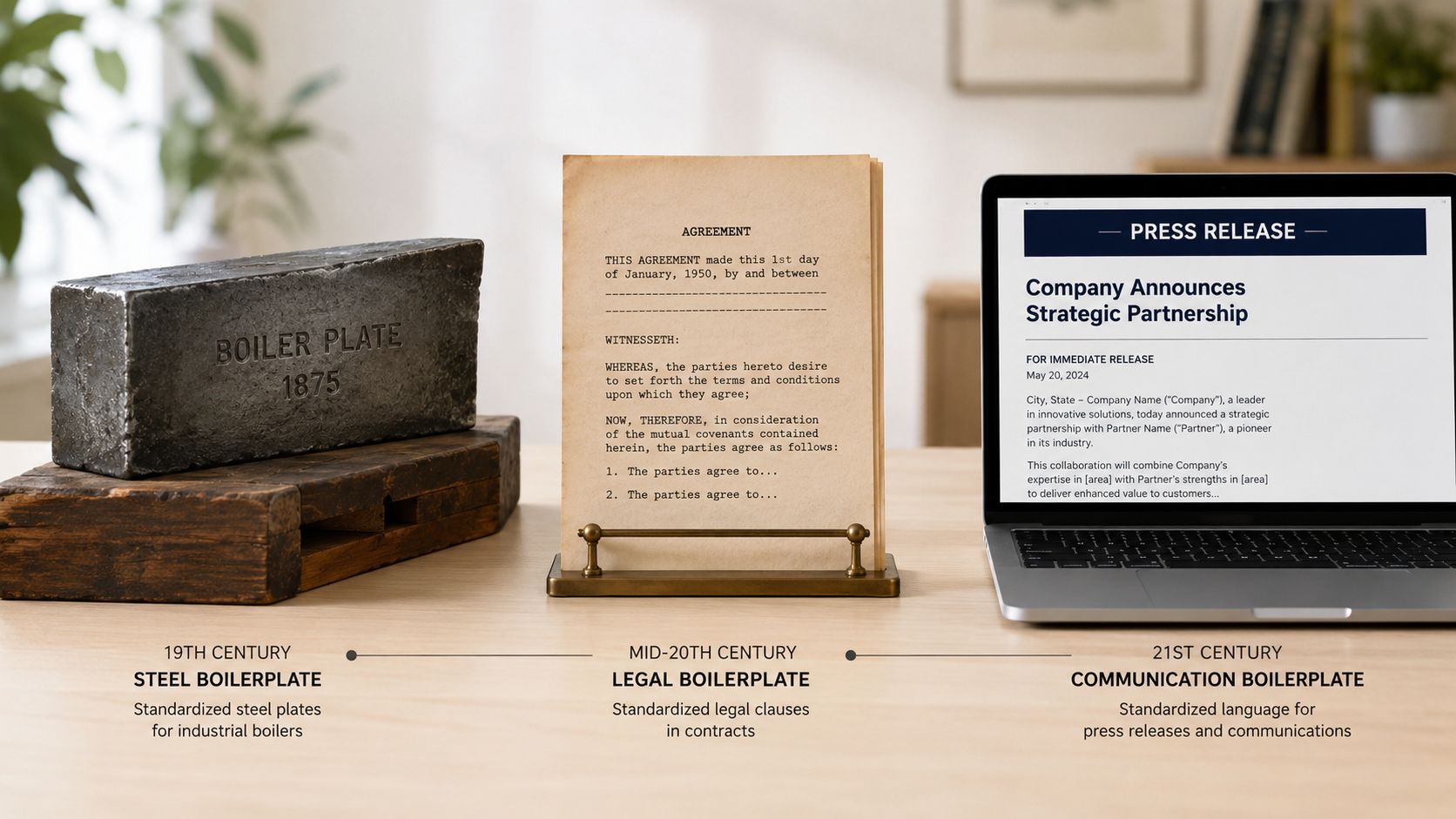
The important lesson isn't the etymology itself. Boilerplate was designed for reuse, consistency, and predictable meaning. Newspaper syndicates distributed ready-to-print material, and later legal and publishing teams used repeated language to reduce effort and variation. A modern company summary should follow the same logic.
Reuse changes the writing standard
A press release boilerplate may appear under a product announcement, partnership release, funding announcement, or conference communication. It should therefore be modular enough to stand alone without sounding tied to a single campaign. A sentence that celebrates a current initiative may work in a launch release but age badly when reused.
The DWW overview of what boilerplate accomplishes frames standardized text as an efficiency and risk-reduction tool. That makes durability more important than cleverness. Proof points should age slowly, and descriptions should remain factual after the announcement's news cycle ends.
A practical writer drafts once, then checks whether the paragraph can be reused without changing its central meaning. Campaign language, temporary slogans, and unsupported superlatives usually fail that test. Clear company language usually passes it.
The Six Building Blocks of a Strong Boilerplate
A reliable drafting sequence keeps writers from jumping straight into adjectives. Fill the factual core first, then decide what deserves emphasis.
1. Legal name and trade name
Start with the organization's approved legal name and the public-facing brand name if they differ. A public company may also need its ticker, but only when that information is relevant and approved.
Test: Can the name survive being copied into a story without creating legal or brand confusion?
2. Headquarters and founding context
Add the headquarters and, when useful, the founding year or origin. Founding context earns space when it clarifies identity, not when it turns the paragraph into a company history.
Test: Would a fact-checker find the location and founding information in an official corporate record or approved source?
3. Core offering in plain language
Describe what the organization does. Replace category jargon with a sentence a generalist reporter could understand on the first read. “Provides workflow software for independent clinics” is more useful than “delivers next-generation operational transformation.”
Test: Could a reader explain the company's offering after reading only this sentence?
4. Audience and scale
State who the organization serves, then choose the proof point that best establishes credibility. Customer count, employee count, reach, awards, units shipped, or another measurable fact may be appropriate, but only when the figure is current and defensible.
Test: Does the proof point support the company's relevance, or is it present only because someone wants another number?
5. Differentiator in editorial tone
A differentiator should distinguish the company without sounding like an advertisement. State an observable fact, such as a specialized market focus, operating model, or documented capability. Avoid “industry-leading,” “world-class,” and similar claims unless an independent source or approved evidence clearly supports them.
Test: Would the sentence read naturally in an encyclopedia entry?
6. Boilerplate sign-off
Close with the official website and, where appropriate, a media contact line or approved social handle. Keep contact details separate from the company description when the release format allows it, so the summary remains clean.
Test: Can a journalist find the next relevant resource without searching for the company independently?
A useful reference for adapting company language beyond press releases is Wispra's guide to company presentation text examples. Its broader presentation context reinforces a practical point: company copy must fit the audience and the place where it appears.
The writing process also benefits from a clear narrative foundation. Teams developing that foundation can use this guide to writing a compelling brand story before reducing the story to boilerplate length.
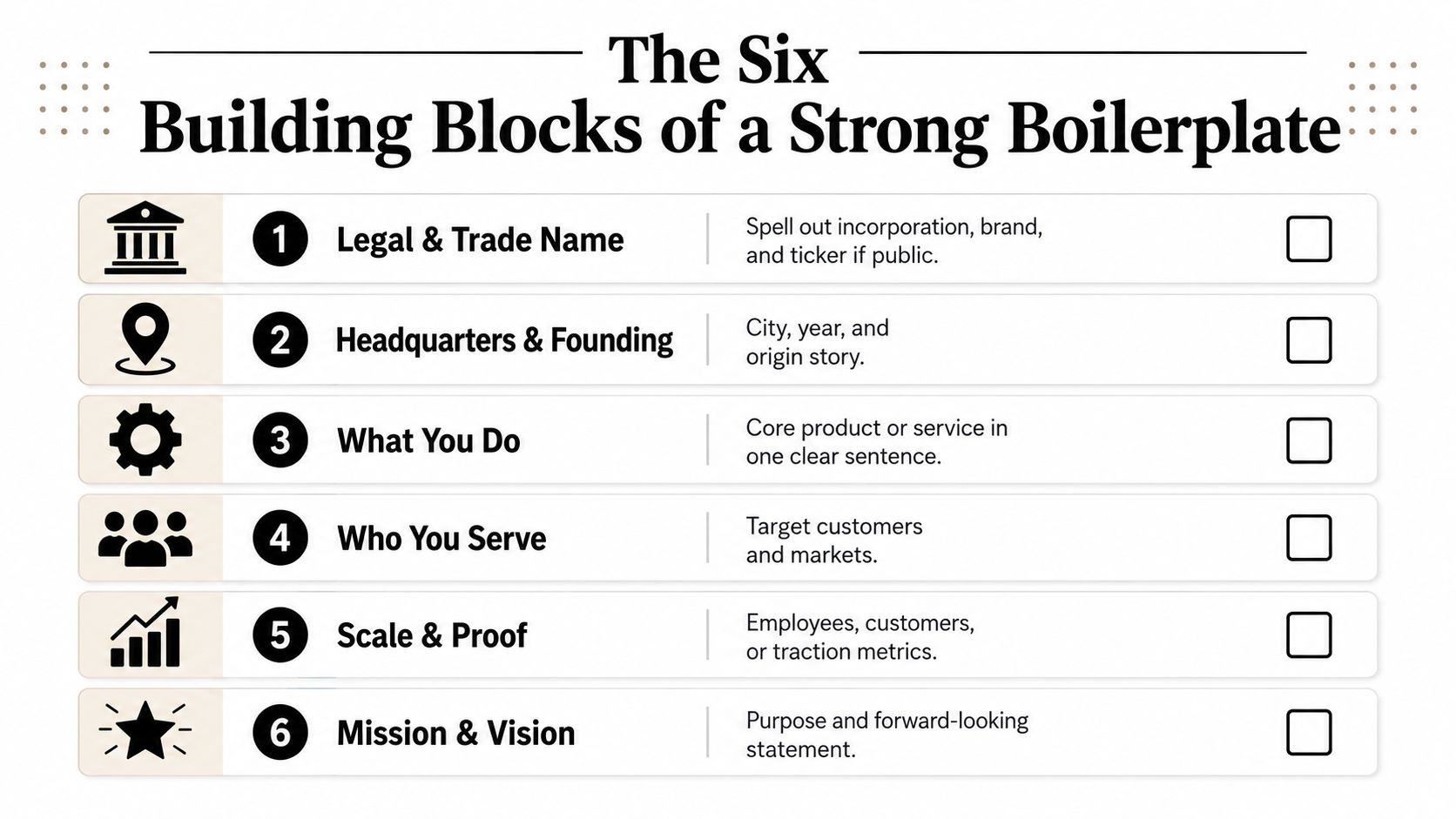
A 20-second drafting checklist
- Name: Legal and trade name
- HQ: Headquarters and founding context
- Offering: Plain-language description
- Audience: Who the company serves
- Proof: One credible, current point
- Differentiator: One factual distinction
- Contact: Website and approved media details
Industry guidance commonly places a press release boilerplate at about 50 to 100 words, as explained by PR Newswire's boilerplate guide. That range is a practical ceiling, not a challenge to use every available word.
Three Drafts of the Same Company Side by Side
Consider Northwind Analytics, a fictional mid-size company that provides forecasting software for manufacturers. The three drafts below contain the same basic business idea, but their editorial quality differs sharply.
Draft A, the marketing version
Northwind Analytics is an industry-leading, world-class technology company transforming the manufacturing sector with innovative, cutting-edge forecasting solutions. Its passionate team of experts empowers forward-thinking businesses to unlock unprecedented efficiency, optimize performance, and drive sustainable growth. Northwind's powerful platform delivers best-in-class insights that help customers stay ahead in today's competitive marketplace. The company is trusted by organizations around the globe and is committed to redefining what's possible through technology.
A journalist would cut nearly every promotional phrase. “Industry-leading,” “world-class,” “cutting-edge,” “passionate,” “unprecedented,” “best-in-class,” and “redefining” are assertions without evidence. The paragraph also avoids the most useful fact, namely what the software does for whom.
Draft B, the thin version
Northwind Analytics provides forecasting software for manufacturers. The company helps businesses make better decisions with data.
This draft is clean but incomplete. It offers a category and a broad benefit, yet gives the reader no location, founding context, audience detail, proof point, or meaningful distinction. A reporter still has to search for reasons Northwind belongs in the story.
Draft C, the usable version
Founded in 2018 and headquartered in Cleveland, Northwind Analytics provides forecasting software that helps manufacturers plan production and inventory. Its platform is used by more than 400 manufacturing sites across North America to turn operational data into forward-looking plans. Northwind serves industrial companies with complex supply chains and focuses on practical forecasting tools that production teams can use without specialized data science staff. Media inquiries: press@northwindanalytics.example.
This version contains a clear lead, a specific audience, one quantified proof point supplied for the fictional example, and a restrained differentiator. At 85 words, it sits within the practical range recommended by industry guidance, but the number isn't what makes it effective. The information hierarchy does.
| Draft | Word Count | Lead Sentence | Key Proof Point | Common Edit Made |
|---|---|---|---|---|
| A, marketing | 68 | Promotional category claim | None | Replace superlatives with verifiable facts |
| B, thin | 23 | Plain offering | None | Add audience, context, and evidence |
| C, usable | 85 | Founding, location, and offering | More than 400 manufacturing sites | Remove hype and add relevant specificity |
The main editing decision is substitution. “World-class technology company” becomes “provides forecasting software.” “Trusted by organizations around the globe” becomes a defined customer footprint. “Powerful platform” disappears entirely because the product description already communicates its function.
The fictional example illustrates the calibration, but real teams should never insert a proof point until the owner has verified its source, date, and permitted wording.
Sector-Specific Boilerplate Variations
The six building blocks remain stable, but the order and proof point should change according to what the audience needs to understand first. A journalist covering software, a nonprofit program, a consumer product, or a professional service won't evaluate relevance in the same way.
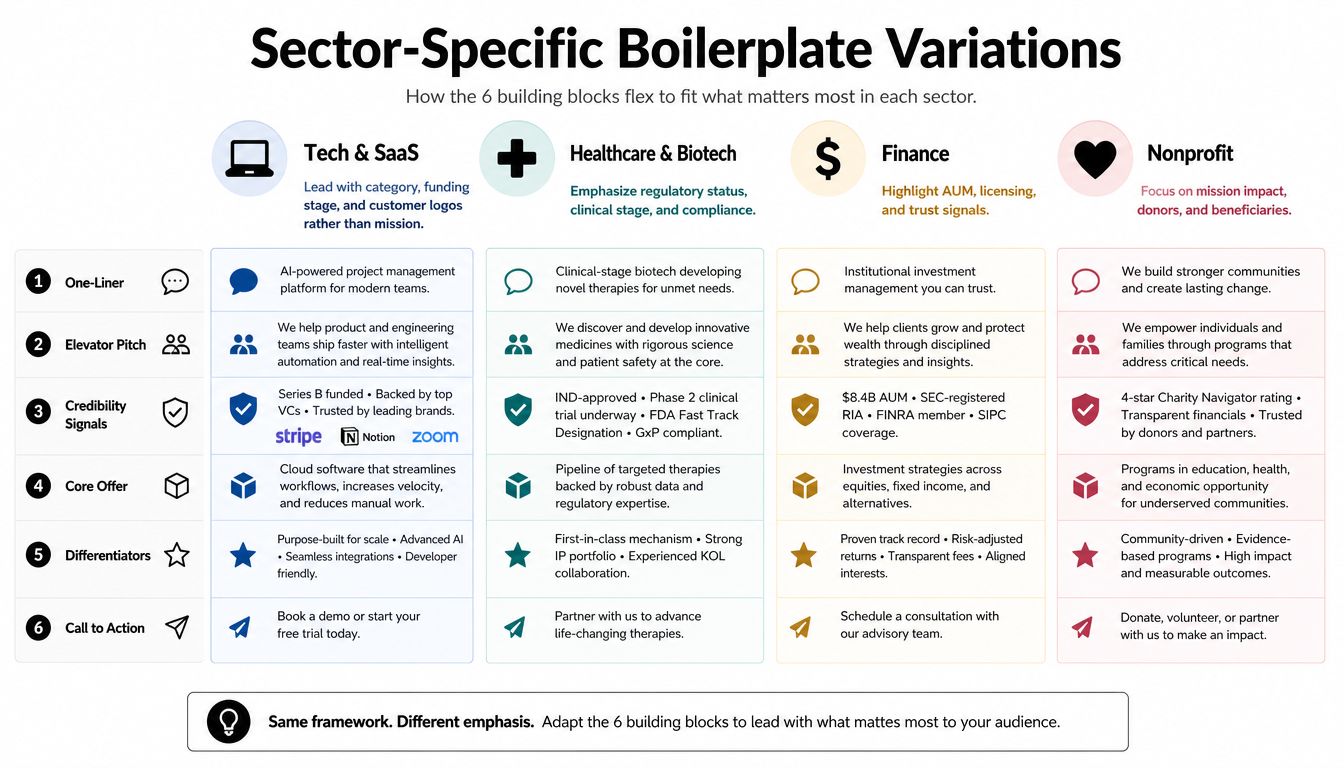
Tech and SaaS
Lead with the category and the customer problem. A software company should say whether it provides security software, collaboration tools, analytics, infrastructure, or another recognizable product class. Funding can be included when it adds legitimate context and has been approved, while customer names should appear only with permission.
Common mistake: Burying the category beneath a mission statement. Reporters need to know what the company makes before they assess its vision.
Nonprofits
Front-load the population served and the program or policy area. A nonprofit's founding date may matter, but it rarely explains the organization as quickly as its beneficiaries, geography, and work. Governance details and tax status can be included when they reassure readers or clarify the entity.
Common mistake: Opening with organizational history instead of the people or communities served.
Retail and consumer brands
Lead with the product category, origin, and sales channels. Store presence, distribution model, product range, or another approved operational detail can help a consumer reporter understand where the brand exists in the market. Origin stories work when they provide a quotable, factual distinction rather than a sentimental slogan.
Common mistake: Describing the brand's personality while omitting where customers can buy the product.
B2B services
Name the buyer first, then the service and the outcome. A consulting, logistics, accounting, or agency boilerplate should identify the client type and the business problem addressed. A quantified result can be persuasive when it is documented and current, but unsupported outcome language weakens trust.
Common mistake: Opening with capabilities such as “offers solutions” instead of identifying the customer.
Sector adaptation doesn't mean creating unrelated versions with different facts. It means choosing the same approved facts in a different order. Healthcare and biotech organizations, for example, may need regulatory or clinical context, while financial organizations may need licensing and trust signals. Those details should be included only when verified and relevant to the audience.
Treating Your Boilerplate as a Living Asset
A boilerplate becomes risky when an organization treats it as finished copy rather than a maintained business asset. The paragraph should have one canonical owner, a central storage location, and a clear approval path. Comms or marketing may manage the wording, but legal, finance, product, and executive stakeholders may need to approve specific claims.
Build a small operating system
Store the approved version in the media kit or shared content library, then reference the same version in the press release template, website newsroom, and internal communications repository. A dated archive makes it possible to identify which wording shipped with an earlier announcement without letting old copy remain the default.
Review the paragraph quarterly, as recommended in guidance focused on boilerplate maintenance from eReleases. A scheduled review should also happen after a leadership change, funding event, major product launch, acquisition, geographic expansion, or material change in customers or reach.
A boilerplate needs an owner, not just an approver.
At each review, the owner should compare the canonical copy against the About page, press kit, pitch deck, and most recent release. Drift is easy to spot when the company uses different descriptions, but it becomes harder to correct when every team edits its own copy.
Governance checklist
- Owner: Assign one person to maintain the canonical version.
- Location: Keep the approved copy in a shared, discoverable repository.
- Review: Put quarterly checks on the communications calendar.
- Triggers: Reopen the copy after material organizational changes.
- Version control: Date revisions and archive retired language.
- Distribution check: Confirm external channels use the approved version.
Search visibility also depends on consistent organization details across public materials. Teams reviewing their release workflow can consult this press release SEO and metadata guide while checking that the boilerplate supports, rather than contradicts, the rest of the release.
Warning signs include an outdated headcount, a missing product line, an old headquarters, a former executive's title, or different company descriptions across the website and pitch deck. Those aren't minor style issues. They tell readers that the organization doesn't control its own basic facts.
Quick Checklist and Common Questions
A final review should be fast enough to use before every release but strict enough to catch credibility problems.
The pre-publish checklist
- Company name: Confirm the approved legal and trade names.
- Founding context: Check the founding year, headquarters, and any origin detail.
- Core offering: Remove jargon and explain the product or service plainly.
- Audience: Identify the customers, beneficiaries, or market served.
- Proof point: Use one current, relevant, verifiable fact.
- Tone audit: Delete superlatives, vague adjectives, and campaign language.
- Reuse test: Read the paragraph without the announcement and confirm that it still makes sense.
- Channel check: Compare the release version with the website and media kit.
The final quality question is simple: Would a journalist unfamiliar with the brand understand the business in one read?
How long should a boilerplate be?
Aim for 50 to 100 words, the range recommended by PR Newswire's boilerplate guidance. A longer paragraph may be justified by complexity, but every extra sentence should earn its place.
Should funding or revenue appear?
Include funding or revenue only when it adds credibility, is approved for publication, and can withstand fact-checking. A number that distracts from the company description or becomes outdated quickly isn't useful evidence.
How should the boilerplate be localized?
Keep the core offering sentence consistent, then adapt headquarters, governance details, audience language, and regional proof points for the market. Don't create a local version that changes the organization's fundamental identity.
When should an existing version be retired?
Rewrite after a material change in leadership, ownership, product line, geography, or scale. Keep a hard review on the calendar even when no trigger event occurs, so stale language doesn't remain invisible.
Press Release Zen provides practical press release guides, templates, formatting advice, and distribution resources for teams building announcements and maintaining reusable copy such as boilerplates. Visit Press Release Zen to refine the full release around a company summary that stays accurate, clear, and ready for reuse.