The release is drafted. The quote is approved. The distribution window is closing. Then the small doubts start. Is it U.S. market or United States market? Does the dateline need the state? Is the title capitalized because it comes before the name, or left lowercase because it describes a role? One sloppy line is often enough to make a release look like it came from marketing instead of a newsroom-ready source.
That's why U.S. AP Style matters so much in press work. Journalists don't stop to admire effort. They scan for signals. Clean AP formatting tells them the release can be trusted, copied from, and moved quickly. Bad formatting tells them they'll need to fix it first, and many won't bother.
This guide is built for that exact moment. It focuses on the rules that stop a press release from looking amateur, and it gives usable templates instead of vague style advice.
Table of Contents
- Why U.S. AP Style Compliance Is Non-Negotiable
- The U.S. Versus United States Rule Explained
- Mastering Capitalization in Headlines and Titles
- Correctly Formatting Datelines and Timestamps
- A Guide to State Names and Street Addresses
- Handling Numbers Dates and Money
- Navigating Nuances and Common Exceptions
- Ready-to-Use AP Style Sentence Templates
Why U.S. AP Style Compliance Is Non-Negotiable
A press release isn't judged only on news value. It's judged on whether an editor can trust it at a glance. AP style is one of the fastest trust signals available.
That standard dominates the channels press releases are built for. The AP Stylebook is the required format for press releases on major platforms like PR Newswire and Business Wire, which handle over 15 million releases annually, and 92% of U.S. newsrooms explicitly require AP Style compliance according to a 2023 audit noted in the verified data provided for this article. In practice, that means a release that ignores AP style is fighting the distribution system and the newsroom at the same time.
Writers who need a broader release-specific checklist can compare this guide with a dedicated AP style press release reference before final review.
Why editors reject sloppy copy fast
Editors rarely announce that they rejected a release because of style. They stop trusting it. Common errors send the same message:
- Wrong abbreviations: Postal codes in body copy look careless.
- Bad dates: Writing “February 12th” signals that nobody checked AP basics.
- Promotional capitalization: Every title in caps makes the release read like ad copy.
- Dateline drift: A malformed dateline suggests the rest of the formatting will also need repair.
Practical rule: If an editor has to fix your first three lines, the rest of the release starts with a credibility deficit.
What AP style does for press release writers
AP style gives PR teams a common operating system. It standardizes names, dates, numbers, locations, and titles so the writer isn't improvising sentence by sentence.
That matters most under deadline. A release written in clean U.S. AP style moves faster through legal review, internal approval, newswire submission, and newsroom pickup because fewer people have to ask formatting questions. Good style doesn't guarantee coverage. It does remove preventable reasons for dismissal.
The U.S. Versus United States Rule Explained
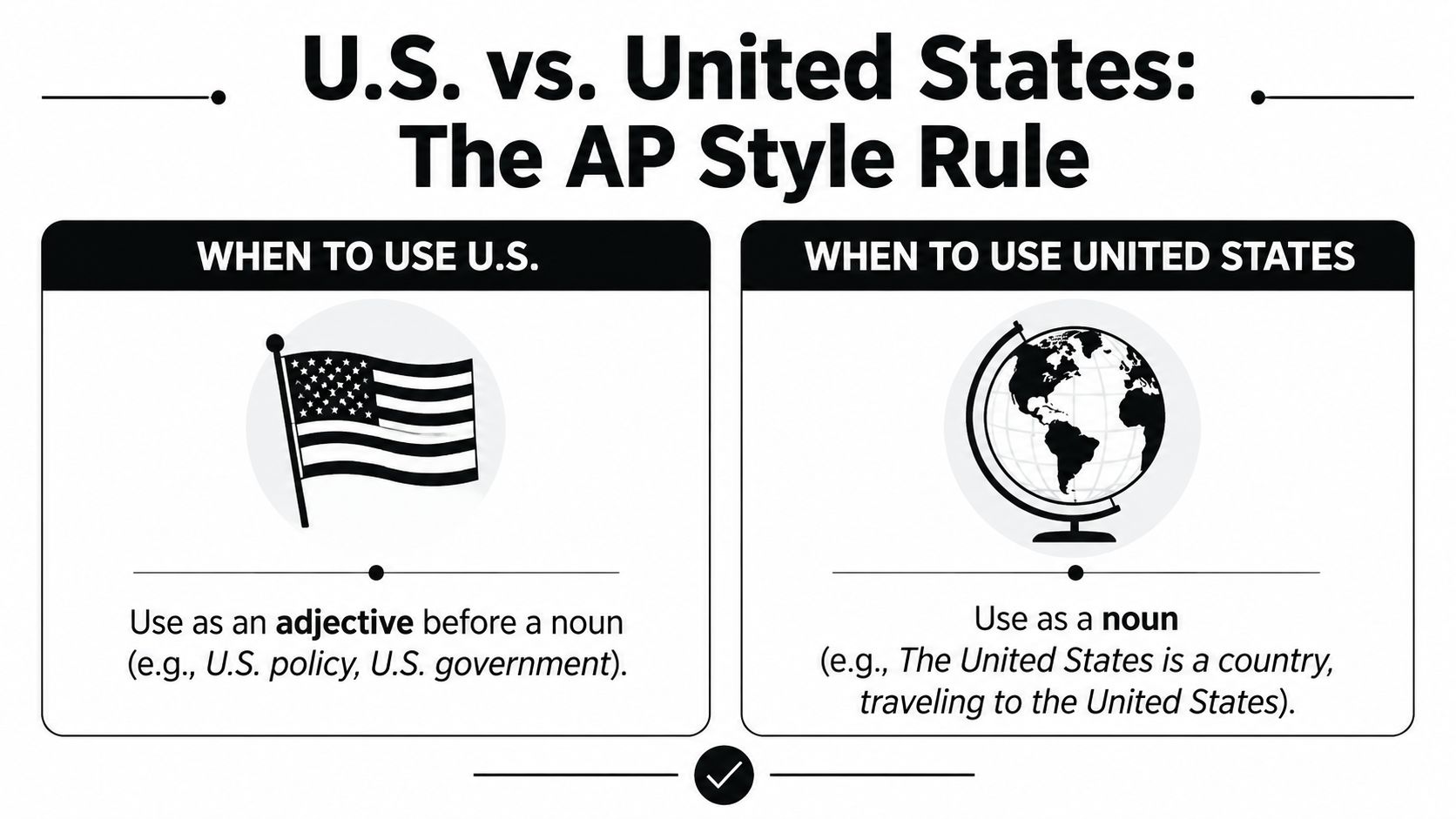
This is one of the first rules editors notice because it appears in headlines, body copy, market claims, investor language, and government references. The short version is simple. Use U.S. as an adjective. Use United States as a noun.
Quick-reference table
| Context | Correct Usage | Example Sentence |
|---|---|---|
| Before a noun | U.S. | The company expanded its U.S. operations. |
| As the country name | United States | The product will launch across the United States next month. |
| Government used as a noun phrase | U.S. before noun | The U.S. government issued new guidance. |
| Travel or presence in the country | United States | The executive will travel to the United States for the event. |
| Market modifier | U.S. | The release highlights growth in the U.S. market. |
What works in release copy
A press release usually uses the term adjectivally. That's why U.S. headquarters, U.S. customers, U.S. retail footprint, and U.S. policy environment all look correct. In each case, the term modifies a noun.
The trouble starts when writers use the abbreviation as if it were the country name itself. “The company expanded in the U.S.” is common in casual business writing, but many newsroom editors prefer the spelled-out noun form in formal copy. “The company expanded in the United States” is cleaner and less likely to trigger edits.
When the phrase answers “which kind,” use U.S. When it names the country itself, use United States.
That rule also helps with awkward constructions. Compare these examples:
- Correct: The manufacturer added two distribution hubs in the United States.
- Correct: The manufacturer increased its U.S. distribution capacity.
- Wrong for AP-style release copy: The manufacturer increased distribution in the U.S. if the term is standing in as the noun.
Clean examples for common announcements
Use these patterns in press release language:
- Market expansion: “The company plans to expand its U.S. sales team in the second half of the year.”
- Government context: “The filing aligns with U.S. regulatory requirements.”
- National launch: “The product will be available across the United States beginning Oct. 1.”
- Corporate footprint: “The brand now operates in three regions of the United States.”
Writers also need to stay consistent inside the same release. Don't switch back and forth because one version sounds shorter. Editors notice that kind of drift immediately, especially in headlines, subheads, and quote attributions.
Mastering Capitalization in Headlines and Titles
Most bad capitalization in releases comes from one habit. Marketing teams capitalize for emphasis. Newsrooms capitalize for rule-based clarity. Those are different systems, and AP style follows the second one.
Headlines use sentence case
AP-style headlines use sentence case, not title case. That means only the first word and proper nouns get capitalized, unless another capitalization rule applies.
Correct:
- Acme Corp. opens new logistics center in Texas
- GreenRiver Health appoints chief operating officer
- City council approves grant for downtown housing project
Wrong for AP style:
- Acme Corp. Opens New Logistics Center in Texas
- GreenRiver Health Appoints Chief Operating Officer
- City Council Approves Grant for Downtown Housing Project
Title case makes a release look like website copy or internal marketing collateral. Sentence case makes it look publishable.
Corporate titles follow position not ego
Job titles get overcapitalized constantly, especially in executive announcements. AP style doesn't capitalize a title because the person is important. It capitalizes a formal title only when it comes directly before a name.
Use these comparisons:
| Correct | Incorrect |
|---|---|
| Chief Executive Officer Jane Smith announced the launch. | chief executive officer Jane Smith announced the launch. |
| Jane Smith, chief executive officer, announced the launch. | Jane Smith, Chief Executive Officer, announced the launch. |
| The board appointed Vice President Mark Ellis. | The board appointed vice president Mark Ellis. |
| Mark Ellis, vice president of operations, will oversee the rollout. | Mark Ellis, Vice President of Operations, will oversee the rollout. |
Writers often resist this because title case feels more respectful. Editors don't care about that. They care about consistency and readability.
A release doesn't become more authoritative by capitalizing every executive title. It becomes less credible.
Proper nouns still stay capitalized
Sentence case does not mean flattening everything. Proper nouns remain capitalized. Company names, product names, branded programs, cities, states, agencies, and formal bodies keep their standard capitalization.
A headline like “Acme launches solar program in California” works because Acme and California are proper nouns. A headline like “Acme Launches Solar Program In California” does not.
Common newsroom fixes
The easiest way to clean capitalization before submission is to check four places:
- Headline: Convert title case to sentence case.
- Subheadline: Apply the same sentence-case rule unless a proper noun requires caps.
- Executive references: Capitalize formal titles before names, lowercase after names.
- Departments and generic bodies: Lowercase generic references such as board, company, and leadership team unless part of a formal name.
Writers who learn this distinction stop making the most visible AP errors. That alone improves how quickly an editor can move through a release.
Correctly Formatting Datelines and Timestamps
The dateline tells the reader where and when the announcement is being issued. If that line is wrong, the release starts badly before the first sentence even begins.
The dateline formula
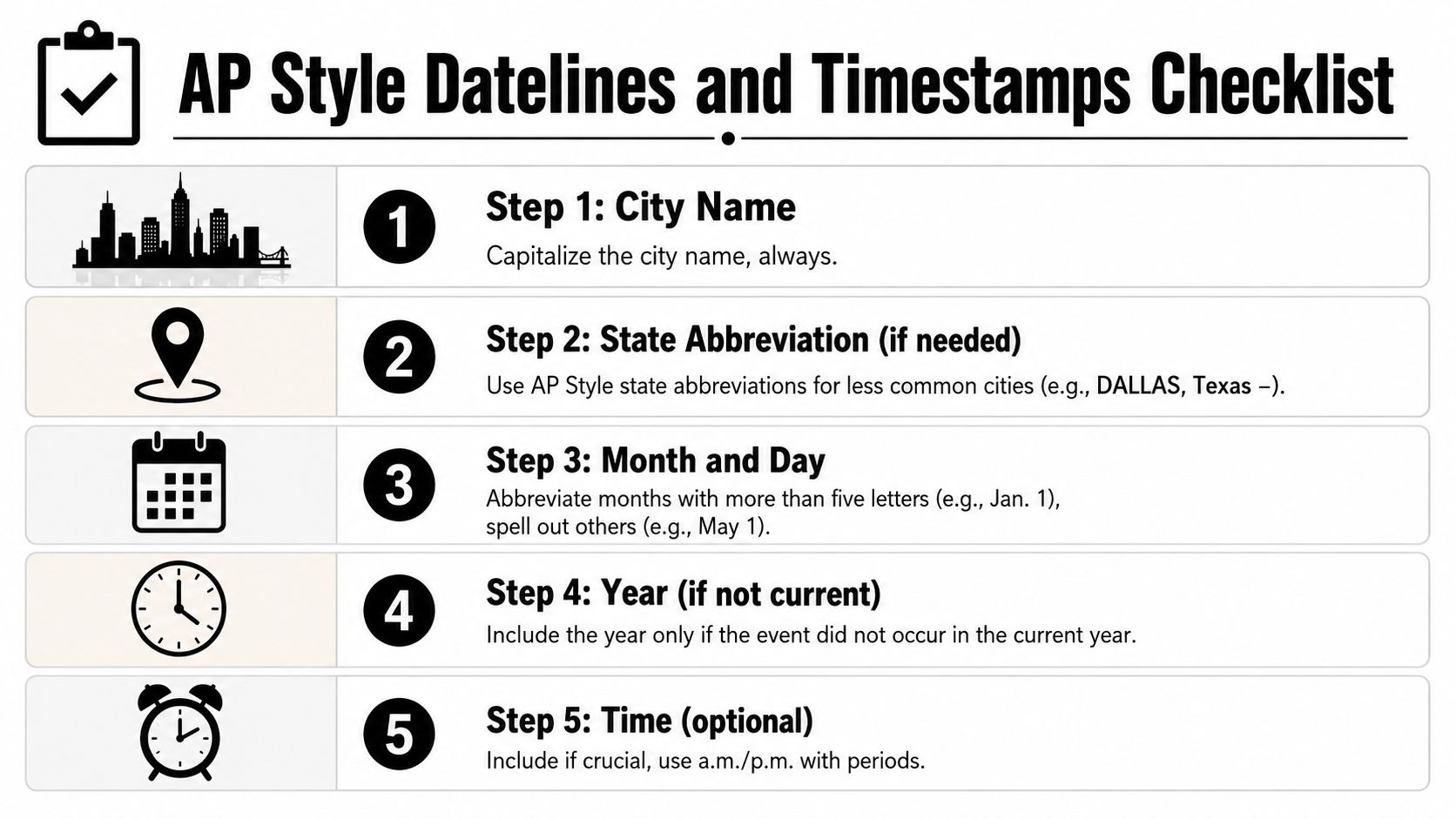
A standard dateline follows a rigid structure:
CITY, State, Month Day, Year (if needed) –
Examples:
- AUSTIN, Texas, June 15, 2026 –
- CHICAGO, June 15, 2026 –
- BOSTON, June 15 –
The city appears in all caps in release formatting. If the city needs a state for clarity, use the AP state abbreviation style, not the postal code. The date follows AP month rules. Verified guidance for this article states that months are abbreviated only when used with a specific date for Jan., Feb., Aug., Sept., Oct., Nov., and Dec., and that commas set off the year in a full date such as June 15, 2026, while no comma is used when only a month and year appear, such as June 2026.
A practical dateline checklist
Before filing a release, check the dateline against this list:
- City first: Use the city name in caps.
- State only if needed: Add the AP state abbreviation when the city doesn't stand alone clearly in context.
- Date style: Use numerals for the day. Don't add ordinal endings.
- Year handling: Include the year when context requires it.
- Punctuation: End the dateline with a hyphen, then begin the lead.
A bad dateline doesn't look minor to an editor. It suggests the writer doesn't know how press copy is built.
Time style that doesn't trip editors
Timestamps inside release copy should use a.m. and p.m. with periods. Avoid redundant wording such as “10 a.m. this morning” or “7 p.m. tonight.” The time already tells the reader enough.
Use:
- The event begins at 9 a.m.
- Trading starts at 4 p.m. Eastern time.
Avoid:
- The event begins at 9:00 AM
- The event begins at 9 o'clock in the morning
For dates, don't write ordinals. The verified data for this article states that AP style excludes st, nd, rd, and th in dates and decades. So the correct form is Feb. 12, not February 12th or Feb. 12th.
The best release writers build the dateline first, then write the lead around it. That prevents mismatches between the top line and the body text.
A Guide to State Names and Street Addresses
Geographic formatting causes more newsroom cleanup than most writers expect. State names, directional cues, and street abbreviations look simple until they're wrong. Then they stand out immediately.
State names in body copy and datelines
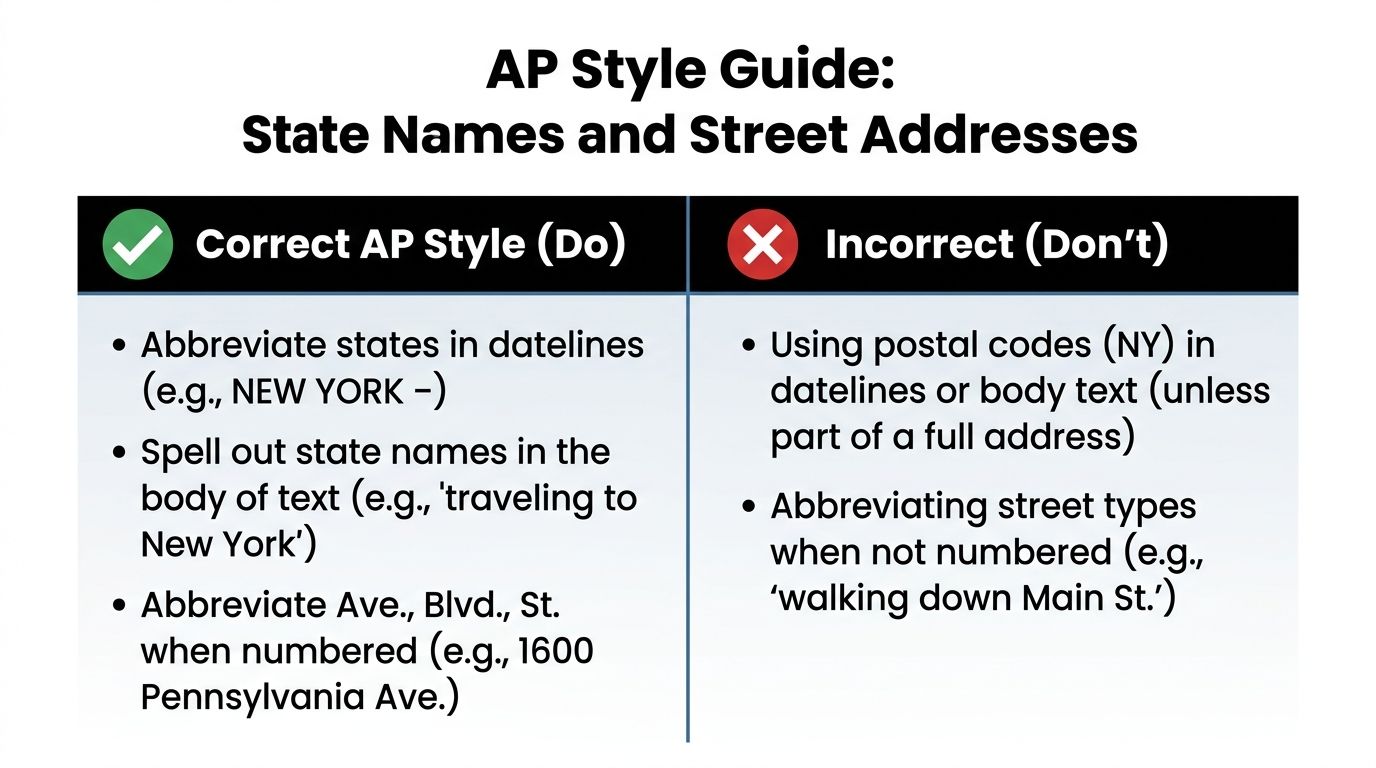
Use the AP state abbreviation style when a state follows a city in a dateline or similar constructed location line. In running body copy, state names are often spelled out when standing alone as place references.
Examples:
- The company will open a new office in California.
- The event will take place in Portland, Oregon.
- SEATTLE, Wash., June 15 –
The key point is that AP abbreviations are not the same as postal codes. Writers who use CA, TX, or NY in body text make a release look corporate and administrative instead of editorial.
Address rules that writers keep getting wrong
Verified AP guidance provided for this article is direct on street formatting. For numbered street addresses, use figures for the address number and abbreviate Ave., Blvd., and St. only when they appear with a specific number. Terms such as Drive and Road are spelled out.
Correct:
- 1600 Pennsylvania Ave.
- 45 West 23rd St.
- 2000 Forest Road
- 12 Lakeview Drive
When there is no numbered address, spell out and capitalize the street name. That means:
- Main Street
- North Main Street
- Pennsylvania Avenue
Not:
- Main St.
- North Main St.
- Pennsylvania Ave.
A verified 2025 analysis of U.S. press releases found that 42% incorrectly capitalized directional cues in unnumbered addresses and 31% improperly abbreviated “Avenue” or “Street” without a number. Those are basic errors, and they're visible ones.
A fast address audit for release writers
Use this check before submission:
- Number present: Abbreviate only Ave., Blvd., and St.
- No number present: Spell out the street type and capitalize the full street name.
- Directional cue used: Treat it as part of the proper street name when appropriate.
- Postal code creeping in: Remove it unless the release requires a full mailing address format.
Most address errors happen because writers apply mailing-address habits to newsroom copy. AP style isn't postal formatting.
If the release includes an event venue, store opening, ribbon cutting, or headquarters move, this check is worth doing line by line. Small location mistakes are among the fastest ways to make a release look unedited.
Handling Numbers Dates and Money
Numbers need consistency more than flair. A release can survive plain phrasing. It won't survive sloppy figures, broken dates, and mixed money style.
The base number rule
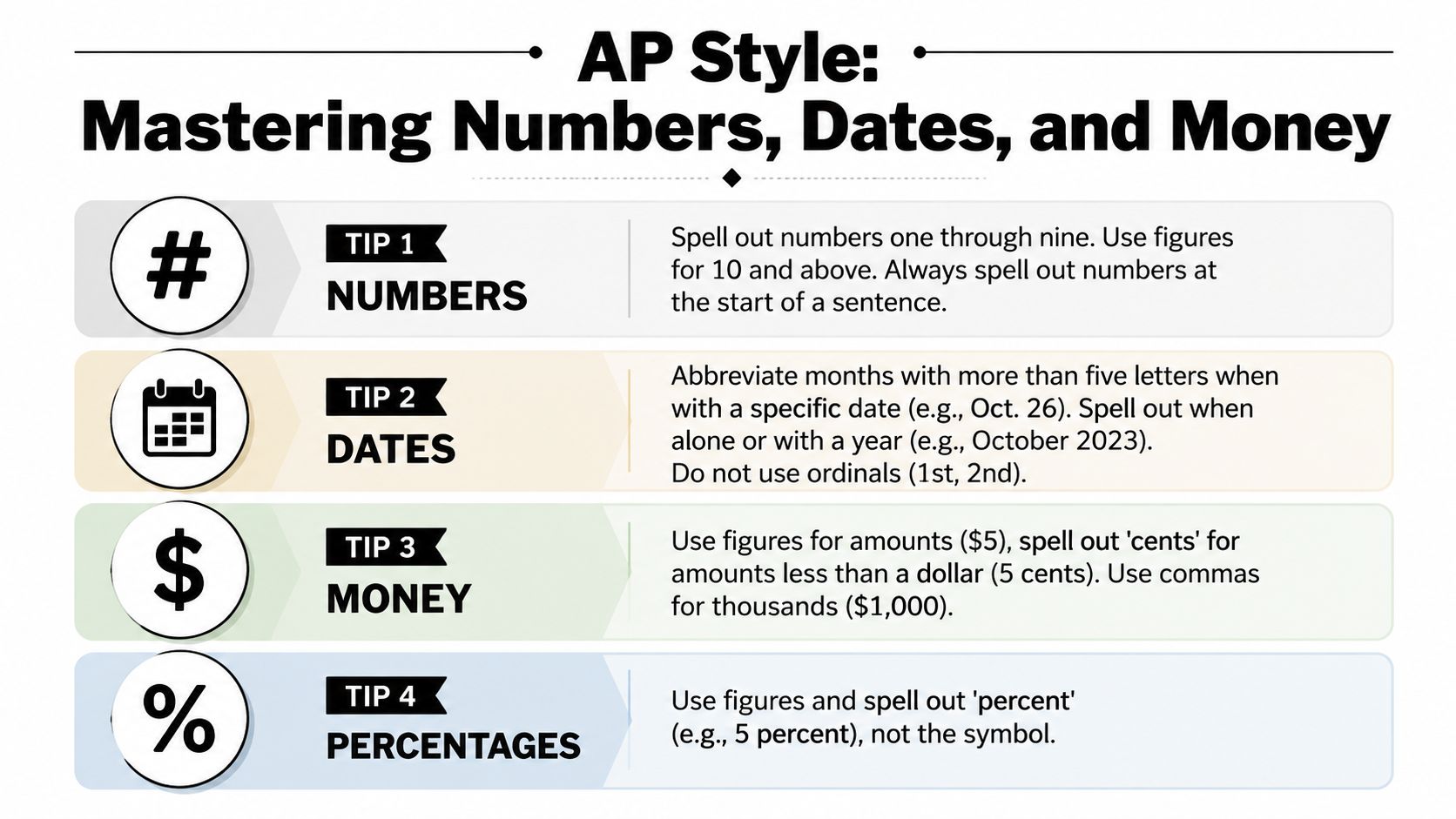
The foundational AP rule is simple. Spell out one through nine. Use figures for 10 and above. Verified data for this article notes that a 2022 Purdue OWL analysis found 98% of U.S. newsrooms follow this rule and associated it with an estimated 45% reduction in editorial inconsistencies in daily news production.
Examples:
- The company hired three analysts and 14 account executives.
- Seven stores will close.
- The project includes 12 buildings.
There are exceptions. Verified AP guidance in the provided data states that ages are written as figures, as in a 24-year-old, and that precise amounts greater than one may use figures and decimals where practical, such as 3.9 or 6.3.
Dates and money in release copy
Date style in AP is strict:
| Correct | Incorrect |
|---|---|
| Feb. 12 | February 12th |
| June 15, 2026 | June 15th, 2026 |
| June 2026 | June, 2026 |
| the 1990s | the 1990's |
| the '90s | the 90s |
The verified data also states that decades use a figure plus s without an apostrophe, except when the leading numerals are omitted, as in the '90s.
For money, use figures with the dollar sign for dollar amounts. Spell out cents for amounts below a dollar. The verified data further states that AP style uses numerals for all dollar amounts and spells out terms such as million for larger figures.
Use:
- $5
- 25 cents
- $3 million
Avoid:
- five dollars
- $0.25
- $3,000,000 when a cleaner rounded form works in context
Release mistakes that create rework
A quick review catches most issues:
- Ordinal dates: Delete every st, nd, rd, and th in dates.
- Mixed number logic: Don't write 8 stores in one sentence and eight stores in the next without a rule-based reason.
- Sentence starts: Spell out a number if it begins a sentence, or rewrite the sentence to avoid a clunky opening.
- Percent style: In AP-style copy for press releases, write percent, not the symbol, unless platform-specific house style requires otherwise.
Numbers are where legal, finance, and communications teams often create inconsistencies. One final style pass after approvals is usually necessary.
Navigating Nuances and Common Exceptions
Some AP rules are mechanical. Others carry cultural weight, editorial judgment, or both. Those are the rules writers hesitate over, and hesitation often leads to inconsistency.
Applying Black and white correctly
AP's decision to capitalize Black but lowercase white was established in June 2020, according to the verified data for this article. The same verified data says 68% of communications professionals hesitate to apply the lowercase white rule, citing concern about backlash, based on reporting from The Vox Agency summary published through AP Stylebook context.
That hesitation is understandable. Corporate communications teams often write for mixed audiences, including employees, customers, journalists, partners, and local communities with very different expectations. But inconsistency is worse than discomfort. If a release refers to racial identity, it should apply the house style deliberately and consistently.
Use:
- Black employees
- Black communities
- white residents
- white voters
Don't alternate forms within the same release based on who drafted each paragraph or which quote came in last.
Sensitive style calls for editorial discipline. Writers should decide early, confirm legal and leadership understand the standard, and apply it consistently.
For teams that need a broader formatting framework around sensitive or high-stakes announcements, this press release style guide with format examples and writing tips is a useful operational companion.
Other gray areas worth checking
Several trouble spots don't always have a single flashy rule, but they still create friction:
- Acronyms: Spell out an organization on first reference unless the acronym is universally known and won't confuse the audience.
- Social handles: Treat them as branded identifiers. Preserve the platform or account styling if accuracy requires it.
- Trademarks: Legal teams often want every mark tagged. News-style copy usually reads better when trademark clutter is minimized unless legal review requires inclusion.
- Corporate styling: If a brand insists on unusual capitalization, the release may need a judgment call between legal preference and editorial readability.
A practical newsroom approach is to defend AP style on everything generic, then document narrow exceptions for protected brand names and formal legal references. That keeps the release readable without starting avoidable internal battles over every capital letter.
Ready-to-Use AP Style Sentence Templates
Most style mistakes happen when writers improvise under pressure. Templates solve that. They give teams a clean structure for the most common announcements so style holds even when approvals get messy.
Announcement templates
Use these as starting lines, not rigid scripts.
New executive hire
CITY, State, June 15, 2026 – Acme Health today announced the appointment of Chief Financial Officer Jane Smith, who will oversee financial strategy and reporting across the company's U.S. operations.
Second reference:
Jane Smith, chief financial officer, joins the company from BroadRiver Capital.
Product launch
CITY, State, Oct. 1, 2026 – Northline Systems today launched Beacon, a workflow platform designed to help midsize manufacturers manage compliance reporting across the United States.
Store opening
CITY, State, Aug. 12, 2026 – Harbor Market today announced the opening of its new location at 1250 Grand Ave. in downtown Spokane.
Partnership announcement
CITY, State, Nov. 3, 2026 – ClearPath Energy and Summit Transit today announced a partnership to expand electric fleet infrastructure in three regional markets.
Earnings release line
CITY, State, Feb. 12, 2026 – Westbrook Technologies today reported fourth-quarter revenue of $3 million and said it expects continued investment in product development.
A good drafting process also benefits from external workflow discipline. Teams using AI to generate first drafts should review actionable tips for private AI so prompts produce cleaner raw copy before AP editing begins.
Boilerplate and review habits
Boilerplate copy should also follow AP rules. That means sentence case, restrained capitalization, and clean references to geography, titles, and numbers.
Use this boilerplate pattern:
About Acme Health
Acme Health is a healthcare technology company based in Boston. The company provides software and support services for hospitals, clinics, and research organizations across the United States.
For a faster starting point, writers can adapt a structured press release template in AP style and then customize the facts, quote, and dateline.
Before distribution, run this final pass:
- Lead sentence: Check the dateline, title capitalization, and first-reference company name.
- Quote block: Remove promotional caps and verify titles after names are lowercase.
- Numbers and dates: Standardize date format, money style, and one-through-nine usage.
- Footer material: Clean the boilerplate, media contact, and location references.
A release doesn't need to sound stiff to meet AP style. It needs to sound controlled. That's the difference between copy that gets edited for publication and copy that gets ignored.
Press Release Zen helps teams write cleaner, faster, newsroom-ready releases with practical guides, templates, and distribution-focused advice. For more support on structure, formatting, and execution, visit Press Release Zen.