A launch announcement is ready. The press release has been drafted, the executive team wants the public post scheduled, and employees are asking what the change means for their jobs and customers. The difficult decision isn't choosing between Slack and LinkedIn. It's deciding what each audience must know, when they should hear it, who can speak, and which details must remain separate.
That makes internal vs external communication a synchronization problem. Poor synchronization creates leaks, contradictory explanations, employee distrust, and avoidable reactive PR. Strong synchronization doesn't mean copying the same message into every channel. It means aligning the facts and strategic direction, then adapting the level of detail, tone, timing, and approval process to each audience.
This guide gives communications leaders a practical rule: align when the core facts and organizational purpose must match, sequence when one audience needs context before another hears the news, and separate when confidentiality, legal exposure, or audience needs require different narratives. The framework covers channels, governance, announcement scenarios, employee advocacy, organizational models, measurement, and a 90-day implementation plan.
Table of Contents
- Why This Decision Matters More Than You Think
- Internal vs External Communication at a Glance
- How Each Side Is Actually Governed
- Three Announcement Types, Three Plans
- The Boundary Problem and Employee Advocacy
- Which Approach Fits Your Organization
- A 90-Day Plan to Stand Up Both Functions
- Frequently Asked Questions
Why This Decision Matters More Than You Think
Internal communication has become a measurable business-performance issue, not merely an HR responsibility. A Gallup-linked benchmark reported that only 21% of employees worldwide were engaged at work, while a separate U.S. measure placed engagement at 31% in 2024, its lowest level in a decade and back at 2014 levels, as reported in this employee engagement statistics benchmark. The same research ecosystem links ineffective communication with substantial lost working time, including more than 35 working days per year for one employee earning between $50,000 and $100,000, equivalent to about $10,140 in annual salary loss per employee, according to the linked benchmark.
Those figures change the planning question. A message that employees misunderstand can delay execution, increase manager workload, and weaken retention before the public sees any problem. Industry summaries also report that 60% of companies haven't implemented a long-term internal communication strategy, which means many organizations are attempting external reputation work without a dependable internal information system.
The synchronization decision
Three questions should be answered before an announcement is approved:
- What must match? Core facts, dates, organizational intent, customer impact, and approved terminology should normally be consistent.
- Who needs context first? Employees may need operational detail, manager guidance, or reassurance before customers, journalists, or investors receive the public version.
- What must stay separate? Confidential personnel information, legal advice, unverified facts, and internal implementation details shouldn't be placed in an external narrative.
Practical rule: Align the facts, sequence the audiences, and separate the details that carry different risks.
A synchronized plan also assigns ownership. Internal communication usually needs managers, HR, operations, and executives to translate a decision into action. External communication needs legal review, a spokesperson, media coordination, and brand-risk controls. Treating both as one broadcast system creates confusion. Treating them as unrelated systems creates contradiction.
Internal vs External Communication at a Glance
Internal communication serves people who execute the organization's work. External communication serves people who judge, buy from, regulate, fund, report on, or partner with the organization. The distinction affects more than channel choice. It determines the amount of context, the acceptable level of candor, the approval path, and the evidence required after publication.
| Dimension | Internal Communication | External Communication |
|---|---|---|
| Audience | Employees, managers, contractors, and internal teams | Customers, prospects, investors, regulators, journalists, partners, and communities |
| Channel | Intranet, all-hands meeting, Slack, Teams, employee email, manager cascade | Press release, media pitch, website, social media, customer email, investor update |
| Tone | Candid, contextual, operational, and responsive | Clear, polished, audience-specific, and reputation-conscious |
| Objective | Alignment, understanding, execution, belonging, and feedback | Reputation, trust, demand, stakeholder confidence, and public clarity |
| Governance | Leadership direction, manager interpretation, HR and operations coordination | Legal review, approved messaging, spokesperson rules, brand controls, and publication approval |
| Measurement | Understanding, response, sentiment, participation, and execution readiness | Coverage quality, message pull-through, stakeholder response, share of voice, and public sentiment |
Internal communication works best when employees can answer practical questions: What changed? Why did it change? What should each team do now? Where can questions go? A public message usually answers a different set: What happened? Why should an outside stakeholder care? What evidence supports the claim? Who can provide a verified comment?
Channel overlap can obscure the difference. Email may serve both audiences, while social platforms can carry employee advocacy and official external messaging at the same time. The channel doesn't define the communication. The audience, objective, and governance do.
Digital channel design matters because teams now work across intranets, collaboration tools, social platforms, and direct messaging. For a broader view of how those environments are changing, communications teams can review these insights from Firacard on digital communication, then select channels based on reach and behavior rather than novelty.
The measurement split is equally important. Internal teams need to know whether people understood and can act. External teams need to know whether the intended reputation or stakeholder response is developing. A high-performing public campaign can't compensate for employees who haven't received usable guidance, and an engaged workforce can't repair an externally published statement that lacks legal or factual control.
The takeaway is simple: internal and external communication are parallel systems, not interchangeable channels. They should share a message foundation, but they shouldn't share every sentence, approval step, or success metric.
How Each Side Is Actually Governed
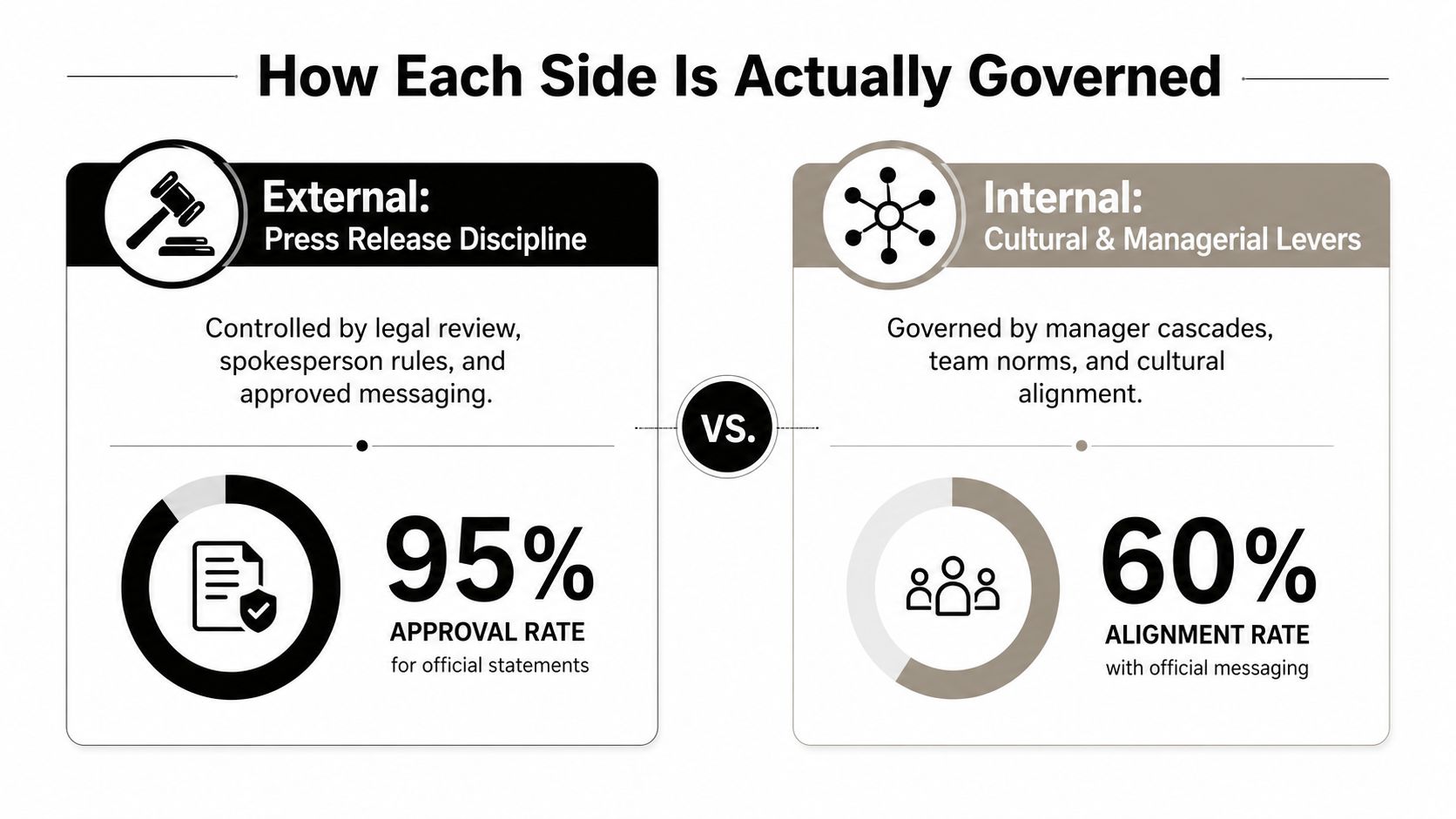
External communication is built for public scrutiny. A press release, executive statement, investor communication, or crisis update typically passes through a controlled path involving the communications lead, legal counsel, an authorized spokesperson, and a senior decision-maker. The process protects the organization from unsupported claims, confidentiality breaches, inconsistent commitments, and reputational damage.
The modern public relations system reflects that discipline. Ivy Lee's 1906 Declaration of Principles is widely recognized as a milestone in transparent communication with the press and public, while Edward Bernays' 1923 book Crystallizing Public Opinion helped establish public relations as a strategic discipline. This history explains why external messaging is judged for credibility, consistency, and accountability across audiences.
Internal communication follows a more fluid model. Leaders set direction, but managers interpret the message for their teams, frontline employees connect it to customer realities, and informal conversations fill gaps left by official updates. Employees aren't passive recipients. A 2026 academic chapter on employee power in legitimate and effective crisis communication describes employees as active sensemakers and communicative agents who can influence how a crisis is understood across internal and external boundaries.
Where ownership collides
The collision usually appears in three situations:
- Embargoes: External teams want a controlled public release, while internal teams need enough notice to prepare employees and managers.
- Executive transitions: Legal and board stakeholders may require confidentiality, but employees need direct leadership context before they encounter the news in media coverage.
- Crises: External teams wait for verified facts, while internal teams need immediate instructions about safety, operations, customers, and escalation.
Internal governance protects against disengagement, rumor, and execution failure. External governance protects against liability and brand damage. A useful owned media explanation can help teams distinguish channels they control from channels where journalists, customers, employees, and other stakeholders shape the conversation.
The approval matrix should therefore name separate owners for content and readiness. Legal can approve what may be said publicly. The executive sponsor can approve the organizational position. Internal communications can approve employee context and manager tools. Operations can confirm that teams can execute the instruction. No single approver should be expected to validate every dimension alone.
Three Announcement Types, Three Plans
The same news requires different synchronization depending on its operational and reputational risk. A product launch usually benefits from internal preparation before public visibility. An executive transition requires employee dignity and direct leadership. A crisis requires speed internally and restraint externally.
| Scenario | Internal sequence | External sequence | Channels internal | Channels external |
|---|---|---|---|---|
| Product launch | Equip product, sales, support, and managers before public release | Brief priority customers or partners, then publish approved public materials and pursue media coverage | Product briefing, manager toolkit, intranet, Slack, all-hands | Press release, trade media pitch, website, customer email, social |
| Executive transition | CEO or board representative addresses employees, followed by manager Q&A | Notify employees first, then brief priority stakeholders and issue the approved public statement | Private all-hands, employee email, manager Q&A document, intranet | Press release, stakeholder briefing, website, media response |
| Crisis | Give employees verified instructions quickly and refresh them as facts change | Use one authorized spokesperson, publish only verified facts, and update through controlled channels | Employee alert, manager cascade, incident hub, operational briefings | Website update, press statement, customer notice, social update |
Product launch
The internal track should lead by 24 to 48 hours when employees need training, customer answers, or operational preparation, as specified in the launch plan. The product leader should explain what is changing, which customer problem it addresses, what employees contributed, and what teams must do before release. Sales and support need objection handling, product limitations, approved terminology, and an escalation route.
The external track should be sequenced around audience relevance. Trade press may receive a controlled pitch, customers may receive a direct explanation, and analysts or partners may need a more technical briefing. The spokesperson should be the product executive or another person who can explain the customer value without overpromising. Teams preparing the supporting materials can use these press release templates for corporate announcements to standardize structure and approval.
Executive transition
Employees should hear from the CEO, board representative, or designated senior leader before the public announcement. The internal message needs a private all-hands, a written summary, and a manager Q&A document covering reporting lines, timing, continuity, and questions the organization cannot yet answer.
The external release should follow the employee communication, with legal and board approval already secured. A single spokesperson should handle media inquiries. The message should focus on verified leadership facts, continuity, and stakeholder relevance, not internal speculation or confidential personnel detail.
Crisis
The crisis plan reverses the usual preference for polished external speed. Internal communication becomes the speed channel because employees may need safety instructions, customer scripts, system restrictions, or escalation contacts immediately. Updates can be frequent, but every update must separate confirmed facts from pending investigation.
External communication should wait for verified information unless silence would create greater harm. One authorized spokesperson should speak publicly, while the website or designated external channel carries the official record. Employees shouldn't improvise public explanations during the initial response, especially when legal exposure remains uncertain.
The Boundary Problem and Employee Advocacy
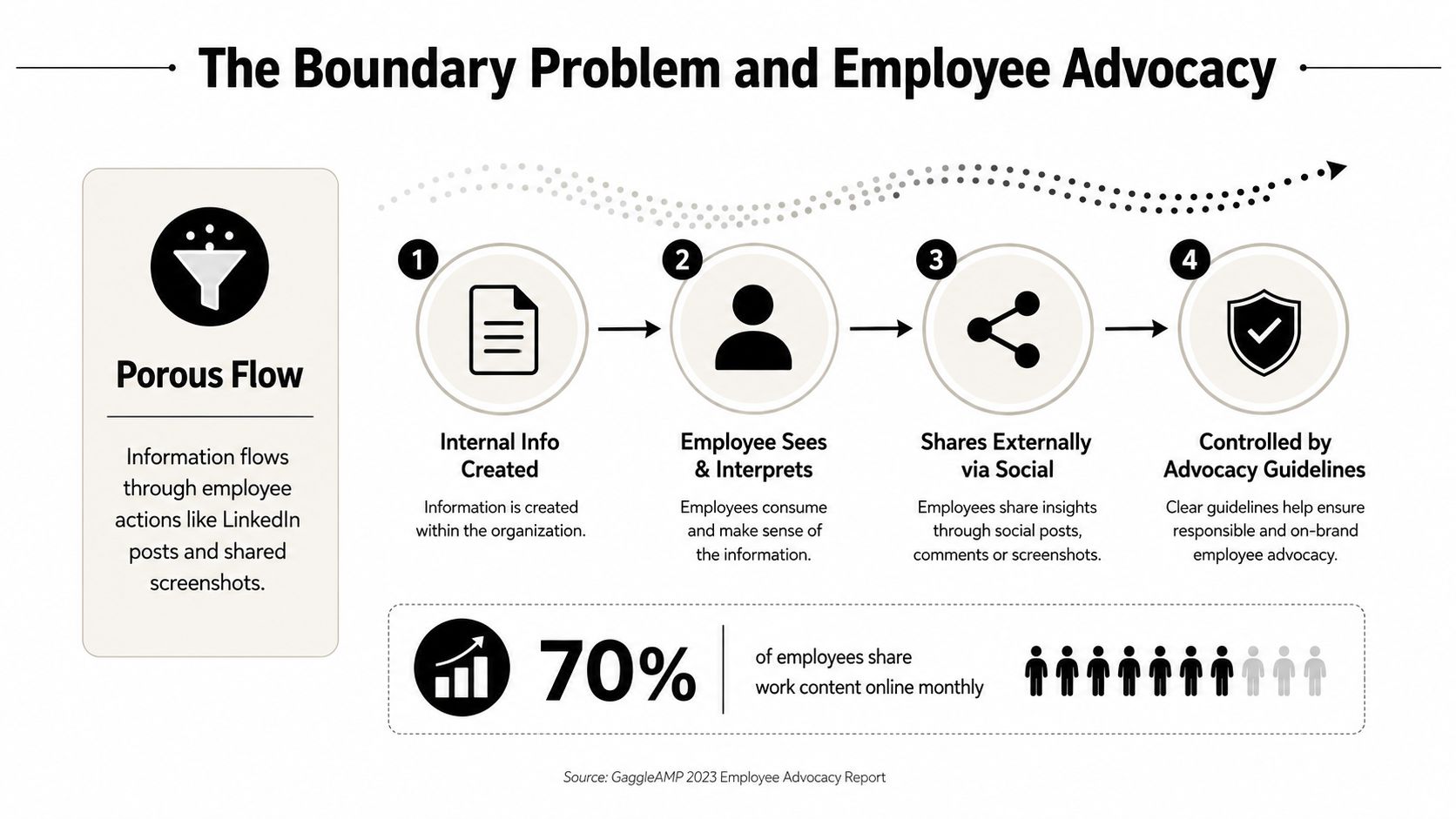
The internal and external boundary is porous because employees carry organizational information into public and semi-public spaces. An employee may post on LinkedIn, answer a customer question in a forum, forward a screenshot in a private chat, or explain a product change during a sales call. Each action can turn an internal message into an external interpretation.
The risk isn't employee participation itself. The risk is unmanaged translation. Employees add context, emotion, assumptions, and local knowledge. That can make a message more credible, but it can also introduce promises, disclose confidential details, or contradict the approved public position.
Controls that reduce distortion
A practical boundary-management system includes:
- Talking points: Give employees a short core message, approved facts, prohibited details, and a route for difficult questions.
- Embargo windows: State when information becomes public, which channels are covered, and what employees should do if a journalist or customer asks early.
- Manager toolkits: Provide answers that managers can adapt without inventing policy or making commitments.
- Advocacy guidance: Offer shareable assets and clear participation rules, while preserving employees' ability to speak in their own voice.
- Escalation routes: Name the person who handles media questions, customer concerns, legal questions, and suspected leaks.
Employee advocacy should be invited when the public story is approved, employees understand the boundaries, and participation adds authentic expertise or reach. Employees should be asked to stay quiet when facts remain unverified, an embargo protects negotiations, or public commentary could create legal or safety exposure.
This principle also applies to outbound employee activity. Teams building prospecting or customer communications should review practical Cold Email Compliance guidance so internal enthusiasm doesn't produce external messages that violate applicable rules or organizational standards.
Boundary rule: Give employees something accurate and useful to share, or give them a clear reason not to share yet. Silence without guidance invites improvisation.
Which Approach Fits Your Organization
The correct operating model depends on workforce structure, regulatory exposure, and the speed of decision-making. A small company shouldn't copy the bureaucracy of a multinational. A regulated organization shouldn't rely on informal Slack interpretation. A frontline workforce needs more than a well-written intranet post.
| Organization profile | Default model | Separation level | Common mistake |
|---|---|---|---|
| Small team with under 50 staff | One coordinated plan led by the founder or senior executive | Low, with clear audience adaptations | Treating every message as a public campaign and neglecting employee context |
| Regulated finance or healthcare company | Separate internal and external tracks with documented approvals | High, with formal sign-off and evidence trails | Letting speed bypass legal, compliance, or records requirements |
| Distributed frontline workforce in retail or logistics | Hub-and-spoke model with central messaging and local manager cascades | Moderate, with strict public message controls | Assuming email or intranet access equals employee reach |
The candid recommendation
A small team should keep the plan simple. One shared messaging document, one approver, and one founder-led briefing can prevent most contradictions. The separation comes through audience-specific detail, not a complicated department structure.
A regulated company needs hard boundaries. Legal, compliance, HR, operations, and communications should each have defined responsibilities, and the organization should retain evidence of approvals and publication decisions. Speed matters, but undocumented speed creates a larger risk later.
A distributed frontline workforce needs redundancy. The central team should write the core internal and external narratives, then equip local managers with short scripts, translated materials where needed, and escalation instructions. The central communications team owns consistency. Local managers own understanding.
A 90-Day Plan to Stand Up Both Functions
A team doesn't need separate internal and external specialists to establish basic discipline. It needs a shared operating system, named owners, and a small number of reliable channels.
| Phase | Weeks | Internal focus | External focus |
|---|---|---|---|
| Audit and assets | 1 to 4 | Map employees, managers, frontline groups, channel access, and recurring information needs | Map customers, media, investors, regulators, partners, spokespersons, and approval risks |
| Pilot | 5 to 8 | Test one primary channel, such as an intranet or employee email, with a manager cascade | Test one primary channel, such as a newsroom, press release workflow, or stakeholder email |
| Formalize | 9 to 12 | Establish weekly all-hands, monthly newsletter, manager toolkit, and feedback route | Establish quarterly press rhythm, media response process, message library, and crisis tabletop |
Weeks 1 to 4
The team should build a stakeholder map, channel inventory, messaging house, spokesperson roster, and approval matrix. The messaging house needs one core proposition, supporting points, proof sources, audience adaptations, and language that employees and external stakeholders can both understand.
Two shortcuts have unusually high impact. First, use one shared messaging document that internal and external teams edit from different views. Second, create one approval matrix that assigns one accountable owner per channel. Shared language prevents drift. Clear ownership prevents stalled approvals.
Weeks 5 to 8
The internal pilot should test reach and understanding, not merely delivery. A short all-hands, intranet post, or manager cascade should be followed by questions, a pulse check, or direct feedback from frontline representatives.
The external pilot should test the complete publication path. Draft the statement, secure review, prepare the spokesperson, publish through the selected channel, and record stakeholder questions. Teams developing leadership routines can also use this 90-day plan for new leaders as a reference for sequencing ownership and operating habits.
Weeks 9 to 12
Formalize the cadence: weekly all-hands, monthly newsletter, quarterly press rhythm, and a crisis tabletop. The crisis exercise should test who approves facts, who updates employees, who speaks externally, and how a suspected leak is handled. A practical communication plan guide with examples can support the documentation phase.
At day 90, review a small measurement set:
- Internal response: Open rates, attendance, question volume, and employee sentiment.
- External response: Coverage quality, message pull-through, stakeholder replies, and share of voice.
- Boundary control: Leak incidents, embargo breaches, contradictory statements, and escalations.
- Operational readiness: Whether managers and customer-facing teams had usable guidance before publication.
Frequently Asked Questions
Should internal and external messaging ever be identical?
The core facts and organizational position should match. The detail shouldn't. Employees need operational context and questions answered, while external audiences need a concise, verified explanation.
How long should an information embargo last?
There isn't a universal duration. The embargo should last until the required employees, managers, legal reviewers, and operational teams have enough information to act, while limiting the window in which a leak can occur. The governance owner should document the exact release time.
Should employee advocacy be centralized or organic?
Use centralized guidance with organic participation. Communications should provide approved facts, assets, and boundaries. Employees should decide whether and how to share, except during a defined crisis or confidentiality period.
What happens if a frontline employee breaks the embargo?
Don't begin with punishment or a public correction. Remove or correct the exposed material where possible, assess legal and customer risk, give the employee a clear instruction, and update the internal guidance if confusion caused the breach. The governance process should identify whether the failure came from unclear timing, poor reach, or deliberate misconduct.
What's the smallest credible measurement set?
A team without an analytics stack can track employee questions, manager feedback, message corrections, media or stakeholder responses, coverage quality, and confirmed leak incidents in a shared document. Consistent manual records are more useful than disconnected dashboards with no owner.
Press Release Zen helps teams plan, write, and distribute press releases with practical guides, templates, and announcement resources that support the external side of a synchronized communications plan. Visit Press Release Zen to build a clearer approval process, prepare the right public statement, and coordinate it with the internal guidance employees need.