A press release goes out. The messaging is sharp, the approval cycle is finally over, and distribution is live. Then an important question hits. Where should reporters, investors, partners, and prospects land when they want more than the headline version?
That answer is owned media.
For PR teams, owned media isn't a side channel run by marketing. It's the infrastructure that gives a press release context, credibility, and staying power. Without it, every announcement depends too heavily on third-party pickup, rented visibility, or social posts that disappear in the feed. With it, a release becomes the start of a coordinated campaign that can support journalists, reinforce key messages, and keep working long after launch day.
Table of Contents
- The Foundation of Modern PR Strategy
- Owned Media vs Earned and Paid Media
- Your Core Owned Media Channels
- The Strategic Benefits and Limits of Owned Media
- How Owned Media Amplifies Your PR Strategy
- Measuring the Success of Your Owned Media
- Your Owned Media Starter Checklist
The Foundation of Modern PR Strategy
What is owned media? In practical terms, it's any digital channel a brand controls directly and publishes on its own terms. In PR, that usually means the website, newsroom, blog, email list, resource library, and branded social accounts that support official communication.
That control matters more than many teams realize. A release distributed through a wire or media list can create awareness, but the brand still needs a reliable destination for the full story, supporting assets, background, and follow-up action. Reporters often want executive bios, product screenshots, prior announcements, fact sheets, and a clean company description. Prospects want proof. Stakeholders want clarity. Owned media gives all of them one place to find it.
The business case is already clear. The global owned media market is valued at approximately $573 billion, which signals how central these brand-controlled assets have become in modern communications, according to WARC's analysis of the owned media opportunity.
Why owned media sits underneath PR execution
PR teams usually work inside a PESO mindset, whether they label it that way or not. Paid media expands reach. Earned media builds third-party credibility. Shared media helps distribution travel through social and community channels. Owned media is the base layer because it holds the message together once attention arrives.
A weak owned footprint creates familiar problems:
- Journalists hit dead ends: No press kit, no usable archive, no current leadership page.
- Traffic leaks away: Social posts and coverage mention the brand, but visitors don't find a clear next step.
- Messages drift: Different channels tell slightly different versions of the story.
- Campaign value fades fast: Once the initial pickup slows, the announcement loses visibility.
Practical rule: If a press release can't send people to a strong owned destination, the campaign is running on borrowed distribution.
PR teams that need structure before scaling output should also build a content marketing plan that ties announcements, thought leadership, and evergreen resources into one operating rhythm. That prevents the common problem of treating each release like a one-off event.
Owned Media vs Earned and Paid Media
What owned, earned, and paid actually mean
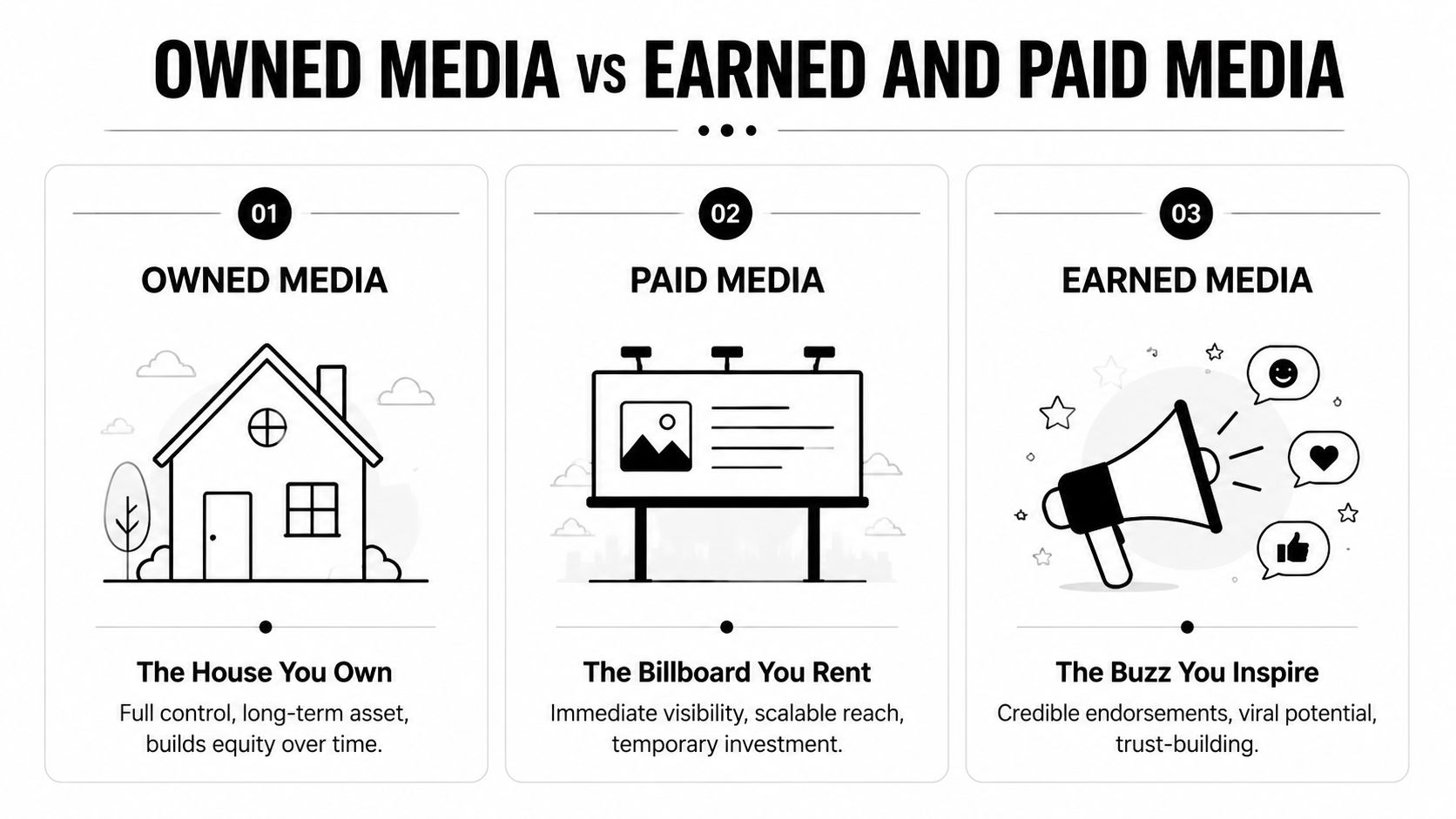
The simplest way to explain the difference is this:
- Owned media is the house the brand owns
- Paid media is the billboard the brand rents
- Earned media is the buzz the brand hopes to inspire
Owned media is any digital property the brand controls directly. That definition includes channels where messaging can be delivered on the brand's terms without third-party costs or constraints, as described in Adjust's definition of owned media. In other words, if the brand controls the property, the publishing rules, and the presentation, it's owned.
Paid media is bought visibility. Think sponsored posts, search ads, display placements, or promoted content. It can create immediate reach, but that reach generally stops when spending stops.
Earned media is third-party coverage or mention. A reporter writes about the company. An industry newsletter references the launch. A podcast host includes the founder in a discussion. PR teams often chase this category most aggressively because it carries external validation. For a deeper breakdown, this guide to earned media coverage examples and benefits is useful when teams need to separate genuine coverage from simple distribution.
A practical comparison
The trade-offs become easier to manage when they're viewed side by side.
| Media type | What the team controls | Cost pattern | Credibility | Longevity | Best PR use |
|---|---|---|---|---|---|
| Owned | Content, timing, structure, archive | Upfront creation and maintenance | Brand-led, so credibility depends on quality | Strong, because assets stay live | Hosting releases, press kits, FAQs, leadership content |
| Paid | Placement, targeting, budget, creative | Ongoing spend for continued reach | Lower than earned because audiences know it's sponsored | Temporary | Amplifying announcements to targeted audiences |
| Earned | Very little once coverage is secured | Time-intensive rather than placement-driven | Strong because a third party publishes it | Varies by outlet and article lifespan | Building trust, visibility, and authority |
A release shouldn't force one channel to do every job. Paid gets attention. Earned adds trust. Owned gives the campaign a stable home.
The mistake many organizations make is treating owned media like a passive archive. It works better as an active system. The newsroom supports journalists. The blog expands the story. The email list alerts people who already care. The website turns attention into action.
Your Core Owned Media Channels
The channels that matter most
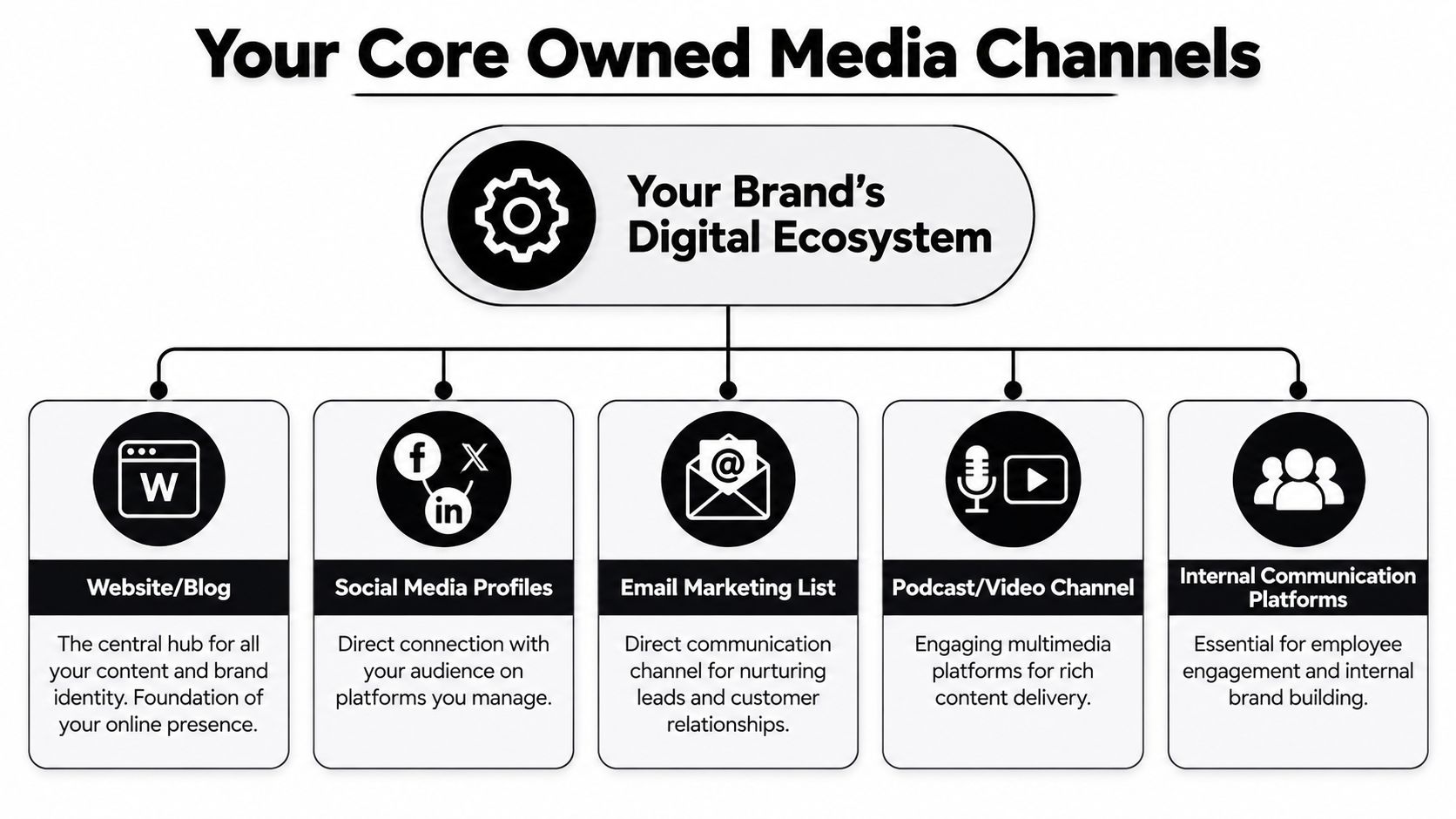
For most organizations, owned media starts with the company website. Industry consensus treats it as the primary owned media funnel and central hub for digital authority, while email lists are especially valuable because they bypass the partial ownership limits of social platforms, as explained in Strategic Nerds' glossary of owned media.
That principle should shape how PR teams organize their assets.
Website and newsroom Official information should live on these platforms. Not buried in a generic blog feed, and not scattered across campaign landing pages with inconsistent naming. A strong site gives media contacts a reliable place for press releases, company background, executive bios, logos, product visuals, and contact details.
Blog or insights hub
A release often says just enough to announce the news. The blog handles everything that doesn't fit cleanly into formal release format. That includes behind-the-news context, customer problem framing, technical explainers, founder commentary, and post-announcement FAQs.
Email list
Email is one of the few channels where the brand can reach its audience directly without depending on a platform feed. For PR, that makes it ideal for stakeholder alerts, launch roundups, executive commentary, event reminders, and follow-up content after media outreach begins.
What counts and what does not
Branded social profiles sit in a middle ground. They are useful owned channels in day-to-day communications because the organization controls the account and the content it publishes. But they are not fully sovereign assets in the same way a website or email list is, because platform algorithms still shape distribution.
That distinction affects planning.
- Treat social as a distribution layer: Use it to point audiences back to the fuller story on the site.
- Treat downloadable assets as owned media too: Whitepapers, media kits, data sheets, and executive briefing docs can all support a release.
- Treat video and podcast channels as extensions: They work well when the story benefits from demonstration, leadership voice, or recurring commentary.
Teams that want to align social execution with PR goals should review practical guidance on PR for social media. The strongest programs don't ask social to replace owned media. They use social to circulate and reinforce what the brand has already published on assets it controls.
The website should answer the journalist's next question before they have to email for it.
A useful test is simple. If a key platform changed its rules tomorrow, which of the brand's channels would still hold audience access, message history, and searchable content? Those are the assets PR teams should protect first.
The Strategic Benefits and Limits of Owned Media
The biggest benefit of owned media is control. The team decides what goes live, how it reads, where supporting files sit, and which action a visitor should take next. That's a major advantage during product launches, leadership changes, funding news, crisis updates, and any announcement where precision matters.
Owned media also creates compounding value. A press release published on a company site can keep serving search, media research, partner due diligence, and sales enablement long after its first send. A newsroom built well once reduces friction every time the next announcement ships.
Where owned media gives PR teams an edge
A second benefit is resilience. Media control has consolidated sharply in the United States. In 1983, 90% of US media was controlled by 50 companies, and by 2011 that same 90% was controlled by just 6 companies, according to Wikipedia's summary of media ownership concentration. For communicators, that trend reinforces a simple reality. Relying only on outside platforms means relying on fewer gatekeepers.
Owned assets reduce that dependence.
- Message control: The exact wording, context, and asset package stays intact.
- Archive value: Important company moments remain accessible in one searchable location.
- Direct audience relationship: Email subscribers and repeat site visitors don't have to rediscover the brand through a third party.
- Better support for earned media: Reporters can verify facts quickly and pull approved materials without delay.
Where teams get this wrong
Owned media has limits, and they matter.
It doesn't come with built-in broad reach. Publishing a release on the site doesn't mean journalists will see it. It also takes operational discipline. Newsrooms break when no one updates old bios, image links, or contact pages. Blogs fail when they become inconsistent or self-promotional.
The most common mistakes look like this:
- Treating the site like storage instead of strategy
- Publishing only when the company has something to sell
- Building social followings while neglecting email capture
- Expecting owned content to replace media outreach
Owned media works best when teams see it as a force multiplier, not a shortcut. It won't do earned media's job, but it makes earned media easier to win and easier to capitalize on.
How Owned Media Amplifies Your PR Strategy
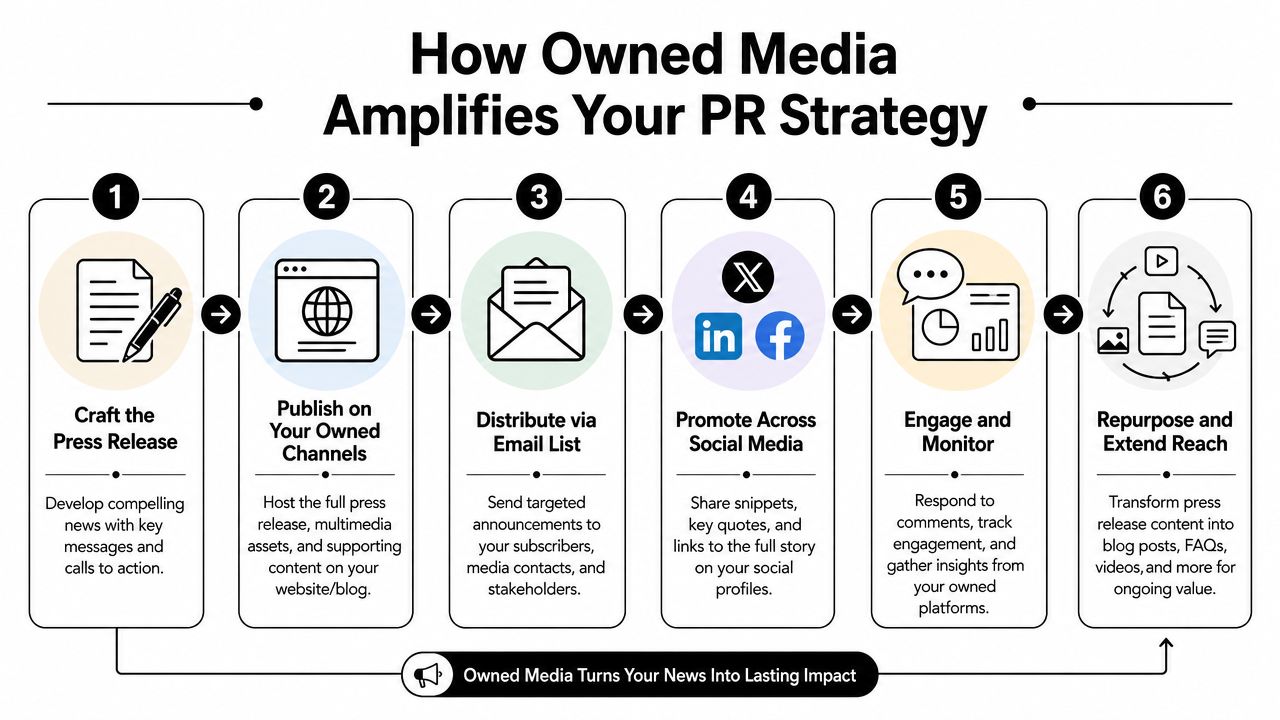
The strongest PR campaigns don't treat the press release as the final asset. They treat it as the source material for a broader owned media rollout.
Before the release goes out
Preparation on owned channels often determines whether the campaign feels coordinated or fragmented.
A practical pre-launch setup includes:
Create a landing point on the website
That could be a newsroom post, release page, campaign hub, or investor update page. It should hold the official text, supporting visuals, boilerplate, and media contact details.Prepare supplementary assets
Journalists and analysts often need more than the release itself. Upload leadership headshots, logos, product screenshots, backgrounders, and FAQs before outreach starts.Write the search-friendly companion content
Some announcements deserve a blog post that explains the significance in plain language. This is especially useful when the release format has to stay formal or compressed.
A release opens the door. Owned content keeps the visitor from bouncing after the first click.
During launch week
Once the release is live, owned media becomes the campaign's coordination layer.
Use email with segmentation
Different stakeholders need different framing. Customers may need practical impact. investors may want business context. Partners may need enablement language. A single blast rarely handles all three well.
Post social with a destination in mind
Social posts should drive traffic back to the owned hub, not force every detail into the platform caption. Executive accounts can reinforce the message, especially when they add perspective instead of repeating the corporate post verbatim.
Extend the story into executive thought leadership
An announcement about product direction, market expansion, or hiring strategy can often support a founder or executive article. Teams working on X should think beyond isolated announcement posts and build your X audience with SupaBird as part of a broader owned-plus-shared distribution approach.
After the first wave of attention
Many PR teams frequently stop too early.
Good owned media programs keep the announcement alive by repurposing it into assets that match audience intent:
- FAQ pages for recurring customer or analyst questions
- Sales enablement summaries for outbound teams
- Short video clips from executives clarifying the news
- Customer-facing blog posts that explain practical implications
- Newsroom updates when there are follow-on milestones or clarifications
That approach also improves media follow-up. When a journalist circles back days later, the brand still has a coherent package online instead of a single aging release with no supporting trail.
A useful operating rule is to plan owned media in three beats: the official announcement, the explanatory layer, and the follow-up layer. Teams that do this well make every release easier to find, easier to understand, and easier to cite.
Measuring the Success of Your Owned Media
PR teams often track pickup, impressions, and placements. Those matter, but they don't fully answer whether owned media helped the campaign perform better. The more useful question is whether the brand's own channels improved discovery, strengthened engagement, and supported earned outcomes.
That matters because this area is often under-measured. Integrated owned-earned strategies increase share of voice by 25-40% compared with isolated owned media efforts, according to Prowly's discussion of owned media measurement and attribution. The opportunity isn't just publishing more content. It's proving how owned content contributes to press results.
Metrics that matter to PR teams
A practical reporting set usually includes a mix of content, referral, and earned indicators.
- Referral traffic from coverage: Check whether media articles are sending visitors to the release page, newsroom, or related resources.
- Engagement with release-supporting assets: Watch which FAQs, bios, downloads, and supporting pages people use after landing.
- Press inquiry quality: Track whether journalists arrive better informed because the site answered basic questions up front.
- Content-assisted pickups: Note when coverage appears after a blog post, executive note, or newsroom package gave the story more substance.
Teams that need a cleaner stakeholder view should build reporting around outcomes, not just output. This guide on public relations reporting is useful for turning scattered metrics into a clearer PR narrative.
A simple attribution setup
Attribution doesn't need to be complicated to be useful.
Start with one release and map the owned trail around it:
| Asset | What to watch | Why it matters |
|---|---|---|
| Release page | Referral sources and engagement path | Shows where attention came from and what visitors did next |
| Newsroom assets | Downloads, visits, repeat access | Indicates whether supporting materials helped media research |
| Email announcement | Click destinations and response patterns | Shows which audience segments cared enough to go deeper |
| Executive content | Mentions, backlinks, journalist interest | Helps connect thought leadership to earned follow-up |
A useful habit is to review these signals in the same reporting cycle as media results. That creates a more honest picture of campaign performance.
For teams outside traditional corporate PR, this resource for church social media managers offers a practical reminder that channel measurement works best when every metric ties back to communication goals rather than vanity totals.
If owned media can't be tied to a business or PR outcome, the team is probably measuring activity instead of impact.
Your Owned Media Starter Checklist
Teams don't need a massive rebuild to start using owned media better. They need a tighter operating baseline.
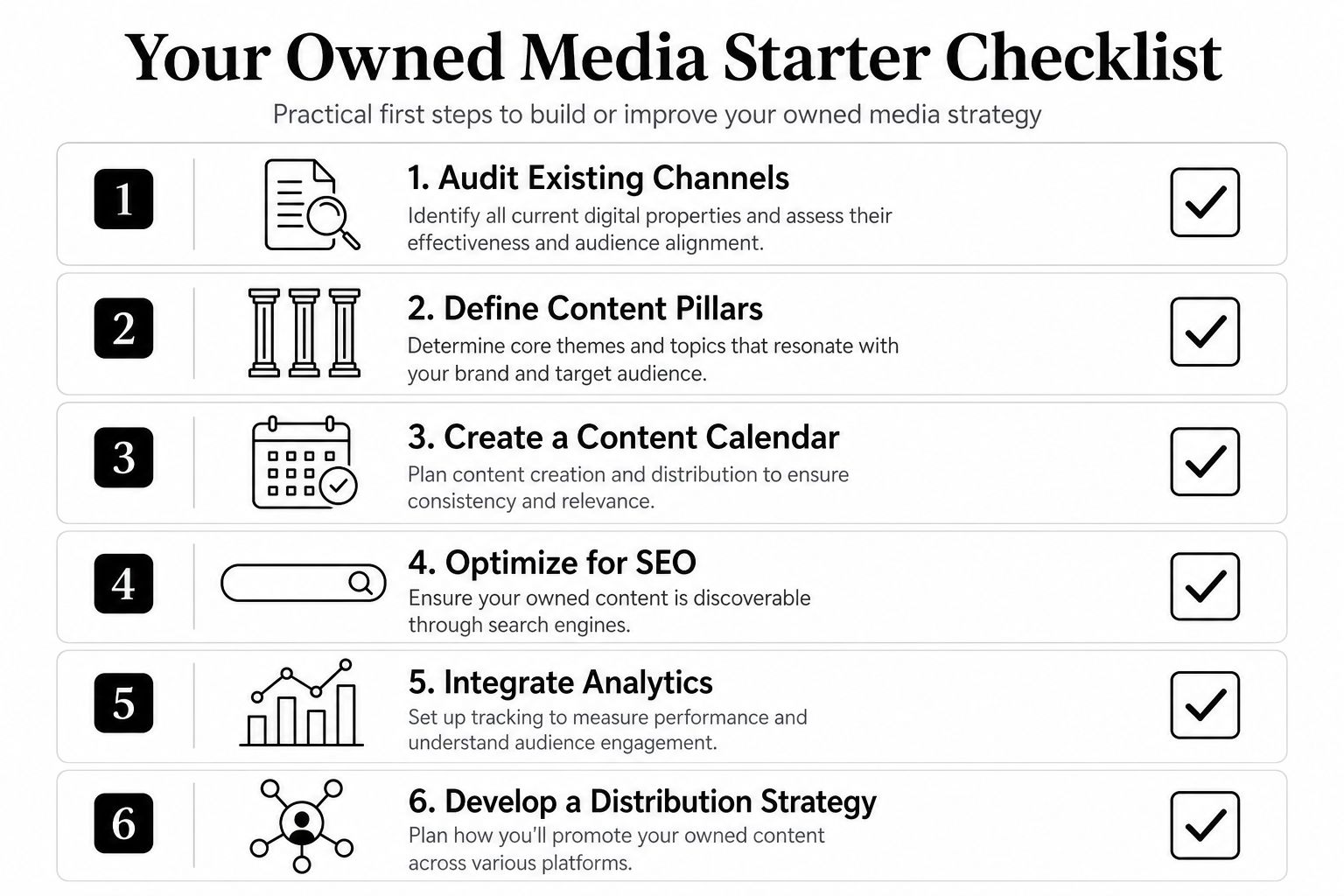
- Audit existing assets: List the website pages, newsroom content, email lists, social profiles, and downloadable materials already in play.
- Fix the press basics: Add or improve the media contact page, executive bios, logo files, and company boilerplate.
- Choose core content pillars: Align announcement topics with recurring themes the organization wants to be known for.
- Build a lightweight calendar: Plan release support content before launch day instead of improvising after distribution.
- Connect analytics: Make sure referral traffic and engagement around release pages can be reviewed after each campaign.
- Repurpose every announcement: Turn one release into a blog post, email, social sequence, and FAQ when the story justifies it.
Done consistently, that checklist gives PR teams something more durable than a one-day spike. It gives them a communication asset base they control.
Press teams that want practical templates, distribution guidance, and step-by-step help can explore Press Release Zen. It's a useful resource for turning announcements into cleaner, more measurable campaigns without overcomplicating the process.