A lot of people searching for how to get PR packages are stuck in one of two places.
One group is made up of creators staring at a polished Instagram profile, wondering why brands still haven't reached out. The other group is made up of founders and marketers looking at shelves of product and asking a harder question: if free product goes out, what comes back besides shipping costs?
Both questions point to the same confusion. A PR package isn't one thing. Sometimes it means a creator seeding box built for social sharing. Sometimes it means a press kit built for journalists who need usable facts, assets, and a news angle. Treating those as identical is where campaigns start to slip.
Table of Contents
- What Does 'PR Package' Really Mean
- Two Worlds of Packages Influencer Boxes vs Media Kits
- For Creators How to Land Your First PR Package
- For Brands Crafting a PR Package That Drives Results
- The Art of the Pitch Outreach and Follow Up That Works
- Measuring Your Impact and Building Relationships
What Does 'PR Package' Really Mean
A founder ships a beautifully packed box to a beauty creator and gets an unboxing on TikTok. The same week, that founder emails a launch kit to an editor who needs product facts, pricing, images, and a clear reason to cover it. Both sends may be called PR packages, but they do different jobs.
In practice, "PR package" covers two distinct formats.
One is the creator-facing version. A brand sends products, brand materials, and often a note to influencers, bloggers, or niche creators with the goal of sparking organic posts, reviews, or social mentions. The package is physical, but the result the brand wants is content.
The other is the editorial version. A brand sends a media kit or press kit to a journalist, editor, producer, or outlet. That package can be digital, physical, or mixed. Its purpose is to speed up coverage by giving the recipient accurate details, usable assets, and a news angle they can assess quickly.
That distinction shapes everything, including how creators try to get PR packages and how brands decide what to send.
A creator usually evaluates fit first. Will this product make sense for my audience? Can I turn it into content without forcing it? A journalist evaluates utility first. Is there enough here to report on the launch, trend, or company without chasing basic facts?
A pretty box can get attention. Relevance and clarity get results.
This confusion causes avoidable misses on both sides. Creators sometimes focus only on follower count when brands are screening for audience match, posting style, and consistency. Brands sometimes spend heavily on presentation and still fail because the recipient lacks the information needed to post or publish.
For a clearer explanation of how press kits and media kits differ in PR use, this guide on press kit vs. media kit differences and best practices is a useful reference.
A skincare brand offers a simple example. If the send is going to beauty creators, the brand should care about visual appeal, product experience, shade or skin-type relevance, and whether the creator can show the item naturally on camera. If the send is going to editors, the same brand needs concise copy, ingredients, pricing, launch timing, high-resolution images, and a credible reason the release matters now.
If the package type and recipient type do not match, the send usually stalls. The box may be attractive. The story may even be good. But the recipient still cannot use it in the way the brand intended.
Two Worlds of Packages Influencer Boxes vs Media Kits
The same phrase covers two very different jobs
An influencer box is built to be opened, filmed, and talked about. A media kit is built to be scanned, verified, and turned into coverage. Both sit under the same PR umbrella, but the working logic is different.
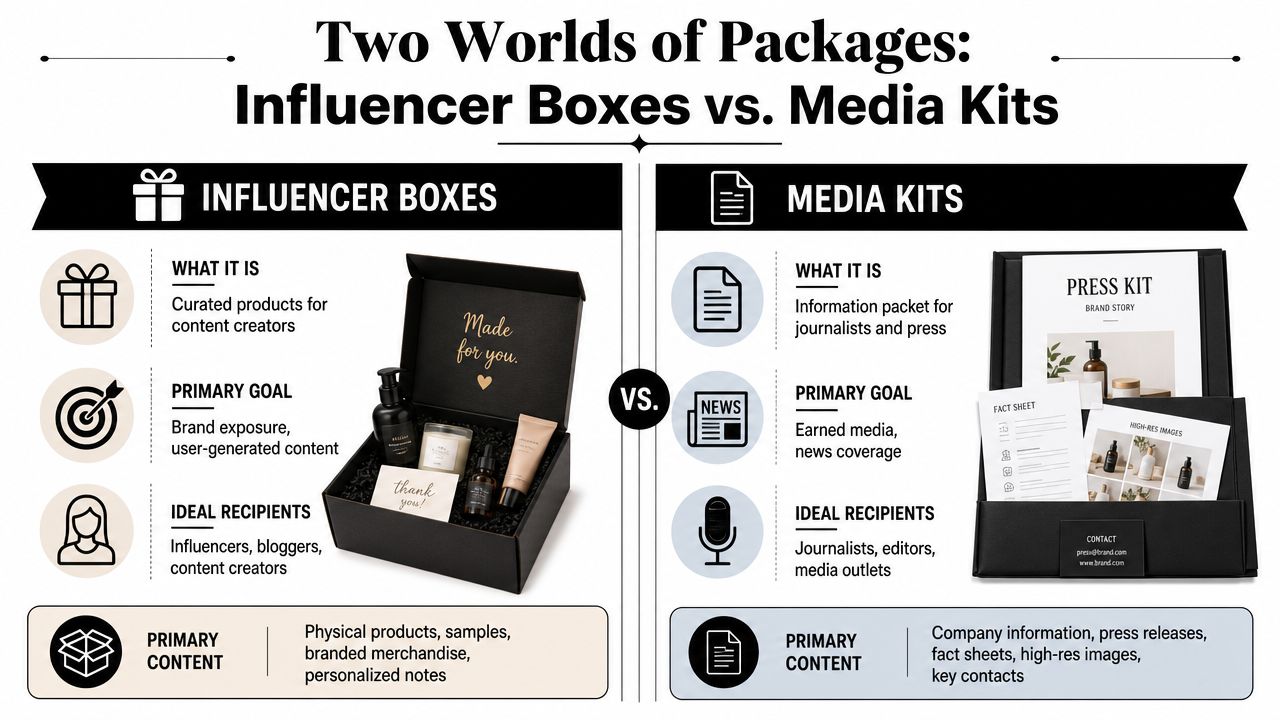
Influencer boxes usually lean on product experience. They need visual interest, brand personality, and some level of personalization. A handwritten note, curated item selection, or theme tied to the creator's niche can make the difference between “thanks” and a real post.
Media kits lean on utility. Journalists don't need filler. They need material they can work with quickly. If a founder sends a gorgeous package with no product specs, no contact details, and no clean explanation of what's new, the box becomes work instead of help.
For teams sorting out naming, format, and use cases, this breakdown of press kit vs media kit differences and best practices is useful because it separates promotional gifting from newsroom-ready materials.
Influencer Box vs. Media Kit At a Glance
| Attribute | Influencer Box (Gifting) | Media Kit (Press Kit) |
|---|---|---|
| Primary purpose | Organic sharing and brand visibility | Earned media and news coverage |
| Main recipient | Influencers, bloggers, content creators | Journalists, editors, media outlets |
| Core contents | Product, branded inserts, personal note | Press release, fact sheet, images, brand story, contact info |
| Success signal | Social posts, stories, UGC, brand mentions | Article, roundup mention, editorial follow-up |
| Tone | Personal, visual, lifestyle-driven | Informational, concise, news-oriented |
| Packaging priority | Memorable unboxing experience | Fast access to accurate information |
| Common failure | Generic gifting with no audience fit | Attractive package with no usable assets |
A founder launching a candle line might send an influencer box with the candle, matchbox, scent card, and a personal note to home decor creators. That same founder should send editors a tighter package with launch details, scent descriptions, pricing sheet if appropriate for the outlet request, high-resolution images, and a one-page fact sheet.
The box can look polished in both cases. The reason it exists changes everything.
For Creators How to Land Your First PR Package
A small creator posts three strong skincare reviews in a month. A brand notices, likes two posts, then does nothing. Another creator with a similar audience gets the package instead. The difference is usually not follower count. It is clarity. The brand can tell what the second creator makes, who the audience is, and how to contact them without digging.
That matters because creators and brands are solving different problems at this stage. Creators want access to products and relationships. Brands want low-friction decisions. If a team has to guess whether an account fits the product, the creator usually gets skipped.
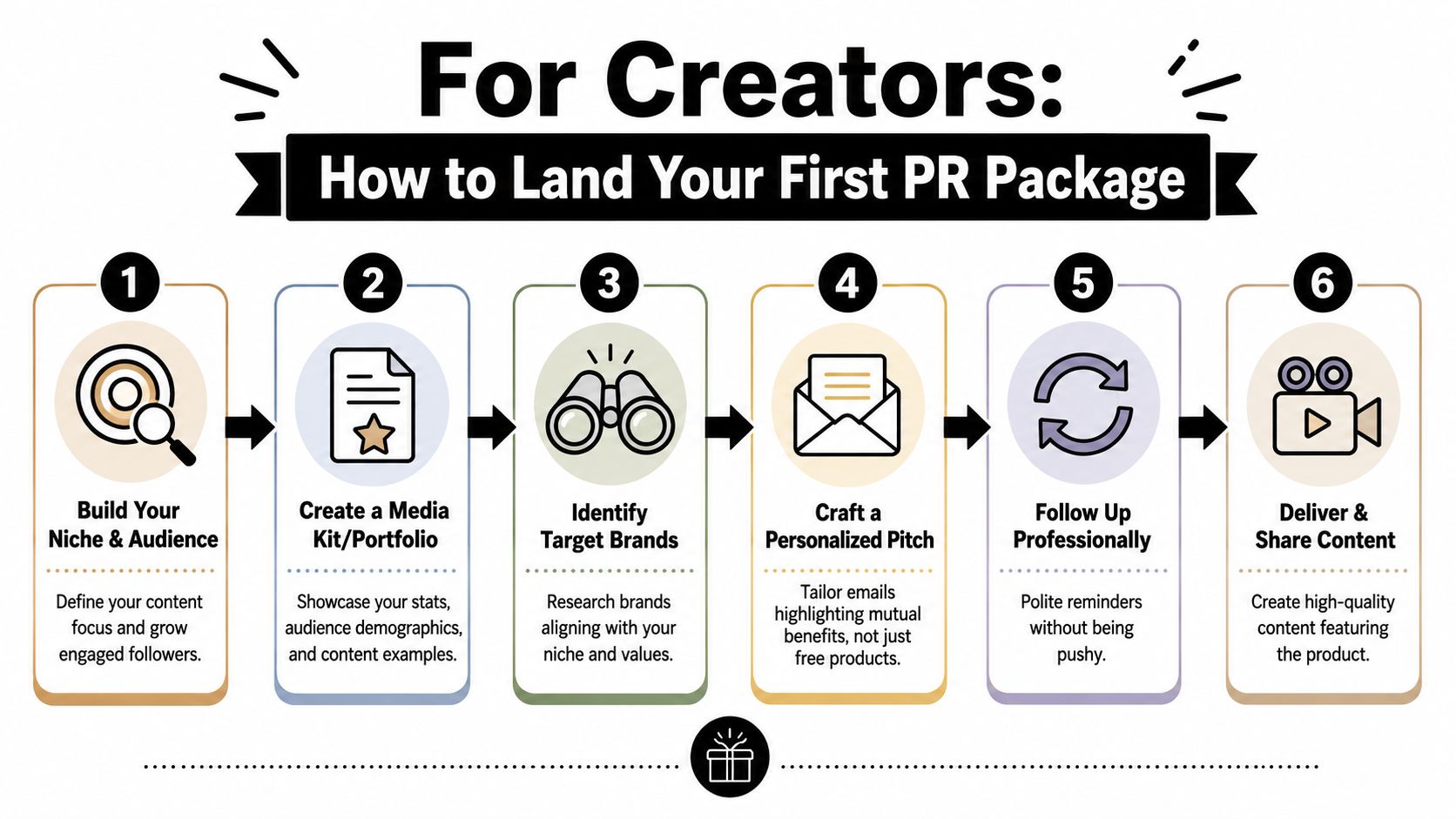
Build a profile brands can evaluate fast
A creator profile should answer three questions in seconds:
- What niche does this creator cover?
- What audience is paying attention?
- Which products would look natural here?
Brands rarely add someone to a seeding list because the bio sounds ambitious. They add creators whose recent content already looks like the kind of content they hope the product will appear in.
A beauty creator with consistent routine videos, clear skin concerns, product close-ups, and visible contact information is easier to assess than an account mixing beauty, travel, comedy, and meal prep with no clear pattern. Variety can work, but it slows down gifting decisions because the fit is harder to defend internally.
A useful profile setup usually includes:
- A clear niche signal in the bio, pinned posts, and recent content
- A visible business contact through email, a contact button, or a site
- A few strong examples of product-focused posts that already look brand-safe
- A simple creator kit with audience snapshot, content formats, and any prior gifted or paid work
For context on what brands look for in seeding campaigns, this overview of PR packages for influencers is a helpful reference.
Find the right contact before pitching
Good outreach starts with contact research, not message writing.
For a small brand, the founder, social lead, or marketing manager may handle gifting. For a larger company, influencer marketing, PR, affiliate, and social can sit on different teams. Sending a creator pitch to a press inbox often goes nowhere because that inbox is built for editors, not seeding requests.
Start with places that signal creator partnerships: the website footer, contact page, ambassador page, creator application page, LinkedIn team listings, or the Instagram email button. If the brand has a newsroom but no creator page, that still gives useful clues about whether PR and influencer work are separate functions.
One practical rule helps here. Do not ask to “be on your PR list” with no context. Ask to be considered for a specific launch, product line, or seasonal send that fits the content already on the account.
That reads like a business request, not a request for free product.
Use a short pitch that makes the decision easy
A first pitch should be brief, specific, and easy to forward to the person who approves gifting. Long intros, personal life stories, and generic praise usually hurt response rates because they bury the only point that matters. Why this creator for this product right now?
A workable pitch includes four parts:
- Reason for outreach: mention the product, category, or launch
- Audience fit: explain who watches and why the product fits that audience
- Proof: link one or two relevant posts, not a homepage full of mixed content
- Clear ask: ask whether the brand is currently building a gifting or seeding list
Example:
Hello [Brand Team],
I create short-form content focused on [niche], with recent posts centered on [specific topic or use case]. [Product line] looks like a strong fit for that audience because they respond well to [format or problem/solution angle].Here are two relevant examples: [link] and [link].
If your team is building a creator gifting list for [specific launch or category], I'd be glad to be considered. I can share shipping details if helpful.
Thank you,
[Name]
That format works because it respects how brand teams review requests. They need enough detail to judge fit, but not a wall of text.
Show demand before you ask for product
Brands are more willing to send product when they can already see organic interest. That does not mean tagging a company in every post for two months. It means creating content that proves you can talk about the category with some authority.
If the goal is skincare PR, post skincare content first. If the goal is home decor gifting, show styling content first. A creator asking for coffee gear with no coffee content is asking the brand to imagine an outcome that has not been demonstrated.
Smaller creators often have an advantage. A focused account with 3,000 engaged followers in a narrow niche can be more useful than a broad account with a larger but less predictable audience. Brands sending influencer boxes care about relevance, content quality, and the odds that the product will appear in a believable context.
Keep basic records once packages start arriving
The first package is exciting. The second and fifth create admin work.
Track what arrived, when it arrived, whether posting was requested, and what content was delivered, if any. A simple spreadsheet is enough. Add the item name, brand, date received, estimated retail value, campaign notes, and whether usage rights or deadlines were discussed.
That record helps with taxes, but it also helps with repeat business. Creators who know what they received and what they produced come across as reliable. Brands remember that.
A PR package is rarely the finish line. It is usually the first low-risk test. Creators who make that test easy to say yes to, and easy to review afterward, get considered again.
For Brands Crafting a PR Package That Drives Results
A founder approves 150 mailers because the packaging looks strong on a mood board. Three weeks later, half went to people with no category fit, two journalists asked for basic specs that should have been included, and the team still cannot say whether the send drove coverage, content, or sales interest.
That is the true failure point. Packaging rarely ruins a PR package. Weak planning does.
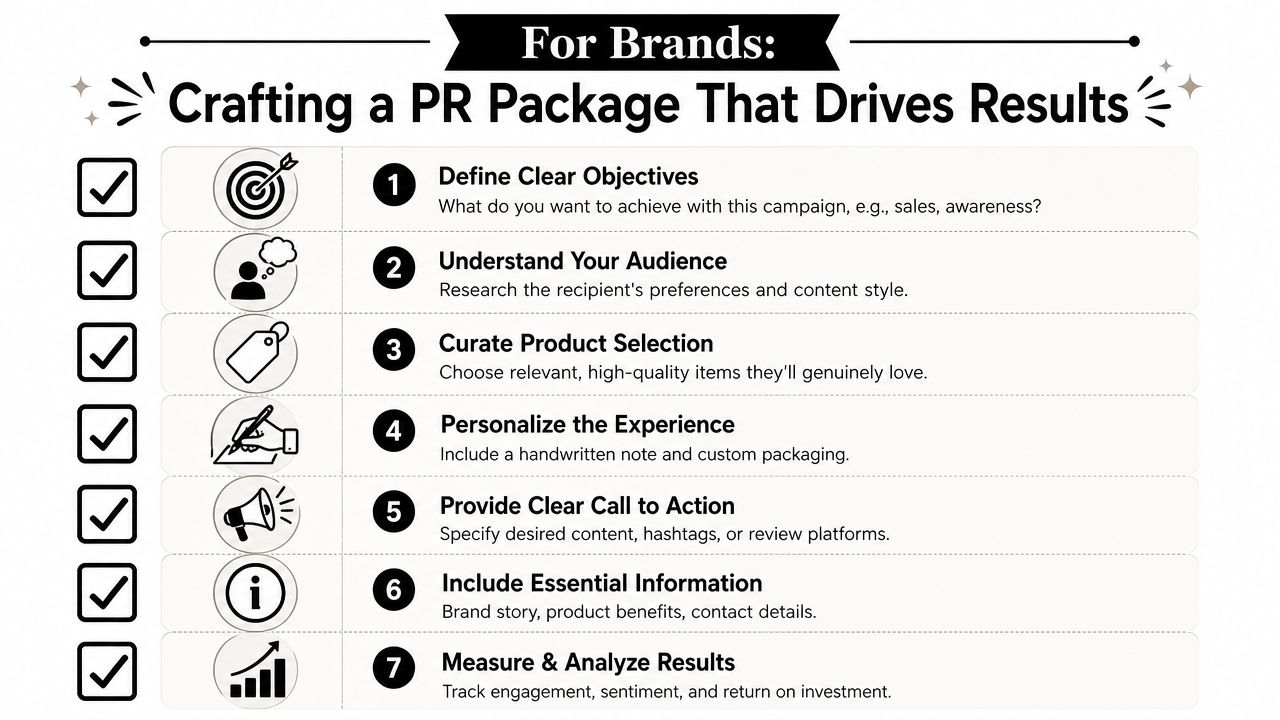
Start with the outcome, then build the package
Brands send PR packages for different reasons, and the right box changes with the goal. A creator seeding campaign needs content potential and audience fit. A media kit for editors needs speed, clarity, and usable assets. Mixing those two jobs into one box usually weakens both.
Set the objective before choosing recipients or packaging. Common goals include:
- creator-generated content for social
- launch awareness in a specific niche
- product testing and informal feedback
- editorial coverage tied to a news angle
- relationship building with a short list of high-fit creators or reporters
That decision shapes the list, the message, the contents, and the follow-up. It also keeps teams from judging a media send by influencer metrics, or judging creator gifting by whether a journalist wrote a feature.
A simple planning pass should answer four questions:
- Why this recipient? Name the audience, beat, or content style that makes the fit real.
- What action do you want? Post, review, consider for coverage, request samples, or keep the brand on file for future stories.
- What would count as success? Define the outputs the team can track.
- Who owns execution? One person should control list quality, shipping, asset delivery, and responses.
I have seen modest sends outperform expensive boxes because the brand picked recipients who already talk to the right customer. Relevance beats ornament.
Build differently for creators and for media
This is where many teams waste budget. An influencer box and a traditional media kit are both PR packages, but they are not interchangeable.
For creators, the package should make it easy to try the product, understand the angle, and turn it into believable content. That usually means the hero product, short usage guidance, a note that shows real familiarity with the creator's niche, and light campaign context if there is a launch story or visual direction to reference.
For journalists and editors, cut the fluff. They need the facts fast. Include the news hook, product details, pricing, availability, high-resolution images, brand boilerplate, and a direct contact who can answer questions on deadline. If a reporter has to email twice just to get specs or image files, the package created work instead of helping coverage happen.
The physical box is only part of the send. The support materials often do more of the job.
| Recipient | What to include | Why it matters |
|---|---|---|
| Creator | Product, concise talking points, usage details, campaign context, contact info | Helps them test accurately and decide whether the item fits their content |
| Journalist or editor | Press release, fact sheet, pricing, launch date, image link, spokesperson contact | Gives them enough verified material to assess the story quickly |
If your team needs help tightening the written materials that support outreach, review these pitch email subject line examples and strategy tips. The same discipline applies to package inserts and follow-up emails. Clear beats clever.
Packaging should support the story, not become the story
Presentation still matters. It just matters in proportion.
A premium product can justify a more designed unboxing experience, especially if visual sharing is part of the plan. But expensive packaging does not fix poor fit, vague messaging, or weak product relevance. In some categories, overbuilt boxes can even backfire. Beauty creators may appreciate a photogenic reveal. Sustainability-focused creators may call out waste. Business reporters usually do not care about ribbon at all.
Use packaging that matches the product, audience, and expected payoff. Spend more where presentation increases the chance of useful coverage or content. Spend less where information quality matters more than theatrics.
Execution decides whether the send lands cleanly
Operational mistakes kill more campaigns than creative mistakes.
Confirm shipping addresses right before dispatch. Check for allergies, shade matching, sizing, or ingredient concerns where relevant. Plan for fragile items, temperature-sensitive formulas, and international customs issues before anything leaves the warehouse. Share tracking internally. Keep a live list of what was sent, when it arrived, and whether any assets or follow-up notes still need to go out.
Then make the recipient experience easy. Put the contact name in one obvious place. Host images and press materials in a clean folder. Do not bury basic details in a long founder letter.
The best PR package removes friction from the next step.
For creators, that next step is testing and making content if the fit is right. For media, it is deciding quickly whether there is a story worth covering. Brands that understand the difference send fewer wasted boxes and get better results from the ones that go out.
The Art of the Pitch Outreach and Follow Up That Works
Outreach is where most PR package plans become real or disappear.

Why precision beats volume
According to a 2026 public relations statistics roundup, the average journalist response rate to PR pitches was 3.43%, and only about 8% of pitches resulted in media coverage. That works out to roughly 1 in 29 pitches getting a response and about 1 in 12.5 leading to publication. The same source notes that embedding relevant URLs in press releases can increase website traffic by up to 77% when the release is picked up.
Those numbers are useful because they reset expectations. Low response rates don't automatically mean the pitch was bad. They do mean broad, generic outreach is usually a poor bet.
A better method is fewer contacts, tighter relevance, and a lower-friction ask. Subject lines matter too. This resource on pitch email subject line strategy is worth reviewing before sending anything externally.
Two outreach templates that travel well
For creators pitching brands:
Subject: Creator fit for [Brand/Product]
Hello [Name],
[Creator Name] creates [niche] content for an audience interested in [topic]. Recent posts have covered [relevant angle], and [Brand/Product] fits that audience naturally.Two relevant examples are here: [link] and [link].
If your team is currently adding creators to a seeding or gifting list, [Creator Name] would be glad to be considered for [specific product or launch]. Shipping details can be shared if helpful.
Thank you,
[Name]
For brands pitching creators or journalists:
Subject: PR send for [launch/product] tailored to [recipient's niche]
Hello [Name],
[Brand] is sending a curated package for [specific launch or angle] and thought it could fit your coverage or content around [topic].The package includes [brief summary of contents]. Supporting assets are available, including images and product details, if useful.
If there's interest, [Brand] can confirm shipping details and timing.
Best,
[Name]
Both work because they get to the point. No long origin story. No fake familiarity. No vague “collab?” opening.
Follow up without becoming noise
The first follow-up should add value, not pressure. A creator might send a short note with a new relevant content example. A brand might resend key assets or confirm delivery timing.
A useful follow-up tends to include one of these:
- A clearer angle that ties the ask to the recipient's audience or beat.
- A missing asset such as images, specs, or shipping confirmation.
- A timing note if the outreach connects to a launch window.
Silence doesn't always mean rejection. It often means the first message didn't beat the inbox.
Repeated nudges with no new information usually hurt more than they help.
Measuring Your Impact and Building Relationships
A PR package is an opening move. The useful work starts after the delivery.
For brands, measurement should match campaign type. Creator seeding can be reviewed through mentions, repostable content, referral traffic, tagged posts, and whether the recipient produced the kind of content the campaign was designed to earn. Media outreach should be judged by pickups, follow-up requests, and whether the package reduced newsroom friction rather than created it.
For creators, the better question isn't just “Did the brand send something?” It's “Did this interaction make the brand more likely to come back?” That usually depends on responsiveness, content quality, and professionalism after receipt. A short thank-you, clean disclosure where needed, and a note sharing the published content can turn a one-off send into an ongoing relationship.
Brands should also pay attention to what happens after the first post. If social content lands but comments are flat, the issue may not be the box. It may be the format, caption framing, or weak audience interaction. Teams trying to sharpen post-send performance can borrow proven tactics to improve X engagement and apply the same thinking to creator reposts, community replies, and campaign conversation design.
Long-term value usually comes from fit, not novelty. The recipients who understand the product and speak to the right audience become the list worth keeping.
Press Release Zen helps teams plan, write, and distribute press releases with practical templates, comparisons, and guidance for real PR workflows. For brands building media kits alongside creator seeding, Press Release Zen is a useful resource for press release structure, outreach strategy, and press materials that are easier for journalists to use.