A lot of teams realize they need a disaster recovery statement at the worst possible moment. Systems are down. Staff are asking what to tell customers. Leadership wants an external message in minutes. Legal wants careful wording. IT wants more time. The gap between those needs is where trust gets damaged.
That's why the statement matters so much. The technical recovery plan tells people how to restore operations. The disaster recovery statement tells employees, customers, partners, regulators, and the public what's happening, what's being done, and what they should expect next. One restores systems. The other restores confidence.
Table of Contents
- What Is a Disaster Recovery Statement and Why It Matters
- Phase 1 The Planning Framework
- Phase 2 Drafting the Communications
- Real-World Examples and Templates
- Phase 3 Approval and Activation Protocols
- Conclusion Evolving Your Statement
What Is a Disaster Recovery Statement and Why It Matters
A disaster recovery statement is a communications document, not a technical runbook. It translates recovery activity into a message that real audiences can understand and act on. When that distinction is missed, companies publish vague updates that satisfy no one. Employees don't know what to say. Customers don't know whether to wait, switch vendors, or escalate. Reporters fill the silence with outside interpretation.
That silence is more dangerous than many teams assume. According to disaster recovery statistics collected by phoenixNAP, only 54% of organizations have a company-wide disaster recovery plan. The same source notes that for businesses hit by a major outage without a plan, some estimates suggest 80% fail within 18 months. Those numbers don't just support technical planning. They justify having a written statement process before the next outage starts.
The statement is the bridge between operations and trust
A disaster recovery plan answers operational questions such as failover steps, data restoration, escalation routes, and system dependencies. A disaster recovery statement answers public and internal questions such as:
- What happened: A direct acknowledgment without speculation.
- What's affected: Services, teams, locations, or transactions.
- What the organization is doing: Containment, restoration, manual workarounds, customer support.
- What happens next: Update cadence, support channels, and expected next notice.
Practical rule: If a message can't be understood by an employee in a busy hour or a customer reading it on a phone, it isn't a usable disaster recovery statement.
What works and what fails
What works is boringly clear. Short sentences. Confirmed facts only. A named owner for updates. A visible next-update time, even if the update only says the work is continuing.
What fails is familiar. Technical jargon pasted from an internal incident room. Empty reassurance. Promises that legal or IT can't support. Timelines based on optimism instead of verified recovery targets.
For teams that need a simpler primer before drafting their own statement, this overview of disaster recovery for Canadian SMBs gives useful grounding on the operational side. It's a helpful complement because the strongest statements are built on real recovery assumptions, not communications guesswork.
Phase 1 The Planning Framework
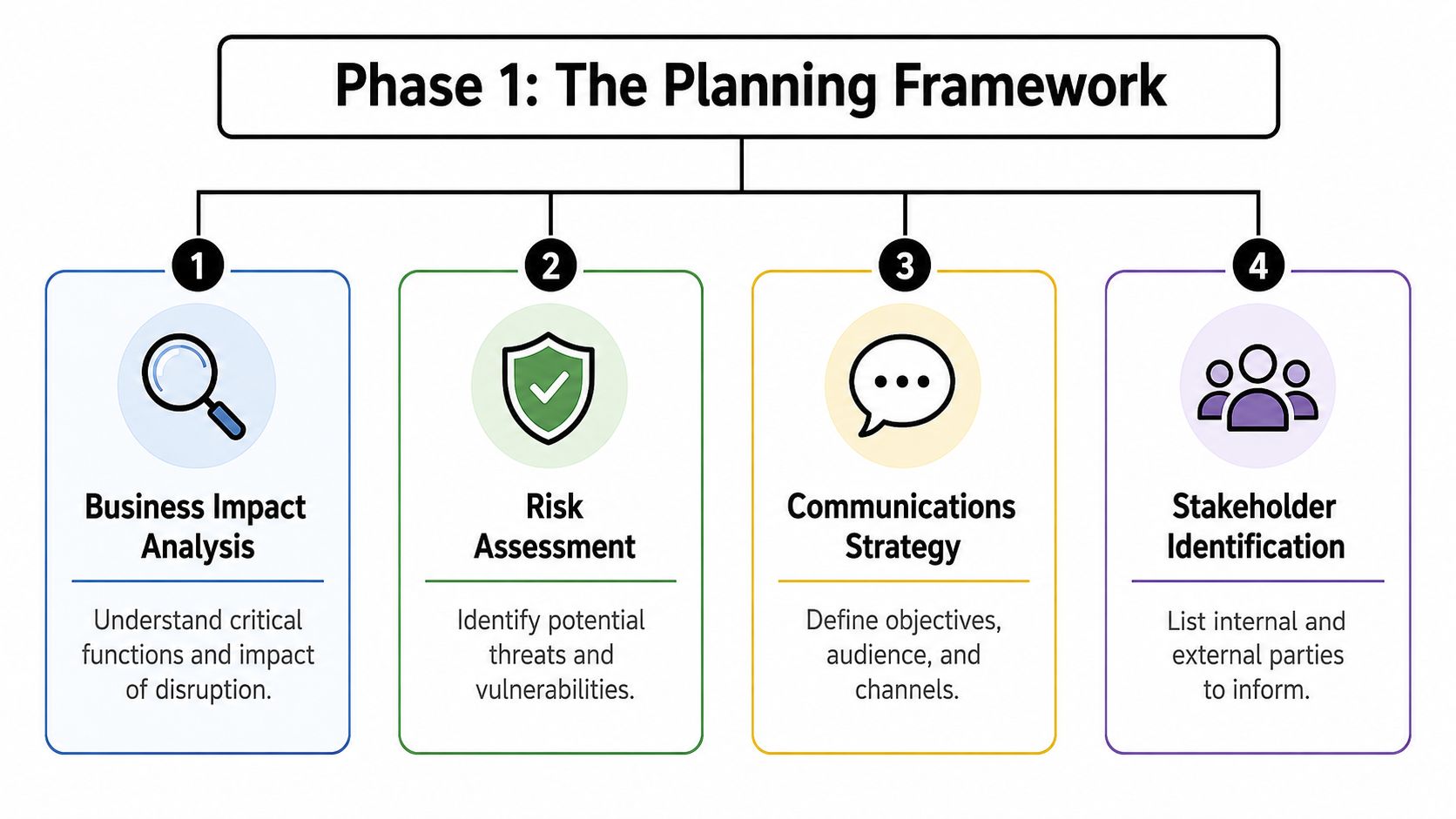
Writing starts after the hard thinking, not before. A strong disaster recovery statement comes from a planning framework that connects business risk, technical recovery, and stakeholder communications. If those three pieces aren't aligned, the statement will either overpromise or say almost nothing.
Start with business impact, not wording
The first job is a Business Impact Analysis, often shortened to BIA. In practice, that means identifying which services matter most, what breaks when they stop, who depends on them, and what the business can tolerate for a limited period. The communications team needs that same map because message priority should follow business priority.
A customer payment portal going down requires one level of communication. An internal file share issue might require another. A warehouse management interruption has a different audience from a public website outage. If every incident gets the same message template, the statement becomes generic and unhelpful.
The next input is the Risk Assessment. In this stage, teams identify likely disruption types and likely points of confusion. Cyber incidents create uncertainty about data exposure. Facility incidents create uncertainty about safety and continuity. Vendor outages create uncertainty about accountability. The statement has to be shaped around the type of uncertainty people are already feeling.
Define recovery metrics in plain language
Technical teams use RTO, RPO, and MTTR because those metrics force precision. CompTIA defines RTO as how long a business process may be unavailable and RPO as the maximum acceptable data loss measured in time. The same source says the average cost of downtime is $14,056 per minute, or more than $840,000 per hour, which is why restoration order and backup cadence can't stay vague in a statement (CompTIA on disaster recovery measurements).
For communications purposes, these metrics should be translated like this:
| Technical term | What it means internally | What it means in the statement |
|---|---|---|
| RTO | Maximum tolerable outage time | When the organization can responsibly discuss service restoration windows |
| RPO | Maximum tolerable data loss window | Whether users may need to re-enter transactions or verify records |
| MTTR | Average time needed to recover | How cautious the organization should be about making time commitments |
A statement should never dump these acronyms onto customers. It should convert them into plain commitments. Which services come back first. Whether recent data may be incomplete. When users should expect the next verified update.
The best public language usually comes from one disciplined question: what can this organization confirm right now without needing to retract it later?
Separate continuity from recovery
A common planning mistake is mixing business continuity with disaster recovery. They overlap, but they aren't interchangeable. Continuity is about keeping the business functioning through workarounds, alternate processes, and service substitutions. Recovery is about restoring disrupted systems and operations to a defined state.
That distinction matters because the statement's scope changes depending on the event:
- Continuity language covers temporary alternatives, manual processing, customer service adjustments, and staffing instructions.
- Recovery language covers restoration sequencing, affected systems, and return-to-service updates.
- Compliance-sensitive language covers notifications, recordkeeping, and approval review.
- Public-facing language should focus on confirmed impact, current actions, and where updates will be posted.
Teams building this framework can also strengthen the communications side by reviewing these crisis communication best practices, especially around consistency, channel control, and update cadence.
Phase 2 Drafting the Communications
Once the framework exists, drafting becomes much easier. The problem isn't usually writing. The problem is trying to write before deciding what the statement must accomplish. A disaster recovery statement has one job: give each audience enough truth, direction, and reassurance to reduce confusion while recovery is underway.
Build the statement in a fixed order
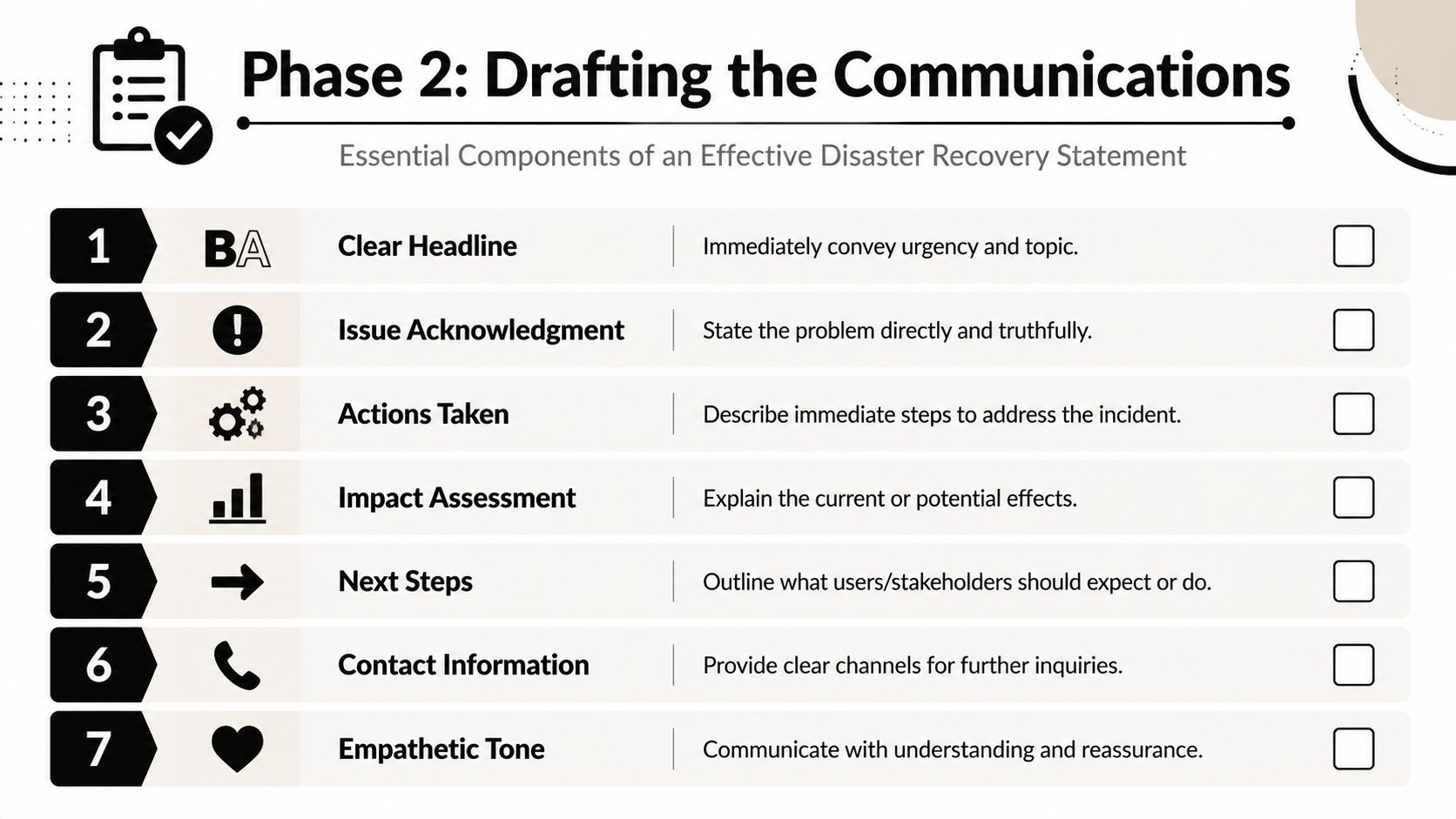
A reliable statement follows a fixed sequence. That consistency speeds approvals and lowers the chance of leaving out critical information.
Headline
State the issue directly. Examples include service disruption, system outage, facility incident, or third-party platform disruption. Don't use clever language.Acknowledgment
Confirm that the organization is aware of the incident and responding. If the event is still being assessed, say that plainly.Current impact
Describe which services, locations, transactions, or user groups are affected. Avoid guessing at full scope if the investigation is still active.Actions underway
Say what response teams are doing. Containment, restoration, vendor coordination, manual processing, customer support expansion, or alternate workflows.Audience instruction
Tell people what they should do right now. Wait, use a backup process, contact support, avoid duplicate submissions, follow a temporary procedure.Update commitment
Provide the next update point or the official place where updates will appear.
According to Fusion Risk Management on building an effective IT disaster recovery plan, an effective recovery structure must answer four critical questions: what needs recovery, the order of restoration, role ownership, and required speed. The same source notes that only 2% of organizations recovered from their latest incident in under an hour. For communications teams, that's a useful reality check. Most incidents won't resolve before the first statement goes out, so the message must be built for sustained updates, not instant closure.
Use language that is calm, specific, and limited
The tone should be confident without being sweeping. Stakeholders don't expect perfection during disruption. They do expect control, honesty, and disciplined follow-through.
Good drafting usually follows these rules:
- Lead with confirmed facts: If the team knows a service is unavailable, say that. If the cause is under investigation, say that.
- Avoid legal exposure through speculation: Don't assign blame, define root cause, or imply data impact before verification.
- Protect credibility: Never write “fully resolved” if monitoring is still underway.
- Keep empathy practical: Acknowledge inconvenience, but don't bury the operational facts in emotional language.
A lot of teams improve this stage by studying examples of developing crisis communication plans that account for both internal and external audiences. The key lesson is that employees need operational direction, while customers need service clarity and confidence that the organization is in control.
A practical drafting model
The simplest working model is this:
Situation
We are currently responding to a disruption affecting [service, location, or process].
Impact
At this time, [systems/users/transactions] may experience [specific consequence].
Response
Our technical and operational teams are [actions underway].
Instruction
Until further notice, [audience action].
Updates
The next update will be provided through [channel] at or before [time/event trigger].
That model can become a press statement, status page notice, customer email, employee alert, or executive holding statement with only minor adjustments.
For teams that need a sharper public-facing version, this guide to writing a crisis communication press release helps convert internal incident language into something fit for media, customers, and broader stakeholders.
Real-World Examples and Templates
Templates are useful only when they reflect the actual shape of the incident. A ransomware event, a server room flood, and a cloud vendor outage don't produce the same audience questions. The wording has to change with the source of disruption, the level of control the organization has, and the decisions stakeholders need to make next.
Cyber incident template
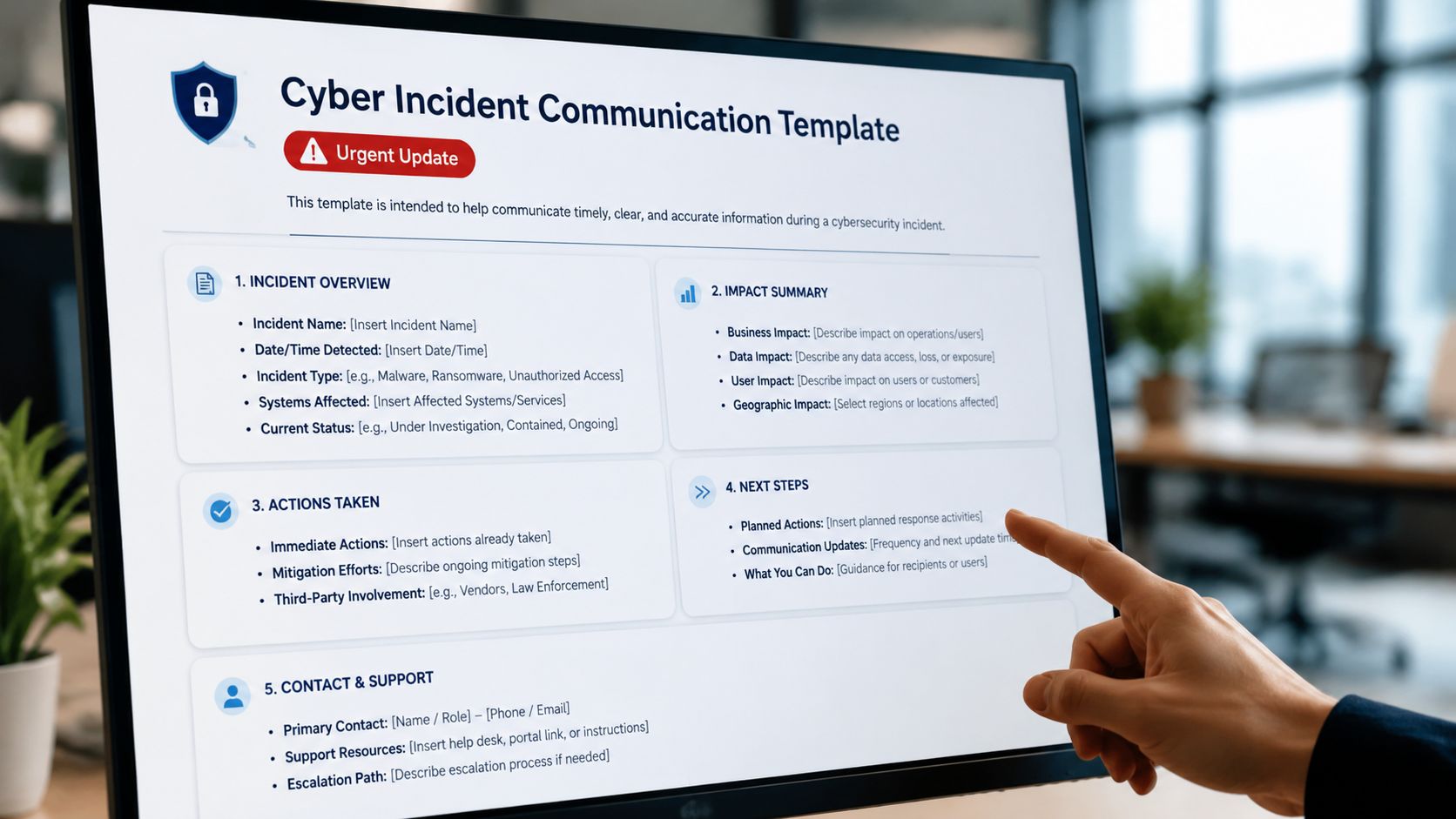
A cyber incident statement should be restrained. The biggest mistake is saying too much too early.
Internal employee version
Subject: Incident update affecting internal systems
We are responding to a cybersecurity incident affecting parts of our environment. The response team has activated containment and recovery procedures, and access to some systems may remain limited while that work continues.Employees should use only approved communication channels and should not speculate about cause, scope, or customer impact. If customers contact your team, direct them to the approved support channel and published updates. Further instructions for system access and workarounds will follow from leadership and IT.
External customer version
Subject: Service disruption notice
We are currently responding to a cybersecurity-related disruption affecting some services. Teams are working to contain the issue and restore operations safely.Customers may experience temporary service limitations while this work continues. The organization will share confirmed updates through the status page and customer support channels. If you need immediate assistance, please contact the designated support team.
Use this format when the priority is control. Don't imply data compromise unless that's confirmed. Don't promise a return time unless operations has verified it.
Physical infrastructure failure template
A fire, flood, or facility loss creates a different messaging burden. Safety and continuity sit at the center.
Internal employee version
Subject: Facility disruption and operating instructions
A physical incident has affected one of our facilities, and response procedures are underway. Employee safety remains the first priority. Team members assigned to the affected location should follow manager instructions and approved emergency notifications before reporting onsite.Business continuity measures are being activated for critical functions. Department leaders will receive role-specific instructions on temporary workflows, alternate locations, and communication procedures.
External customer version
Subject: Operational update
A facility-related disruption is affecting part of our operations. Recovery teams are assessing impact and implementing continuity measures to support critical services.Some orders, appointments, or service timelines may be affected while operations are stabilized. Customers will receive updates through our official channels, including any temporary process changes that apply to scheduled services or account support.
For incident planning around physical response and site procedures, many teams find a structured emergency response plan template useful because it helps align operational actions with what the external statement can safely say.
Third-party outage template
Vendor outages create a special problem. Customers don't care whose system failed. They care whether your organization is in control of the response.
Internal employee version
Subject: Vendor outage affecting customer services
We are managing a service disruption caused by a third-party provider issue. Internal teams are working with the vendor and activating available workarounds for critical operations.Employees should avoid assigning blame externally and should use approved language that focuses on customer impact, current workarounds, and where updates will be posted.
External customer version
Subject: Notice of service interruption
We are currently experiencing a disruption linked to a third-party service provider that supports part of our operations. Teams are coordinating recovery efforts and prioritizing critical customer-facing services.Customers may notice delays or limited functionality until the provider restores full service and validation is complete on our side. Updates will be posted through our official support and service channels.
A practical way to store these variants is to keep a scenario library by audience, not just by incident type. This sample crisis communication plan is useful as a working container for that library because it helps teams organize approvals, channels, owners, and message versions in one place.
Phase 3 Approval and Activation Protocols
A polished statement still fails if no one can approve it quickly or send it through the right channels. Many organizations subsequently lose time they thought they had. Drafts bounce between IT, legal, communications, operations, and leadership while employees improvise answers and customers refresh the status page.
Pre-approve before the incident
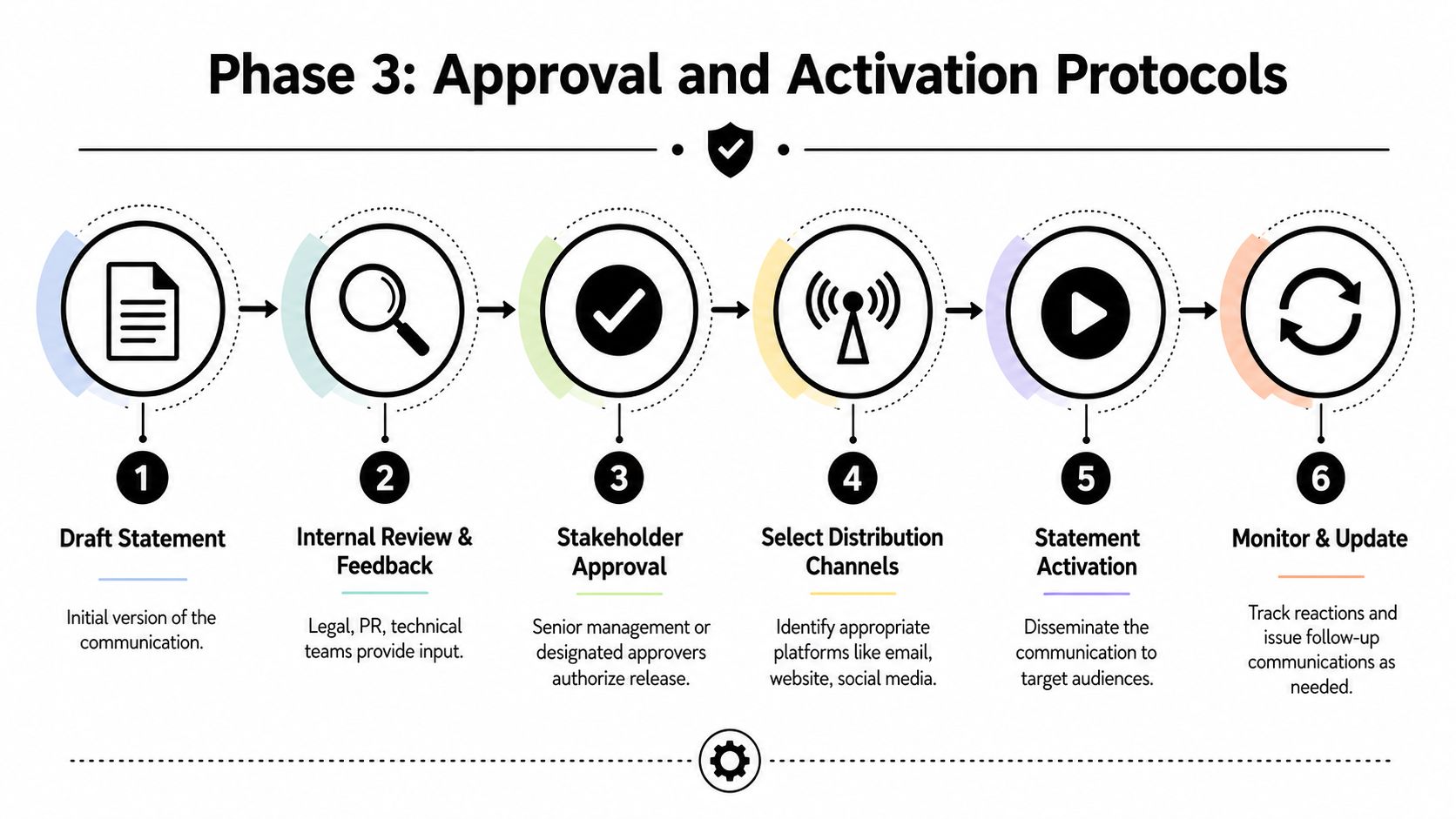
The fastest approved statement is the one that was mostly approved before the event happened. That means pre-cleared templates, named approvers, and rules about what can be sent without full executive review.
IBM notes a documented 35% failure rate in disaster recovery testing, which is a strong argument for validating approval and activation workflows in advance, not just technical recovery steps (IBM on disaster recovery strategy). Communications failure often starts as workflow failure. No trigger. No owner. No sign-off path. No channel discipline.
A practical pre-approval package should include:
- Scenario templates: Cyber, facility, vendor, and generic outage versions.
- Audience variants: Employees, customers, partners, regulators, media, and leadership.
- Approved language blocks: Acknowledgment, under-investigation wording, update commitments, and support instructions.
- Escalation thresholds: What requires legal review, executive approval, or board awareness.
“Approval speed comes from predefined boundaries, not from asking everyone to decide everything in real time.”
Set activation triggers and channel rules
Activation should begin with a trigger, not a feeling. The trigger might be service interruption, confirmed facility impact, incident command activation, major vendor dependency loss, or a threshold where customer inquiries exceed normal support handling.
Once triggered, each channel should have a role:
| Channel | Best use | Common mistake |
|---|---|---|
| Status page | Fast factual updates | Publishing language no one internally has seen |
| Employee alert | Internal instruction and alignment | Sending external details before managers are briefed |
| Customer email | Actionable service guidance | Overloading with technical explanation |
| Social media | Short awareness and redirect | Treating it as the primary source of record |
| Press statement | Broad stakeholder accountability | Issuing it before core facts are stable |
The rule is simple. One channel should serve as the source of record. Every other channel should point back to it or adapt its content carefully.
Use a lean approval map
The approval chain should be short enough to work under pressure and clear enough to avoid conflict. A typical map includes:
- IT or incident lead confirms technical facts.
- Operations lead confirms business impact and workaround status.
- Legal reviews risk-sensitive wording.
- Communications lead owns clarity, audience fit, and channel adaptation.
- Executive approver signs the release if the event meets defined thresholds.
What doesn't work is a broad committee model. Too many reviewers create wording drift. The statement becomes padded, evasive, and slow.
Operational check: If the team can't name the final approver for a midnight outage, the approval process isn't ready.
Conclusion Evolving Your Statement
The best disaster recovery statement is never finished. It's revised, tested, challenged, and updated as the organization changes. New vendors change dependency risk. New products change restoration order. New regulations change wording requirements. New executives change approval paths. If the statement stays static, it slowly becomes inaccurate.
Treat the statement as an operational asset
A statement should sit inside governance, not on a forgotten shared drive. It needs an owner, review dates, version control, and ties to incident response, continuity planning, and executive communications. That's especially important because emerging best practices point toward statements that define scope, audience, and recovery hierarchy more explicitly, since real-world failures often happen in those areas rather than in the technical recovery alone, as discussed in this disaster recovery discussion on evolving statement scope.
That shift matters. Generic language doesn't survive a real incident. A useful statement says who it is for, what it covers, what it does not cover, and how updates will be managed as facts change.
Run a communications after-action review
After any serious incident, the communications review should be as disciplined as the technical review. Ask direct questions:
- Did the first statement go out fast enough?
- Were employees aligned before customers started calling?
- Did any language create confusion or unnecessary legal risk?
- Did the approved channels work as intended?
- Did support teams receive the same guidance that the public received?
Then update the templates. Fix the contact list. Remove language that invited speculation. Tighten approvals that created delay. Clarify what can be published early and what must wait.
A mature organization treats the disaster recovery statement as part of resilience, not just part of public relations. When the next disruption arrives, that preparation shows up immediately in the quality of the first message. People can tell the difference between an organization that is managing a crisis and one that is narrating its confusion.
Press Release Zen helps teams turn messy incident details into clear, usable public communications. If a communications team needs practical guidance on drafting statements, structuring updates, and using ready-made templates for high-pressure situations, Press Release Zen is a solid place to start.