Only 6% of S&P 100 companies used the term “ESG” in annual sustainability report titles in 2025, down from 40% in 2023, according to The Conference Board's reporting on climate disclosure and sustainability terminology. That drop changes the job of a sustainability press release. The old formula of broad claims, polished language, and generic purpose statements doesn't hold up well anymore.
The stronger model is tighter and more demanding. It starts with verified outcomes, names the community impact in plain language, and admits what still isn't solved. That last part matters more than many teams expect. A release that sounds flawless often sounds untrustworthy.
Most companies don't fail because they care too little about sustainability. They fail because they communicate it like a campaign instead of a record. Journalists, stakeholders, and skeptical readers don't need another victory lap. They need evidence, boundaries, and context.
Table of Contents
- The Foundation of a Credible Sustainability Announcement
- How to Structure Your Release for Human Impact
- Mastering Data Reporting and Avoiding Greenwashing
- Optimizing for Journalists and Search Engines
- Strategic Distribution and Personalized Outreach
- Your Sustainability Press Release Checklist
The Foundation of a Credible Sustainability Announcement
A credible sustainability press release is usually won or lost before drafting starts. Open the document before the facts, boundaries, and proof points are agreed, and the release will fill up with soft claims that legal trims, journalists question, and stakeholders do not trust.
The market has already shifted away from broad umbrella terminology. As noted earlier, companies are using more specific climate, sourcing, and impact language instead of relying on catchall labels. That change matters because generic framing signals imprecision. In sustainability communications, imprecision is a risk.
Drop the label and define the issue
Start with a narrow communications brief. It should answer four questions clearly:
- What changed
- Why it matters to people outside the company
- How the result was measured
- What the company still needs to improve
The fourth question is the one many corporate drafts avoid. It is also the one that often determines whether the announcement reads as credible or promotional. If the company reduced waste in one facility but still lacks supplier data, say that. If a pilot worked in one region but is not yet scaled, say that too. Transparent limits do not weaken the story. They give it weight.
Practical rule: If a claim cannot survive a follow-up email from a skeptical reporter, it should not be in the release.
A useful prep document can fit on one page. It needs specifics, not slogans. Replace “announcing our sustainability commitment” with a statement tied to an operational change, a timeframe, a measurement method, and a named impact area such as energy use, waste, sourcing, or community outcomes.
For teams that need a starting format before shaping the final message, a corporate social responsibility press release template can help organize source material. It should support the strategy, not substitute for it.
Set goals before drafting
Clear goals prevent a common failure in sustainability PR. The company announces an aspiration, but the release never states what success looks like, what evidence supports the claim, or what remains unfinished.
Use SMART goals to force precision. Specific, measurable, achievable, relevant, and time-bound objectives make weak language harder to hide behind and give approvers a shared standard.
| Weak framing | Strong framing |
|---|---|
| We're committed to greener operations | We're reporting progress against a defined operational target |
| Our program supports communities | We're naming who benefited and how that benefit appeared locally |
| We're improving transparency | We're showing the data basis, scope, and remaining limits |
Internal alignment also matters at this stage. Legal, sustainability, operations, and communications should agree on terms, source documents, boundaries, and methodology before approval begins. If those issues are settled late, the draft usually gets diluted into language that feels safe but says very little.
The reward for doing this work early is not just lower greenwashing risk. You get a release with a clear news angle, a defensible evidence trail, and a stronger chance of earning trust because it reports both progress and friction. That is the standard serious readers now expect.
How to Structure Your Release for Human Impact
Many sustainability announcements are technically correct and still fail. They open with internal milestones, certification language, or abstract environmental framing that asks the reader to care before giving them a reason. The better approach is more human and more local.
Human-centered, localized stories drive 3x more media pickup than abstract environmental metrics because 78% of climate journalists prefer stories with human impact anchors over standalone data points, according to this analysis on sustainability news structure. That should change the order of the release, not just the tone.
Lead with people, not process
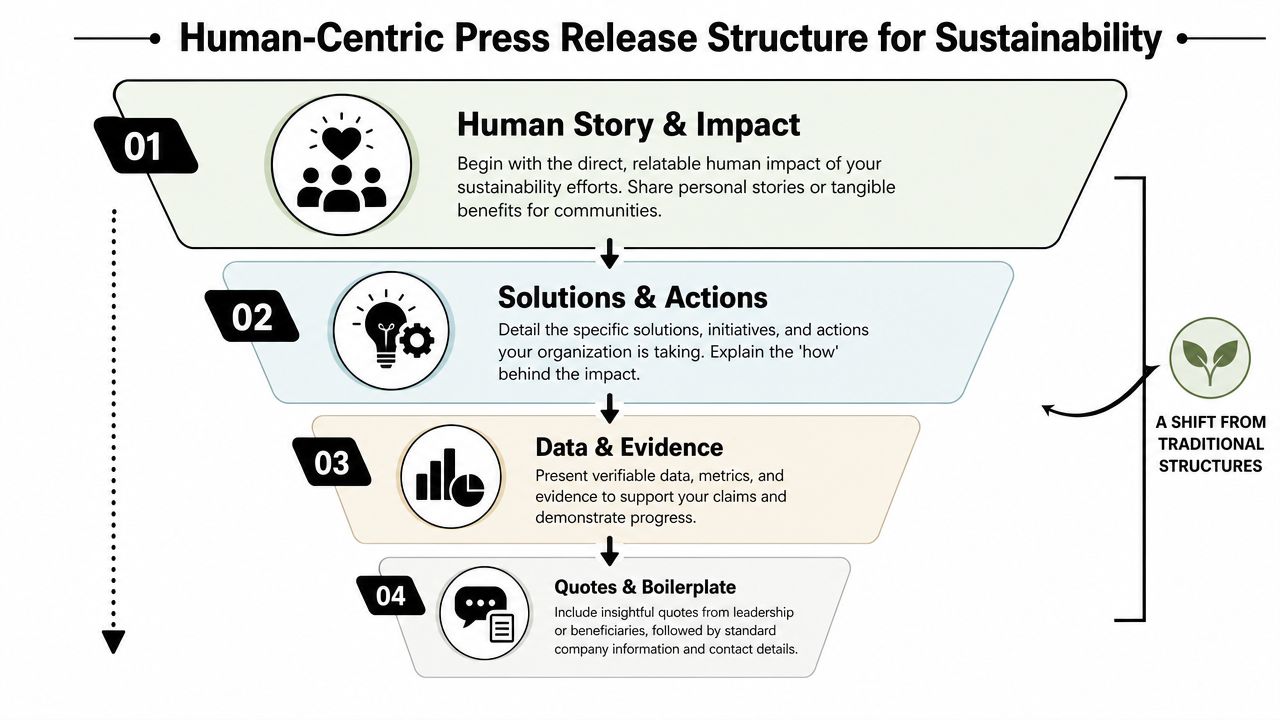
A sustainability press release doesn't need to abandon the inverted pyramid. It needs to adapt it. The top of the story should still hold the most important news, but that news should be framed through visible impact on people, places, or partners.
A practical structure looks like this:
- Headline: Lead with the outcome, not the initiative name.
- Opening paragraph: State the result and connect it to a real group affected by the change.
- Second paragraph: Explain the actions that produced the outcome.
- Later paragraphs: Add supporting data, methodology, quote, boilerplate, and contact details.
That order works because readers process consequences faster than corporate process. “Residents now have access to…” lands better than “The company today announced a strategic initiative to…”
A release becomes more newsworthy when the first paragraphs answer “who benefits?” before “what program launched?”
Build the middle with action and proof
The middle of the release should show operational seriousness. In this section, the company explains what it did. Keep this concrete. Name the initiative, identify the operating area, and state how the work connects to the broader business.
Three writing moves help here:
- Name the affected community clearly: Avoid broad phrases like “stakeholders” when the release can say workers, local suppliers, nearby residents, schools, or nonprofit partners.
- Explain the mechanism: Reporters want the bridge between intention and result. That means naming the change in sourcing, facilities, logistics, packaging, training, or investment.
- Place metrics after relevance: Data matters, but it lands harder once the reader understands why it matters.
A simple narrative example
A weak lead sounds like this in substance: the company is proud to advance its sustainability journey through a new initiative.
A stronger lead sounds like this in structure: the company reports a measurable operational result, identifies the local group affected, and states how that result connects to daily life.
Here's the contrast in shorthand:
| Less effective opening | More effective opening |
|---|---|
| Announces program and values | Reports result and names affected people |
| Uses company-first framing | Uses community-first framing |
| Delays relevance | Establishes relevance immediately |
Quotes should support the release, not repeat the lead. The best quote adds judgment, trade-off, or context. A strong executive quote might explain why the company chose a harder operational path. A partner quote might describe what changed on the ground. A generic quote about being proud and excited usually adds nothing.
A well-structured sustainability press release makes room for empathy without losing discipline. It doesn't sentimentalize the story. It directly puts human consequence where readers can see it.
Mastering Data Reporting and Avoiding Greenwashing
Consumer skepticism is the starting point, not a footnote. If a sustainability press release sounds cleaner than the underlying operation, readers, reporters, and advocacy groups will test it fast.
The common mistake is easy to spot. Teams strip out unresolved problems, soften trade-offs, and publish only the strongest results. That approach rarely protects the brand. It creates a credibility gap, especially when the release avoids the hard parts that serious journalists expect to see.
A more credible standard is simple. State the result. Define the boundary. Explain what is still incomplete.
Existing sustainability guides often miss a critical point for authenticity: proactively disclosing “what we haven't fixed yet.” With 63% of consumers doubting corporate sustainability claims, releases that transparently communicate limits and unresolved challenges are perceived as far more credible, according to guidance on sustainability press release credibility.
Why polished optimism creates risk
Greenwashing accusations usually start with loose language, missing scope, or selective evidence. A company announces a packaging improvement but does not say whether it applies to one product line or the full portfolio. It reports lower emissions but omits the baseline year. It highlights a community initiative but never explains what changed for people locally. Those gaps turn a promising announcement into a reputational liability.
Disciplined data reporting becomes critical at this point. Every sustainability claim in the release should have backup behind it, whether that proof appears in the body copy, a linked report, or materials your media contact can send within minutes. The standard is not stuffing every paragraph with numbers. The standard is being able to substantiate every factual statement.
Teams that need a practical refresher on evidence-led writing can review guidance on using data and statistics in press releases. It is especially useful when a draft makes strong claims but still lacks context, scope, or methodology.
For readers who need broader context on terminology, frameworks, and disclosure expectations, understanding ESG reporting from Global Governance Media helps clarify the reporting environment surrounding these announcements.
What honest reporting looks like
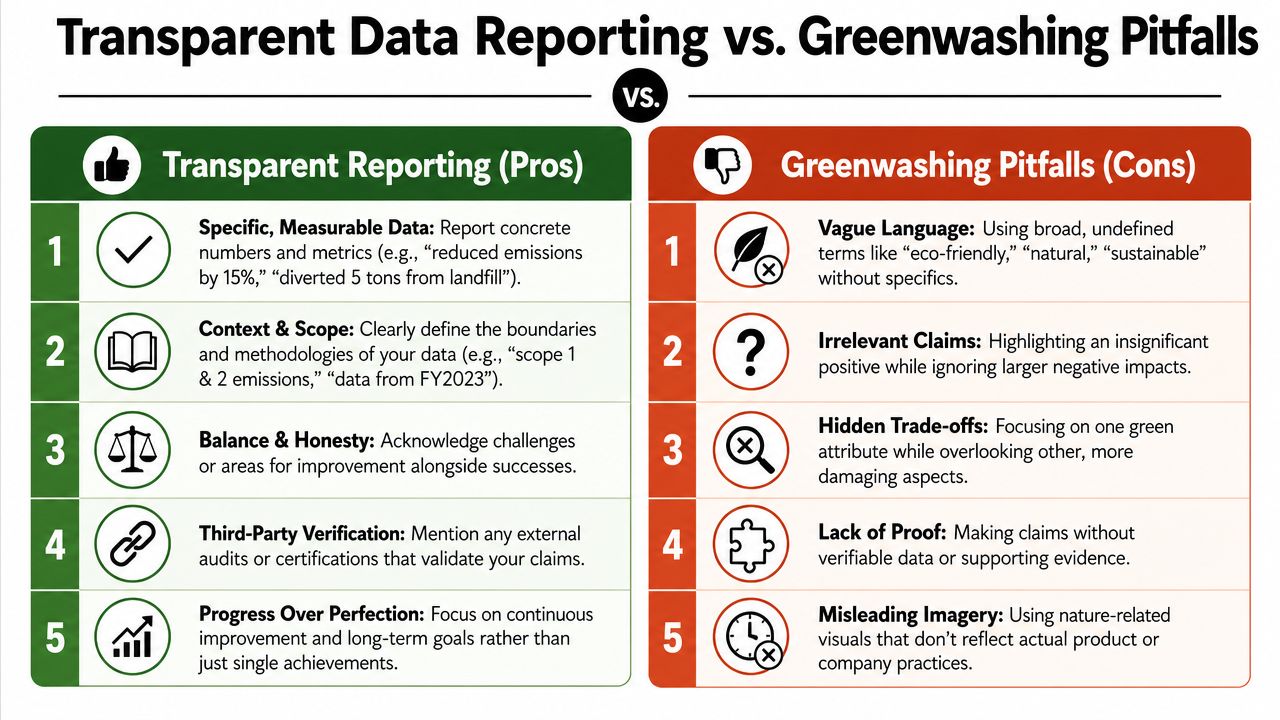
Transparent reporting usually includes five elements:
- A defined scope: The release states what operations, facilities, programs, or time period the data covers.
- A method note: Readers can understand how the result was calculated, tracked, or verified internally.
- A limit statement: The company names what the initiative doesn't yet address.
- A trade-off acknowledgement: If one improvement created another challenge, the release says so.
- A progress frame: The company presents the result as part of ongoing work, not as final perfection.
In practice, the strongest sentence in the release is often the one legal and leadership first want to cut. It is the line that says a pilot covered only three sites, supplier data is still incomplete, recycled content raised costs, or the program reduced one category of waste without solving another. That sentence does not weaken the announcement. It signals control, maturity, and respect for the audience.
Reality check: If the announcement has no sentence beginning with the equivalent of “we still need to improve,” it probably isn't ready.
A practical red flag test
Before approval, test every key claim against three questions:
- Can the company produce backup documentation quickly?
- Would a skeptical reader understand the boundary of the claim?
- Does the release admit at least one unresolved challenge where relevant?
If any answer is no, revise the draft.
Good sustainability PR is not about sounding perfect. It is about being specific enough to be trusted, and honest enough to show where the work is still unfinished.
Optimizing for Journalists and Search Engines
Edelman's Trust Barometer has shown the same pattern for years. People expect companies to show evidence, not just intent. That standard applies to journalists too. If a sustainability release is hard to scan, hard to verify, or padded with soft language, it loses value fast.
Packaging matters because credibility now depends on retrieval. A reporter under deadline needs to find the claim, the scope, the local relevance, and the contact person in seconds. Search engines reward many of those same signals. Clear headlines, specific language, structured summaries, and useful supporting assets improve both discovery and editorial usability.
Write for newsroom triage
Assume reporters will not read top to bottom on first pass. Structure the release for quick scanning.
That means the subject line, headline, opening paragraph, and asset package need to do the heavy lifting. If the release says the company "advances sustainability initiatives" but does not name what changed, where it happened, and who it affected, the story stalls before anyone reaches the detail.
A newsroom-ready setup includes:
- A clean keyword target: Use “sustainability press release” only where it fits naturally. Give more weight to the actual news angle, such as emissions reduction, recycled packaging, water use, local hiring, or supplier traceability.
- A direct headline: Lead with the result, not the campaign name.
- A summary that can stand alone: The first paragraph should still make sense when it appears in search results, email previews, or newsroom CMS snippets.
- A local human detail: Add one concrete point that shows who benefits, where, and at what scale. This is often the missing element in corporate sustainability news.
- A real contact person: Use a named media contact who can answer follow-up questions quickly, including tough ones about limitations.
Teams that need help with metadata, headline phrasing, and search-facing structure can use this guide to optimizing press release SEO keywords and metadata.
Package the release so it travels
The body copy is only one part of the asset. Editors, producers, and trade reporters often decide whether to use a story based on how much work the package removes from their day.
A useful release package usually includes:
| Asset | Why it matters |
|---|---|
| Data visual | Helps readers grasp the evidence quickly and quote it accurately |
| Executive headshot or site image | Gives editors immediate visual context |
| Short FAQ | Answers predictable questions about scope, timing, and constraints |
| Media contact details | Shows the company is prepared for scrutiny |
This is also where many sustainability announcements lose credibility. They attach polished brand imagery but skip the chart, the facility photo, the methodology PDF, or the local context that would help an outlet turn the claim into a real story. If the release says a packaging change reduced waste, include a visual that shows the change and name the market, facility, or community affected. If the announcement involves a pilot, label it as a pilot in the asset names and captions.
Remember that the factors driving search visibility also improve media relevance. The release that is easiest to scan, summarize, and verify is usually the one more likely to surface in search, earn clicks, and hold up under editorial review.
Strategic Distribution and Personalized Outreach
Publishing the release in a newsroom isn't distribution. It's storage. A sustainability announcement usually needs a layered rollout because the audience is mixed. Journalists, trade outlets, investors, community partners, customers, and employees don't all discover news the same way.
The release itself also needs discipline. An expert sustainability press release should stay within a 300 to 550 word range, use a headline led by the specific outcome, and open with a quantified impact statement, based on guidance for ESG announcement structure. That length works well because it gives outreach teams a compact asset they can pitch, quote, and adapt without rewriting it from scratch.
Use a tiered distribution model
A useful distribution model has three layers.
First layer. Publish the release on the company newsroom or media page with downloadable assets, contact details, and any supporting documents the company is comfortable sharing.
Second layer. Use a wire or distribution service if broad visibility matters. This is useful when the announcement has regulatory relevance, national footprint, or investor implications. The trade-off is that broad distribution rarely replaces targeted pitching.
Third layer. Send personalized outreach to a short list of journalists, editors, local reporters, trade publications, and community outlets. At this stage, the localized angle proves valuable. A national trade reporter may care about methodology and industry impact. A local reporter may care more about jobs, access, or neighborhood effect.
Broad reach creates awareness. Personalized pitching creates actual coverage.
A workable outreach note
A sustainability media pitch should be short, informed, and clearly matched to the recipient's beat. It shouldn't paste the entire release into the email, and it shouldn't pretend the story is relevant to everyone for the same reason.
A practical structure looks like this:
- Subject line: State the outcome and the local or sector angle.
- Opening sentence: Show why the journalist was selected.
- Two-sentence summary: Explain the result, the human impact, and why it's timely.
- One support line: Mention available spokespersons, visuals, or data notes.
- Close: Offer the full release and interview coordination.
Example framework:
| Pitch element | Example approach |
|---|---|
| Subject line | Company reports sustainability outcome tied to local community impact |
| Relevance line | Reaching out because this fits the reporter's climate, business, or local development coverage |
| News summary | One result, one human consequence, one reason it matters now |
| Offer | Interview with operations or sustainability lead, plus visual assets |
Timing matters too. Send when the contact can act on it. Avoid dropping a technical sustainability announcement late in the day without anyone available to answer questions.
Distribution works best when the release is treated as one asset in a broader media system. The copy opens the door. The outreach gets someone to walk through it.
Your Sustainability Press Release Checklist
Most sustainability press release problems show up before publication, not after. A rushed draft reveals itself through unsupported claims, weak localization, generic quotes, and an approval chain that polished the language but stripped the clarity. A checklist helps catch those failures while they're still fixable.
The most useful checklist is not just editorial. It covers strategy, proof, structure, and outreach.
Pre-draft checks
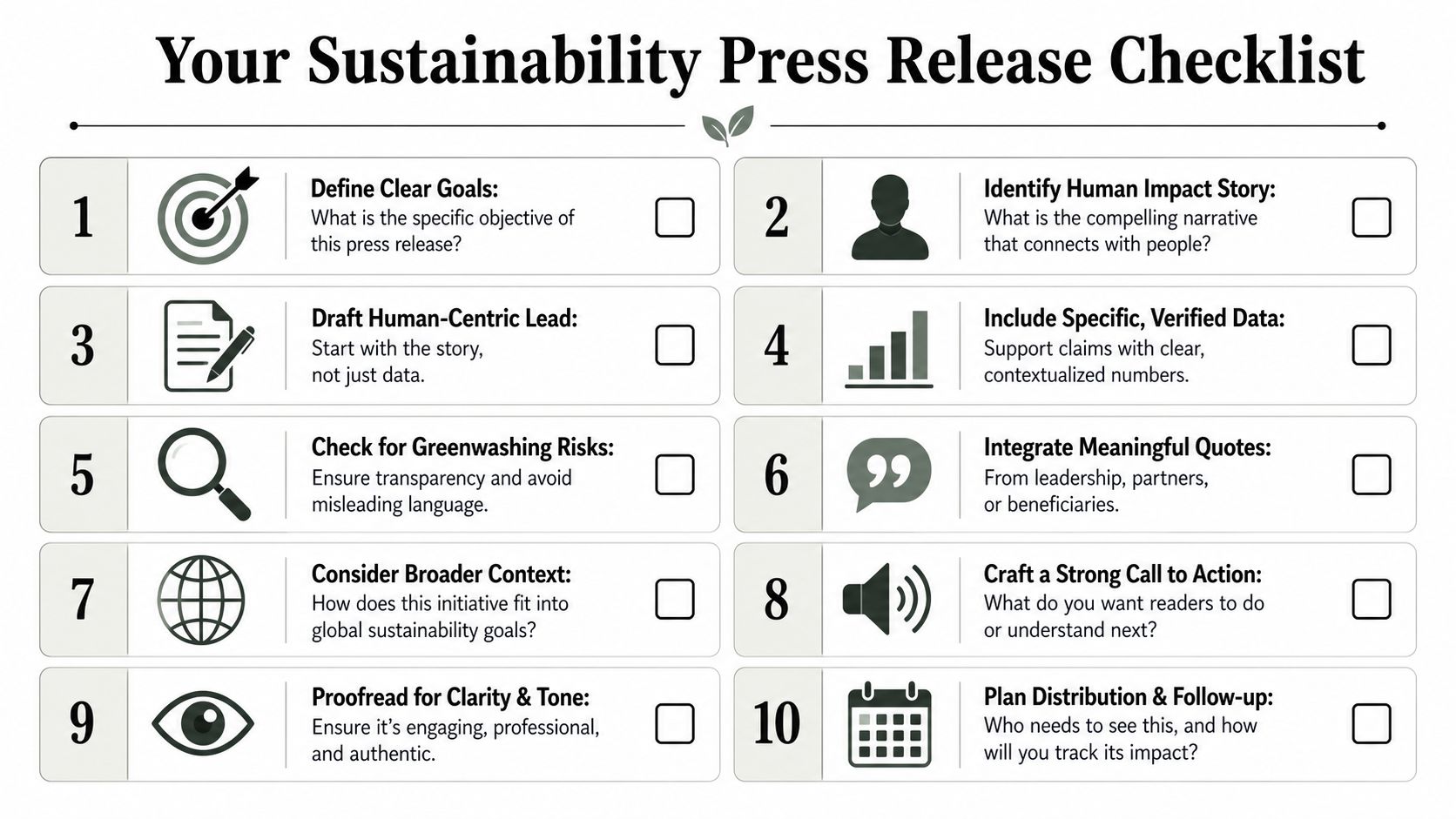
Before drafting, confirm these points:
- The news is real: The company is reporting an outcome, a milestone with evidence, or a clearly defined initiative with public relevance.
- The claim owner is clear: Someone in operations, sustainability, or legal can validate each important statement.
- The audience is defined: The release knows whether it is primarily for trade press, local media, investors, community stakeholders, or a combination.
- The human angle exists: The draft team can name who is affected and how.
If any of those items are unclear, drafting usually produces filler.
Draft and review checks
Once the release is written, audit it line by line.
- Lead quality: The headline reports an outcome. The opening paragraph states the result and why it matters.
- Evidence quality: Claims are specific, contextualized, and internally documented.
- Method quality: The release explains the basis for the claim in language a non-specialist can follow.
- Credibility quality: The copy includes relevant limits, unresolved challenges, or next-step realities where appropriate.
- Quote quality: The quote adds perspective instead of repeating the lead.
A compact review table can help:
| Check | Pass standard |
|---|---|
| Clarity | A reporter can summarize the news after one read |
| Specificity | The release avoids broad environmental adjectives without proof |
| Relevance | The community or stakeholder impact is visible early |
| Integrity | The company isn't hiding material limits |
Launch checks
Final review should focus on execution, not rewriting.
- Contact readiness: A named media contact can respond quickly.
- Asset readiness: Visuals, background notes, and supporting links are live and accurate.
- Pitch readiness: Outreach emails are customized by audience type.
- Approval readiness: Legal and sustainability teams approved the final wording, not an earlier version.
- Follow-up readiness: The company knows who will monitor replies, coverage, and correction requests.
The best sustainability press release doesn't sound perfect. It sounds documented, relevant, and honest.
A repeatable checklist turns a fragile one-off announcement into a stronger communications process. That's a key advantage. It lowers reputational risk while making the release more useful to the people who matter most.
Press Release Zen helps teams turn complex announcements into clear, publishable media assets. For practical templates, writing guides, and distribution advice suited for real PR workflows, visit Press Release Zen.