Media relations is the strategic process of building relationships with journalists to earn positive media coverage, and today 62% of U.S. adults get news from social media. That makes media relations one of the core engines of modern public relations, especially if you're trying to earn attention instead of buying it.
You might be in a familiar spot. You have a strong product, a meaningful event, a smart founder, or a real community story, but the market feels noisy and your inbox outreach seems to disappear into a void.
That's where many people get stuck. They think media relations means sending a press release and hoping for luck. It doesn't. Done well, it's a system. You find the right story, match it to the right reporter, package it clearly, follow up professionally, and measure what happened so the next round gets sharper.
If you've ever asked what are media relations, the simplest answer is this. It's the part of PR that helps other people tell your story credibly. Advertising lets you pay for space. Media relations helps you earn attention through trusted channels.
Introduction Why Media Relations Matters Now More Than Ever
Small business owners often face the same frustrating pattern. They launch something valuable, post about it on social media, maybe send an email announcement, and then wonder why nobody beyond their current audience notices.
Media relations solves a different problem than marketing ads. Ads can create reach. Media relations creates third-party validation. When a journalist, producer, editor, or podcast host decides your story matters to their audience, that carries a kind of credibility your own brand copy can't replicate.
That matters more now because the media environment has splintered. Your audience may discover news through a trade publication, a neighborhood site, a local TV segment, a LinkedIn post from a reporter, a niche newsletter, or a social platform. The channels have multiplied, but the underlying challenge hasn't changed. You still need a story people care about, and you still need someone credible to share it.
Practical rule: Media relations isn't about asking for coverage. It's about making a journalist's job easier with a relevant, timely, accurate story.
People also confuse media relations with publicity stunts or press release distribution alone. Those can be part of the work, but they aren't the whole discipline. Real media relations includes preparation, targeting, relationship-building, timing, and measurement.
If you learn the strategic why and the tactical how together, the work becomes much easier to manage. You stop treating PR as a mystery and start treating it like a repeatable operating system.
The Engine of Public Relations Understanding Its Strategic Role
If public relations is the vehicle, media relations is the engine. PR covers the broader work of shaping reputation, trust, and public understanding across audiences. Media relations is the function inside that larger machine that connects your organization with journalists and media outlets to earn coverage.

A lot of confusion comes from how close these terms sound. Here's the cleaner distinction:
| Term | What it means in practice |
|---|---|
| Public relations | Managing how the public understands your organization |
| Media relations | Working with journalists and outlets to earn editorial coverage |
| Advertising | Paying for placement and controlling the message |
| Content marketing | Publishing your own content on channels you control |
Media relations matters because it adds an outside voice. If your company says it's cutting-edge, that's a claim. If a respected local business reporter interviews your founder and highlights your product in a story, that's validation.
Why earned coverage carries different weight
Readers know ads are purchased. They also know editorial coverage is filtered through an outlet's judgment. That doesn't make coverage automatically positive, but it does make it more trusted when the story is relevant and well reported.
This is why media relations sits so close to reputation management. A single article can introduce your company to a new audience, frame your expertise, or shape how stakeholders interpret a major announcement. The point isn't just visibility. The point is credibility in public.
Think about a nonprofit announcing a new community program. An ad can promote attendance. A local journalist can explain why the program exists, who it serves, and why the issue matters. Those outcomes are not the same.
The field was built on informing the public
Modern media relations didn't start as a social media tactic. Its roots go back to the early professionalization of PR. The modern public relations profession emerged in the early 1900s with the establishment of the Publicity Bureau in 1900, and Ivy Lee introduced a code of ethics in 1906 built around the principle that "the public be informed", helping define the public information model that still shapes media relations today, as outlined in this history of public relations.
That history matters because it answers a common beginner question. Is media relations about persuasion or information?
The honest answer is both, but not by deception. Strong media relations packages accurate information in a way that helps journalists assess news value quickly. It treats the PR professional less like a hype machine and more like a translator between organizations and the public.
Good media relations doesn't start with "How do I get press?" It starts with "What does the public need to understand, and why would a journalist care?"
Strategic role inside a broader communications plan
Media relations becomes powerful when it works with the rest of your communications. Your owned content supplies background. Your spokesperson gives interviews. Your social team amplifies earned coverage. Your leadership team stays aligned on message.
That means media relations isn't a one-off task. It's a connective discipline. It turns business developments into public narratives.
When companies struggle with PR, the problem usually isn't just weak outreach. It's that the engine isn't connected to the vehicle. The story is unclear, the proof is missing, the spokesperson isn't prepared, and the target list is too broad. Fix those pieces, and the system starts to move.
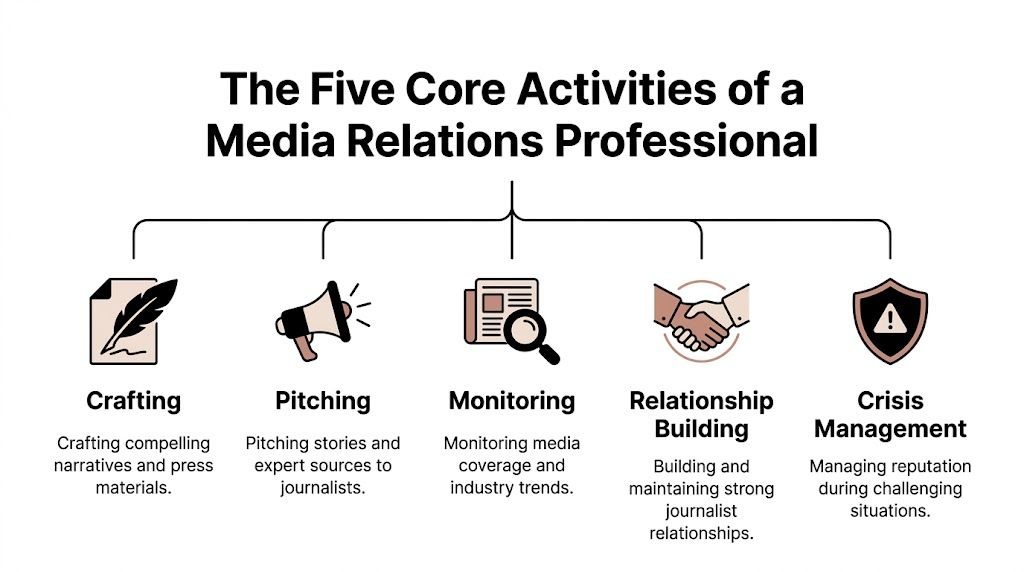
The Five Core Activities of a Media Relations Pro
Daily media relations work looks less glamorous than many people expect, but it's far more effective. Most successful teams repeat a handful of core activities well and consistently.
The channels have changed over time. Television expanded audience reach in the 1950s, social media press releases emerged in the early 2000s, social platforms became central in high-profile campaigns by 2008, and now 62% of U.S. adults get news from social media, which is why modern outreach has to account for both journalists and the platforms where audiences discover their work, as noted in this history of PR and media evolution.
Crafting stories that deserve attention
A press release is not the story. It's the container.
The core work is deciding what makes the announcement matter. A founder thinks, "We added a new service line." A journalist asks, "Why should my audience care?" Your job is to bridge that gap.
A stronger angle usually includes one or more of these elements:
- Timeliness: Why is this relevant right now?
- Impact: Who is affected and how?
- Conflict or change: What problem does this solve?
- Specificity: What is new, different, or useful?
- Human stakes: Who benefits, struggles, wins, or learns?
For example, "local bakery opens second location" is an announcement. "local bakery expands into a food desert neighborhood and adds workforce training" is a story.
Pitching with precision
Pitching is the act of presenting a story idea directly to a journalist. Many beginners often overcomplicate this process.
A good pitch is usually short. It shows you've read the reporter's work, explains why the story fits their beat, and offers useful materials such as a spokesperson, background, visuals, or data. It does not bury the idea under a full company history.
A simple pitch structure works well:
- Relevant subject line tied to the journalist's beat
- One-sentence hook about why the story matters
- Why this fits them based on recent coverage
- What you can provide such as an interview, photos, or local context
- Clear close asking whether they're interested
A local example might sound like this in practice: "You recently covered neighborhood retail turnover. We're opening a worker-owned grocery on the east side next month and can connect you with the founders and residents who shaped the plan."
Send the shortest email that still answers the journalist's first three questions: Why this, why now, and why me?
Building and maintaining media lists
A media list is a working roster of relevant contacts, not a giant spreadsheet of anyone with an email address. Quality beats quantity.
A useful list includes details that help you target properly:
| Field | Why it matters |
|---|---|
| Name and outlet | Basic identification |
| Beat or topic area | Tells you what they actually cover |
| Geographic focus | Prevents irrelevant outreach |
| Recent story examples | Shows whether your angle fits |
| Preferred format | Helps tailor email, call, or social contact |
| Notes | Captures deadlines, style, interests, and past interactions |
Tools like Cision, Meltwater, and BuzzSumo can help with discovery and monitoring, but they don't replace judgment. A list built from live reading is usually stronger than one exported in bulk.
For a startup launch, you might split your list into local business reporters, trade reporters covering your category, and newsletter writers who spotlight founders. For a nonprofit event, you might separate metro reporters, assignment desks, community calendars, and neighborhood outlets.
Nurturing journalist relationships
The best media relations pros don't only show up when they need coverage. They become reliable, useful contacts.
That can mean sending a quick note when a reporter writes a sharp piece, connecting them with a source even when your company isn't in the story, or flagging a trend that genuinely fits their beat. Over time, this changes how a journalist sees you. You're no longer just pitching. You're helping them do their job.
This also means respecting boundaries:
- Don't force urgency when there isn't any
- Don't follow up repeatedly without new value
- Don't pitch outside the beat
- Don't send attachments cold if a link will do
- Don't treat one placement as a permanent relationship
Relationships in media work more like bank accounts than vending machines. You make useful deposits before expecting a return.
Handling embargoes and exclusives carefully
Two terms confuse many newer practitioners.
An embargo means you share information before publication on the agreement that a reporter won't publish until a specified time. An exclusive means one outlet gets the story first or gets it alone.
Both can work, but only when used intentionally. If your news needs broad simultaneous coverage, an embargo can help multiple journalists prepare thoughtful reporting. If your story is highly distinctive and one outlet has the exact audience you want, an exclusive may create deeper coverage.
The risk comes from using either casually. If you promise exclusivity and shop the story elsewhere without disclosure, trust drops fast. If you offer an embargo without clear details, reporters may pass.
Monitoring and responding
The visual in this section includes monitoring and crisis management for a reason. Media relations doesn't stop when the email is sent.
You need to watch for coverage, audience reactions, follow-up questions, corrections, and opportunities to extend the story. If a reporter covers your announcement, another outlet may want a local angle. If social conversation raises a concern, your spokesperson may need a clarifying statement.
Good media relations is active, not passive. You don't toss a story into the world and disappear. You stay available, accurate, and responsive.
How to Build Authentic and Lasting Journalist Relationships
The most durable advantage in media relations isn't a clever subject line. It's trust.
A journalist may ignore one pitch and open the next one from the same person if that person has a pattern of sending relevant, accurate, well-timed ideas. That's why relationship-building outperforms one-off outreach over time. You're not trying to become memorable through persistence alone. You're trying to become useful.

Start with beat research, not your announcement
Many bad pitches reveal the same mistake in the first line. The sender knows their own company well and knows almost nothing about the reporter.
Research should answer practical questions:
- What do they cover repeatedly
- Who is their audience
- Do they write news, features, explainers, or commentary
- What sources do they quote
- What stories have they already written that make your angle redundant
If you need a refresher on how publications differ, this guide to what a media outlet is helps clarify the range from mainstream publications to niche and community channels.
The goal is fit. A perfect story sent to the wrong journalist is still a bad pitch.
Give value before asking for attention
Reporters remember people who reduce friction. That can be as simple as sending clean background notes, offering a spokesperson who answers directly, or recommending another expert when you're not the best fit.
Here are practical ways to build goodwill without forcing a transaction:
- Respond fast: If a reporter asks for comment, reply clearly and within their time window.
- Bring proof: Offer documents, timelines, visuals, or context that make verification easier.
- Respect their format: A radio producer needs different material than a trade editor or podcast host.
- Stay concise: Long emails create work. Short relevant emails remove it.
The fastest way to lose credibility is to make a journalist do extra work for information you should have provided upfront.
Follow up like a professional
Follow-up is where tone matters. One polite nudge can help. A stream of "just checking in" emails usually hurts.
A useful follow-up adds something. Maybe you have a sharper angle, a local customer available for interview, or a photo set ready in a shareable link. If you don't have new value, silence is often better than pressure.
For teams training spokespeople or junior staff, this short lesson is useful because it shows the relationship side of outreach in a simple, practical format.
Inclusive outreach isn't optional anymore
One of the biggest blind spots in media relations is overfocusing on large mainstream outlets while ignoring community, BIPOC, queer-led, and niche publications. That misses both a strategic opportunity and a trust-building responsibility.
An important perspective from this media relations overview on inclusive outreach is that standard guidance often overlooks these outlets, even though they may be less inundated and better positioned to serve underrepresented communities that have lower trust in traditional news and often want solutions-oriented journalism.
That changes how smart outreach works. If you're a healthcare nonprofit serving Black neighborhoods, a community paper or ethnic media outlet may be far more relevant than a broad metro feature desk. If you're launching a queer-owned retail concept, an LGBTQ+ publication may offer context, audience trust, and stronger resonance.
Build the relationship beyond the pitch
The strongest journalist relationships usually include small, human behaviors that compound over time.
Consider a few habits:
| Habit | Why it works |
|---|---|
| Read their work regularly | You pitch with context |
| Congratulate thoughtfully | Shows real attention, not flattery spam |
| Share useful ideas off-cycle | Builds credibility beyond your agenda |
| Prepare spokespeople well | Makes interviews smoother and more reliable |
| Accept "no" gracefully | Preserves the relationship for future stories |
Authenticity in media relations isn't about acting casual. It's about being relevant, honest, and consistently helpful.
Common Media Relations Mistakes and Proven Best Practices
Most media relations failures don't come from a lack of effort. They come from doing the wrong work with confidence.
I've seen this pattern in very different organizations. A startup sends the same launch note to every tech reporter it can find. A nonprofit announces a major community event but forgets to package a local human story. A retail owner opens a new location and assumes a press release alone will generate coverage.
Three mini-stories that show what goes wrong
A software startup had a founder with a strong product and a real customer problem to solve. The team wrote a long release full of product language, blasted it widely, and got silence. The mistake wasn't the product. It was the framing. They led with features instead of what had changed in the market and who the launch helped.
A nonprofit planned a youth event with strong attendance potential. The communications lead sent a calendar listing and waited. Local coverage never materialized because no one explained why the event mattered to families, schools, or neighborhood stakeholders. Once they added parent voices, student outcomes, and a clear local angle, the outreach became usable.
A retail store opening looked visually appealing, but the owner pitched it as "we're excited to open." Editors hear that every week. The story only became interesting when the owner reframed it around bringing essential goods back to an underserved shopping corridor and made store images and interview times easy to access.
Strong outreach rarely fails because the news is small. It fails because the value to the audience isn't stated clearly.
Best practices that fix common mistakes
Here are the patterns I push clients to learn early:
| Best Practice (Do This) | Common Mistake (Not That) |
|---|---|
| Research the reporter's beat before pitching | Mass-blasting a generic email |
| Lead with audience relevance | Lead with company excitement |
| Offer one clear angle per pitch | Pile multiple announcements into one note |
| Prepare usable assets like quotes, photos, and background | Make the reporter ask for basics |
| Follow up once with new value | Send repeated nudges with no update |
| Use owned media to support discoverability | Rely only on cold outreach |
| Set realistic expectations for timing and pickup | Assume every release deserves coverage |
Don't ignore your owned media foundation
One underused best practice is building assets that journalists can find without being pitched directly. Your online newsroom, blog, podcast, expert commentary archive, and media kit all support inbound discovery.
Given overloaded inboxes, a reporter may search for background, leadership bios, previous announcements, or category commentary before replying. If your material is easy to find and easy to trust, you improve your odds before the first conversation even starts.
This approach is explained well in this guide to owned media as an inbound PR channel, which highlights online newsrooms, brand journalism, and podcasts as discoverability tools for journalists and especially useful assets for small businesses and startups.
A practical standard for everyday work
When you're unsure whether your approach is strong enough, use this quick check:
- Can a stranger understand the news in one sentence
- Does the target reporter clearly cover this topic
- Have you made interviews and proof easy to access
- Would the story still matter if your brand name were removed
- Can a journalist verify the claims quickly
If the answer to several of those is no, the issue isn't outreach volume. It's preparation.
How to Measure the True Impact of Media Relations
One of the oldest mistakes in PR is treating coverage count as the whole scoreboard. Placements matter, but they don't tell you enough by themselves.
If you want to understand whether media relations is working, you need to look at quality, reach, tone, competitive position, and business response together.

The metrics that actually tell a story
A practical measurement stack usually includes these terms:
| Metric | What it tells you |
|---|---|
| Share of Voice | How much of the media conversation you occupy relative to competitors |
| Sentiment analysis | Whether coverage tone is positive, neutral, or negative |
| Media impressions | The potential audience size of the coverage |
| Referral traffic | Whether coverage sent people to your website |
| Message pull-through | Whether your core points showed up in the story |
| Spokesperson performance | Whether interviews produced usable, accurate quotes |
These metrics work together. A large placement with poor message pull-through may create awareness but distort your positioning. A niche trade story with modest reach may generate better leads because the audience is more precise.
Why data now shapes modern media relations
Modern media relations is strongly connected to analytics. Share of Voice helps benchmark your presence against competitors, sentiment analysis helps assess tone, 51% of PR professionals rank social listening as the top method for reputation assessment, and 37% of journalists favor data-backed pitches, according to this analysis of data integration in media relations.
That single fact changes daily execution. It means measurement isn't just a reporting exercise after coverage appears. It influences the pitch itself. If journalists respond better to data-backed outreach, then stronger evidence belongs upstream in your process, not just downstream in your dashboard.
How to track impact without getting lost
Small teams often freeze because the array of tools feels too technical. It helps to keep the workflow simple.
Start with three layers:
Coverage layer
Track where you were mentioned, what type of story it was, and whether the outlet matched your target audience.Quality layer
Review sentiment, quote quality, headline framing, and whether your key message appeared accurately.Business layer
Watch referral traffic, contact form activity, demo requests, event signups, or other downstream actions your organization already tracks.
If you want a broader framework for connecting communications performance to company goals, this guide to tracking marketing metrics and KPIs is a useful companion because it helps translate channel activity into measurable business language.
Tools and reporting habits that make this manageable
Tools like Meltwater, Brand24, Cision, and Google Analytics can support different parts of the process. Use monitoring tools to catch mentions and sentiment patterns. Use analytics tools to see whether earned coverage led people back to your site or resource pages.
For internal reporting, don't dump raw clips into a slide deck and call it done. Summarize what happened and what it means.
A solid monthly report might include:
- Top placements: Which pieces mattered most and why
- Message accuracy: Whether your framing survived the interview
- Audience fit: Whether the outlets reached the right people
- Traffic signals: Whether readers took action after coverage
- Next moves: Which angles or reporter segments deserve more focus
For teams building a formal reporting process, this guide to public relations reporting can help structure what to collect and how to present it.
Measurement should answer two questions. Did the right people hear the story, and did anything useful happen next?
What good measurement changes
Once you measure properly, your PR work gets sharper. You stop chasing every mention equally. You spot which story formats travel well, which spokespeople earn stronger quotes, which reporters convert to quality coverage, and which outlets send meaningful traffic or inquiries.
That's the payoff. Measurement turns media relations from hopeful activity into informed decision-making.
Putting It All Together Your Media Relations Action Plan
Media relations works best when you treat it as a system instead of a stunt. You need a story with public value, a targeted list of relevant journalists, a pitch that respects their beat, relationships built on usefulness, and a measurement process that tells you what to improve.
Often, the first move isn't sending more emails. It's tightening the chain from strategy to execution. Clarify the angle. Build a cleaner list. Prepare quotes and background. Make your owned content searchable. Track the result. Then repeat with better inputs.
If you're building a program from scratch, write down a simple operating rhythm:
- Choose one newsworthy angle
- Match it to a small, relevant media list
- Prepare assets before outreach
- Pitch personally and follow up once
- Review outcomes and refine
That rhythm is what turns "what are media relations" from an abstract concept into a practical habit.
When you need to align PR activity with broader planning, this guide on how to write a communication plan with examples is a useful next step because it helps connect your outreach, messaging, audience, and timing into one working plan.
If you want practical help applying this, Press Release Zen offers templates, checklists, and step-by-step guides for press releases, communication planning, media outreach, and PR reporting so you can move from theory to execution with less guesswork.