A business has real news. There's a launch, a new executive, a community partnership, a funding milestone, or an event worth promoting. Then the hard part starts. Someone has to turn that update into writing that a journalist can scan in seconds and decide not to delete.
That's where public relations writing separates itself from marketing copy. It doesn't exist to sound impressive. It exists to make a story usable. The strongest release or pitch gives a reporter a clear angle, clean facts, a reason to care, and enough structure to move quickly.
Modern practice didn't appear by accident. The field became a teachable discipline in 1923, when Edward Bernays taught the first dedicated public relations course at New York University, formalizing PR writing as strategic narrative work rather than loose publicity tactics, as noted in this history of PR calling and practice. That still matters because the core job hasn't changed. Public relations writing must align message, audience, and outcome.
Teams that want sharper releases usually don't need more adjectives. They need tighter thinking, cleaner structure, and better editing discipline. For anyone trying to improve professional writing skills, PR writing is one of the best places to build those habits because weak phrasing gets exposed immediately.
Table of Contents
- Why Great Public Relations Writing Matters More Than Ever
- The Strategic Foundation Before You Write a Single Word
- Anatomy of an Effective Press Release
- Choosing the Right Format for Your Announcement
- How to Find a News Angle When Nothing Feels Newsworthy
- Avoiding Common Pitfalls That Get Your Release Deleted
- Your Pre-Distribution and Writing Checklist
Why Great Public Relations Writing Matters More Than Ever
Public relations writing matters because attention is scarce and credibility is fragile. A company can have a legitimate update and still lose coverage if the announcement reads like an ad, hides the point, or buries the useful details in jargon. Journalists don't have time to decode bad writing.
The business context makes that pressure even sharper. The global public relations market is projected to reach $132.52 billion by 2029, up from $100.06 billion in 2024, growing at a 6% CAGR, according to these public relations market and writing statistics. More money in the market doesn't make writing easier. It means more competition for the same editorial attention.
The standard is higher now
A weak release used to be merely forgettable. Now it often gets filtered out before a real human gives it serious consideration. Editors and reporters expect copy that's instantly legible on a phone, easy to trim, and grounded in facts they can use.
Practical rule: If the first paragraph doesn't tell a busy reporter why the announcement matters, the rest of the release won't save it.
That's why good public relations writing is part strategy, part newsroom empathy. The writer has to know what matters internally, then translate it into something externally relevant.
What strong PR writing actually does
Good PR writing usually accomplishes four things at once:
- Clarifies the news: It states what happened without forcing the reader to hunt for the point.
- Frames significance: It explains why the update matters now, to this audience, in this context.
- Supports the claim: It adds specifics, proof, and usable detail instead of brand slogans.
- Makes response easy: It gives a journalist or stakeholder the next step, whether that's coverage, contact, attendance, or follow-up.
A small business owner often thinks the problem is distribution. In many cases, the core problem is framing. If the announcement isn't shaped into a story, no distribution list fixes that.
The Strategic Foundation Before You Write a Single Word
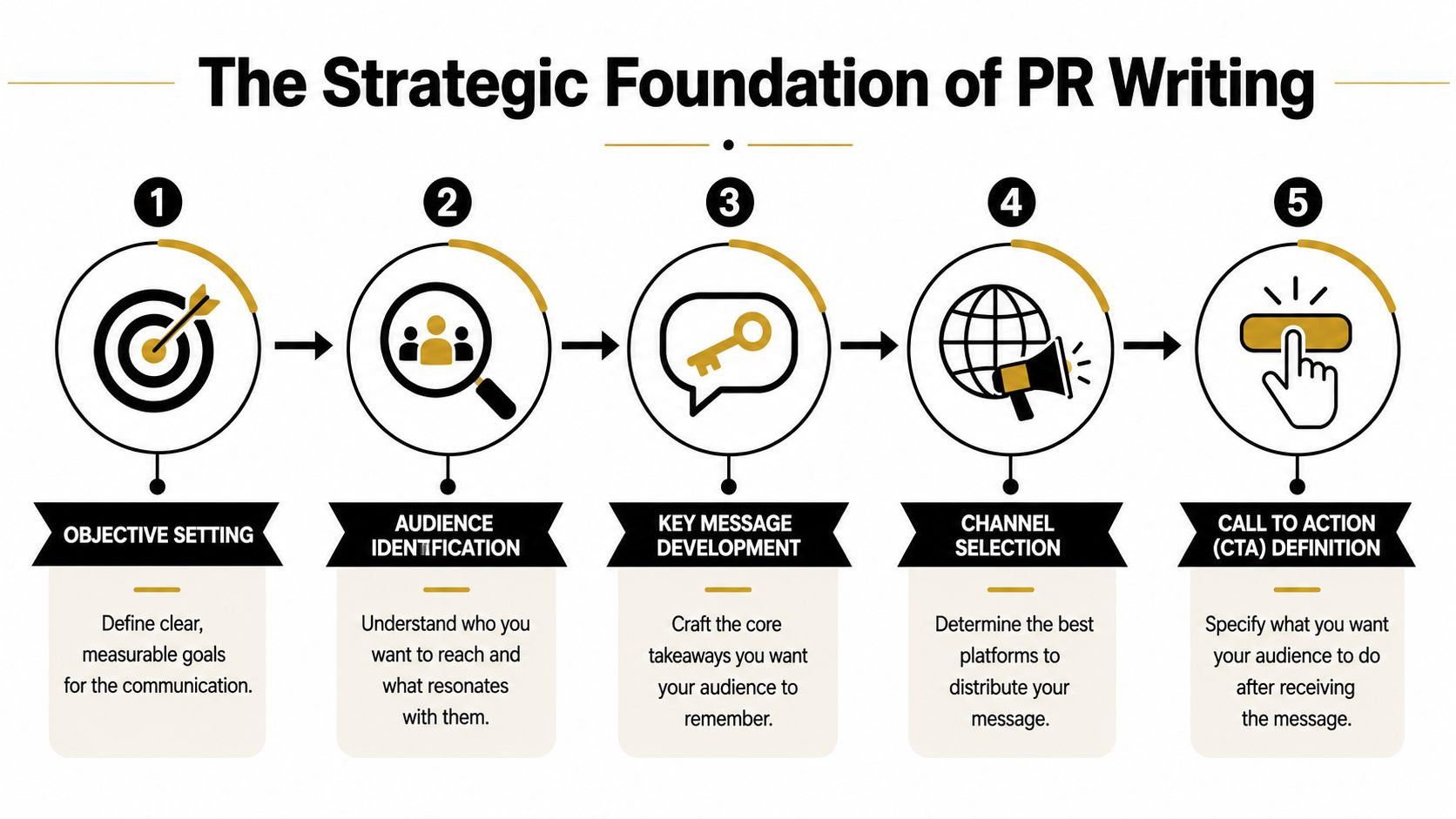
Most weak releases are written too early. The draft starts before the message is clear, before the audience is defined, and before anyone has decided what success should look like. That's how teams end up with copy that says a lot and communicates very little.
The standard planning tool is RACE, which stands for Research, Action planning, Communication, Evaluation. Used properly, it keeps PR writing from becoming a formatting exercise. It forces the team to answer the strategic questions first, including timing. The optimal pitching window is typically Tuesday or Wednesday between 10 a.m. and 12 p.m., tied to a 3.43% average journalist response rate, according to this RACE framework and pitching timing reference.
Start with the problem, not the draft
Research is the stage teams skip most often. They assume they already know the story because they know the business update. That's risky. Internal importance and external relevance are rarely the same thing.
Before writing begins, sort the announcement through a few practical filters:
- What changed: A new product feature, a personnel move, an event, a milestone, or a community initiative each creates a different kind of story.
- Who cares outside the company: Customers, investors, local reporters, trade media, partners, and employees all need different framing.
- Why now: Timing can come from seasonality, industry context, public need, or a tied event.
- What proof exists: Data, customer demand, local impact, executive perspective, or visuals can support the release.
A junior PR writer often asks, “What should the headline say?” The better first question is, “What problem is this announcement solving for the reader?”
Turn vague goals into operating decisions
Action planning turns broad hopes into usable choices. “Get press” isn't a working objective. A team needs to know whether the release is meant to drive attendance, signal growth, support credibility, create backlinks, reassure stakeholders, or equip sales conversations.
That decision shapes everything that follows.
The best releases are usually decided before they're drafted. By the time the writing starts, the team already knows the audience, the angle, and the action they want.
Communication is the visible part. It includes the release itself, any pitch email, supporting assets, media list selection, and the send plan. Evaluation comes after distribution and asks a blunt question: did the writing achieve the intended business result?
A practical planning sheet before drafting should include:
Core objective
One sentence. No jargon. Example: announce a local partnership and drive event attendance.Primary audience
One group gets priority. Everyone else is secondary.Key message
Three points max. If the team has seven “key” points, none of them are key.Proof elements
Facts, names, dates, images, or supporting context.Call to action
Register, attend, request an interview, visit a landing page, or contact the spokesperson.
Writers who do this prep almost always draft faster. More important, they cut less later.
Anatomy of an Effective Press Release
A reporter opens your release at 9:12 a.m., between a city council alert and three vendor announcements. You have seconds to make the story legible. If the headline is vague, the lead buries the news, and the quote says nothing new, the release is gone.
That is the standard to write for.
A press release is a working document. Its job is to help someone grasp the announcement fast, verify the facts, and decide whether it deserves coverage, a follow-up call, or a quick mention in a roundup. Good PR writing respects that workflow. If you need help pressure-testing whether your update has enough substance, this guide on what makes a press release newsworthy is a useful companion before you draft.
The parts that earn attention
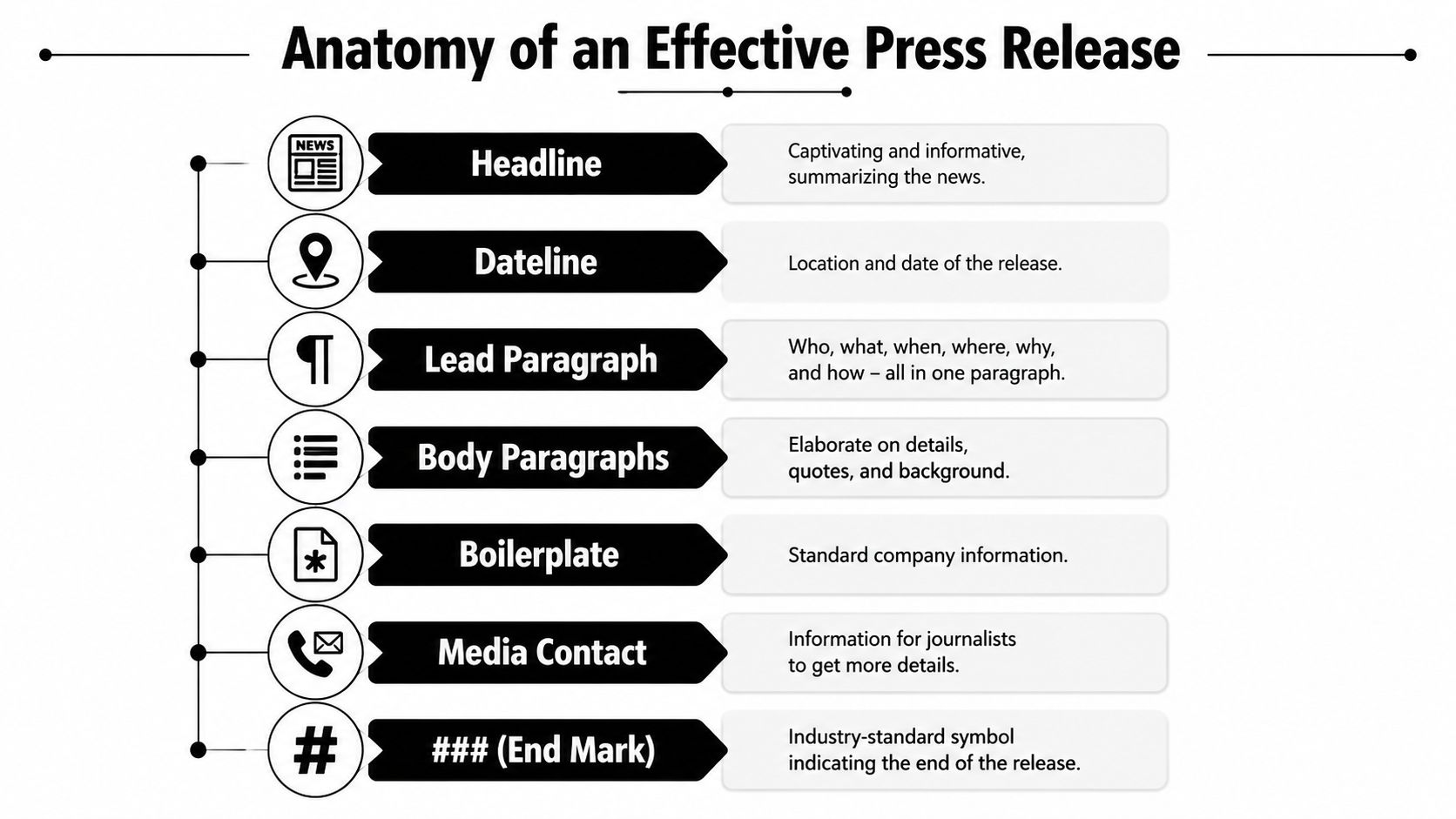
A professional release usually includes these components:
Headline
State the news in plain language. Name the company, the action, and the point of relevance if space allows.Dateline
The city and date tell the reader where the news is happening and when it became official.Lead paragraph
Put the core facts here. Who did what, when, where, and why it matters should be clear in one pass.Body paragraphs
Add support, context, operational detail, and one or two quotes that move the story forward.Boilerplate
Keep this stable and brief. It explains who the organization is without turning into ad copy.Media contact
List a real person and a monitored contact method. Reporters should not have to hunt for a response path.End mark
The standard ### signals the release is complete.
An annotated teardown
Here is the difference between a release that reads like internal enthusiasm and one that gives a journalist usable material.
| Component | Weak version | Strong version |
|---|---|---|
| Headline | “Innovative Company Announces Exciting News” | “Local Manufacturer Opens New Training Center for Skilled Trades” |
| Lead | Starts with brand praise and background | Starts with the event, action, date, and relevance |
| Quote | Generic executive enthusiasm | Specific perspective that adds meaning not already stated |
| Body | Repeats headline in longer form | Adds details a reporter might use |
| Boilerplate | Stuffed with slogans | Brief description of who the organization is and what it does |
The headline and lead do most of the lifting. If those two parts are soft, the rest of the release has to work too hard. I tell teams to test them with a blunt question: could a trade editor copy the first two sentences into a brief and still get the story right?
Quotes are where many small businesses lose discipline. They approve language that sounds positive but says nothing. “We're thrilled” is rarely useful. A better quote interprets the announcement. It explains why the partnership changes service in a region, why the hire matters to customers, or why the new location solves a capacity problem. That is what gives a reporter something worth pulling.
Body paragraphs should answer the follow-up questions a skeptical reader will have. How large is the expansion. Who benefits first. What changes on a specific date. What can a customer, resident, partner, or attendee expect next. This is also where routine announcements get stronger. A new office is not just a new office if it creates local jobs, cuts shipping time, adds bilingual support, or gives a trade publication a workforce angle.
A few editing rules improve almost every draft:
- Lead with verbs and facts: “opened,” “launched,” “partnered,” and “appointed” carry more weight than padded adjectives.
- Use quotes to interpret: The quote should add judgment, context, or implications, not restate the headline.
- Front-load relevance: Put the local impact, business effect, customer benefit, or public value near the top.
- Cut internal politics: A release is not the place to satisfy every stakeholder with a paragraph.
- Write for easy trimming: Editors should be able to cut from the bottom without losing the core story.
One trade-off comes up in nearly every review. Internal teams want one release to do five jobs. They want it to impress investors, help sales, reassure staff, please the CEO, and attract local press. That instinct usually produces a crowded draft with no dominant angle. Strong releases pick one clear news event and support it with facts. The extra messages belong in the pitch email, FAQ, spokesperson notes, or website copy.
Choosing the Right Format for Your Announcement
A common PR mistake isn't poor writing. It's choosing the wrong format. Not every update deserves a full press release, and not every reporter wants to receive one. The format should match the goal.
A press release works when the organization has a formal announcement that could be referenced, quoted, archived, or distributed broadly. A media advisory is more functional. It invites media to attend or cover something specific, usually an event, appearance, or press conference. A pitch email is the most personal format. It's used when a specific angle matters more than a formal document.
When a press release is the right tool
Use a press release when the update has enough substance to stand on its own. Good candidates include leadership changes, partnerships, launches, awards, public initiatives, event announcements with broad relevance, and official statements.
Choose a media advisory when the objective is attendance or on-site coverage. It's shorter, more logistical, and built around who, what, when, where, and visual opportunity.
Use a pitch email when the writer is trying to match a story specifically to one journalist's beat or recent coverage. The email itself carries the persuasion. A release may still sit behind it as backup.
Reporters don't reward format inflation. If a two-paragraph advisory does the job, a padded release only creates friction.
A quick comparison
| Format | Primary Purpose | Best For | Audience |
|---|---|---|---|
| Press Release | Formal public announcement | Launches, hires, partnerships, milestones, statements | Broad media list, stakeholders, website newsroom |
| Media Advisory | Drive attendance or coverage of an event | Openings, ceremonies, media briefings, public events | Reporters, assignment desks, photo editors |
| Pitch Email | Personalize an angle for one contact | Exclusive ideas, trend stories, local hooks, feature opportunities | Individual journalist or small targeted list |
A simple decision test helps. If the update needs permanence and official framing, use a release. If it needs bodies in a room, use an advisory. If it needs persuasion specifically for one editor, use a pitch.
How to Find a News Angle When Nothing Feels Newsworthy
Public relations writing presents its true challenges. A founder wants coverage for a routine update. A client wants a release because something changed internally. A nonprofit has a valid announcement, but it doesn't feel big enough on its own.
That problem is common. 68% of PR professionals admit to creating artificial hooks when trying to manufacture news angles for routine client updates, according to this discussion of the story angle challenge in PR practice. The issue isn't that routine news can't work. It's that teams often choose the wrong frame.

Five angle paths that usually work
Most “non-news” becomes more usable when it's attached to something larger.
The customer problem angle
A product update isn't just a feature change. It may solve a recurring complaint, remove friction, or address a common question.The local impact angle
A small company expansion may not matter nationally, but it can matter to local business media, workforce coverage, or community outlets.The category trend angle
A routine update gains relevance when it reflects a broader shift in the industry.The people angle
A new hire, volunteer effort, or founder milestone becomes stronger when the story centers on expertise, lived experience, or community effect.The useful-data angle
Internal patterns, customer behavior, or operational insight can support a broader narrative if they're relevant and responsibly presented.
A solid reference point for evaluating whether the angle is strong enough is this guide on what makes a press release newsworthy. It helps separate a valid angle from a forced one.
Questions that uncover the real story
When the announcement feels flat, better questions usually fix it.
What changed for someone outside the company?
If the answer is “nothing,” the story probably isn't ready.What tension exists?
Is there a challenge, gap, demand shift, timing issue, or public need behind the announcement?Why now instead of earlier or later?
Timing often creates relevance.Who is affected first?
Customers, residents, students, patients, job seekers, donors, or partners each suggest a different angle.What would a skeptical editor ask?
Usually: Why should readers care?
Don't force scale. A small, specific, credible story beats a bloated claim every time.
A useful discipline is to write three possible headlines before drafting the release. If all three sound like internal celebration, the angle still needs work.
Avoiding Common Pitfalls That Get Your Release Deleted
A reporter opens your email between deadlines. The headline sounds promotional, the first paragraph buries the point, and the quote reads like a sales brochure. That message does not get a second chance. It gets archived, deleted, or remembered for the wrong reason.
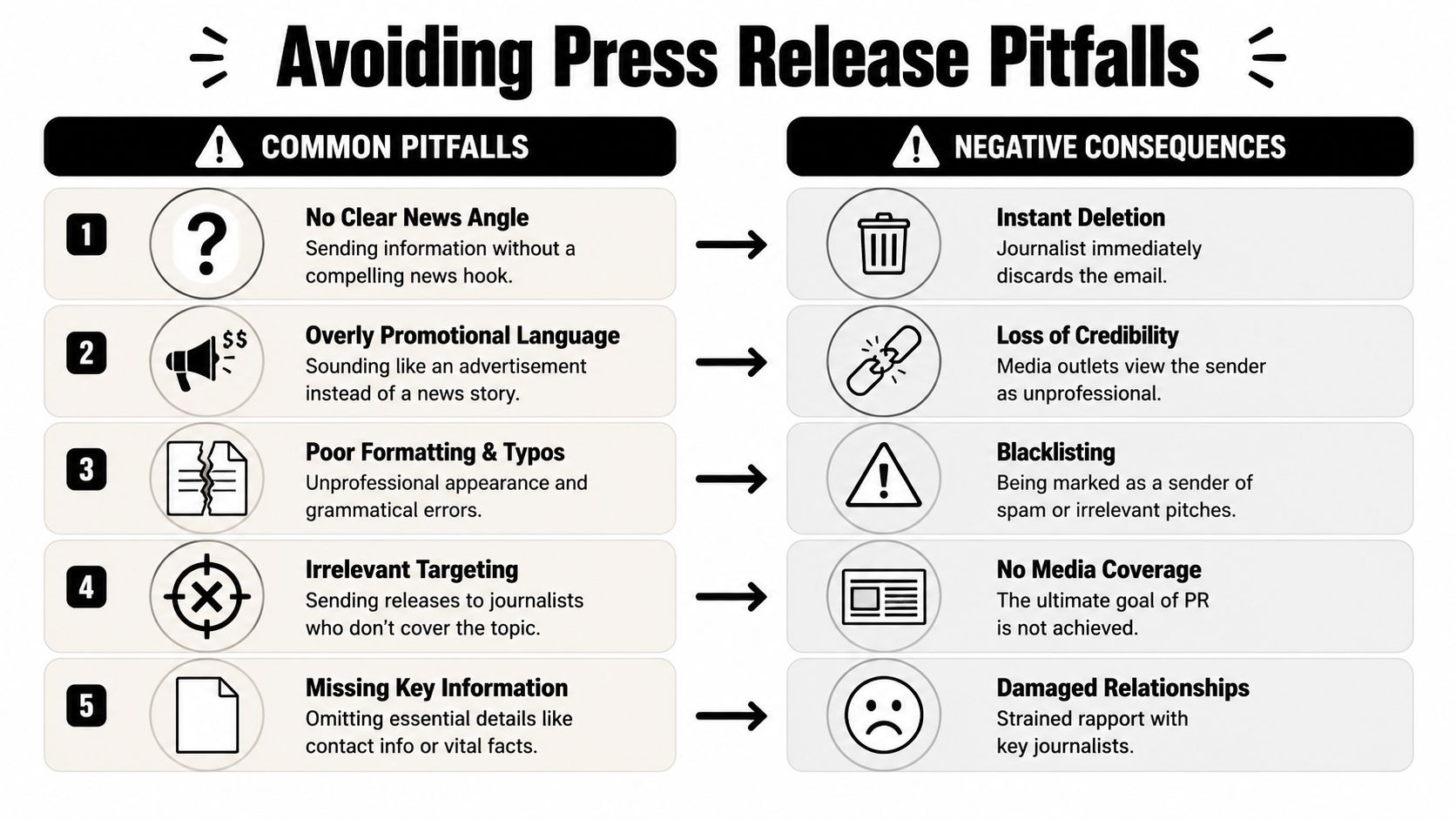
That is why weak releases fail. The problem usually is not one fatal error. It is friction. The recipient has to figure out the news angle, strip out the hype, verify missing details, and guess whether the sender understands the beat.
What journalists respond to
Editors and reporters are making a speed decision.
They want to know, fast, whether the story is usable. In practice, that means your release or pitch needs to answer four questions near the top:
- What is new here?
- Why does this fit my beat or audience?
- What facts can I trust and use right away?
- Is this sender careful enough to quote accurately?
Small business teams often miss the fourth question. A release can have a valid announcement and still lose credibility through avoidable sloppiness. Typos in the headline, broken links, inconsistent dates, and vague claims all create the same impression. More work is coming if they engage. For teams tightening copy before outreach, this guide for marketing content quality is a useful checkpoint because grammar and readability problems often signal the same trust issue in media outreach.
The mistakes that get a release ignored
These are the habits I see repeatedly in drafts from founders, in-house marketers, and junior PR staff.
- Mass irrelevant outreach: Sending the same release to every contact in a database saves time on your side and wastes it on theirs. A local business expansion might fit regional business reporters, trade outlets, and community publications. It does not belong in the inbox of a national tech editor.
- Hype instead of proof: Words like “leading,” “cutting-edge,” and other inflated adjectives do not make the story stronger. Specifics do. State what changed, who it affects, where it is happening, and what evidence supports the claim.
- Quotes that say nothing: “We are thrilled to announce” is filler. A good quote adds judgment, context, or stakes. If the quote can be deleted without losing meaning, rewrite it.
- Missing operational details: Dates, locations, pricing, availability, spokesperson contact information, and correct titles should never be hard to find. If a reporter has to email for basics, many will move on.
- One release trying to carry three stories: This is common with SMB announcements. The company wants to mention the launch, the founder story, the partnership, and the hiring push in one document. Pick the primary news. Put the rest in supporting material or a follow-up pitch.
- Language that ignores audience sensitivity: In healthcare, education, nonprofit, and community-facing work, wording matters. Clarity and respect are part of credibility, not a separate edit.
One practical way to catch these problems is to mark up your own draft like a reporter would. Circle every sentence that contains news. Underline every sentence that contains proof. If you find large blocks with neither, cut them. That simple teardown habit improves weak releases fast.
A useful cleanup reference is this article on press release mistakes to avoid and how to fix them. It pairs well with an internal review because bad outreach rarely comes from one issue alone.
If a journalist has to rewrite your angle, trim your claims, and chase basic facts, your release is asking for more effort than it earns.
Your Pre-Distribution and Writing Checklist
A final review catches the errors that damage otherwise solid work. This step should be operational, not emotional. The question isn't whether the team likes the release. The question is whether a journalist can use it immediately.
Final checks before sending
- Headline clarity: Does it state the news in plain language?
- Lead strength: Does the first paragraph contain the essential facts?
- Angle discipline: Is there one central story, not three competing ones?
- Quote quality: Do quotes add perspective instead of repetition?
- Proof and links: Are names, dates, titles, and links correct and working?
- Format choice: Is this a release, or would an advisory or pitch work better?
- Targeting: Does each recipient cover this topic?
- Assets: Are images, logos, or supporting files ready if requested?
- Boilerplate and contact: Is the organization description current, and is the contact monitored?
For teams publishing releases on their own site, it also helps to review search presentation and metadata. This guide on optimizing press releases for SEO and metadata is useful at that final stage because discoverability matters after distribution too.
A strong release doesn't need to sound grand. It needs to be clear, relevant, and easy to use. That's what gives public relations writing its real value.
Press Release Zen gives communications teams a practical place to get unstuck. Anyone writing releases in-house can use Press Release Zen for templates, examples, and step-by-step guidance that makes announcements easier to plan, format, and distribute with fewer mistakes.