Key Takeaways
- Use a press release when your announcement targets traditional journalists and requires a formal, fact-driven format.
- Use a media release when your outreach includes bloggers, influencers, podcast hosts, and digital creators who respond to a more flexible tone.
- Both documents follow the same core structure, and the terminology difference is largely about audience and language preference, not format.
- Choose the right term for your recipient. “Press release” signals traditional media outreach, while “media release” signals a broader, digital-first distribution strategy.
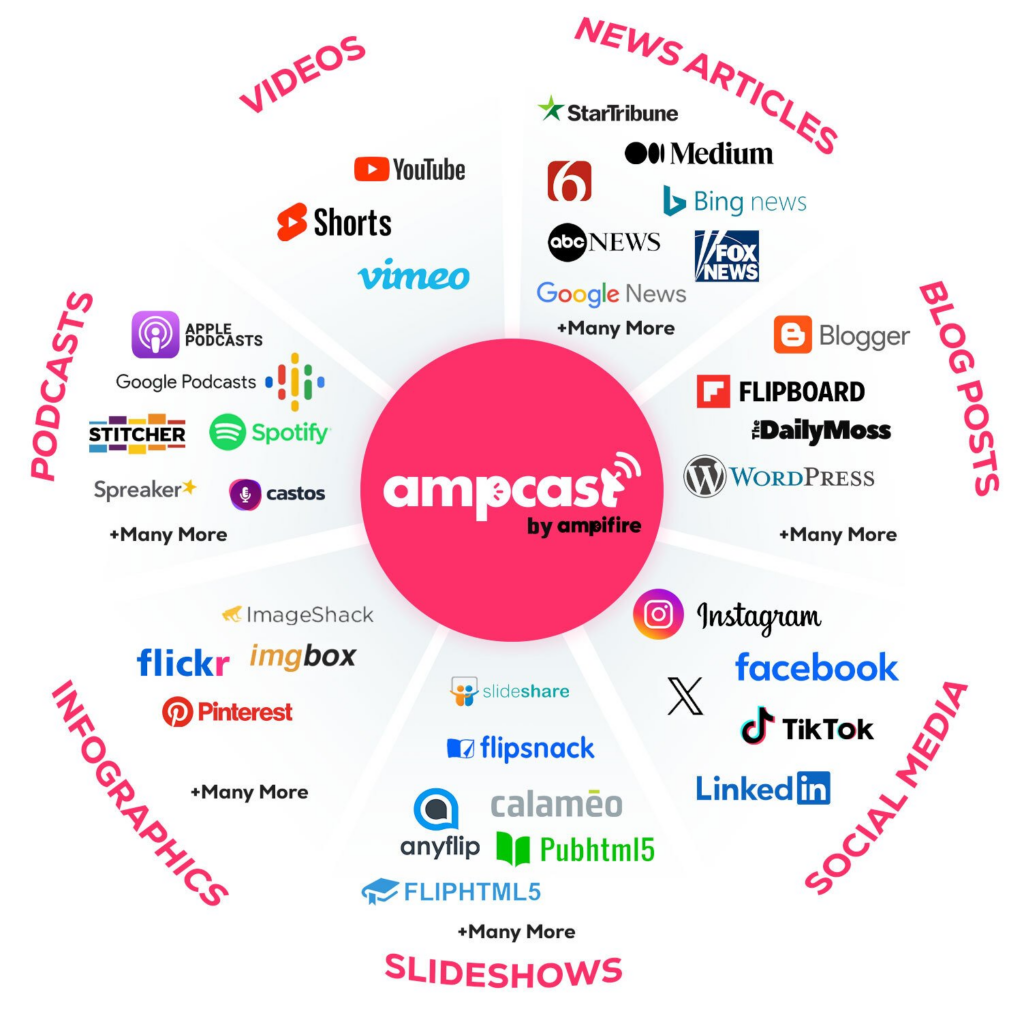
- Reach every audience at once with AmpiFire’s AmpCast AI, which creates eight content formats from one topic and places them across over 300 high-authority platforms.
Press Release vs Media Release: Is There a Difference?
If you have been wondering about the difference between a press release and a media release, the short answer is that there is very little.
The two terms are used interchangeably across the PR and communications industry, and in most professional settings, either one serves the same function: getting your announcement in front of journalists and generating media coverage.
“Media release” became a more inclusive term that reflects how modern communication actually works. This guide breaks down where the two terms overlap, where they diverge, and when it matters.
Why Press Releases Don’t Work Anymore
Smart Businesses Are Moving Beyond Traditional PR
• The Problem: Press releases reach one audience through one channel, while your customers are everywhere online. Most get buried within days with poor ROI.
• The Solution: AmpiFire’s AmpCast creates 8 content formats (news articles, blog posts, interview podcasts, longer informational videos, reels/shorts, infographics, flipbooks/slideshows, and social posts) from a single topic and distributes them across 300+ high-authority sites, including Fox affiliates, Spotify, and YouTube.
What You’ll Learn on PR Zen:
✓ Why multi-channel content delivers 10x better results than press releases
✓ How to amplify your PR efforts across multiple platforms
✓ Real case studies of businesses dominating search, social, video, and podcasts
✓ Cost-effective alternative to expensive PR agencies
Ready to Replace Press Releases? Learn the AmpiFire Method →
What Is a Press Release?
A press release is a formal written statement issued by a company, organization, or individual to journalists, editors, and news reporters. Its primary purpose is to announce something newsworthy and provide enough factual detail that a journalist can write a story based on it with minimal additional research.
Standard Format of a Press Release
A well-structured press release follows a clear, predictable format that journalists recognize immediately. Deviating from it is one of the fastest ways to get your release ignored.
- Headline: A concise title that communicates the news immediately
- Dateline: The city of origin and release date
- Lead paragraph: Answers who, what, when, where, and why in the first one to two sentences
- Body paragraphs: Supporting details, quotes from key stakeholders, and context
- Boilerplate: A standard “About” paragraph placed at the end
- Contact information: Name, phone number, and email of the media contact
- End notation: Three pound signs (###) to signal the end of the release
How to Use a Press Release
Press releases are best used when you have hard news to share with genuine public interest or industry significance.
Common use cases include product launches, executive appointments, mergers and acquisitions, earnings announcements, and award recognitions.
If your news is time-sensitive and you need traditional media outlets like newspapers, wire services, or broadcast networks to pick it up quickly, a press release is the appropriate format.
What Is a Media Release?

A media release serves the same fundamental purpose as a press release. It announces news to media outlets. The difference is that the term reflects a broader understanding of who “the media” is today.
Where press releases were written exclusively for journalists at traditional outlets, media releases acknowledge that your audience now includes digital creators and social media influencers.
The tone of a media release can be slightly more flexible. While it follows the same general structure as a press release, it may incorporate a more conversational voice, embedded links, or multimedia attachments that make it more suitable for digital distribution.
How to Use a Media Release
Use a media release when your outreach extends beyond traditional journalism. If you are pitching to lifestyle bloggers, industry newsletters, podcast hosts, or social media creators, a media release gives you the flexibility to speak their language without abandoning professional structure.
It is also the better choice when your announcement has a strong visual component, such as a community event or a brand campaign, where linking to photos, videos, or landing pages adds real value.
Media releases also work well in industries where the traditional press has limited reach. A local restaurant opening, a nonprofit fundraiser, or a fitness brand launching a new app may not land on a journalist’s radar, but a well-crafted media release sent to the right digital creators can result in features across niche blogs, social media posts, and podcast mentions that directly reach your target customers.
Press Release vs Media Release: Core Differences

Tone & Intent
Press releases are formal by design. They are written in the third person, use neutral and objective language, and are structured to deliver facts efficiently.
Media releases allow for a slightly warmer tone without sacrificing professionalism. You can use storytelling elements, frame the announcement around a broader narrative, or adopt a more conversational voice. The intent shifts from purely informing to also engaging.
Target Audience
The press release was built for one audience: journalists. That includes reporters, editors, producers, and correspondents at newspapers, magazines, TV stations, radio programs, and wire services.
A media release speaks to a broader audience, including digital journalists, independent bloggers, influencers, podcast hosts, and content creators. This audience diversity means the writing needs to be as clear to a morning show producer as it is to a sustainability blogger.
Content & Language
Press releases stick to hard facts: announcements, data, quotes, and verified information. Media releases have more content flexibility.
While accuracy is still essential, you can incorporate brand voice more naturally, include multimedia references, and frame the story in a way that connects with niche communities.
Real Examples of Each Release Type
The following examples show how the same announcement, a company launching a new product, would be framed differently depending on the intended recipient.
Press Release Example
FOR IMMEDIATE RELEASE
Contact: Sarah Mitchell, PR Manager | sarah@techcorpinc.com | (212) 555-0198
TechCorp Inc. Launches the ProScan X200, a Next-Generation Document Scanner for Enterprise Teams
NEW YORK, May 14, 2025 — TechCorp Inc., a leading provider of enterprise document management solutions, today announced the launch of the ProScan X200, a high-speed document scanner designed for large-scale business environments. The ProScan X200 processes up to 120 pages per minute and integrates natively with all major cloud storage platforms, including Microsoft OneDrive, Google Drive, and Dropbox.
“The ProScan X200 addresses a critical bottleneck in enterprise document workflows,” said James Okafor, CEO of TechCorp Inc. “Our customers told us they needed speed without sacrificing accuracy, and that’s exactly what we’ve delivered.”
The ProScan X200 is available immediately through authorized resellers and the TechCorp online store. Pricing starts at $1,499 per unit.
About TechCorp Inc.: TechCorp Inc. is a New York-based technology company specializing in document management hardware and software solutions for enterprise clients across 40 countries.
###
Media Release Example
A media release covering the same launch would take a different approach. It might open with something like:
“For anyone who has spent an afternoon buried in paper files wondering if there is a faster way, TechCorp’s new ProScan X200 was built for exactly that moment.”
From there, it transitions into the same factual content but maintains a narrative thread that speaks to lifestyle and productivity-focused digital audiences.
The structure stays the same: headline, lead, body, boilerplate, and contact information. But a media release might also include a press kit section with links to high-resolution product images, a demo video, and a one-page fact sheet.
These assets make the release immediately useful for a content creator producing a YouTube review, an Instagram post, or a newsletter feature, none of which require the formality of a traditional news story.
Press Release vs Media Release: Quick Comparison
| Factor | Press Release | Media Release |
| Primary Audience | Journalists, editors, wire services | Journalists, bloggers, influencers, digital creators |
| Tone | Formal, neutral, third-person | Professional but flexible, can be conversational |
| Content Type | Hard news, corporate announcements | Hard news + human interest, lifestyle, community stories |
| Language | Strictly factual, no promotional language | Factual with room for brand voice and narrative |
| Multimedia | Often included as attachments or hosted links | Embedded inline with direct links to images, video, and press kits |
| Distribution | Wire services, direct journalist outreach | Wire services, email lists, digital PR platforms |
| Format Flexibility | Rigid, standardized | Slightly more adaptable |
Amplify Your Content Distribution with AmpiFire
Press releases and media releases are both useful tools, but they work within the same basic framework. You write one document in one format, send it out, and depend on others to carry your message forward.
AmpiFire’s AmpCast AI takes a completely different approach. From a single topic, it generates eight different content formats, including news articles, blog posts, interview-style podcasts, long and short-form videos, infographics, slideshows, and social posts. Each one is then placed on over 300 reputable platforms, from Fox affiliate news sites and YouTube to Spotify and major blog networks.
That means your story is already published and visible wherever your target audience spends time. AmpCast AI handles the entire process, making it faster and more cost-effective than hiring an in-house content team or working with a traditional PR agency. For businesses tired of relying on a single release to carry their entire message, AmpCast AI puts that message everywhere it needs to be, all at once.
And unlike a one-off press release, the real power comes from consistency. The longer you maintain an ongoing content strategy through AmpCast AI, the more your brand authority compounds across platforms, building a lasting organic presence that grows over time rather than fading after a single news cycle.
Ready to Go Multi-Channel? Try AmpCast AI Today.
Frequently Asked Questions (FAQs)
Is a media release the same as a press release?
Yes. Both are formal written announcements distributed to media outlets to generate coverage. The term “media release” is simply a more modern label that reflects the expanded media world beyond traditional print and broadcast journalism. In practice, the two are used interchangeably and treated the same way by recipients.
What is the difference between a press release and a news release?
A news release is another name for a press release, with a slight shift in emphasis. “Press release” references the traditional print press, while “news release” focuses on the content being shared. In practical terms, the format, structure, and distribution method are virtually identical, and the choice often comes down to industry convention or geographic preference.
When should you use a media advisory instead of a press release?
A media advisory is used when you want to invite journalists to cover an event in person rather than report on an announcement from a written document. It is shorter than a press release, typically one page, and focuses on logistics: what the event is, where it is happening, when it starts, and who will be available to speak. A press release tells the story. A media advisory sends the invitation beforehand.
What format should a press release follow?
A press release follows the inverted pyramid structure, where the most critical information comes first. The required elements in order are: a headline, a dateline, a lead paragraph answering who, what, when, where, and why, two to three body paragraphs with supporting details, and at least one attributed quote, a company boilerplate, and media contact information. The document ends with three centered pound signs to signal it is complete.
How does AmpiFire go beyond traditional press release distribution?
Press releases and media releases both rely on journalists to pick up your story and publish it.AmpiFire’s AmpCast AI removes that dependency. It converts one topic into eight different formats, from news articles and podcasts to short-form videos, blog posts, and social content, then distributes every piece across its network of over 300 high-authority channels. Your announcement shows up on platforms like YouTube, Spotify, AI recommendations, and major news affiliate sites without relying on journalists.
*Note: Pricing and/or product availability mentioned in this post are subject to change. Please check the retailer’s website for current pricing and stock information before making a purchase.