Most advice on how to make a press release newsworthy is too polite and too vague. It tells you to be timely, relevant, and unique, then leaves you alone with a routine announcement and a blank document.
That’s why so many releases fail. The problem usually isn’t the writing. It starts earlier. Teams confuse “important to us” with “interesting to a journalist.” Those are not the same thing.
A product update, new hire, donation, partnership, or event can earn coverage. But only if you frame it around public value, not internal pride. Small businesses and nonprofits often assume they’re at a disadvantage because they don’t have research budgets, celebrity spokespeople, or original studies. In practice, they often have a better raw material: local impact, visible problems, and real human stories.
A strong release also has to do more than win pickup. If you care about business outcomes, you need to build it for search visibility, referral traffic, branded search lift, and conversions. That changes how you choose the angle, write the lead, and distribute the story.
Decoding Newsworthiness Before You Write a Word
Most bad press releases die before the first sentence. The team never tested whether the underlying story had enough substance to travel outside the company.
A useful filter is the TRUTH framework. Expert guidance says a story should satisfy at least two of these five criteria to have a real shot at media interest: Topical, Relevant, Unusual, Trouble, and Human Interest. That framework comes from the SAGE press release toolkit on newsworthiness.
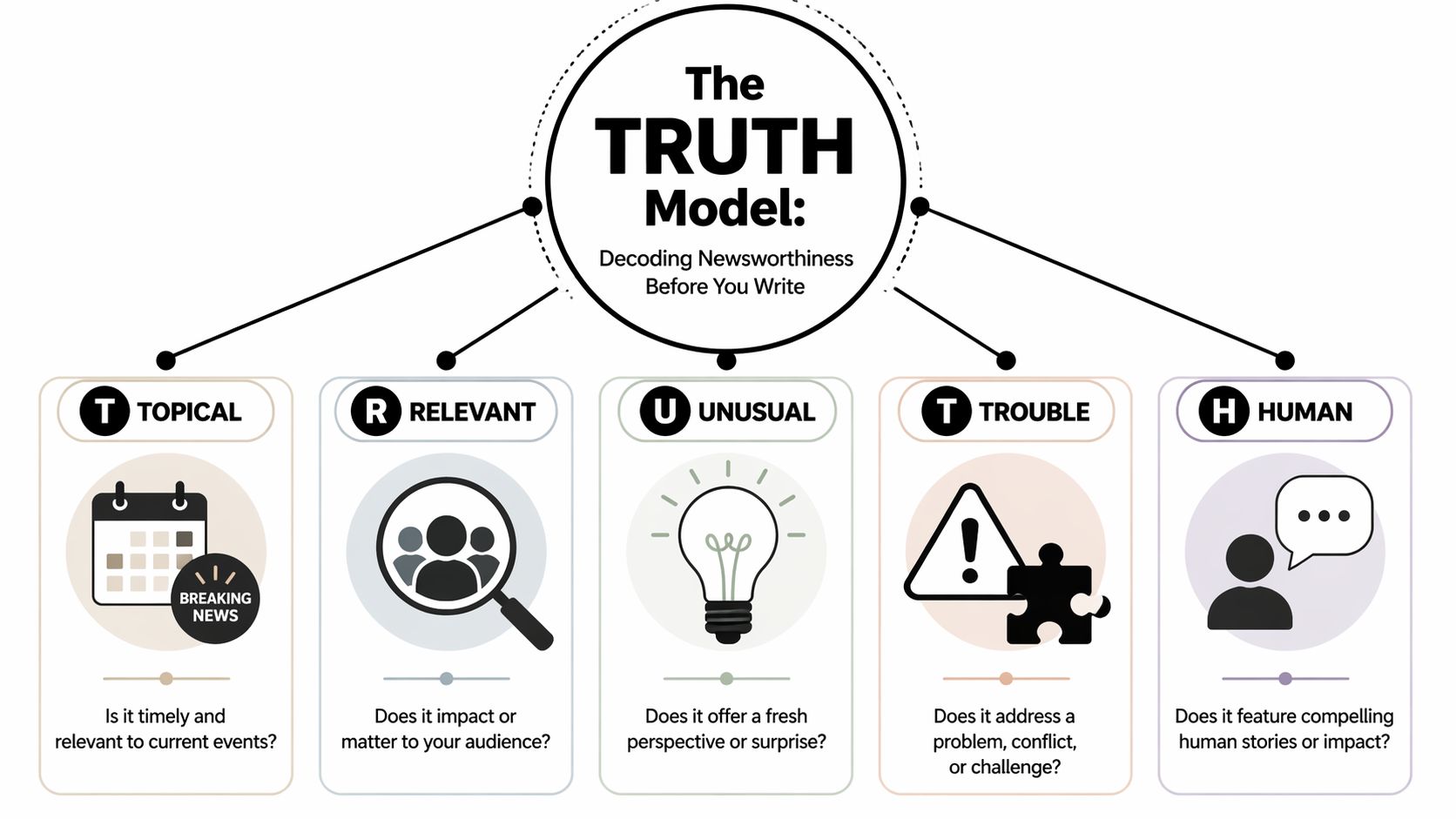
What each TRUTH element actually means
Topical means the story connects to something current. That might be a seasonal issue, a regulatory shift, a community event, or a live conversation in your market. “We launched a service” isn’t topical by itself. “We launched this service as local demand changes” is closer.
Relevant means it affects people beyond your office walls. Journalists ask whether readers will care. A software feature that saves time for your internal team is not relevant. A service change that affects customers, residents, donors, patients, or local employers can be.
Unusual is the pattern break. Routine announcements fail because they sound like every other announcement. The unusual angle might be the method, the audience served, the speed of change, or the way a problem is solved.
Trouble is underused. Journalists are drawn to tension because readers are. If your release addresses a shortage, delay, safety issue, access problem, rising demand, or operational headache, you have a stronger story than if you just announce expansion for its own sake.
Human Interest gives the release a pulse. Without it, many corporate drafts collapse into sterile language. People respond to what changed for an actual person, neighborhood, staff member, volunteer, or customer group.
Practical rule: If your announcement only satisfies one TRUTH element, you probably don’t have a press release yet. You have a company update.
A simple scoring method
Before drafting, force the idea through a quick audit:
| TRUTH element | Ask this question | Pass or fail |
|---|---|---|
| Topical | Why now, not six months ago? | |
| Relevant | Who outside the company benefits or is affected? | |
| Unusual | What makes this different from standard business activity? | |
| Trouble | What problem, friction, or challenge does this address? | |
| Human Interest | Where is the real person in the story? |
If you can check two or more, proceed. If not, rework the angle before you write.
What passes and what fails
A weak version sounds like this: a local nonprofit announces its annual fundraiser. That’s usually not enough. It may matter to the organization, but it doesn’t automatically matter to a newsroom.
A stronger version might connect the fundraiser to a visible local need, explain what problem it addresses, and include the people affected. Now it can hit relevance, trouble, and human interest.
A weak small business version: “Family-owned auto shop expands service menu.” That’s internal.
A stronger version: the same shop frames the expansion around a local access issue, wait-time problem, or a need in an underserved part of town. That version gives a reporter something to work with.
Journalists don’t publish announcements because a business is proud of them. They publish stories because readers get something from them.
The mindset shift that changes everything
Teams often ask, “What do we want to say?” The better question is, “What can a reporter build a story around without extra excavation?”
That one shift improves almost every release. It pushes you to lead with impact, identify the tension, and make the public benefit obvious. It also saves time. If the idea doesn’t pass the TRUTH test, no amount of headline polishing will rescue it.
When people ask how to make a press release newsworthy, this is the starting point. Not adjectives. Not distribution. Not formatting. You need a story shape that already contains news.
Finding Your Angle When You Have No Obvious News
The hardest press releases aren’t for major acquisitions or national studies. They’re for everyday organizations with modest announcements and no budget for big data. That’s where generic PR advice becomes useless.
This gap matters because small businesses make up 99.9% of U.S. firms, and one practical way they can prove newsworthiness is through hyper-local impact, according to BBC Money’s guidance on developing a newsworthy angle. That’s the move most underused by small companies and nonprofits.

Stop looking for national significance
A lot of founders think, “If this wouldn’t interest a national outlet, it isn’t news.” That’s backward. Local and niche coverage often starts with a tighter, more concrete angle.
A neighborhood business doesn’t need a national trend report. It needs a credible local story.
Here’s how that reframing works in practice:
- Retail opening: Don’t lead with ribbon-cutting language. Lead with what the store changes for nearby residents, shoppers, or jobs.
- Auto repair service expansion: Don’t lead with “now offering more services.” Lead with the customer problem it solves in the community.
- Nonprofit partnership: Don’t lead with the partnership itself. Lead with the local issue the partnership addresses and who benefits.
- Professional services firm: Don’t announce “new office location” as if square footage is the story. The story is access, demand, or community need.
Build from community friction
The easiest way to find an angle is to ask where people are frustrated, underserved, confused, delayed, or priced out. Newsworthiness often lives in friction.
Use this short prompt set during brainstorming:
- What problem is visible in our town, sector, or customer base?
- What changed because of this announcement?
- Who feels that change first?
- Why would a local editor care this week?
- What detail makes this more than standard business activity?
If the answers stay abstract, you still don’t have the angle. Keep pushing until the story touches a real group of people in a real place.
Free tools that help surface the angle
You don’t need an analyst team for this. Use tools you already have access to:
- Google Trends: Check whether your topic is already part of a live conversation.
- Google search results: Look at what local outlets are already covering. That tells you what frame they prefer.
- Local government and census pages: Useful for public context, especially for housing, business activity, transportation, and population shifts.
- Your own customer questions: Sales emails, intake calls, support tickets, and volunteer feedback often reveal the actual story faster than a brainstorming session does.
One practical extension is to pair a routine announcement with a timely conversation. If you’re doing that, this guide to newsjacking in PR with examples and practical execution is useful because it helps teams connect their announcement to a broader public narrative without sounding forced.
Angle test: If you remove your company name from the draft and the story still sounds interesting, you’re getting closer.
AI can help, but only if the prompt is sharp
AI is useful for angle generation, not for inventing facts. The input determines the output.
Weak prompt: “Write a newsworthy press release angle for our business.”
Better prompt: “Give me five local media angles for a nonprofit launching a weekend food program. Focus on community impact, access problems, parent concerns, and one human-interest frame.”
Another effective prompt: “Reframe this announcement for a city business journal, a neighborhood newspaper, and a nonprofit newsletter. Keep each angle distinct.”
The value isn’t in letting AI write the release. The value is in forcing yourself to test multiple story lenses quickly. Organizations often settle too early on the first angle, and it’s usually the most self-centered one.
Three reframes that usually work
| Routine announcement | Weak frame | Better frame |
|---|---|---|
| New service launch | “Company adds service line” | “New option addresses a local customer pain point” |
| Small donation or grant | “Organization receives support” | “Funding helps address a concrete community need” |
| Event announcement | “Join us for our annual event” | “Event responds to a current challenge or public concern” |
The organizations that consistently earn coverage aren’t always the biggest. They’re the ones that can answer one blunt question: why should anyone outside your team care right now?
That’s how to make a press release newsworthy when nothing about the raw announcement feels dramatic. You don’t invent scale. You uncover consequence.
Crafting the Irresistible Press Release
A strong angle can still die in the draft.
I see this all the time with small businesses and nonprofits. They do the hard work of finding a timely, community-relevant angle, then bury it under throat-clearing, vague quotes, and five paragraphs of internal language. The job of the release is simpler than that. It should let a journalist, partner, donor, prospect, or search engine understand the story fast and use it without extra work.
The writing should serve distribution, SEO, and lead generation at the same time. That matters if you do not have a big PR budget. One release should be able to support earned media outreach, live on your site as a search asset, and give sales or development teams a credible proof point to share.
The safest structure is still the inverted pyramid. Reporters know it. Editors expect it. Search readers benefit from it too. This guide to writing a press release breaks down why that format remains standard.

Put the news in the first line
The opening sentence should carry the story on its own. If an editor reads only that sentence and the headline, they should still understand what happened, who it affects, where it matters, and why now.
A practical formula:
[Organization] + [what happened] + [where or when] + [the consequence for customers, community, or the market].
That last part is where many drafts fail. “We launched a program” is information. “We launched a program that cuts wait times for uninsured patients in three rural counties” is a story.
Here is the trade-off. Dense specificity makes a release stronger, but only if the details are meaningful. A pile of dates, feature names, and internal terminology makes the lead harder to scan. Keep the facts that prove relevance. Cut the ones only your team cares about.
Write a headline an editor can use
A press release headline is not branding copy. It is a sorting tool.
The strongest headlines usually include:
- Who is acting
- What changed
- Why it matters
That is enough.
Good:
- Local nonprofit launches mobile pantry program for families in East Austin
- Accounting firm opens second office to meet small-business demand in Round Rock
Weak:
- [Brand] is proud to announce an exciting new chapter
Editors do not publish excitement. They publish developments with consequences.
A useful test is blunt. If your headline could sit on your homepage, in a local business journal, or in a Google result without further explanation, it is probably clear enough.
Build the body for fast extraction
After the lead, stack information by usefulness, not by internal politics. The founder’s quote is rarely the second-most important thing.
A practical sequence looks like this:
- Lead paragraph: the announcement and why it matters.
- Second paragraph: the problem, demand shift, local context, or audience need behind it.
- Third paragraph: a quote that adds interpretation, judgment, or stakes.
- Remaining paragraphs: logistics, scope, supporting details, timing, links, and media contact.
- Boilerplate: basic company or nonprofit description at the end.
This order works for journalists, but it also works for everyone else who may encounter the release later. Prospects skim. Donors skim. AI systems skim. If your key facts are buried, the release loses value long after the media window closes. That is one reason why PRs are important for AI search citations.
Length matters too. Long enough to be useful. Short enough to stay readable. Stellar Content’s overview of press release standards gives a reasonable benchmark, but I would focus less on word count and more on whether every paragraph earns its place.
Use data to support the angle
Data helps a release when it answers one question: why should anyone care?
A single local figure often outperforms a page of broad industry stats. For a small business, that might be a waitlist increase, service gap, hiring trend, or customer demand pattern. For a nonprofit, it might be the number of households served, the rise in referrals, or a county-level problem your program addresses.
Use data well by following four rules:
- Pick one or two numbers that carry the argument
- Explain the meaning of the number
- Use current, relevant figures
- Leave out any metric you cannot verify
Weak use of data looks like decoration. Strong use of data gives the editor or reader a reason to keep going.
| Weak use of data | Strong use of data |
|---|---|
| Lists several unrelated statistics | Uses one clear statistic tied to the core announcement |
| Drops numbers into the middle of the release without explanation | Connects the number to a customer, donor, or community impact |
| Uses national figures when the story is local | Uses local or organization-specific evidence when available |
If you want examples of presenting numbers cleanly, using data and statistics in press releases to enhance credibility offers a useful reference.
Quotes should add judgment or human consequence
The quote is usually the weakest part of the release because teams use it as a place to sound official.
Skip that instinct.
A good quote does one of three jobs:
- explains why the change matters,
- clarifies the decision behind it,
- or shows what changed for a person, customer, patient, student, or community member.
Bad quote:
“We are thrilled to announce this exciting initiative, which reflects our continued commitment to excellence.”
Better quote:
“Parents were asking for weekend food support because school meals were not covering the gap. This program lets us deliver help before Monday becomes a crisis.”
That second version gives a reporter something usable. It also gives your site a line worth indexing and your team a message worth repeating.
Package the release so people can use it
Usability is an underrated advantage, especially for lean teams. If your release answers the obvious questions and includes the right assets, it can keep producing value after the first pitch cycle.
Before publishing or sending, check for these basics:
- a direct media contact with email and phone
- a plain-format version that is easy to copy from
- one helpful visual, if the story benefits from it
- links to supporting pages, not a dump of unrelated files
- a quote that can stand alone in coverage or on social
I would rather send a clean release with one sharp image and one credible stat than a bloated package full of filler. Fancy packaging does not rescue weak material. Clear facts do.
A short visual explainer can help teams internalize the structure quickly:
Strong press releases feel easy to read because they are disciplined to write. They respect the editor’s time, the reader’s attention, and the organization’s budget. That is how a release earns more than pickups. It earns search visibility, referral traffic, and sales or donor conversations too.
Strategic Pitching and Smart Distribution
Wide distribution feels efficient. It usually wastes time, burns goodwill, and gives small teams a false sense of momentum.
Good pitching is narrower than many organizations want to admit. A release earns attention when it reaches the few reporters, editors, producers, and newsletter writers whose audience already cares about the subject. For a neighborhood retail expansion, that may mean one local business reporter, two community outlets, and a trade publication. For a nonprofit initiative, it may mean a health reporter, an education newsletter, and a metro desk that is already covering the underlying problem.
That is a better use of a limited budget than paying for reach you cannot justify.
Build a list around fit, not volume
I would rather see a client pitch 12 well-matched contacts than dump a release into 500 inboxes. The first approach creates conversations. The second creates deletes.
Use four filters before anyone goes on the list:
- Beat fit: Do they cover this topic regularly?
- Audience fit: Will their readers, listeners, or viewers care?
- Format fit: Do they publish briefs, trend pieces, profiles, or issue-driven stories like yours?
- Timing fit: Are they covering related developments this week or this month?
This standard matters even more for small businesses and nonprofits. You do not need broad national pickup to get results. One respected local placement, one trade mention, and one link from a niche outlet can outperform a long list of low-value syndication copies, especially if your goal includes search visibility, referral traffic, and qualified inquiries.
Treat the pitch email as a separate asset
The press release is the source document. The email is the case for why a specific person should care.
Too many teams paste the release into an email, change the subject line, and call that pitching. Reporters can spot that immediately. Write the email for the recipient, not for your approvals file.
A usable pitch email usually has:
- a subject line that states the angle in plain English
- one opening sentence that connects the story to that outlet’s audience or recent coverage
- two or three lines on what is new, useful, or timely
- a direct offer, such as an interview, local data point, photo opportunity, or advance access
Keep it brief. If the relevance is not clear in a few seconds, the pitch is doing extra work for the reader, and busy journalists rarely accept that bargain.
Distribution choices affect outcomes beyond earned media
This is the part many teams miss. Placement quality now influences more than coverage. It affects what shows up in search, what earns links, and what AI systems can cite when they summarize your organization or your topic. Austin Heaton explains that shift well in why PRs are important for AI search citations.
That changes the distribution math. A release placed where credible sites can find, reference, and link to it may create more value than a larger blast with no editorial fit. For lean teams, that is good news. Precision is cheaper than volume.
Match the send timing to how the outlet works
Timing errors sink strong stories.
Community outlets may need a few days of lead time. Trade editors often plan around editorial calendars. Local TV producers may care more about whether there is a visual element and someone available for an interview that day. A nonprofit tied to an awareness month might benefit from pitching before the calendar fills up, not on the first day everyone else sends the same idea.
Embargoes help when you are offering something with real reporting value, such as early access, exclusive local context, or a scheduled announcement with clear public interest. They do not make a routine update feel more important.
Follow-up needs the same discipline. One concise check-in is reasonable. More than that usually means the target was wrong, the angle was weak, or the timing missed the window.
Use tools that match your team, not someone else’s workflow
An in-house marketer at a small company does not need the same setup as a national PR firm. A spreadsheet, a clean contact list, and a repeatable outreach process can work well if the targeting is sound. Larger teams may want a media database or outreach platform because it saves time on research and tracking.
What matters is consistency. Keep notes on who responds, who prefers email versus phone, which subject lines earned replies, and which outlets produced links, calls, or donor interest. If you want a practical reference for tying outreach to business results, Press Release Zen has a useful guide on press release KPIs and performance measurement.
Smart distribution is selective on purpose. The goal is not to maximize sends. The goal is to put a credible story in front of the few people who can turn it into coverage, links, search visibility, and measurable demand.
Measuring the True Impact of Your Newsworthy Angle
A press release does not have to become a headline story to pay for itself.
I’ve seen small businesses get one modest trade mention and turn it into qualified traffic, branded searches, and demo requests for weeks. I’ve also seen releases earn a stack of low-value pickups that looked good in a report and did nothing for pipeline, donations, or search visibility. If you only measure coverage count, you miss the difference.

Build a measurement stack your team will keep using
Small teams do not need an expensive PR analytics platform to judge whether an angle worked. They need a setup they can run every time without debate or cleanup later.
Use four basics:
- UTM-tagged links: Separate traffic from release placements, direct outreach, and follow-up coverage.
- Google Analytics: Check sessions, engaged visits, and conversions tied to those links.
- Google Search Console: Track branded queries, impressions, and landing page visibility after distribution.
- A baseline snapshot: Record traffic, branded search volume, and conversion rates before launch so the post-release lift has context.
For teams building a repeatable reporting process, this guide to press release KPIs and performance measurement gives a practical model without forcing enterprise-style reporting on a small operation.
Measure outcomes in layers
The right angle often creates value in more than one place. Some signals appear fast. Others show up later.
Use a dashboard that answers four separate questions:
| Metric | What it answers | Why it matters |
|---|---|---|
| Referral traffic | Did coverage send people to your site? | Confirms real audience movement, not just mention volume |
| Conversion activity | Did visitors donate, book, subscribe, or contact you? | Ties PR to revenue or mission results |
| Branded search lift | Did more people search for your name afterward? | Shows awareness and recall |
| Organic visibility | Did the release support rankings or impressions over time? | Captures the longer-tail SEO return |
That last row gets overlooked constantly.
A nonprofit, local service business, or early-stage company may not get national press. It can still gain useful search visibility if the release targets a specific problem, place, dataset, or audience question reporters and searchers care about. That is one of the few affordable PR advantages smaller organizations still have. A narrow, relevant angle can outperform a broad announcement with no public value.
Track SEO impact without overstating it
Search benefit from press releases is real, but it is uneven. A release with an original data point, a local trend, or a strong expert hook can attract links, secondary mentions, and branded searches. A release built around a routine update usually will not.
That trade-off matters in reporting. If the angle earned coverage on credible sites, watch for:
- increased impressions for the linked landing page,
- growth in branded and related search queries,
- assisted conversions from visitors who first discovered you through coverage,
- and referral traffic that keeps arriving after launch week.
If none of those move, the release may still have served a reputation purpose. But it did not create much measurable demand. Call that result what it is.
Review on three timelines
One reporting snapshot is not enough.
Check performance in the first 72 hours for placements, referral traffic, and direct conversions. Review again after two to four weeks for branded search lift, assisted conversions, and late coverage. Revisit after six to eight weeks if the release supported a landing page, report, or resource hub that could keep generating organic traffic.
This habit keeps teams from making two bad calls. They stop declaring success because a logo wall looks impressive. They also stop killing a good angle before search and branded demand have time to show up.
Coverage shows reach. Business results show whether the angle was worth repeating.
Your Final Pre-Launch Newsworthiness Checklist
Before sending, run the release through a blunt go or no-go check.
The core story check
- TRUTH test passed: Does the story clearly satisfy at least two newsworthiness elements?
- Public value is visible: Can an outsider tell why this matters without knowing your company?
- Angle is specific: Are you leading with consequence, not just the announcement?
The writing check
- Headline is clear: Does it communicate the actor, action, and consequence without hype?
- Lead does real work: Does the first sentence tell the reporter what happened and why it matters?
- Structure follows the inverted pyramid: Are the most important facts at the top?
- Data is selective: Did you include only the numbers that strengthen the story?
- Quote adds meaning: Does the quote interpret impact instead of repeating the headline?
The distribution and measurement check
- Pitch list is targeted: Are you sending this to people who cover the topic?
- Pitch email is adapted: Does the note explain why the story fits that reporter’s audience?
- Links are trackable: Did you add UTM parameters where appropriate?
- Success metrics are defined: Do you know what traffic, search, or conversion signals you’ll watch after launch?
If you’re still arguing internally about what the story is, don’t distribute yet. The newsroom won’t solve that for you.
If you want practical templates, formatting examples, and step-by-step guidance for writing and distributing releases, Press Release Zen is a useful resource for in-house teams, agencies, nonprofits, and founders who need a repeatable process without turning every announcement into guesswork.