An event announcement press release often starts with a familiar problem. Registration is open, the speakers are confirmed, the venue team is waiting, and the announcement still reads like an internal memo. The date appears too late, the headline says little, and the media list includes everyone except the journalists who cover the subject.
A strong release gives journalists a usable story, gives audiences the details they need, and gives the organizing team a controlled message to distribute. The work isn't finished when the document is drafted. Timing, targeting, assets, and follow-up determine whether the announcement reaches a newsroom or disappears in an inbox.
Table of Contents
- What You're About to Build
- Why Event Announcements Still Earn Media Pickup
- Plan the Announcement Before You Write a Word
- Write the Press Release Section by Section
- A Real-World Event Announcement Sample
- Distribute It and Pitch Journalists
- Checklist, Pitfalls, and Quick Answers
What You're About to Build
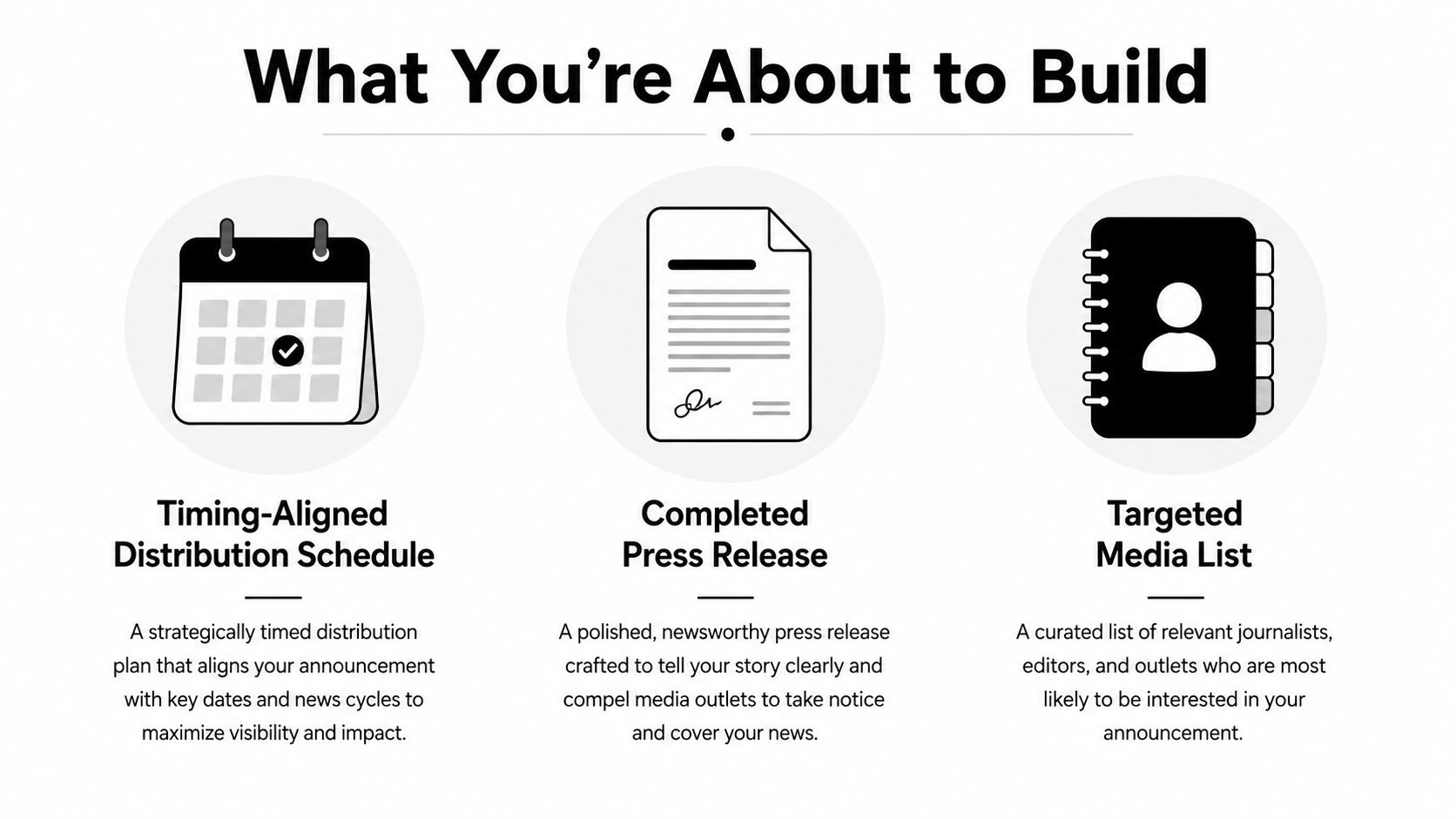
This guide treats an event announcement as a working brief, not a writing exercise. By the end, the reader will have three finished assets: a timing-aligned distribution plan, a fill-in-the-blank pitch email ready for personalization, and a fully annotated sample press release that can be adapted for a conference, fundraiser, launch, webinar, or community gathering.
The process follows the order used by PR teams moving an announcement from draft to pickup:
- Context: Understand why event news remains useful to journalists and audiences.
- Planning: Test the news hook, define the essential facts, map outlets, and prepare assets.
- Writing: Build the release around who, what, when, where, and why.
- Sample: Study a complete fictional nonprofit announcement with annotations.
- Distribution: Choose channels, schedule the send, pitch priority journalists, and follow up.
- Review: Run a pre-send checklist and correct the failure points that regularly stop coverage.
The distribution section also uses the available timing evidence to identify a practical morning window. That matters because a well-written release can still underperform if it arrives when journalists are already sorting through the day's workload.
Readers with an event idea but no draft should begin with planning. Those with a rough document should jump to the section-by-section mechanics. Teams preparing to send should focus on distribution and the final checklist. The point is execution: a clear announcement, a relevant audience, and a send plan that respects how newsrooms work.
Why Event Announcements Still Earn Media Pickup
The format has survived because it solves a practical newsroom problem. The modern press release is widely traced to 1906, when Ivy Lee issued a statement after a New Jersey train wreck that killed more than 50 people. By 1954, PR Newswire had begun operations, introducing a distribution model that allowed organizations to send one announcement to multiple newsrooms at once. Later industry coverage described release networks reaching more than 200,000 media outlets and 10,000 top websites by 2020. The historical progression is documented in the history of the press release.
An event announcement fits existing editorial planning better than generic corporate news. A journalist can use the date, venue, speakers, purpose, and registration details to build a calendar item, preview, local-business story, or beat-specific article. The brand benefits from visibility before the event, while the journalist receives a clearly packaged lead with an obvious public-interest angle.
Current industry data reinforces that practical alignment. A reported 70% of daily newspapers use press releases as a content source, 85% of consumers trust press releases more than social media posts, and releases reach 40% of B2B decision-makers each month, according to the reported press release statistics. The same source reports that healthcare press releases have generated a 45% higher event attendance rate than other categories. These figures should guide expectations, not replace editorial judgment. Relevance still decides whether a journalist engages.
| Factor | Journalist Priority | Brand Benefit |
|---|---|---|
| Clear event date | A calendar-ready fact | Earlier awareness and planning |
| Local relevance | A useful community angle | Regional registrations and recognition |
| Specific participants | Names that can anchor coverage | Credibility and audience interest |
| Concrete public benefit | A reason the story matters | Stronger attendance motivation |
| Easy contact and assets | Faster verification and production | Fewer delays before publication |
Search visibility adds another layer. A release hosted on an organization's site and distributed through appropriate channels can remain discoverable for searches involving the event name, location, date, or topic. That doesn't guarantee rankings or coverage, but it gives the announcement a durable public record beyond the original inbox send.
Editorial test: If a journalist can explain why the event matters without borrowing promotional language, the release has a workable news angle.
Plan the Announcement Before You Write a Word
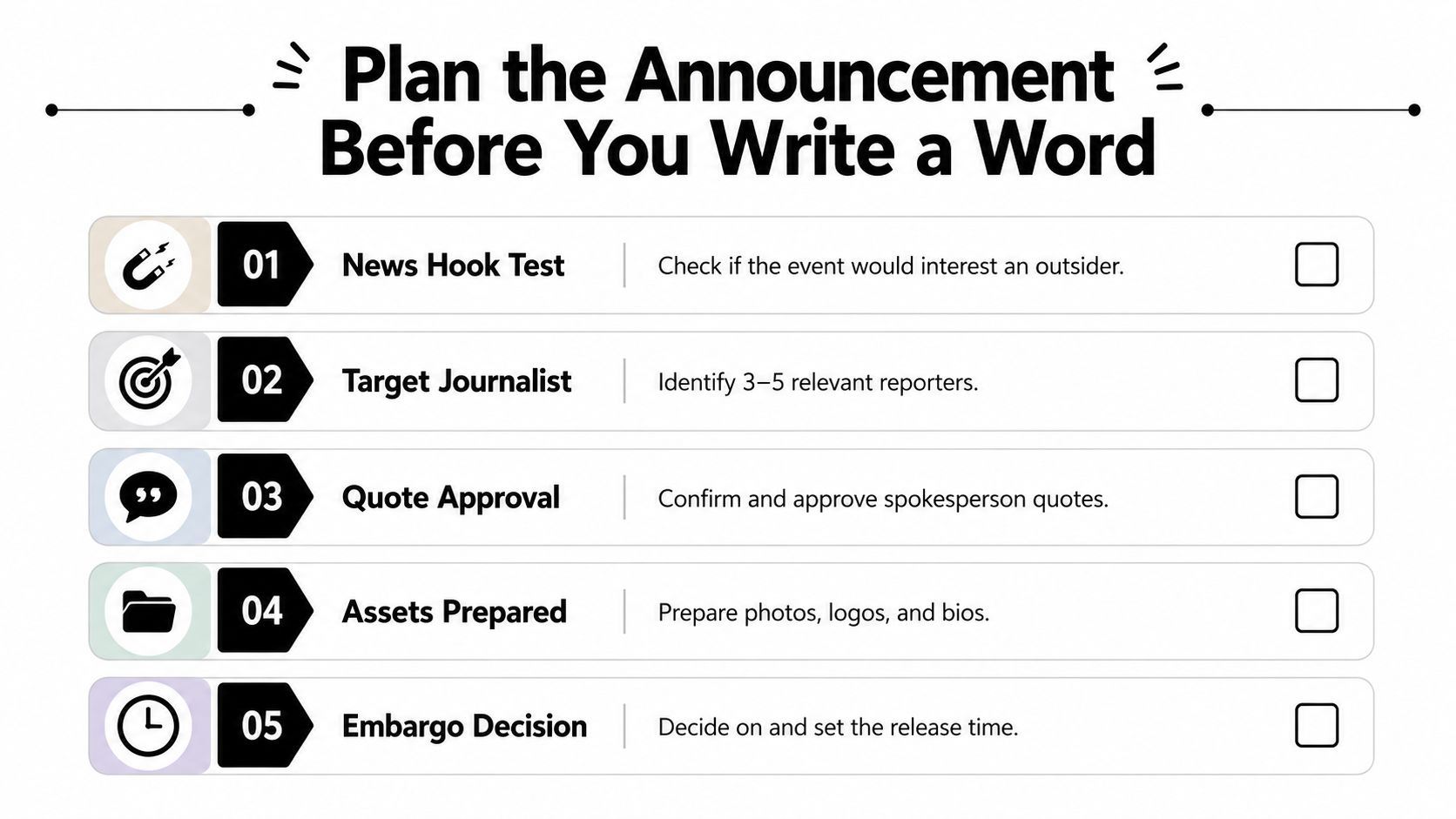
Writing should begin only after the announcement survives the news hook test. Ask whether a journalist who doesn't cover the organization would still see a story in the event. “Company hosts annual networking event” is usually weak. “Regional hospitals bring emergency-care leaders together to address rural access” gives the journalist a subject, audience, and public relevance.
Define five anchors before drafting:
- Headline subject: Decide whether the news is the event itself, a keynote, a partnership, a milestone, or a beneficiary.
- Event identity: Confirm the official name and format. An in-person conference, hybrid summit, and virtual briefing require different logistics.
- Date and location: Record the local time zone, full venue name, street address, and event URL.
- Newsworthy detail: Select one leading fact, such as a recognized founder, a new partnership, a community milestone, or a distinctive experience.
- Action path: Decide whether readers should register, request media access, apply for tickets, or contact the organizer.
The audience map should separate trade press, local news, and national business press. List the beats inside each tier, such as healthcare policy, technology, city development, entrepreneurship, philanthropy, or consumer events. A targeted list of relevant reporters is more useful than a large untargeted database.
Prepare the supporting material before the release goes out:
- Brand files: High-resolution logo in light and dark versions.
- People files: Executive, founder, keynote, and beneficiary headshots.
- Event visuals: Key art, venue image, schedule graphic, or approved experience photography.
- Media kit: A one-page page containing event facts, speaker bios, registration information, and contact details.
For experiential events, the media kit should explain the experience in plain terms. An organizer promoting a racing activation, for example, can use the PSW Events F1 simulator guide to clarify setup details for partners, reporters, and production teams.
Timing belongs in planning, but it shouldn't be treated as a universal rule. Trade press generally needs 7 to 10 days for a focused event notice, local outlets often work closer to 3 to 5 days, and national feature calendars may require 2 to 4 weeks. Those lead-time ranges are planning guidance, not guaranteed pickup windows.
For a deeper test of the central angle, use this guide to what makes a press release newsworthy. Before opening a blank document, confirm the hook, audience, five anchors, media tiers, approved quotes, asset folder, registration path, and contact owner. If any answer is uncertain, polished prose won't rescue the release from the first skim.
Write the Press Release Section by Section
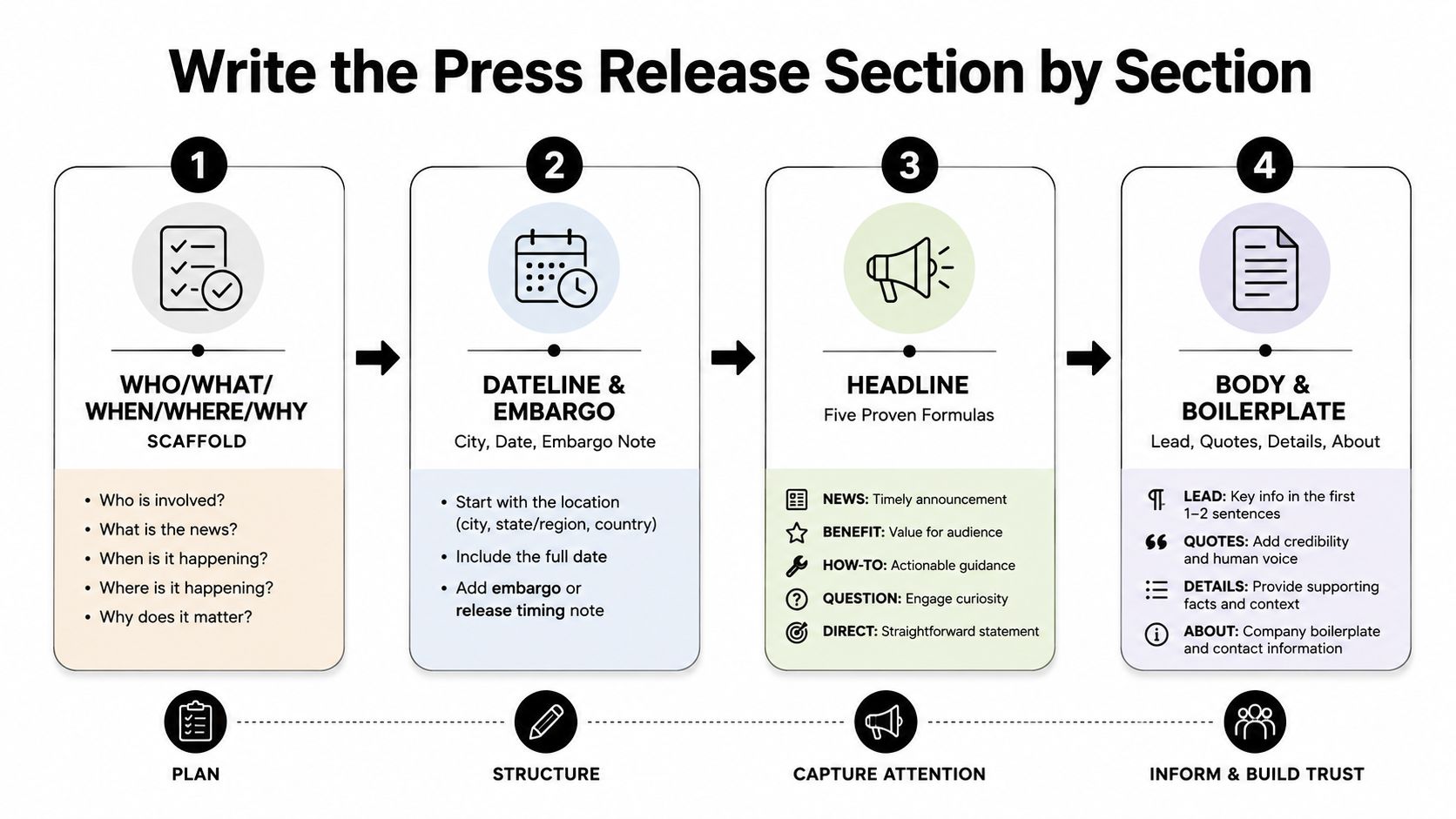
A reliable release follows the WHO, WHAT, WHEN, WHERE, WHY scaffold, but the scaffold should stay invisible to the reader. The document should feel like a concise news item, not a completed questionnaire.
Start with the release designation, such as FOR IMMEDIATE RELEASE, unless an embargo has been agreed. If an embargo applies, state the date and time clearly and confirm that every recipient understands it. The dateline then identifies the city and date, followed by the announcement.
Build a headline with a real news angle
Five practical headline formulas cover most event situations:
- News:
[Brand] Announces [Event] in [City] - Benefit:
[Event] Brings [Audience] Together to [Public or Industry Benefit] - How-to:
[Event] Shows [Audience] How to [Specific Outcome] - Question:
What Will [Audience] Need to Know About [Topic] at [Event]? - Direct:
[Speaker] to Headline [Event] on [Date]
The headline should identify the event and make the news visible. The subhead adds context, such as the audience, distinctive program, beneficiary, or confirmed participant. It shouldn't repeat the headline with different wording.
Compress the five Ws into the lead
The opening paragraph should answer who is hosting, what is happening, when and where it takes place, and why the announcement matters. Two sentences are usually enough. If the event is multi-day, include the full date range and explain whether attendance is available for all days or selected sessions.
The body can then cover the program, audience, speakers, ticketing, and logistics. State whether registration is free, paid, invitation-only, or subject to approval. Virtual events need the platform or access URL, while hybrid events need both the physical venue and online participation path.
Use quotes that add information
The organizer's quote should explain the reason for the event, not express generic excitement. A partner, attendee, beneficiary, or subject-matter participant can provide a second perspective, showing who benefits and why the program has meaning outside the host organization.
Keep the boilerplate short and factual. It should explain what the organization does and whom it serves. End with the media contact block and ###. The ASBMB press release guidance recommends leading with the news hook, answering the key questions early, using plain language, and including a clear resource or contact line.
The release should stay under 400 words for this format. Use AP style, active verbs, short paragraphs, and restrained descriptions. Words such as “groundbreaking” and “unmissable” often make an announcement sound like advertising rather than news.
A Real-World Event Announcement Sample
A release can contain the right facts and still fall flat if its news angle is buried. The fictional nonprofit example below puts the fundraising target in the headline and lead, then shows how event details, quotes, boilerplate, and contact information fit together. Readers can also compare the format with this event announcement press release sample.
Complete sample
FOR IMMEDIATE RELEASE
Harbor Light Foundation to Host “Steps for Shelter” Walk in Baltimore on October 12
Community fundraiser will support emergency housing and winter supplies for families facing displacement
BALTIMORE, Md., August 18, 2026. Harbor Light Foundation will host its annual “Steps for Shelter” community walk on October 12 at Patterson Park in Baltimore, raising funds for emergency housing and winter supplies for families facing displacement. Registration is open at HarborLight.org/steps.
The event will begin at the park's main entrance and include a family route, volunteer information tables, and a resource fair featuring local housing organizations. The foundation is seeking community participants, neighborhood businesses, and volunteers to help meet its $25,000 fundraising goal.
“Every registration gives neighbors a practical way to support families during a housing crisis,” said Elena Morris, executive director of Harbor Light Foundation. “The walk also connects residents with organizations that can help before a short-term housing problem becomes an emergency.”
“People shouldn't have to choose between a safe place to sleep and other basic needs,” said Marcus Hill, a Harbor Light program participant. “The foundation helped my family find a temporary home while we looked for a stable solution.”
The walk begins at 9 a.m. and will continue in light rain. Participants can register online, join as volunteers, or contact the foundation for accessibility information.
About Harbor Light Foundation
Harbor Light Foundation connects families facing housing instability with emergency shelter, referrals, and practical support. The nonprofit works with community partners to help residents move toward safe and stable housing.
Media contact
Dana Lee
Communications Manager
press@harborlight.org
(410) 555-0184
Why each block works
The headline uses an active verb, names the host, identifies the event, and includes the city and date. The lead answers the main questions quickly, while the second paragraph supplies the differentiator and the specific $25,000 goal. That target gives journalists a measurable news peg without turning the release into advertising.
The organizer quote explains the event's purpose and the action it enables. The beneficiary quote adds lived experience, giving the story a perspective beyond the organization's own messaging. Together, the quotes show both why the walk exists and whom it serves.
The boilerplate follows the event facts, so it provides organizational context without delaying the announcement. At roughly 250 words, the sample leaves room for editing. The clear media contact and standard ### sign-off also make the release easy for a newsroom to process.
Distribute It and Pitch Journalists
Distribution has two separate jobs. A wire service creates broad availability and potential online syndication, while a direct pitch explains why the event fits one journalist's audience. Sending a release without targeted outreach is efficient, but it often lacks relevance. Sending only personalized emails can improve fit, but it limits scale.
Timing deserves a specific decision. One wire-service timing study found that releases sent between 6:30 and 7:25 a.m. Eastern Time achieved a 41% open rate among U.S. business and technology journalists, compared with 27% at 8:00 to 9:00 a.m., 16% at noon, and 9% after 3 p.m. The same dataset reported 4.7 average pickups in the optimal morning window versus 0.8 in the weakest window. The timing study supports testing an early-morning send rather than defaulting to a convenient office hour.
The study's audience and time zone matter. A local newsroom may follow a different schedule, and an embargo can override convenience. Schedule the wire release, direct pitches, owned-channel publication, newsletter mention, and speaker or partner sharing so the announcement doesn't appear fragmented.
| Channel | Reach | Cost | Best For | Pickup Likelihood |
|---|---|---|---|---|
| Free PR sites | Broad online availability | Usually free or limited | Search visibility and public access | Variable |
| Paid wires | Broad newsroom and syndication distribution | Paid | Larger announcements and wider reach | Variable, dependent on news value |
| Owned channels | Existing subscribers and followers | Internal effort | Registration and message control | Not earned media |
| Direct journalist outreach | Narrow but relevant | Staff time | Priority reporters and tailored angles | Stronger when personalized |
| Partner distribution | Relevant adjacent audiences | Coordination effort | Co-marketing and community reach | Depends on partner relevance |
For channel selection and sequencing, use this guide to distributing a press release. EventUploader can also help organizers package event information for outreach through its event pitching workflow, particularly when multiple stakeholders need consistent details.
Fill-in-the-blank pitch email
Subject: [Event name] gives [audience] a local angle on [topic]
Subject alternative: [Speaker or partner] to join [event name] in [city]
Hi [Journalist name],
[Organization] is announcing [event name], a [format] for [audience] taking place on [date] at [location]. The event matters to [publication audience] because [specific local, industry, or public-interest hook].
[One sentence describing the most newsworthy detail, speaker, partnership, milestone, or beneficiary.] Registration and the full release are available at [URL].
Would this fit your coverage of [beat or recent topic]? [Spokesperson name and title] is available for a short interview, and the media kit includes [logo, images, bios, and fact sheet].
Best,[Name][Title][Email][Phone]
The body mirrors the lead but adds a reporter-specific reason to care. It doesn't paste the entire release into the email. If a journalist asks for an exclusive, confirm the scope, deadline, and exact materials before agreeing. An exclusive should go to a suitable outlet, not the first recipient who replies.
Follow up once with a useful addition, such as a confirmed speaker, image, interview availability, or corrected logistics. If there is no response, stop pressing that contact for this announcement and preserve the relationship for a more suitable story.
Checklist, Pitfalls, and Quick Answers
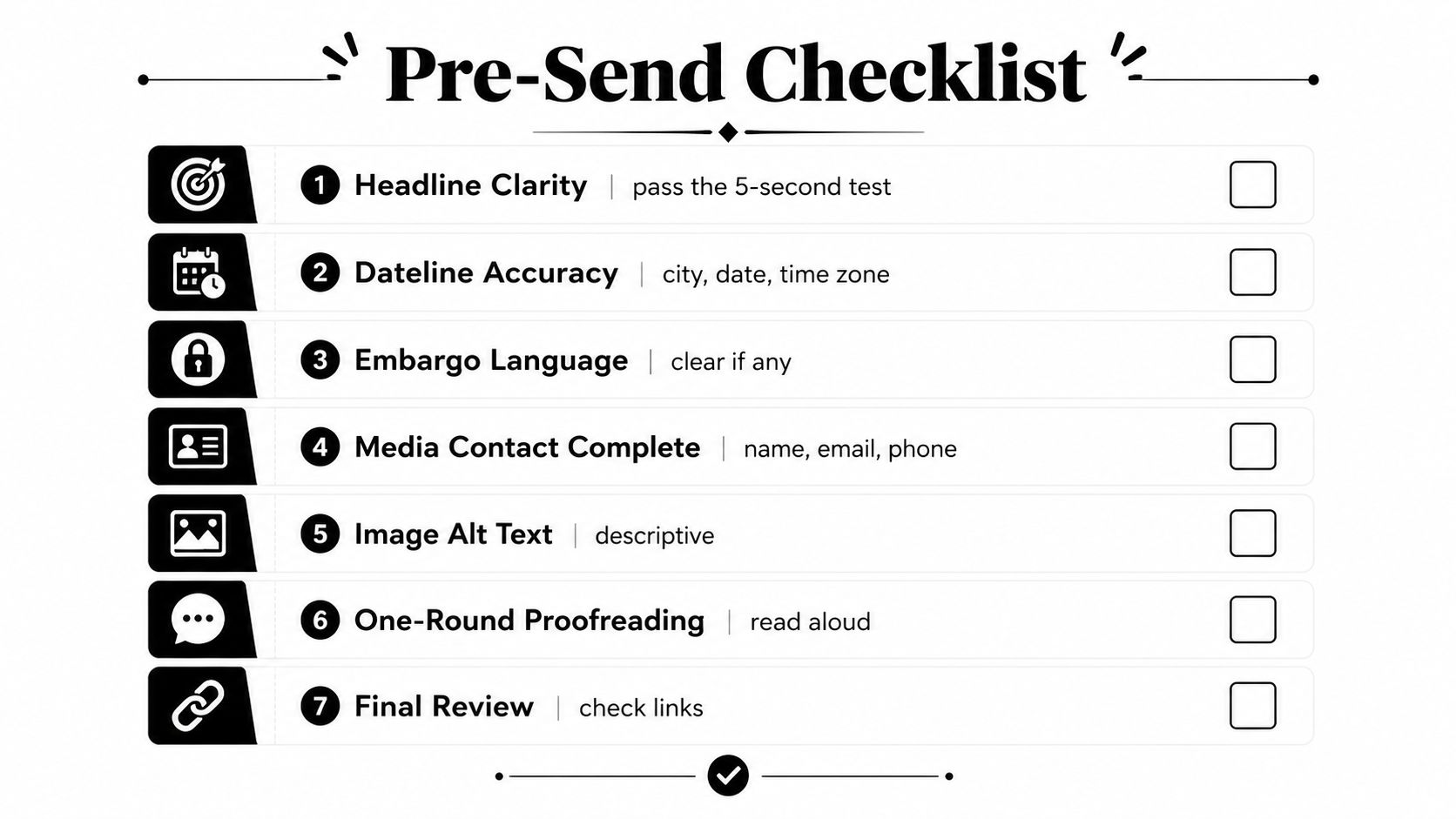
A final review should be short enough to use before every send. Confirm the headline passes a quick clarity test, the dateline has the correct city, date, time, and time zone, and any embargo language is unmistakable. Check the media contact, links, image alt text, registration window, and approved quotes, then read the release aloud once.
The most common failures are easy to diagnose:
- Date buried in paragraph three: Put the date and location in the lead.
- Vague venue address: Include the venue name, city, and usable access details.
- Missing RSVP window: State when registration opens or closes.
- Stock-photo imagery: Supply approved event or organizational visuals instead.
- One spokesperson over-quoted: Add a partner, beneficiary, speaker, or attendee perspective.
For broader event logistics, organizers can use this event planning checklist template to align operational details with the media-facing announcement.
Quick answers
What is the ideal send time? Use the early morning window identified in the timing study, while adjusting for the target newsroom's local schedule and any embargo.
Should the release include a boilerplate? Yes. Keep it factual, concise, and placed after the event information.
How should a virtual event appear? State the platform or access URL, time zone, registration route, and whether media access requires approval.
What if pickup is silent? Review the hook, confirm delivery, send one useful follow-up, and repurpose the announcement through owned and partner channels.
How should success be measured? Track relevant coverage, accurate event details, referral traffic, registrations, media inquiries, and useful relationships, not clip volume alone.
Press Release Zen provides practical guides, templates, examples, and distribution advice for teams preparing an event announcement press release. Visit Press Release Zen to turn the finished assets into a clear, send-ready PR workflow.