Use this APA format for a press release: Organization Name. (Year, Month Day). Title of press release [Press release]. URL. The core parts are the organization as author, the full date, the italicized title in sentence case, the bracketed label [Press release], and the URL.
If you're staring at a draft report, media recap, thesis chapter, or client deliverable and wondering whether the wire version, investor relations version, or subsidiary version changes the citation, you're asking the right question. Press release apa formatting looks simple until you hit the messy corporate realities that standard examples rarely address.
A clean citation does more than satisfy a style manual. It signals that your documentation is reliable, your sourcing is traceable, and your team understands the difference between promotional copy and citable source material. That matters even more in PR, where the same release may appear on a brand newsroom, a media database, and a distribution service with slightly different metadata.
Why APA Formatting for Press Releases Matters
PR teams often need to cite their own releases in places that aren't promotional at all. Board updates, campaign postmortems, crisis documentation, investor materials, graduate coursework, and agency strategy decks all require formal sourcing. In those settings, sloppy references create immediate doubt.
That doubt isn't abstract. A 2025 survey of 500 journalists and media analysts found that 68% were more likely to distrust data from reports containing citation errors, with incorrect source formatting identified as a major credibility red flag, according to the journalist trust and citation error survey. If your report includes earned media outcomes, sentiment analysis, or announcement timelines, weak citations can make the whole document look less reliable.
Credibility is part of the message
A press release is already a self-authored source. That means readers will examine how carefully you present it. If the title isn't formatted correctly, if the date is incomplete, or if the source looks improvised, the citation starts to feel like an afterthought.
Practical rule: When you're citing your own organization's press release, precision matters more, not less. Readers know you had direct access to the source.
This is why citation discipline increasingly overlaps with broader brand visibility work. Teams that care about traceable sourcing in reports usually also care about traceable brand mentions in AI and search contexts. For that larger perspective, Busylike's LLM citation guide is useful because it frames citations as part of how organizations earn trust and retrievability across modern information systems.
What works and what doesn't
What works is straightforward:
- Use the issuing organization as the author. In APA, the organization usually takes the author role for a press release.
- Treat the release as a distinct document type. The bracketed descriptor tells the reader exactly what they're looking at.
- Cite the version you used. If you relied on the newsroom post, cite that. If you used the wire copy, cite that version unless you can verify the original.
What doesn't work is treating a press release like a generic webpage. That strips away context APA expects and weakens the reference.
The Anatomy of an APA Press Release Citation
A citation that looks fine at first glance often breaks on one detail. The release came from a subsidiary, the newsroom page differs from the wire version, or the distribution service appears more prominently than the company that issued the statement. Those are the cases that expose whether the citation is built correctly.
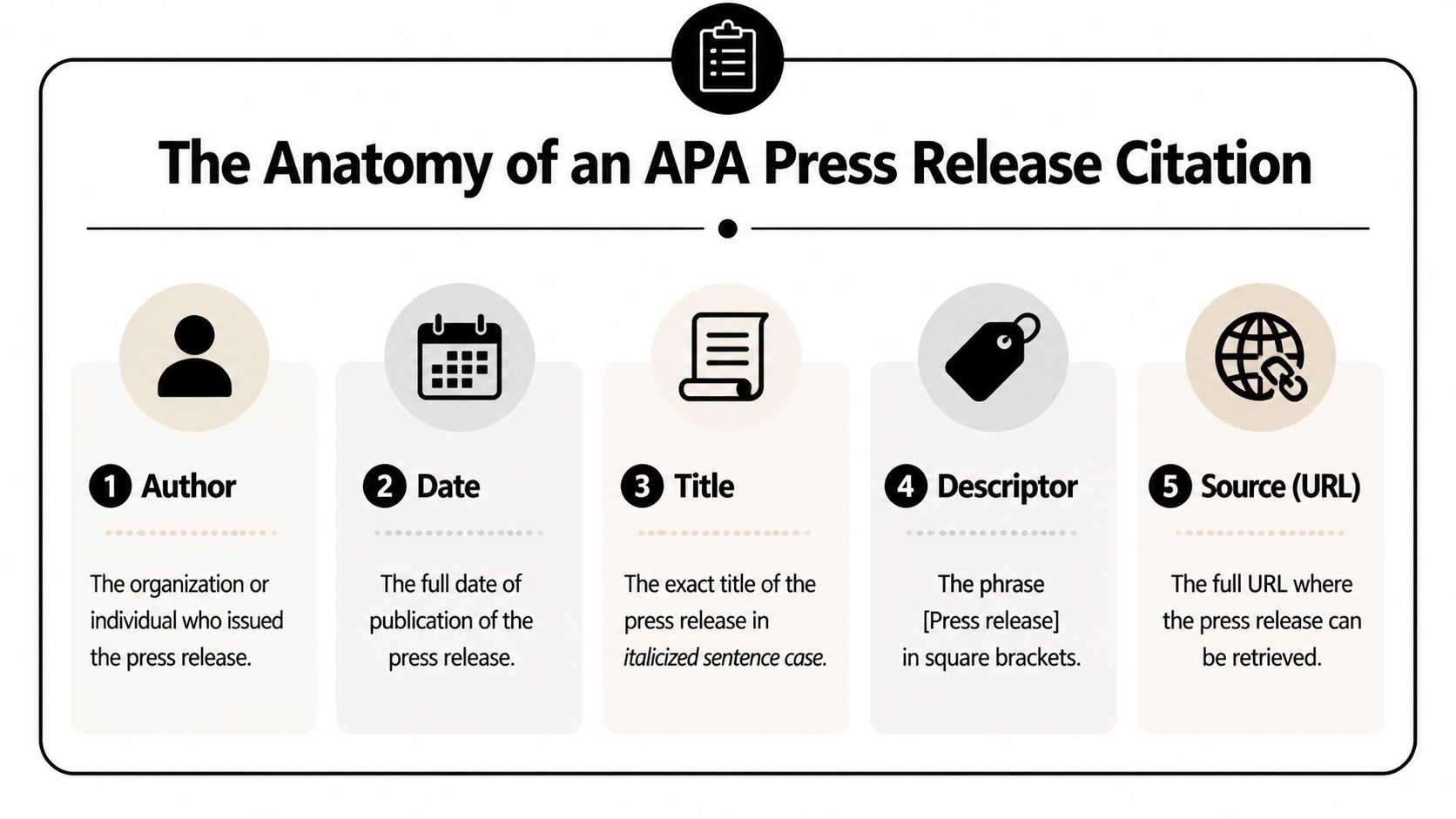
The five required components
| Component | What it is | Example |
|---|---|---|
| Author | The organization or individual who issued the press release | Microsoft |
| Date | The full publication date | (2024, May 10) |
| Title | The exact press release title in italicized sentence case | Microsoft announces new product update |
| Descriptor | The document label in square brackets | [Press release] |
| Source (URL) | The direct retrieval link | https://example.com/news/release |
APA press release citations use a stable five-part structure: author, date, title, descriptor, and URL. The pattern is simple. The judgment calls are not.
Why each piece matters
The author establishes who is responsible for the statement. In practice, that means identifying the issuing entity with care. If a release is posted through Business Wire or PR Newswire, the wire service is usually the delivery channel, not the author. If a parent company publishes a release on behalf of a subsidiary, use the name presented as the issuer on the release itself unless the page makes clear that the parent company issued it directly.
The date fixes the citation to a specific version of the statement. That matters when a newsroom post is revised after publication or when the wire copy and the corporate newsroom copy appear on different dates. Use the date attached to the version you consulted.
The title should match the published release title, formatted in sentence case and italics. Do not rewrite a promotional headline into something more academic. APA expects the published title, not an edited substitute.
The bracketed document label serves an important function. It tells the reader that the source is a press release rather than a general webpage, report, or article.
The descriptor often determines whether the reference reads as compliant or improvised. Leave out [Press release], and the entry loses the document-type signal that helps editors, reviewers, and fact-checkers classify the source correctly.
The URL should point to the exact version retrieved. That is where edge cases matter most. If the release appears both on a company newsroom page and on a distribution service, cite the version you used. If the wire version strips branding, changes formatting, or truncates attachments, I recommend checking the original newsroom posting before finalizing the citation. For teams also reviewing whether the release itself follows standard newsroom structure, this press release style guide with format examples and writing tips is a useful editorial check.
How to Write the Reference List Entry
A reference list entry for a press release has to do one job well: let a reader identify the exact release you used and retrieve that same version without confusion.
Organization Name. (Year, Month Day). Title of press release [Press release]. URL
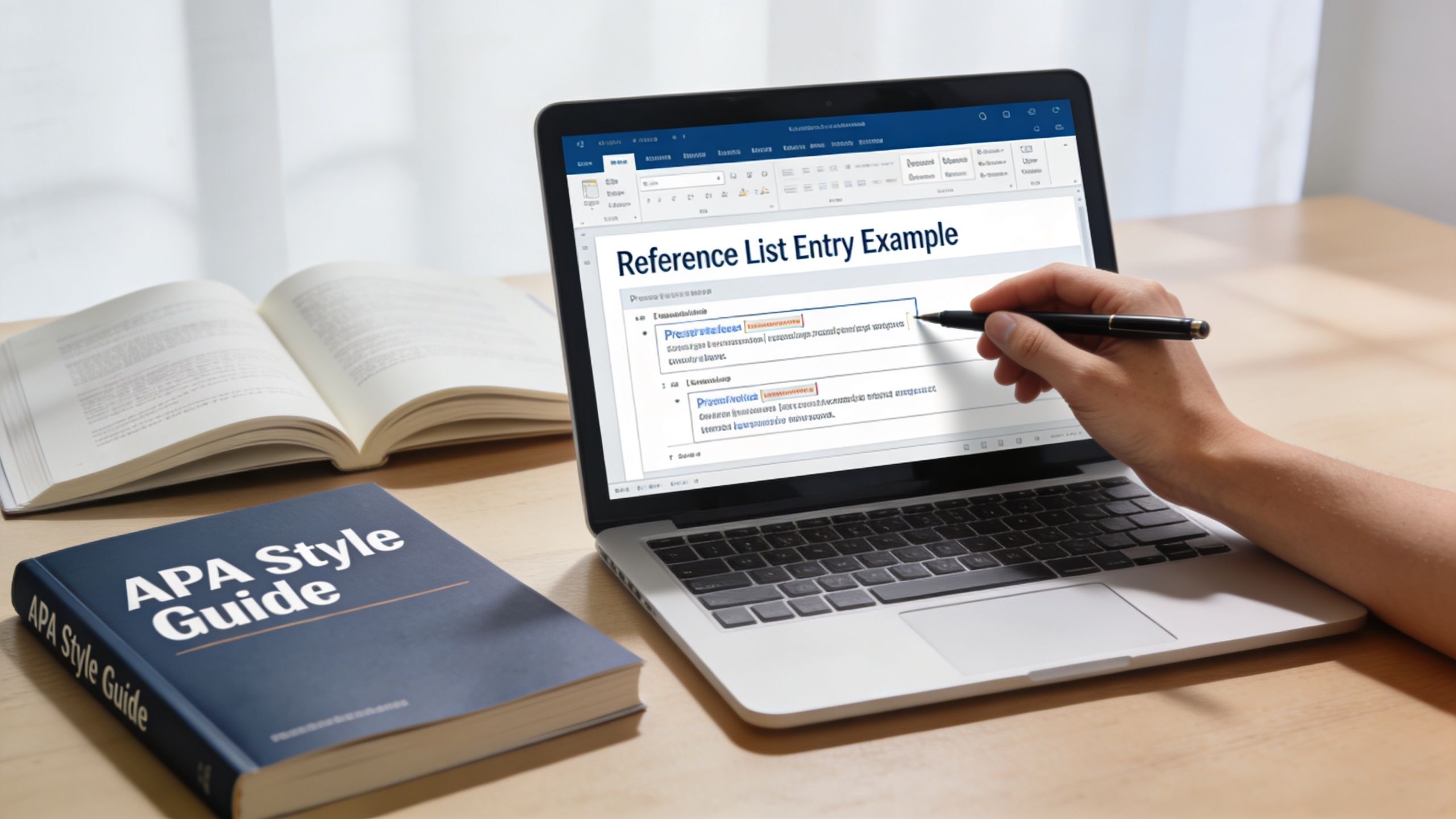
Use that template as your working model. In APA style, the organization typically serves as the author for a press release. The rest of the entry follows a fixed sequence: date, italicized title in sentence case, the bracketed label [Press release], and the URL.
That order matters because press releases often circulate in more than one place. A parent company may issue the release, a subsidiary may host it, and a wire service may distribute a near-duplicate version. Your reference should reflect the version you consulted, not the one that feels most recognizable.
Build the citation in the right order
Apply the elements in this sequence:
- Start with the organization name. Use the issuing body shown on the release. If the release is posted in a subsidiary newsroom, check whether the author is the subsidiary, the parent company, or a named corporate division.
- Add the full date in parentheses. Include year, month, and day exactly as published on the version you used.
- Insert the title in italics and sentence case. Preserve proper nouns, product names, and branded capitalization where needed.
- Add [Press release] immediately after the title. Keep the phrase in square brackets and do not italicize it.
- Finish with the direct URL. Point to the page for the specific release you used, whether that is the company newsroom or a distribution service archive.
A basic example looks like this:
Example citation:
Microsoft. (2024, May 10). Microsoft announces new product update [Press release]. https://example.com/news/release
Use that example for structure only. In actual editing, every element needs to match the published source exactly.
The formatting points PR teams miss
The most common errors are small, but they create a reference that looks improvised instead of compliant.
- Use sentence case for the title: Convert headline-style capitalization to sentence case unless a word is a proper noun or branded term.
- Italicize only the title: The bracketed source label stays in plain text.
- Keep the descriptor exact: Use [Press release] for a press release. Do not swap in a house term unless the source is genuinely a different document type.
- Do not add a separate publisher element when the author and publisher are the same organization: APA does not need the duplication.
One edge case deserves extra attention. If a release appears on GlobeNewswire, PR Newswire, Business Wire, and the company newsroom, those pages may not be identical. Distribution copies sometimes shorten titles, alter branding lines, or strip attachments. If your analysis depends on wording, cite the exact hosted version you read and make sure the organization named as author matches that version.
For a visual walkthrough, this short explainer is useful:
A practical editing habit
I check the reference from left to right in one pass: author, date, title, descriptor, URL. If the title is not italicized or [Press release] is missing, there is usually another error nearby, often the wrong corporate author or a URL pointing to a different version of the release. That quick audit catches problems before they reach review.
Handling In-Text Citations Correctly
The reference list entry handles retrieval. The in-text citation handles attribution inside the body of the document. For press release apa work, that usually means one of two forms: parenthetical or narrative.
Parenthetical citation
Use a parenthetical citation when the source appears at the end of the sentence.
Example:
The company stated that the product would roll out in phases (Microsoft, 2024).
This format is compact and works well in analytical writing where the source supports a factual point but doesn't need to be foregrounded.
Narrative citation
Use a narrative citation when you want the organization to appear as part of the sentence.
Example:
Microsoft (2024) stated that the product would roll out in phases.
This reads more naturally when you're comparing multiple organizational statements or discussing communications strategy over time.
Choose the version that keeps the sentence readable. APA cares about clear attribution, not mechanical repetition.
When teams get this wrong
Most mistakes fall into three patterns:
- Using the title instead of the organization: In APA, the author element drives the in-text citation.
- Adding the full date in-text: Standard in-text citations use the organization and year.
- Mismatch with the reference list: If the reference lists the parent company but the sentence cites the brand name, readers can't connect the two cleanly.
A simple rule helps. Use the same author name in the text that you used at the start of the reference entry. If your reference begins with “Apple,” your in-text citation should also use “Apple,” not “Apple Newsroom” or the title of the release.
Parallel examples
| Citation style | Example |
|---|---|
| Parenthetical | The company expanded the initiative (Apple, 2024). |
| Narrative | Apple (2024) announced the expansion of the initiative. |
That consistency is what makes the reference system work.
Navigating Common Citation Edge Cases
Standard APA examples assume a clean, single-entity source. Real PR work rarely stays that tidy. Releases come through investor relations portals, regional subsidiaries, franchise systems, and wire services. APA acknowledges part of this problem by stating that when the author and publisher are the same, you omit the publisher, but APA's press release reference guidance leaves limited direction for more complex structures.
Subsidiaries and parent companies
If a subsidiary issued the release under its own name, cite the subsidiary as author. Don't replace it with the parent company unless the parent is clearly the issuing entity on the release itself.
If both names appear, ask a functional question: who is taking public responsibility for the statement? In most cases, that's the entity named as the release issuer, not the holding company mentioned in boilerplate.
Editorial test: Cite the organization a journalist would identify as the issuer if they had to verify the announcement quickly.
For example, if a regional division publishes the release in its newsroom and the parent company appears only in background text, use the regional division as author. If investor relations for the parent company publishes a corporate earnings-related announcement, use the parent.
Wire services and distribution platforms
A distribution service such as PR Newswire or Cision often hosts the release, but that doesn't automatically make the platform the author. Treat the distribution service as a hosting channel, not the issuing body, unless the content clearly identifies a different responsible entity.
In practice:
- Company newsroom available: Cite the newsroom version you used.
- Only wire version available: Use the issuing organization as author and the wire URL as the retrieval source.
- Metadata conflict between wire and company site: Favor the version with clearer authorship and date information.
If your team is deciding which file format to circulate before publication, this guide on whether a press release should be PDF or Word is useful because source format can affect how easily readers verify the final published release.
Missing or messy publication details
Sometimes the release page is incomplete. Dates may be buried, titles may differ between page title and on-page heading, or the release may be republished in a media room without obvious authorship.
Use this order of preference:
- Use the organization named on the release page
- Use the publication date shown with the release
- Use the on-page release title, not a browser tab shortcut if they differ
- Use the URL of the version you accessed
If the organizational author isn't obvious, identify the most authoritative responsible entity. That's the practical standard for ambiguous corporate publishing environments.
Your APA Press Release Citation Checklist
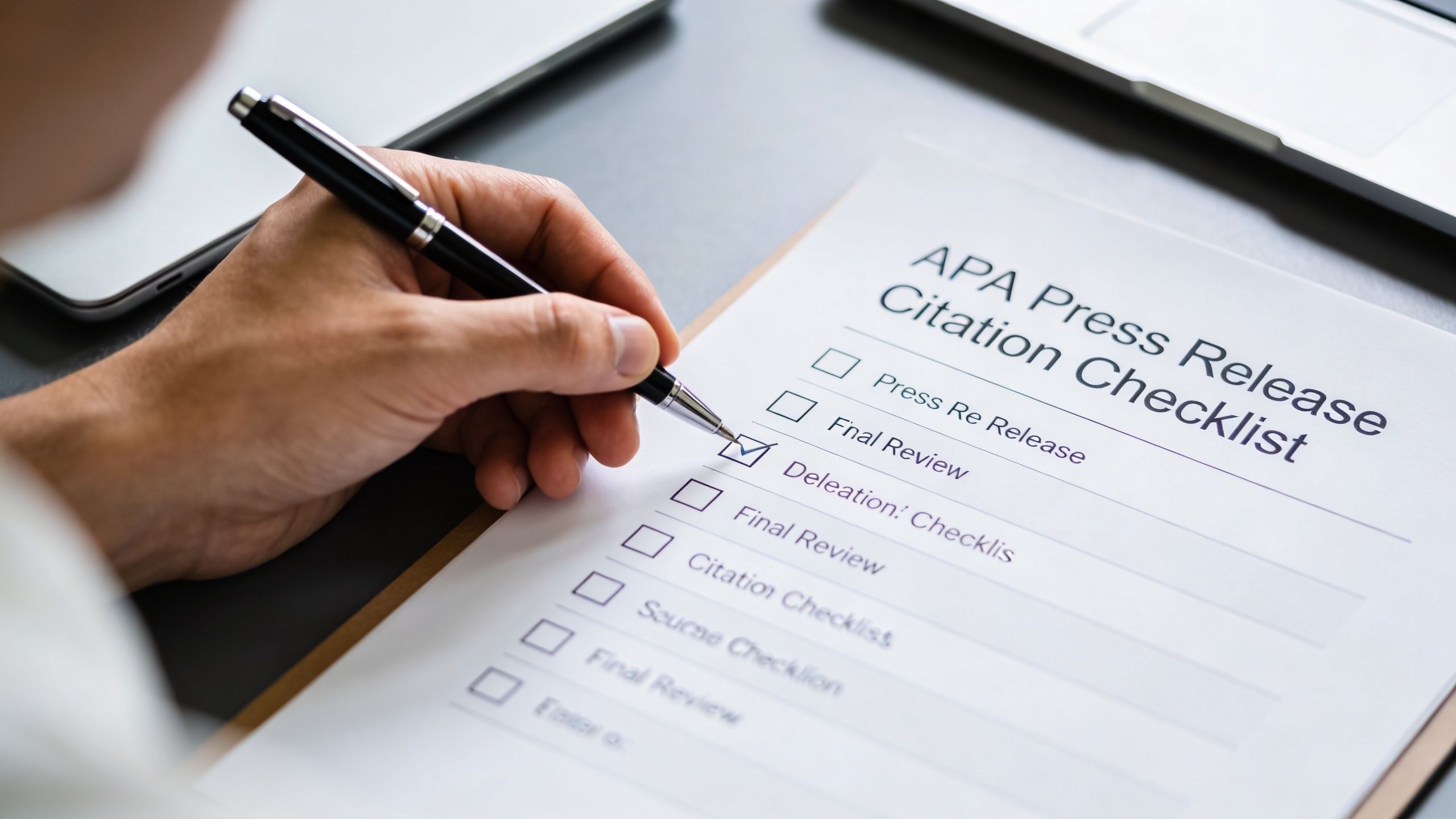
A strong citation should survive a final proofread without debate. Use this as a pre-flight review before you submit a report, publish a white paper, or send a client deliverable.
Final review list
- Verify the author name: Is the first element the organization that issued the press release?
- Check the date format: Does the reference include year, month, and day in parentheses?
- Confirm sentence case in the title: Is only the first word and any proper nouns capitalized?
- Italicize the title: Is the title italicized, with the bracketed descriptor left in regular type?
- Include the exact descriptor: Does the title end with [Press release] immediately after it?
- Use the correct URL: Does the citation point to the exact version you consulted?
- Match the in-text citation: Does the author name in the sentence or parenthetical citation match the reference list?
- Remove redundant publisher information: If the author and publisher are the same, have you omitted the publisher?
- Check edge-case logic: If the source came from a subsidiary, investor relations page, or wire service, does the author reflect the true issuer rather than the host platform?
Fastest manual audit
Read the citation backward from the URL to the author. That catches structural issues quickly because missing brackets, broken italics, and stray punctuation stand out more when you aren't reading for meaning.
A lot of citation mistakes come from copying the page and assuming the formatting is fine. It usually isn't.
Frequently Asked Questions About APA Citations
How do I cite a press release in print instead of online
Use the same basic reference structure, but omit the URL. The core format remains the organization name, full date, italicized title, and [Press release] label. The difference between print and online is minimal in APA practice.
What if the press release is a PDF
Treat the PDF as the source file for the same press release document. If the PDF is the version you accessed, cite the organization, date, title, [Press release], and the URL where the PDF can be retrieved. The file type doesn't change the source category by itself.
What if an individual author is listed
If a press release clearly names an individual author in addition to the organization, use editorial judgment based on how the release presents authorship. In most corporate releases, the organization remains the functional author. If the release explicitly credits a person as author, make sure that choice stays consistent in both the reference entry and the in-text citation.
Do I need a retrieval date
Not for a standard press release citation unless your institution or publisher has a special rule. The typical APA press release reference relies on the publication date and the direct URL.
What if the release title on the page doesn't match the browser tab
Use the title presented on the release itself. Browser tabs and social preview text often contain shortened or SEO-edited variants that aren't the formal document title.
Should I cite the newsroom page or the wire copy
Cite the specific version you used, but prefer the original issuing organization's newsroom page when both are available and substantively identical. If the wire copy is the only stable public version, use it and keep the issuing organization as author where appropriate.
How do I handle style differences across citation systems
Don't import MLA or Chicago habits into APA. The bracketed source descriptor matters in APA, and the author-date logic drives the in-text citation format. If you work across styles, this cross-style guide on how to cite a press release in Harvard, APA, MLA, Chicago, Turabian, and IEEE style is a practical comparison reference.
What's the most common press release apa mistake
In production work, it's usually one of three things: the wrong author, the missing [Press release] label, or the title left in promotional headline case instead of APA sentence case. All three are easy to miss when a team copies directly from a newsroom CMS.
If your team regularly writes, formats, and distributes announcements, Press Release Zen is a useful reference library for checking release structure, formatting choices, distribution questions, and citation details before documents go out.