Let's get one thing straight: not every bad day is a full-blown public relations crisis. A negative review stings, but it's not the end of the world. A product recall that puts customers at risk? That's an entirely different beast.
The real trouble begins when a small issue, left unchecked, spirals into a major threat to your brand’s reputation. Think of it like a small fire in the kitchen. If you act fast, it’s a minor inconvenience. If you ignore it, you risk burning the whole house down.
Defining a True Brand Emergency

Knowing the difference between a problem and a genuine crisis is the first, most critical step. A true brand emergency has a specific DNA that separates it from routine business challenges. It’s all about the scale, the speed, and the stakes.
Misjudging the situation can be catastrophic. Reacting too slowly almost always makes things worse, but overreacting to minor bumps can exhaust your team and damage credibility. Recognizing a true crisis allows you to pull the right levers and deploy the right resources at exactly the right time.
The Three Core Elements of a Crisis
So, how do you know you're officially in the hot seat? A genuine PR crisis ticks three specific boxes. If your situation has all three of these characteristics, it's time to shift into crisis mode.
- A Significant Threat: This isn't just about a few angry tweets. The event poses a real, substantial risk to your organization's operations, bottom line, or public reputation. It’s a threat that could fundamentally harm the business.
- The Element of Surprise: The crisis hits you out of the blue. Even if you’ve anticipated potential risks, the actual event—its timing, nature, or scale—catches you off guard and shatters your normal day-to-day operations.
- A Short Decision Time: Things are moving fast. The situation is unfolding in real-time, forcing you to make huge decisions with limited information and under immense pressure. The window to act is terrifyingly small.
A crisis is a high-impact event characterized by ambiguity and the need for swift action. It forces an organization to operate in a mode that is anything but business as usual.
This perfect storm of a major threat, a surprise attack, and a compressed timeline creates a pressure-cooker environment where every move you make is magnified. There’s simply no room for error. It's a shocking reality that while most executives expect to face a crisis, nearly 70% of businesses admit they don't have a formal plan. This is where reputations go to die.
Common Types of Public Relations Crises
To help you anticipate where trouble might come from, it's useful to categorize the kinds of crises organizations often face. Seeing them laid out can help you spot vulnerabilities in your own operations before they become front-page news.
Here's a breakdown of common crisis types:
| Crisis Category | Description | Example Scenario |
|---|---|---|
| Financial | A crisis involving the financial health of the organization, often leading to a loss of investor or public trust. | A publicly traded company announces unexpected major losses, triggering a stock price collapse and an SEC investigation. |
| Personnel | Issues stemming from the behavior of employees, from frontline staff to the C-suite. | A CEO is caught on video making offensive remarks, leading to public outrage and calls for their resignation. |
| Organizational | A crisis resulting from mismanagement, misconduct, or unethical practices within the company's operations. | A whistleblower reveals that a company has been knowingly cutting corners on safety regulations. |
| Technological | A failure of technology, such as a data breach, service outage, or industrial accident. | A major e-commerce site crashes during a holiday sale, or a cybersecurity breach exposes millions of user records. |
| Natural/External | Crises caused by external events beyond the company's direct control, like natural disasters or pandemics. | A manufacturing plant is destroyed by a hurricane, disrupting the global supply chain for a popular product. |
Recognizing these categories isn't about predicting the future; it's about preparing for it. Each type requires a slightly different playbook, but the core principles of rapid, honest communication remain the same.
Why This Definition Matters
If you're running a startup, a small business, or a nonprofit, your resources are already stretched thin. You can't afford to treat every problem like a five-alarm fire. Knowing the difference between a problem and a crisis helps you focus your energy where it counts.
This knowledge is the foundation of any solid crisis management strategy. Our guide on the essentials of crisis management in PR dives deeper into building that resilience. By learning to spot the warning signs of true public relations crises, you give your organization the best shot at controlling the story, protecting your hard-won reputation, and coming out stronger on the other side.
It’s one thing to talk about crisis plans and frameworks. It’s another thing entirely to live through one. The real lessons are learned in the trenches, where every decision can either save your brand or sink it completely.
Let's dissect two of the most famous PR crises in history. One is a masterclass in what not to do, while the other set the gold standard for getting it right. These aren't just stories; they're roadmaps showing what happens when leadership is tested under fire.
Lessons from Landmark Public Relations Crises
The Catastrophe of Detached Leadership
The BP Deepwater Horizon oil spill on April 20, 2010, is a textbook case of an operational failure snowballing into a full-blown reputational disaster. It started with a rig explosion that tragically killed 11 workers and tore a hole in the ocean floor.
For 87 excruciating days, the world watched as roughly 4.9 million barrels of crude oil poured into the Gulf of Mexico. The spill contaminated over 1,100 miles of coastline, devastating the environment and gutting local economies. Fisheries worth an estimated $2.5 billion a year were crippled.
But it was BP's PR response that turned a catastrophe into a corporate nightmare. The company’s first statements were slow, vague, and drastically downplayed the spill's size. This lack of transparency instantly fueled public rage and accusations of a cover-up.
This scorecard from The Pollack Group shows just how much the response matters.
A crisis handled poorly, like BP's, results in a long-term "loss" of public trust. The damage was personified by CEO Tony Hayward’s infamous, tone-deaf comment, "I'd like my life back," which became a symbol of corporate arrogance.
As public fury mounted, BP's stock price tanked by 50%, vaporizing $100 billion in market value. It’s a brutal reminder of how detached leadership and poor communication can be just as destructive as the crisis itself. You can find more on how PR failures make disasters worse at everything-pr.com.
The Gold Standard of Crisis Response
Now, let's flip the script. The 1982 Tylenol tampering incident is, to this day, the benchmark for flawless crisis management. The nightmare began when seven people in Chicago died after taking Tylenol capsules that had been laced with cyanide.
For Johnson & Johnson, Tylenol's parent company, this was an existential threat. It could have easily been the end of their flagship brand.
Instead of hiding or deflecting blame, Johnson & Johnson took immediate, decisive, and radical action. Their entire response was driven by one core principle: put people first, no matter the cost.
"We have to take the Tylenol off the shelves. It’s the only way to protect the public." – James Burke, CEO of Johnson & Johnson at the time.
That one decision set the tone for everything that followed. The company didn't just recall the affected batches; it pulled all 31 million bottles of Tylenol off shelves across the country. This move cost them over $100 million (a massive sum in 1982) but it sent a clear, powerful message.
Their communication was just as impressive:
- Full Cooperation: They worked hand-in-hand with law enforcement and the media, holding constant press briefings to keep everyone informed.
- Direct Communication: They set up toll-free hotlines for worried consumers and ran national ads to explain the danger and their response.
- Innovation: Just months later, Tylenol was back on the shelves in new, triple-sealed tamper-resistant packaging—an innovation that quickly became the industry standard.
By choosing people over profits and communicating with total honesty, Johnson & Johnson didn't just save Tylenol—they made the brand stronger. Trust returned, and Tylenol quickly regained its market share. This case proves that while you can't always control the crisis, you have absolute control over your response.
Your Crisis Communications Playbook
When a PR crisis hits, panic is your worst enemy. A solid playbook is your best defense, turning a chaotic firestorm into a managed process.
Think of it as the pre-written emergency plan that swaps confusion for clear, actionable steps. It’s what allows your team to act fast, with confidence, and protect the brand reputation you've worked so hard to build.
This playbook isn't a set of rigid, unbreakable rules. It's a flexible framework that walks your team through the essential phases—from those first chaotic moments to a coordinated, calm response. Following these steps gives you the structure needed to minimize the damage and start rebuilding on solid ground.
Assemble Your Crisis Team
Before a single word is said to the public, you need to know who has the authority to speak and act. Your first move is to assemble your Crisis Communications Team (CCT). This is a pre-selected group of leaders who will steer the ship through the storm.
Your CCT needs to be small, agile, and empowered to make decisions on the fly. It typically includes:
- Team Lead: The final decision-maker, often the CEO or another C-suite executive.
- Communications Lead: Your head of PR or marketing, who owns the overall strategy and messaging.
- Legal Counsel: Absolutely critical for reviewing every statement to manage legal risks.
- Operational Expert: The person who knows the technical or operational side of the crisis inside and out (e.g., Head of Product, Chief of Security).
- Customer Support Lead: Your eyes and ears on the front lines, managing the direct customer response and feeding back sentiment from the ground.
Once this team is in the "war room," their immediate job is to get a grip on the situation and prep the very first public communication.
Craft the Initial Holding Statement
In a crisis, silence isn’t golden—it’s damning. The media and the public expect to hear from you, and they expect it now. A holding statement is a short, concise message you must release within the first 60 minutes of a crisis becoming public.
Its job isn't to provide all the answers, because you won't have them yet. Its job is to show you're aware, you're taking action, and you're in control of the response.
A good holding statement must do five things:
- Acknowledge the incident in simple, clear language.
- Express empathy for anyone affected.
- State that you are actively investigating to get the facts.
- Outline the immediate actions you are taking.
- Promise a specific time or timeframe for your next update.
This initial message buys you precious time to gather more information without creating a vacuum. If you don't fill that void, speculation and rumor will rush in to fill it for you.
Gather Intelligence and Develop Messaging
With the holding statement out, your CCT can shift from pure reaction to proactive strategy. This means it's time to gather intelligence and nail down the facts. What do we know for sure? What is still just a rumor? Who has been impacted? This fact-finding mission is the bedrock of credible messaging.
Your core messages must be truthful, consistent across all channels, and tailored to your key audiences. They should answer three basic questions:
- What happened? (Give a factual, verified account of the event.)
- What are you doing about it? (Detail your immediate response and long-term plans.)
- Why won't it happen again? (Explain the corrective actions you'll take to prevent a recurrence.)
This infographic shows just how differently two major public relations crises played out based on the messaging approach.
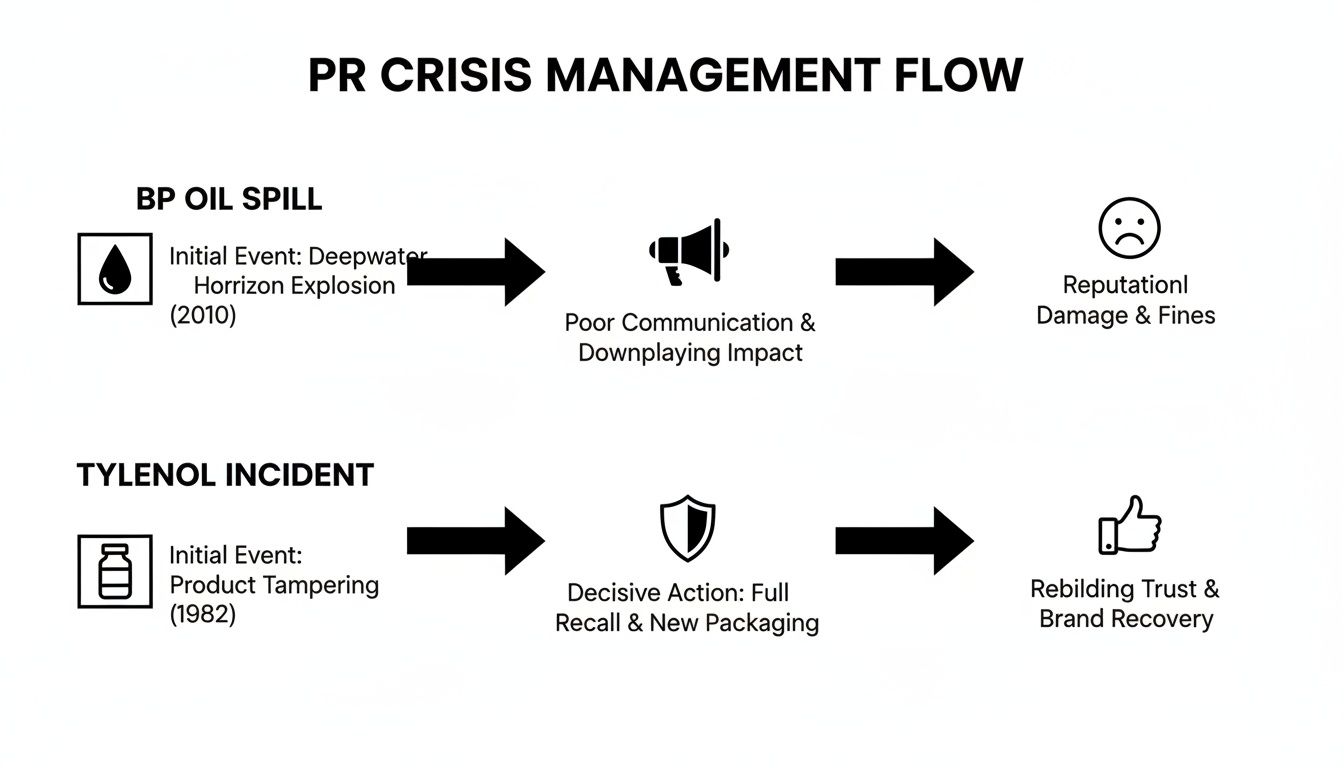
The difference couldn't be starker. Transparent, action-focused communication (like Tylenol's) builds trust, even in the worst circumstances. Evasive, defensive messaging (like BP's) destroys it.
Execute a Multi-Channel Response
Once your core messaging is locked down and greenlit by legal, it's time to execute. Your response has to be deployed across every relevant channel to reach all your different stakeholders. A piecemeal approach just creates more confusion. For a deeper look at the nuts and bolts of execution, check out our guide to crisis communication best practices.
Your multi-channel strategy should cover:
- Media Outreach: Send a formal press release to your key media contacts and get it posted in your online newsroom.
- Social Media: Push updates to all official channels. Just as importantly, actively monitor mentions and respond to questions using your approved messaging.
- Website: Spin up a dedicated crisis response page on your website. Make it a central hub for all updates, information, and contact details.
- Internal Communications: Tell your employees first. They are your brand ambassadors, and they need to hear the official position from you, not from the news.
- Direct Stakeholder Communication: Personally reach out to your most important clients, partners, and investors to give them context and reassurance.
By sticking to this playbook, you bring discipline to an otherwise chaotic process. It gives your team the structure they need to think clearly under immense pressure and make the right calls to protect your brand's future.
Navigating Crises in the Digital Age
Think of a traditional PR crisis as a kitchen fire. It’s bad, but with the right tools, you can usually contain it. A digital crisis, on the other hand, is a wildfire. Social media is the gasoline, and a single spark can set the entire landscape ablaze in minutes.
The speed, scale, and public nature of online platforms have completely rewritten the crisis playbook. Information—both true and false—travels at the speed of a share button. Outrage gets amplified by algorithms, and your audience is a global community armed with smartphones.
The Accelerant Effect of Social Media
Social media doesn't just report on a crisis; it fuels it. What might have been a single customer complaint can now morph into a global headline in a matter of hours. This means your communication strategy has to be built for speed and absolute transparency.
The 2018 Cambridge Analytica scandal is the textbook example. The world watched as it was revealed that the firm had scraped the personal data of 87 million Facebook users, all through a simple quiz app. This data was then weaponized for political advertising, igniting a firestorm over privacy that torched $134 billion from Facebook's market value in just two days. The #DeleteFacebook movement went viral, and public trust cratered.
In the digital age, a delayed response is a failed response. The court of public opinion convenes instantly on social media, and your silence will be held against you.
It took Facebook's leadership four agonizingly long days before CEO Mark Zuckerberg issued a public statement. That four-day gap felt like an eternity and was widely seen as a deliberate refusal to take responsibility. It allowed public anger to cement a narrative of corporate greed and negligence. The lesson was brutal: when a crisis explodes online, the clock is ticking in seconds, not days.
New Triggers and New Tactics
Today's world has introduced a whole new set of tripwires for brands. Things like data breaches, privacy blunders, and viral misinformation campaigns are now common catalysts for a full-blown brand emergency. If you have any kind of digital presence, you simply have to prepare for these scenarios.
- Social Media Monitoring: You need real-time "eyes and ears" on all social platforms. This isn't just about PR; it's critical business intelligence. You have to be tracking brand mentions, sentiment, and the stories people are starting to tell about you.
- Preparing for Backlash: Any big announcement or marketing campaign has the potential to blow up in your face. Your team needs to war-game the worst-case reactions and have response templates ready for the most likely criticisms.
- Digital-First Communication: When things go south, your website and social media channels are ground zero. Your first statement and every single update need to be designed for these platforms first.
In this environment, a thorough social media investigation is no longer a "nice-to-have." It's an essential part of understanding what people are saying, identifying the source of misinformation, and responding with precision.
The Facebook/Cambridge Analytica saga taught us some hard lessons. While the $5 billion FTC fine was staggering, the real long-term damage was the deep erosion of user trust. It proved that for any brand today, a proactive, transparent, and digitally-savvy approach to managing public relations crises isn't just a good idea—it's a matter of survival.
From Response to Recovery and Rebuilding Trust
Making it through the initial chaos of a PR crisis isn't the end of the road. In fact, it's more like the halfway mark. The immediate fire might be out, but now the real work begins: the methodical, often painstaking process of recovery and rebuilding the trust you’ve lost.
This next phase shifts your focus from immediate damage control to a deep, honest internal review. The point isn’t to point fingers or assign blame. Think of it as a clear-eyed post-mortem to figure out exactly what went wrong, so you can make sure it never, ever happens again.
Conducting a Post-Mortem Analysis
Once the dust has settled and the phones stop ringing off the hook, it's time for your crisis team to get back together. This isn’t just a quick recap meeting; it's a full-blown investigation to analyze the event and how your team handled every minute of it. A structured analysis is the only way to get the clarity you need to come out of this stronger.
Your post-mortem should dig into a few critical questions:
- The Real Cause: What was the true, underlying trigger? Was this a one-off mistake, or a sign of a deeper, systemic problem in our culture or processes?
- Response Report Card: What parts of our crisis plan actually worked under pressure? More importantly, where did we drop the ball?
- Message Impact: Did our statements and apologies hit the mark? Were they clear, sincere, and did they reach the right audiences?
- Team Dynamics: How did the crisis team hold up? Were roles clearly defined, or was there confusion? Were decisions made swiftly and effectively?
Gathering this feedback from everyone involved—from the executive suite right down to the customer service reps on the front lines—gives you a 360-degree view of the situation. This raw honesty is what lays the foundation for real, meaningful change.
Measuring Impact and Relaunching Your Brand
After a crisis, you can't just cross your fingers and hope public opinion swings back in your favor. You have to measure it. A critical first step in rebuilding is to accurately measure brand perception. This means tracking social media sentiment, the tone of media coverage, and direct customer feedback.
The recovery phase is a true test of a company's character. It's your chance to show everyone you're accountable and that your apology was more than just words. It’s about showing, not just telling, stakeholders that you’ve learned and changed.
With hard data in hand, you can set realistic goals for your recovery. The final step is to shift into proactive communication that moves beyond just saying sorry. This is where you highlight the concrete changes you've implemented, showcase new safety measures, or introduce fresh leadership.
An apology cracks open the door to forgiveness, but it's the tangible actions that truly rebuild a shattered reputation. For a detailed walkthrough on this, our guide on how to write an apology press release provides actionable examples. This forward-looking communication proves you’ve learned your lesson and renews your commitment to your customers and the public.
Frequently Asked Questions About Crisis Management
When a crisis hits, the questions start flying. Leaders need answers, and they need them fast. This section tackles some of the most common—and critical—questions we hear, giving you the clear, straightforward advice you need to act with confidence when every second matters.
How Quickly Must We Respond to a Crisis?
You have to move almost instantly. The first 60 minutes after a crisis explodes into the public eye is what we call the "golden hour" of communications. Your only job in this window is to get an initial holding statement out the door.
This isn't about having all the answers yet. It's about taking control of the story. You need to show you’re aware of the situation, you’re taking it seriously, and you’re on it. In the age of social media, if you don't fill that information vacuum, someone else will—usually with rumors and bad information. Speed isn't just a suggestion; it's a requirement.
What Is the Biggest Mistake Companies Make?
Without a doubt, the most damaging thing you can do is say "no comment" or, almost as bad, try to downplay how serious the situation is. Both reactions scream that you're either hiding something or you're too arrogant to care. Trust evaporates in an instant.
A "no comment" is never seen as a neutral response. To the public and the media, it sounds like an admission of guilt. This single phrase can inflict more lasting damage to your reputation than the crisis itself.
When things go wrong, people are looking for two things: accountability and empathy. Staying silent suggests you have neither. It leaves everyone to assume the absolute worst. Being transparent, even when the truth is ugly, is always the better path.
Can a Small Business Afford a Crisis Plan?
Let’s flip that question: can a small business afford not to have one? The cost of having your reputation torched is infinitely higher than the time it takes to put a basic plan on paper. You don't need a huge communications budget to get ready.
A lean, effective crisis plan can be built with just a few key steps:
- Pre-draft templates for holding statements and press releases.
- Assign crisis roles to your existing team so everyone knows their job when the pressure is on.
- Build a contact list of key media and stakeholders before you ever need it.
- Run simple tabletop drills to walk through a potential scenario and see where the holes are.
Preparedness is a mindset, not a budget line item. For a small business or nonprofit, a simple plan is the most valuable insurance policy you can own.
At Press Release Zen, we provide the templates and guides you need to build a robust crisis communications plan. Explore our resources to protect and strengthen your brand at https://pressreleasezen.com.