The most popular advice treats press releases like relics, as if social posts and influencer campaigns replaced them. That advice misses what the format does in 2026. A press release is still one of the few ways to package company news so journalists, search systems, and AI-driven discovery can parse it quickly, verify it faster, and decide whether it matters.
For businesses, that matters because importance is not about nostalgia. It's about whether a communication format can turn a real announcement into something structured, credible, and easy to reuse. When a release is written well, it can support earned media, owned discoverability, and the kind of message clarity that ad hoc posting rarely delivers.
Table of Contents
- The Press Release Is Not Dead
- Core Reasons Press Releases Drive Business Value
- SEO and Discoverability Benefits in the AI Era
- Real-World Use Cases Across Industries
- How to Measure Press Release Impact
- Common Misconceptions About Press Releases
- Your Action Plan for Writing and Distributing a Press Release
The Press Release Is Not Dead
The claim that press releases are dead usually comes from people judging them by bad examples. A weak release reads like corporate filler. A strong release does something different, it turns a newsworthy update into a format that journalists can scan, search systems can index, and AI tools can interpret without guesswork.
That is why the format persists. A press release still packages the headline, lead paragraph, body, boilerplate, and contact information in a way that helps editors extract the five W's and H quickly. That structure can reduce the time needed to verify and rewrite an announcement, as noted in Purdue OWL's press release guidance. It also helps explain why the format still has a place for teams that want a reality check on whether press releases are worth it in 2026.
Structure beats noise
Modern releases are not just a megaphone. They are a structured evidence packet. When a release is built around one clear angle and supported with context, it becomes easier for a journalist to separate a real development from routine self-promotion.
The best practical advice still starts with the basics, and a useful companion for that is effective press release tips from SubmitMySaas, especially for teams that want to tighten the headline, lead, and proof points before sending anything out.
A lot of founders assume social media can replace this work. It cannot, because social posts are usually fragmented, time-bound, and hard to verify later. A release gives the news a stable, citable home.
Practical rule: if the update would make sense only as a post or a caption, it probably does not deserve a press release yet.
Press releases also force discipline. The format makes teams answer what happened, why it matters, and who should care. That clarity is a business asset, not a media vanity exercise.
Core Reasons Press Releases Drive Business Value

A press release earns its keep when it serves the newsroom and the business at the same time. It turns one announcement into a usable record, gives editors a clean version of the facts, and creates a source that the company can reuse across sales, investor, and customer conversations. That is the business case, not the inflated promise that every release will generate headlines.
It reduces the editorial burden
Editors and reporters sort through a lot of pitches. A release that leads with the announcement, explains why it matters, and includes the basic contact and background details is easier to work with than a thin email thread or a vague outreach note. The format, as described by Purdue OWL, gives the editor a fast way to check the essentials and decide whether the story deserves attention.
That matters most in a crowded inbox. If the release states the news clearly and keeps the boilerplate clean, the journalist spends less time reconstructing the facts and more time judging the angle. Less reconstruction means less friction, and less friction improves the odds that the announcement is handled while it still feels timely.
It builds credibility through proof
A release works best when it reads like evidence, not a sales pitch. For technical or product-heavy announcements, the strongest versions translate features into claims that can be checked, using supporting data, quotes, multimedia, and clear differentiators, according to Newswire Canada's guidance for tech companies.
That distinction has commercial value. Self-promotion rarely travels far on its own. A release that gives a third party enough context to repeat the update accurately has a better chance of earning pickup, and even limited pickup can signal that the announcement passed an outside relevance test.
It extends the reach of owned channels
Owned channels matter, but they are still limited by who already follows the brand. A release can move beyond that circle when distributors, journalists, newsletters, and aggregators reuse it. That is the hidden ROI many teams miss. They look only at immediate traffic and overlook the way a structured announcement keeps showing up as a reference point after the first publish date.
A release works best when other people can reuse the story cleanly, not when the company only wants to broadcast it once.
The difference between earned media value and owned discoverability starts to matter here. A distribution platform can widen exposure, but the stronger asset is the permanent record that search engines, analysts, and AI systems can read later. For that reason, a release should also be built with press releases for SEO in mind, because the same document can serve both immediate media outreach and long-tail discoverability.
A disciplined announcement strategy also keeps the strongest proof point near the top, where it can be seen quickly. Research-based PR guidance emphasizes using only the most relevant three to five statistics, with each number backed by a credible source and explained in context, as noted in this 2026 PRLab guidance. That is not decoration, it is how business value gets communicated fast without overclaiming what a release can realistically do.
The payoff is usually uneven, and that is normal. One release may bring a journalist response, another may strengthen branded search, and a third may do most of its work by giving the company a cleaner, more authoritative footprint online. The goal is to understand those different returns and write for the ones that compound.
SEO and Discoverability Benefits in the AI Era

The core SEO question is not whether every release ranks. It's whether a release improves discoverability in ways that matter when traditional pickup is uncertain. That includes branded search, entity clarity, and the ability for search and AI systems to understand what the company announced.
Precision matters more than distribution volume
A lot of press release advice still repeats the old distribution-first mindset. That's too simplistic. Current guidance is more focused on distribution strategy, multimedia assets, targeted media lists, time-zone-aware timing, and one clear angle, which points to precision rather than volume as the performance lever, as noted by PR Newswire's resource on press release benefits.
That distinction matters because the search value of a release usually comes from relevance, not from raw blast size. A precise announcement is easier to associate with the right topic, the right audience, and the right entity. A broad, vague one is easy to ignore.
For teams trying to understand how AI-era discovery works, the LLMrefs guide to AEO is a useful complement, because it frames visibility around clear entities, clean language, and content that machines can parse without confusion.
Owned visibility and earned pickup are different outcomes
A release can create owned visibility even without major coverage. It gives the company a clean page to link from, cite in follow-up outreach, and reference in later reporting. That's useful, but it isn't the same as earned media value. Earned pickup still depends on whether the topic is timely and whether the release gives editors a reason to care.
That's why the business ROI is often hidden. The release may not drive a flood of traffic on day one, but it can support branded search, reinforce entity recognition, and serve as a source document when customers, analysts, or journalists look the company up later.
If discoverability is a priority, the press release SEO playbook can help teams think about formatting and on-page clarity without pretending that every announcement is an SEO win.
AI systems reward clarity
AI tools need organized signals. Releases that state what happened, who is involved, and why it matters give those systems less room for error. That doesn't guarantee visibility, but it improves the odds that the announcement will be understood correctly.
In 2026, that's the realistic advantage. A press release is not a magic ranking trick. It is a structured public record that can help people and systems identify the company, the news, and the context with less friction.
Real-World Use Cases Across Industries
A press release earns its keep when the announcement changes something outside the company. That is the dividing line. A minor internal update belongs in a blog post or staff memo. A public change with market relevance belongs in the formal release format.
Different industries, same logic
Real estate teams use releases for property launches, portfolio updates, and market reports because those announcements affect buyers, tenants, and local media interest. Nonprofits use them for campaign launches, funding milestones, and event announcements because public visibility can bring donors, volunteers, or partner attention. Retail teams use them for store openings and product launches because those are clear consumer-facing events with a time-sensitive angle.
Tech companies have a sharper need for the format. Product specifications, feature releases, and infrastructure changes can sound like jargon unless they are turned into evidence-backed stories. The release format matters here because it turns technical detail into something journalists and analysts can evaluate as news rather than promotional copy. Newswire Canada's tech release guidance makes the same practical point about clarity and relevance.
Crisis and leadership moments need different treatment
Executive transitions, compliance updates, and crisis communications all call for the same structural discipline. The language has to be clear, factual, and easy to quote correctly. In those moments, a press release is less about promotion and more about reducing confusion.
The best crisis release does not try to win attention, it tries to control ambiguity.
Leadership changes need that treatment too. A properly written release gives outside stakeholders a stable reference point, which is better than forcing people to reconstruct the story from scattered posts and rumors.
Newsworthiness is the filter
A routine staffing note, a vague partnership, or a recycled milestone usually will not move anyone. The release works when the business event affects a market, a customer group, or a professional community that cares about the outcome.
That filter protects credibility. Teams that publish only meaningful releases build a stronger expectation of relevance over time. Teams that overuse the format train reporters to ignore them.
For teams trying to separate useful output from noise, the press release KPI framework is a practical way to judge whether the announcement supported real visibility, not just activity.
How to Measure Press Release Impact
A press release is only valuable if the team can tell what it changed. Measurement should start with the release's purpose, not with a vanity dashboard. Different announcements produce different outcomes, and the right scorecard depends on whether the goal was coverage, discoverability, audience response, or all three.
Track the right category for the right goal
| Metric Category | Specific Metric | What It Tells You | Realistic Benchmark |
|---|---|---|---|
| Media pickup | Editorial mentions | Whether journalists found the story relevant | Coverage varies by topic and outlet |
| Discoverability | Branded search activity | Whether the announcement increased name recognition | Look for directional change, not instant spikes |
| Referral quality | Clicks from media and syndication pages | Whether readers moved from coverage to owned assets | Track source quality, not just total visits |
| Message pickup | Quote or fact reuse | Whether the release gave editors reusable material | Stronger when the release is tight and specific |
| Timing | Publication response window | Whether the release landed when attention was available | Higher response is more likely in the Tuesday to Thursday window between 8 a.m. and 1 p.m. per PRLab's timing guidance |
The timing point matters because distribution is not just about writing. It's also about sending the release when media attention is highest, which PRLab highlights as Tuesday through Thursday between 8 a.m. and 1 p.m. The message can be excellent and still underperform if it lands at the wrong moment.
Use attribution carefully
Press release ROI gets overstated when teams credit every later win to the release. That's lazy measurement. A better approach is to map the release against the actual business objective, then look for connected evidence, such as pickups, branded queries, or referral traffic from the publication that covered it.
The release planning page at Press Release Zen's KPI guide can help teams build a cleaner internal scorecard, especially when different departments want different definitions of success.
Ignore the wrong signals
A high send count does not prove impact. Neither does a large number of social impressions if nobody clicked through or quoted the story. The more useful question is whether the release made the company easier to find, easier to cite, or easier to understand.
That's the true ROI test. If the announcement left behind a clearer public record and supported future discoverability, it did more than generate activity. It created reusable value.
Common Misconceptions About Press Releases
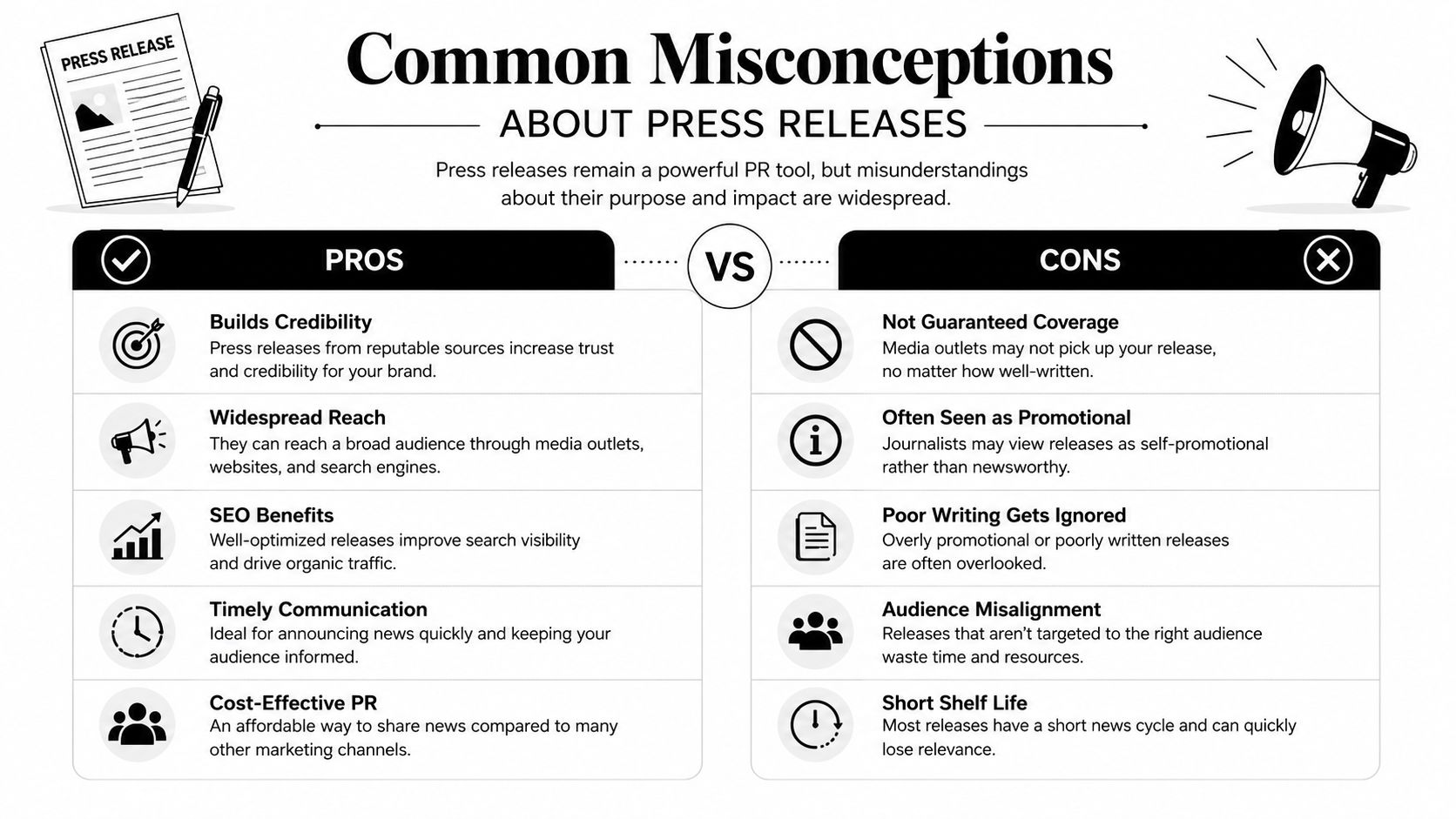
A lot of weak press release advice starts with a bad assumption about what the format is supposed to do. Once that is corrected, the common myths become easier to see for what they are.
Myth one, any news is press release news
A company update does not become newsworthy just because the team is excited about it. Internal enthusiasm does not make a story relevant to anyone outside the business. The announcement needs a public reason to exist, whether that reason is market impact, customer relevance, technical significance, or community value.
Myth two, wider distribution always helps
That idea sounds practical, but it misses how distribution works in the field. Distribution performs better when the list is targeted, the angle is singular, the timing reflects the audience's day, and the release includes useful media assets, which is the kind of approach reflected in PR Newswire's resource on press release benefits. Broad distribution can still make sense, but only if the story has enough substance to justify wider exposure.
Myth three, press releases are only for links
That view is too narrow. A release can support search visibility, analyst awareness, and editorial pickup even when the direct link value is limited. Treating the format like a link-building shortcut usually weakens the writing, because the team starts optimizing for placement instead of news value.
Myth four, one release creates lasting attention
A single release rarely carries attention for long on its own. It creates a moment, a reference point, or a citation source. Follow-up content, outreach, and product momentum still matter. The release is the container, not the whole campaign.
Use the statistic to explain the implication, not to decorate the paragraph.
That matters most in headline writing. Headline style has more influence than many teams admit. Research-based PR guidance notes that headlines using odd numbers, question phrasing, or punctuation such as a colon or hyphen can achieve click-through rates up to 21% higher than average for eight-word headlines, while odd-numbered lists can see about 20% higher CTR according to Journolink. The point is not to force gimmicks. It is to shape the headline so the reader sees a clear reason to open it.
A release works when it respects the reader's time. If the first paragraph answers the “so what” immediately and the data points are tied to context, the release has a much better chance of being read, reused, and remembered.
Your Action Plan for Writing and Distributing a Press Release
Start with a real news event, not a marketing wish. Then write the release so the core announcement is clear in the headline and first paragraph, because journalists need the point quickly. Keep the body concise, around 300 to 500 words, which aligns with the practical writing benchmark and the reported average press release length of about 400 words in 2025 from PRLab's 2026 statistics guide.

Use only the most relevant three to five statistics, and make sure every number is tied to a credible source and a clear implication, as the PR guidance recommends in the same PRLab reference. Then choose distribution based on who should care, not on how many inboxes can be hit. Timing still matters too, and the best pickup windows are highlighted as Tuesday through Thursday between 8 a.m. and 1 p.m. in that same source.
If the release is meant to support SEO or AI-era discovery, keep the wording clean, the entities obvious, and the angle singular. If the update is better suited to a blog post, social announcement, or direct pitch, use that instead. A press release is most useful when the story deserves a public record and needs to travel across media, search, and stakeholder channels with minimal friction.
Press Release Zen helps teams plan, write, and distribute releases with a clear structure, practical templates, and guidance that fits real newsroom expectations. For a straightforward way to turn an announcement into something journalists and search systems can use, visit Press Release Zen and compare its release-writing resources with your next launch, update, or company milestone.