Your phone lights up before breakfast. A customer posts a video accusing your company of negligence. An employee replies from a personal account. Sales wants a statement. Legal wants silence. Your founder is texting half-written responses to the marketing lead. By 10 a.m., the issue isn’t just the incident. It’s the confusion around it.
That’s when teams realize they never needed a generic document. They needed a working sample crisis communication plan that tells people exactly who decides, who speaks, what gets paused, and what gets said first.
A usable plan isn’t a binder that sits untouched until something goes wrong. It’s an operating system. It assigns roles, controls message flow, creates escalation paths, and keeps the organization from making a bad day worse. If you’re building your first plan, that’s the standard to aim for.
Why You Need a Plan Before the Crisis Hits
A crisis rarely starts with a formal alert. It starts with fragments.
A customer complaint becomes a thread. A local reporter emails for comment. Someone in operations says the issue is contained. Someone in customer service says it isn’t. Leadership asks for facts that don’t yet exist. Meanwhile, the public sees silence and fills in the gaps.

That pattern is common in small businesses and growing organizations because nobody has decided three critical things in advance:
- Who owns the response
- Who can approve a statement
- Which channels get used first
Without those decisions, the first hour gets wasted on internal debate. The public doesn’t see your process. They only see delay, contradiction, and defensiveness.
What unprepared teams usually get wrong
The first mistake is treating crisis communication as a writing problem. It’s a command problem.
Teams often assume they can draft something once they know more. In practice, they need a structure before they know everything. That means a call tree, a spokesperson, a holding statement, and a clear rule that nobody improvises publicly until the response team aligns.
The second mistake is thinking crisis planning is only for big brands. It isn’t. A small retailer, nonprofit, startup, school, or local service business can face a reputational event just as quickly. If anything, smaller teams have less margin for confusion.
Practical rule: If your team is deciding who should talk after the incident starts, you’re already behind.
The case that still defines modern planning
The reason practitioners still talk about Tylenol isn’t nostalgia. It’s because the response showed what disciplined communication can do under pressure.
According to the CDC CERC material, Johnson & Johnson's 1982 Tylenol crisis response plan allowed the company to recover 70% of its market share within a year, despite a $100 million initial loss. The response relied on pre-defined roles, rapid recall, and transparent updates, and it still shapes modern templates today through the same operational logic used in crisis plans now. The CDC summary of that benchmark is in its CERC crisis communication planning guidance.
That’s the lesson. The plan didn’t remove the crisis. It gave the company a way to act quickly, speak clearly, and protect trust while the facts developed.
If you need a broader foundation before building your template, this overview of what is crisis management in PR, types, benefits, examples gives useful context on where communication fits inside the larger response.
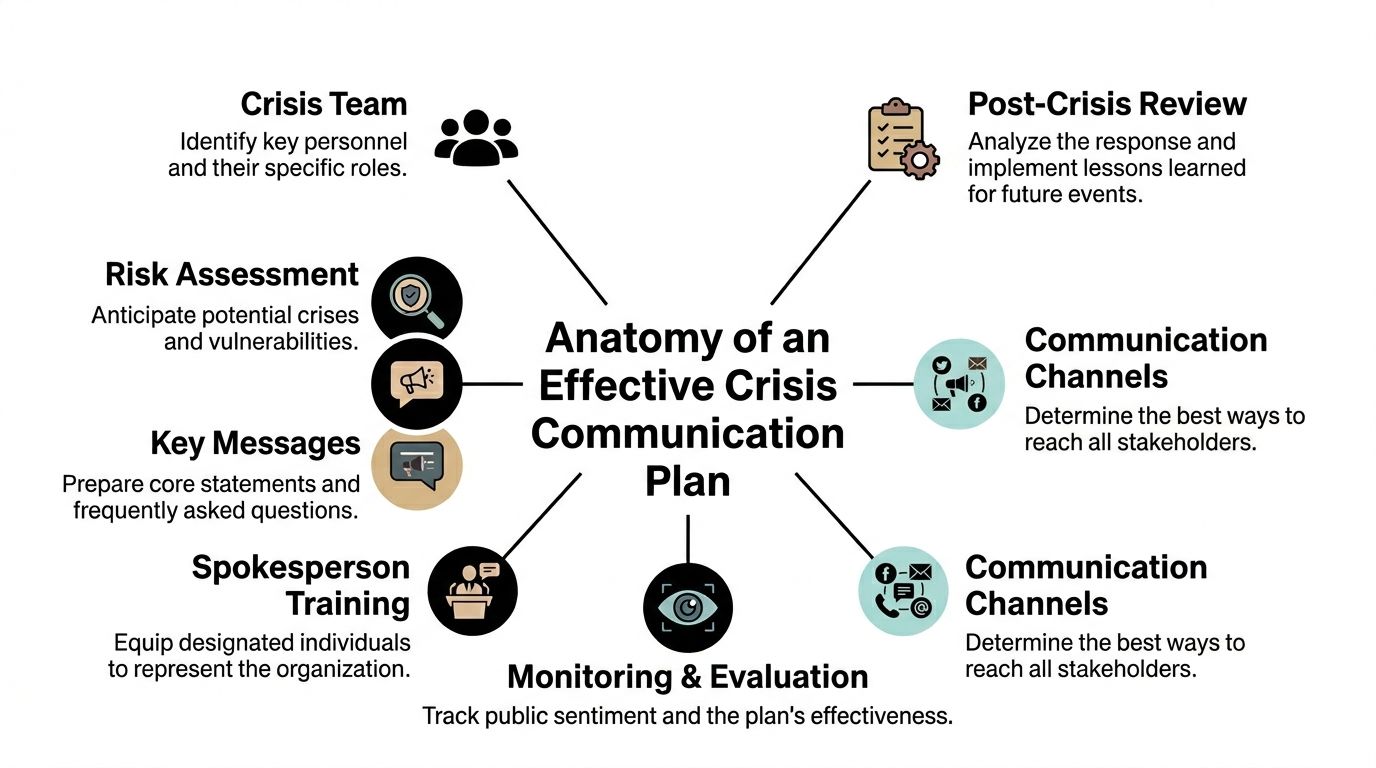
Anatomy of an Effective Crisis Communication Plan
A strong sample crisis communication plan isn’t a stack of sample statements. It’s a decision framework that people can use under pressure.
The most reliable structure still comes from the CDC’s CERC model because it forces teams to think in phases, not just announcements. In the cited template literature, the CDC's CERC framework has been adopted by over 80% of US public health agencies, reduced public panic by 40% during the 2009 H1N1 pandemic, and plans based on this model cut response time by 50% through pre-approved templates and defined crisis phases. That summary appears in the Georgia Libraries crisis communication template.
The sections that belong in the document
If I’m reviewing a client’s first draft, I look for these components before I worry about wording polish.
| Plan component | What it must include | Why it matters |
|---|---|---|
| Activation criteria | Clear triggers for when the plan starts | Prevents debate over whether the issue is “serious enough” |
| Crisis team roster | Names, roles, mobile numbers, backups | Cuts time lost chasing people |
| Approval chain | Who clears statements and in what order | Stops last-minute message rewrites from too many stakeholders |
| Stakeholder matrix | Employees, customers, media, partners, regulators, community groups | Keeps teams from addressing only the loudest audience |
| Holding statements | Short pre-approved drafts for likely scenarios | Lets you respond before every fact is known |
| Channel plan | Website, email, social, press release, internal comms | Matches the message to the audience |
| Monitoring log | Media inquiries, social themes, misinformation, response status | Creates visibility and accountability |
| Recovery materials | Follow-up updates, apology language if needed, progress communications | Extends the plan beyond day one |
A lot of teams skip the stakeholder matrix and media log because they look administrative. That’s a mistake. In a live incident, those two tools often reveal whether your response is coordinated or fragmented.
What each component actually does in practice
The activation criteria matter because hesitation is expensive. If a product safety complaint trends, a staff member is arrested, a cyber event affects customer access, or a local outlet requests urgent comment, somebody needs authority to activate the plan without waiting for a perfect briefing.
The holding statement matters because silence gets interpreted as indifference or concealment. A good holding statement does four things:
- Acknowledges the issue without speculation
- States what the organization is doing right now
- Shows concern for affected people
- Commits to further updates through a named channel
The stakeholder matrix prevents one of the most common errors in crisis work. Teams draft for the media and forget employees. Then staff learn about the issue from social media and start answering questions without guidance.
Plans fail when they assume one message works for every audience. It doesn’t. Employees need direction, customers need practical updates, and reporters need verified facts.
The monitoring log sounds simple, but it’s where you track reality. What questions keep repeating? Which claim is spreading fastest? Which reporter is on deadline? Which false point needs correction and which one should be ignored? If your team doesn’t log those signals, response quality drops quickly.
Don’t confuse a template with readiness
A downloadable template is useful only after you adapt it to your organization.
That means replacing placeholders with real names, real numbers, real channels, and real escalation paths. It also means deciding who has the final word when legal, operations, and communications disagree. If that conflict isn’t resolved in advance, the template becomes decorative.
For teams refining the broader communications side of this work, EvergreenFeed has a solid primer on building an effective communication plan and strategy. It’s helpful because crisis planning works better when it sits on top of an existing communication discipline instead of trying to invent one mid-incident.
Assembling Your Crisis Response Team
Plans don’t execute themselves. People do.
The teams that handle crises well usually keep the core group small. They pull in specialists when needed, but they don’t invite everyone into the command loop. Too many voices slow approvals and blur responsibility.
The benchmark guidance tied to crisis planning shows that organizations with tested crisis plans reduce response time by 50-70%, and 62% of untested plans fail because a designated and trained spokesperson is missing. That finding is summarized in Mississippi State Extension’s guidance on preparing to respond in four steps.
Keep the core team lean
A practical crisis team usually includes leadership, communications, legal, operations, and the business function closest to the issue. If the incident affects staff directly, HR belongs in the room. If the issue is digital, add IT or security. If customers are impacted, customer support can’t be an afterthought.
What matters most is role clarity. One person leads the response. One person speaks publicly. One person manages internal messaging. One person watches incoming signals and logs them.
Crisis Communication Team Roles and Responsibilities
| Role | Primary Responsibilities | Ideal Candidate Profile |
|---|---|---|
| Crisis team lead | Activates the plan, runs briefings, assigns actions, keeps decision-making moving | Senior leader with authority and calm judgment |
| Primary spokesperson | Delivers public statements, handles media interviews, stays on message | Executive or communications lead with media training |
| Backup spokesperson | Steps in if the primary spokesperson is unavailable | Trusted leader with audience credibility |
| Communications manager | Drafts statements, aligns internal and external messaging, manages approvals | Senior PR or communications professional |
| Legal advisor | Reviews language for liability, regulatory exposure, and disclosure issues | Internal counsel or outside legal partner |
| Operations lead | Confirms facts from the ground, reports operational changes, flags risks | Department head closest to the incident |
| HR or people lead | Guides employee messaging and manager communications | HR leader with strong internal communication judgment |
| Monitoring lead | Tracks media, social conversation, and inbound questions | Social, digital, or PR team member with discipline under pressure |
| Customer response lead | Equips frontline staff with scripts and updates | Support or account management leader |
Backups aren’t optional
Every key role needs a backup. Not because backups are nice to have, but because crises happen outside business hours, during travel, during illness, and during leadership gaps.
A plan that depends on one spokesperson, one approver, or one channel owner is fragile. Build redundancy into the document itself. Include primary and secondary contacts. Include the order of substitution. Include authority limits.
Field note: The fastest way to lose control of a crisis is to discover your spokesperson is on a plane and nobody else is cleared to speak.
Train the people, not just the paper
Teams spend too much time polishing the template and too little time practicing. A written plan without drills creates false confidence.
Run tabletop exercises around the issues your organization is likely to face. Ask the hard questions. What if the allegation is partly true? What if a manager posts before the company does? What if legal says wait and the story breaks anyway? Those are the trade-offs that matter.
If your legal team needs better visibility into review workflows, contract issues, or incident-related documentation, some firms also use modern legal tech tools to tighten coordination. The point isn’t the tool itself. It’s making sure legal review supports response speed instead of blocking it.
Customizing Your Plan with a Risk Assessment
A template becomes useful when it starts reflecting your actual vulnerabilities.
A manufacturer, a SaaS startup, a local nonprofit, and a health clinic shouldn’t use the same risk assumptions. The structure can be shared. The scenarios can’t. That’s why risk assessment is where a sample crisis communication plan turns into a real operating document.
The most important reason to do this work in advance is speed. According to the cited benchmark summary, 55% of crises escalate because the response is delayed beyond 24 hours, and pre-crisis risk assessment with scenario-specific strategies can support up to 60% faster recovery times. That finding is summarized in The Writers For Hire article on the seven elements of a crisis communication plan.
Start with your top scenarios
You don’t need a library of dozens of crisis playbooks on day one. Start with the situations most likely to hurt your operations, reputation, or stakeholders.
For many organizations, that short list includes:
- Reputation event such as social backlash, executive misconduct claims, or a controversial post
- Operational disruption such as service outage, supply failure, or event cancellation
- Safety issue such as injury, product concern, or facility incident
- Data or privacy incident that affects customers, donors, or employees
- Personnel issue involving termination, discrimination allegations, or workplace conflict
If you serve a regulated industry, add scenarios tied to compliance and disclosure. If you serve the public in person, build around safety and service continuity.
Use a simple likelihood and impact filter
You don’t need a complicated scoring model to start. Use a basic matrix and ask four questions for each scenario:
| Question | What to assess |
|---|---|
| How likely is it | Rare, possible, or probable based on your operations |
| Who gets affected first | Employees, customers, partners, donors, media, local officials |
| How fast will it spread | Private complaint, local issue, public social issue, national media issue |
| What must be said early | Safety guidance, acknowledgement, service update, accountability message |
This exercise forces teams to separate dramatic but unlikely crises from the ones that happen in their sector.
Build scenario files, not just generic messaging
For each priority risk, create a one-page scenario file inside the plan.
That page should include:
- Trigger events that activate the scenario
- Known facts needed before first response
- Primary audiences
- Likely questions from each audience
- Approved holding statement
- Internal guidance for frontline staff
- Escalation notes for legal, leadership, or operations
That’s also the stage where many teams add a press release draft or statement shell. If you need examples of how those public-facing materials should be structured, this guide on crisis management PR firms is a useful reference point for how experienced teams package urgent responses.
What works and what doesn’t
Here’s the trade-off I see most often. Teams want highly polished messages for every imaginable scenario. That takes too long and usually produces generic language no one uses.
What works better is narrower preparation:
- Write strong first responses for your highest-risk scenarios
- Map the first audience questions
- Decide the approval path
- List the facts that must be verified before naming causes or blame
What doesn’t work is overcommitting in the first statement. Don’t promise timelines you can’t meet. Don’t speculate about fault. Don’t say an issue is isolated unless operations has confirmed that.
A risk assessment isn’t about predicting the exact crisis. It’s about reducing the number of decisions your team has to invent under pressure.
Activating Your Plan When a Crisis Strikes
The first hour decides tone, control, and credibility.
Most organizations don’t lose control because they lack caring people. They lose control because too many people start talking before anyone establishes a process. Activation solves that. It converts noise into sequence.

The first 60 minutes
When a serious issue appears, don’t begin by drafting a perfect statement. Begin by stabilizing communication.
Use this checklist:
Confirm the trigger
Determine whether the issue meets your activation threshold. If yes, activate immediately.Assemble the core team
Pull in only the decision-makers and operational leads needed for the first briefing.Establish a fact owner
One person gathers and updates verified information. Everyone else works from that source.Issue an internal hold
Pause unsanctioned public comments from staff, social managers, sales reps, and department heads.Open the incident log
Track what is known, unknown, asked, approved, posted, and promised.Prepare the holding statement
Acknowledge the issue, express concern where appropriate, state immediate action, and commit to updates.Choose the first channel
If customers are affected, direct communication may come first. If press inquiries are already active, public posting may need to happen quickly.
The next working window
Once the team gets through the first hour, the job changes from stabilization to controlled distribution.
For the next several hours, focus on:
- Internal alignment so employees hear from leadership before or at the same time as the public
- Message consistency across social, email, website, media response, and frontline scripts
- Inquiry handling so reporters and customers receive routed, timely responses
- Correction decisions about whether misinformation needs public rebuttal or quiet monitoring
If your response includes a formal statement, update, or media-facing announcement, a structured draft helps. This guide on how to write a crisis press release with templates, examples, and tips is useful for turning the approved facts into something publishable without adding unnecessary exposure.
A quick video can also help teams understand the communication rhythm expected during a live incident.
The first 24 hours
The first public statement is not the finish line. It’s the opening move.
During the first day, your team needs a predictable update cadence, even if the update is limited. Stakeholders usually tolerate incomplete information better than unexplained silence. They react badly when an organization promises visibility and then disappears.
A practical first-day checklist looks like this:
| Timeframe | Priority action |
|---|---|
| First hour | Activate team, verify facts, stop rogue communication, issue holding statement |
| Hours two to eight | Update internal stakeholders, answer priority inquiries, monitor reaction, revise messaging |
| By 24 hours | Publish a substantive update, clarify next steps, identify who will provide future updates |
Beyond the Basics Inclusive Messaging and Recovery
Most crisis plans are written for the easiest audience to reach.
They assume people speak the dominant language, read at a high level, have regular internet access, and trust official channels. That assumption breaks down fast in community-facing work, public service settings, healthcare, education, nonprofits, and any organization serving a mixed population.
The gap is well documented in crisis planning templates. Most sample crisis plans lack guidance on communicating with underserved populations, and plans should include protocols for translating messages and using community partners to reach residents with limited English proficiency or disabilities, according to the Kansas template resource for local health departments and CERC planning at KDHE’s crisis communication plan template.
Build accessibility into the team, not just the message
Inclusive communication starts before copywriting.
If your audience includes multilingual communities, older adults, people with disabilities, or people with limited digital access, your plan should name who checks messages for accessibility and cultural fit before release. In many organizations, that means assigning a community liaison, bilingual advisor, or trusted partner organization to the response process.
That changes the workflow in practical ways:
- Translations are planned, not improvised after the English statement goes live
- Plain-language versions exist for urgent instructions
- Alternative formats such as large print, visual signage, or phone-based outreach are considered
- Trusted intermediaries can carry the message when the institution itself may not be the most credible messenger
Operational advice: If a safety instruction only works for people who are online, fluent in your primary language, and already engaged with your brand, it isn’t a complete crisis message.
Recovery messaging needs its own plan
Another major weakness in standard templates is what happens after the first headlines fade.
A lot of organizations assume that if the immediate issue settles, communication can slow to a stop. That usually creates a second trust problem. Stakeholders want to know what changed, what was learned, what support remains available, and when normal operations resume.
Recovery communication should answer different questions than the opening response. Early statements focus on acknowledgement and control. Recovery statements focus on accountability, progress, and repair.
A useful recovery framework includes:
| Recovery need | Message focus |
|---|---|
| Status updates | What has changed since the initial response |
| Corrective action | What the organization fixed, reviewed, or paused |
| Stakeholder support | What affected groups can access now |
| Leadership accountability | Who owns the next steps |
| Trust rebuilding | How the organization will keep communicating |
Sample language for the recovery phase
You don’t need polished PR language here. You need clarity and consistency.
A few examples of recovery-phase messaging types:
Progress update
“Since our initial statement, we’ve completed our internal review of the affected process and implemented additional safeguards. We’ll continue to share updates as those measures are put into practice.”Accountability statement
“We understand that this incident affected our customers and partners. We’re sharing the steps we’ve taken, the areas still under review, and how we’ll report progress going forward.”Community-facing message
“We’re working with community partners to make sure updates are available in formats and languages that more people can use.”
These messages don’t need to overpromise. They do need to show movement. Recovery is where organizations either demonstrate seriousness or look like they were only managing headlines.
The Post-Crisis Review Learning and Adapting
Many teams treat the post-crisis review like paperwork. That’s a missed opportunity.
The review is where your organization converts a painful event into better judgment, tighter process, and a stronger next response. If you skip it, you keep the same blind spots that caused delays, contradictions, or audience confusion the first time.
The key reason this matters is simple. Effective crisis communication doesn't end with the initial response, and many templates still fail to guide organizations through the recovery phase where they need to sustain communication, manage stakeholder fatigue, communicate lessons learned, and rebuild trust over time. That gap is noted in West Virginia University’s resource on crisis communications planning.
What a useful debrief looks like
A real review is candid and structured. It shouldn’t become a blame session, and it shouldn’t get reduced to “overall, we handled it well.”
Ask:
- What did we know first, and how quickly did it reach decision-makers
- Where did approvals slow down
- Which messages worked, and which ones created confusion
- Did employees get guidance early enough
- Which audiences were underserved
- What questions kept repeating that the plan didn’t anticipate
Bring in the people who carried the work. That includes comms, operations, customer-facing teams, and leadership. They’ll usually identify different failures. You need all of them.
Update the plan while the memory is fresh
Don’t file a debrief memo and move on. Revise the plan.
Change the call tree. Replace weak template language. Add the scenario you missed. Clarify approval authority. Add the community partner who proved valuable. Remove channels that underperformed. Keep the review tied to practical edits.
The strongest crisis plan isn’t the one that looks most complete. It’s the one that changed after the last hard lesson.
A strong sample crisis communication plan should leave your team more disciplined after every incident, not just more tired.
If your team needs practical templates, crisis press release examples, and hands-on guidance for turning a draft plan into something usable, Press Release Zen is a useful resource hub to keep alongside your internal playbook.