Key Takeaways
- Press release headlines and lead paragraphs use the present tense. Body copy uses the past tense. Quotes and boilerplate stay in the present tense. That four-part structure is the standard across professional press releases.
- The present tense makes news feel current and urgent, even if the event has already happened. A headline that reads “Company Launches New Product” draws a journalist in. “Company Launched New Product” reads like old news.
- The body of a press release is where you report facts, background, and context. Past tense fits that job because it signals verified information rather than a live announcement.
- Use the future tense in a press release only for confirmed upcoming milestones, such as a product launch date or a scheduled event. Overusing the future tense makes a release feel speculative, which reduces its credibility with journalists.
- AmpiFire’s AmpCast AI converts your press release topic into eight content formats (news articles, blog posts, interview podcasts, longer informational videos, reels/shorts, infographics, flipbooks/slideshows, and social posts) and distributes them across 300+ high-authority sites at once, building high-quality backlinks and compounding search engine visibility over time.
Is a Press Release in the Present or Past Tense?
A press release uses the present tense for the headline and lead paragraph, and the past tense for the body copy. Quotes and boilerplate also stay in the present tense. That four-part rule is the standard structure media professionals expect, and breaking it signals to journalists that a release was written by someone unfamiliar with the format.
Most writers default to the past tense throughout the entire release because the event has already happened. That’s the wrong approach. The headline and lead need to feel current because journalists receive a high volume of press releases every day, and a headline written in the past tense reads like old news before they’ve finished the first sentence.
The sections below cover the correct tense for each part of a press release, with real examples for product launches, executive hires, and funding announcements.
Why Press Releases Don’t Work Anymore
Smart Businesses Are Moving Beyond Traditional PR
• The Problem: Press releases reach one audience through one channel, while your customers are everywhere online. Most get buried within days with poor ROI.
• The Solution: AmpiFire’s AmpCast creates 8 content formats (news articles, blog posts, interview podcasts, longer informational videos, reels/shorts, infographics, flipbooks/slideshows, and social posts) from a single topic and distributes them across 300+ high-authority sites, including Fox affiliates, Spotify, and YouTube.
What You’ll Learn on PR Zen:
✓ Why multi-channel content delivers 10x better results than press releases
✓ How to amplify your PR efforts across multiple platforms
✓ Real case studies of businesses dominating search, social, video, and podcasts
✓ Cost-effective alternative to expensive PR agencies
Ready to Replace Press Releases? Learn the AmpiFire Method →
Use Present Tense for Headlines, Past Tense for Body
This is the foundational tense structure of every well-written press release. Here’s a quick breakdown to guide you:
- Headline: Always present tense, because it conveys action happening now.
- Lead paragraph: Present tense reinforces the headline’s immediacy.
- Body paragraphs: Past tense reports facts, background, and context.
- Quotes: Present tense (speakers “say,” not “said”).
- Boilerplate: Present tense to describe who the company is right now.
Why Headlines Always Use the Present Tense
A headline written in the past tense instantly feels stale. Compare “Company X Hired New CEO” versus “Company X Hires New CEO.” The second version commands attention.
It signals that something is happening right now, and it mirrors the style of newspaper headlines that journalists are trained to write and respond to. AP style strongly favors the present tense in headlines for exactly this reason.

When Past Tense Belongs in the Body Copy
Once you move into the body of the release, the past tense takes over. This is where you report the facts: what happened, when it happened, and the details surrounding it. The body is your evidence, and evidence is reported, not announced.
For example, after a present-tense headline like “Greenfield Foods Expands Into European Markets,” the body might read: “The company signed distribution agreements with three major European retailers last month, completing a process that began in early 2023.” That shift from present to past is intentional and correct.
Use Future Tense for Future Announcements
The future tense is appropriate only when your press release is announcing something that has not yet happened. This could be a product launching next quarter, an upcoming event, or a planned merger. Even then, use it sparingly.
Too much future tense makes a release feel speculative rather than newsworthy. The general rule: anchor your release in the present, reference the past for context, and use the future tense only for specific dates or confirmed upcoming milestones.
Present Tense & Past Tense Press Release Examples That Work
The examples below show exactly how present and past tenses work across different types of press release announcements, including product launches, executive hires, and funding rounds.
Product Launch Example
Strong headline (Present Tense): “TechNova Launches Aria Smart Home Hub at Under $50, Targeting First-Time Smart Home Buyers”
Lead paragraph (Present Tense): “TechNova Inc. introduces the Aria Smart Home Hub, a voice-activated home automation device priced at $49.99, making smart home technology accessible to budget-conscious consumers for the first time.”
Body copy (Past Tense): “The company developed the Aria Hub over 18 months in collaboration with home automation engineers and conducted user testing across 500 households in the United States.”
Notice how the shift from present to past tense happens naturally as the release moves from announcement to background. The headline grabs attention, the lead reinforces it, and the body grounds it in verified facts.
Executive Hiring Announcement Example
Strong headline (Present Tense): “Meridian Capital Appoints Sarah Chen as CFO to Lead Aggressive Growth Strategy”
Lead paragraph (Present Tense): “Meridian Capital announces the appointment of Sarah Chen as Chief Financial Officer, bringing over 15 years of financial leadership experience to the firm’s expanding North American operations.”
Body copy (Past Tense): “Chen previously served as Vice President of Finance at Goldman Sachs, where she oversaw a $2.3 billion portfolio and led a team of 40 financial analysts across three regional offices.”
The quote section is where many writers make a subtle but damaging error. Attribution in quotes should always use “says,” not “said.” Writing “Sarah Chen says, ‘This role represents an exciting new chapter'” keeps the quote alive. Switching to “said” ages the release immediately and signals to journalists that the news is old.
Funding Announcement Example
Strong headline (Present Tense): “Stackr AI Secures $12 Million Series A to Scale Predictive Analytics Platform”
Lead paragraph (Present Tense): “Stackr AI announces the close of a $12 million Series A funding round led by Horizon Ventures, with participation from Benchmark Capital and three strategic angel investors.”
Body copy (Past Tense): “The funding round concluded after six months of negotiations and due diligence, during which Stackr AI demonstrated a 340% year-over-year increase in enterprise client acquisition.”
The body naturally shifts to the past tense “concluded” because it is reporting a fact that happened.
Amplify Your Reach Beyond Press Releases With AmpiFire’s AmpCast AI
Getting the tense right in your press release is the foundation of sounding credible to journalists. Present tense in the headline, past tense in the body, present tense in quotes and boilerplate, and future tense for future announcements. That structure signals professionalism before a journalist reads a single fact.
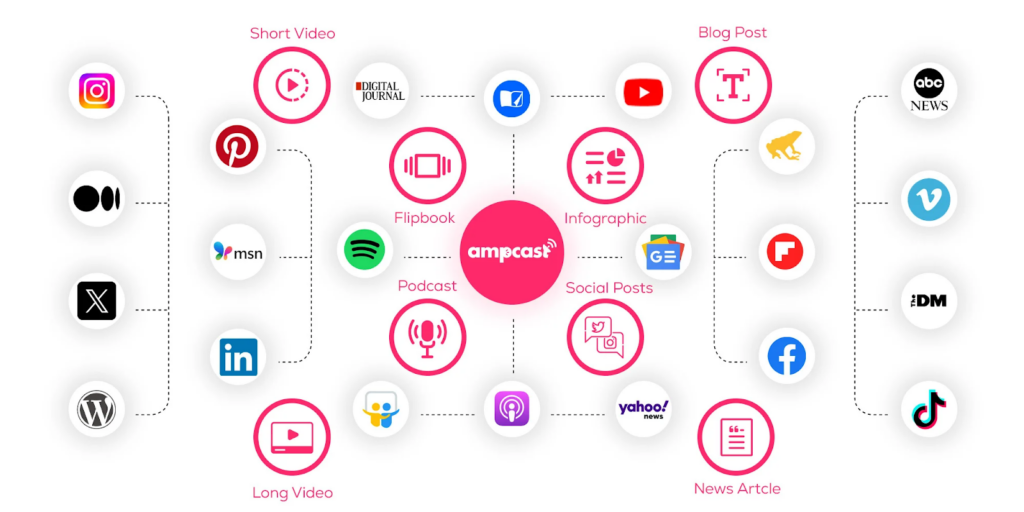
A well-written release, though, can only reach as far as its distribution allows. AmpiFire’s AmpCast AI fixes this by converting your announcement into eight content formats (news articles, blog posts, interview podcasts, longer informational videos, reels/shorts, infographics, flipbooks/slideshows, and social posts), then pushes them across 300+ high-authority sites simultaneously. If you want to see how the multi-channel approach works, try AmpiFire’s AmpCast AI today.
Ready to Go Multi-Channel? Try the AmpiFire Method →
Frequently Asked Questions (FAQs)
Should a press release be written in the past or present tense?
A press release should use the present tense in the headline, lead paragraph, quotes, and boilerplate, and the past tense in the body copy where background facts and context are reported. The headline and lead create urgency and immediacy, while the body delivers the evidence and detail that give the announcement credibility.
Can you switch tenses within a press release?
Yes. Intentional tense shifts are part of what makes a press release read correctly. Switching from the present tense in the headline to the past tense in the body is the correct structure. However, randomly switching tenses within the same paragraph, or using the present tense in the body where the past tense belongs, creates confusion and signals a lack of professional writing experience to the journalists reading it.
Do press release headlines always use the present tense?
Yes. Press release headlines should always be written in the present tense, regardless of whether the event has already occurred. This mirrors standard newspaper headline style and creates a sense of immediacy that draws journalists in. Even if a product launched three days ago, the headline should read “Company X Launches New Product,” not “Company X Launched New Product.”
How is Ampifire’s multi-channel content distribution better than press releases?
The reach of a traditional press release depends entirely on whether a journalist picks it up. AmpiFire’s multi-channel approach solves the dependency problem. Rather than waiting for a journalist to act on your release, AmpCast AI converts your news into eight content formats and simultaneously pushes it to 300+ high-authority news sites, podcast platforms, video channels, and blog networks. This creates multiple indexed pieces of content across authoritative domains, each contributing to your brand’s search presence and online credibility over time.
*Note: Pricing and/or product availability mentioned in this post are subject to change. Please check the retailer’s website for current pricing and stock information before making a purchase.