Key Takeaways
- A strong press release headline leads with the news, stays between 51 and 75 characters, and uses active voice. Those three choices alone separate headlines that get picked up from ones that get ignored.
- Specific numbers make headlines more credible. A headline that says “Cybersecurity Breaches Cost Small Businesses an Average of $200,000 Per Incident” outperforms “Cybersecurity Is a Growing Concern” every time because it gives journalists something concrete to anchor a story around.
- Headline format should match the type of press release. A product launch, a funding announcement, a crisis response, and an award recognition each call for a different approach; the structure that works for one will fall flat for another.
- Real-world examples show exactly why strong headlines work. The three examples in this post break down the specific techniques (conflict, data leads, and tension) so you can apply them directly to your next release.
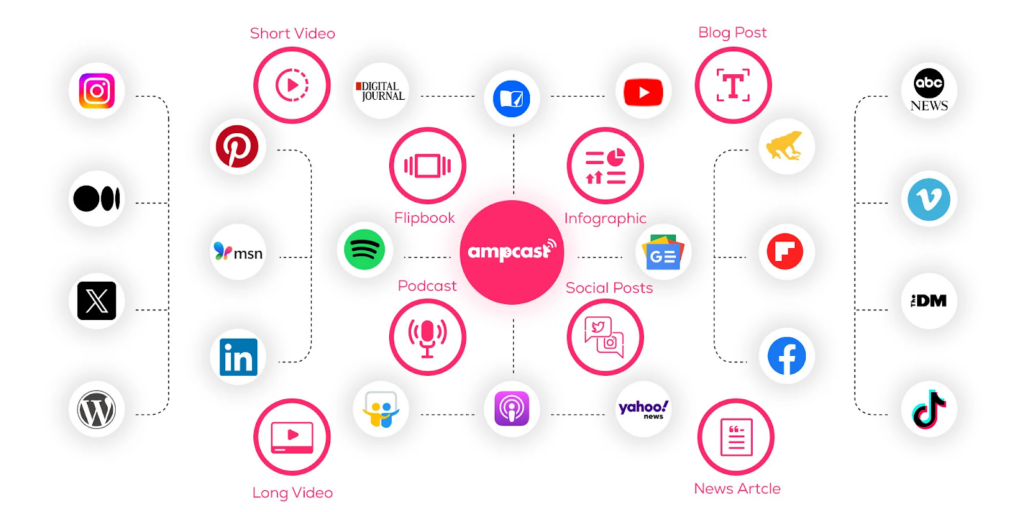
- AmpiFire’s AmpCast AI takes your announcement beyond a single press release. It converts your story into eight content formats (news articles, blog posts, interview podcasts, longer informational videos, reels/shorts, infographics, flipbooks/slideshows, and social posts) and distributes them across 300+ high-authority sites simultaneously, so your headline works harder across every channel.
How to Write a Press Release Headline?
To write a strong press release headline, lead with the news (not your company name), include a specific number or data point, keep the headline between 51 and 75 characters, write in active voice, and match the format to the type of release you are sending. Get those five things right and your headline will earn a journalist’s attention in seconds.
Most press release headlines fail because they lead with the brand instead of the story. A headline like “XYZ Corp Releases Annual Workplace Report” tells a journalist nothing worth reading. A headline like “New Study Reveals 40% of Remote Workers Experience Digital Burnout Weekly” gives them a story they can use immediately.
Why Press Releases Don’t Work Anymore
Smart Businesses Are Moving Beyond Traditional PR
• The Problem: Press releases reach one audience through one channel, while your customers are everywhere online. Most get buried within days with poor ROI.
• The Solution: AmpiFire’s AmpCast creates 8 content formats (news articles, blog posts, interview podcasts, longer informational videos, reels/shorts, infographics, flipbooks/slideshows, and social posts) from a single topic and distributes them across 300+ high-authority sites, including Fox affiliates, Spotify, and YouTube.
What You’ll Learn on PR Zen:
✓ Why multi-channel content delivers 10x better results than press releases
✓ How to amplify your PR efforts across multiple platforms
✓ Real case studies of businesses dominating search, social, video, and podcasts
✓ Cost-effective alternative to expensive PR agencies
Ready to Replace Press Releases? Learn the AmpiFire Method →
Best Practices for Writing a Strong Press Release Headline
1. Lead With the News, Not the Company Name
Your company name is rarely the most interesting part of your announcement. What’s interesting is what happened, what changed, or what it means for the audience. Start with the actual news and let your brand name follow naturally in the subhead or opening paragraph.
A headline like “New Study Reveals 40% of Remote Workers Experience Digital Burnout Weekly” is far more compelling to a journalist than “XYZ Corp Releases Annual Workplace Report.”

2. Use Specific Numbers & Data to Build Instant Credibility
Numbers signal that what follows is grounded in reality, not opinion. A headline like “Cybersecurity Breaches Cost Small Businesses an Average of $200,000 Per Incident” is immediately more trustworthy and compelling than “Cybersecurity Is a Growing Concern for Small Businesses.” The stat gives journalists something concrete to anchor a story around.
Headlines that include specific figures tend to outperform vague, general statements in terms of pickup rate and engagement. When you have access to proprietary data, survey results, or research findings, lead with your strongest number. It’s your most powerful headline asset.
3. Keep It Under 10 Words Without Losing the Point
Brevity is a discipline, not a limitation. The sweet spot for press release headlines sits between 51 and 75 characters (roughly 8 to 10 words).
Beyond that range, headlines tend to get truncated in search results, email previews, and social media feeds, and the core message gets lost. Every word in your headline should earn its place. If you can cut a word without losing meaning, cut it.

4. Write in Active Voice, Not Passive
Active voice makes your headline feel immediate, direct, and energetic. Passive voice does the opposite by burying the action and making your news feel secondhand.
Compare “New Partnership Signed Between Tech Giants” (passive, flat) with “Google and Salesforce Partner to Reshape Enterprise AI” (active, specific, compelling). The active version tells you who is doing what, and it does so with momentum.
Active voice forces you to identify the subject of your news clearly, which in turn sharpens the entire headline. If you’re struggling to write an active headline, it’s often a sign that the news angle itself needs to be clarified first.
5. Match Your Headline to the Type of Press Release You’re Writing
Not all press releases are built the same, and your headline formula should shift depending on what kind of announcement you’re making. A product launch headline operates differently from a crisis response, a funding announcement, or an award recognition. Each type has a distinct primary reader goal and an emotional register.
Here’s how headline approach shifts by press release type:
- Product Launch: Lead with the problem the product solves or the key capability. “New App Cuts Invoice Processing Time by 80% for Freelancers.”
- Funding Announcement: Include the dollar amount and what it signals. “HealthTech Startup Secures $45M Series B to Expand AI Diagnostics Platform.”
- Award or Recognition: Frame it as third-party validation. “Fortune Names [Company] One of America’s Most Innovative Workplaces for Third Consecutive Year.”
- Research or Data Release: Lead with the most surprising or counterintuitive finding. “Study Finds 70% of Consumers Trust AI Recommendations Over Human Advisors.”
- Crisis or Response: Be direct, factual, and avoid anything that reads as defensive. “[Company] Issues Safety Update Following Product Review; Recall Affecting 12,000 Units.”
- Partnership or Merger: Name both parties and the outcome. “Adobe and Figma Combine Forces to Redefine Collaborative Design at Scale.”
Real Press Release Headline Examples That Work (And Why)
The following headlines each demonstrate a distinct technique that you can apply directly to your next press release.
Example 1
Headline: “Prosperity or Catastrophe: #Insurance2040 Study Reveals Four Possible Futures for the Industry”
Why it works: This headline works on multiple levels. First, the contrast between “Prosperity” and “Catastrophe” creates immediate tension. The reader is forced to ask which outcome applies to them.
Second, the specificity of “Four Possible Futures” signals that the content is structured, research-backed, and worth digging into. Third, the hashtag subtly signals social media readiness without being gimmicky. The result is a headline that feels urgent, credible, and forward-looking all at once.
Example 2
Headline: “Remote Work Promised Flexibility — New Data Shows It’s Delivering Burnout Instead.”
Why it works: This headline uses conflict and contrast to force a reader to keep going. The contrast between expectation and reality is impossible to ignore. It challenges a widely held assumption with the promise of evidence, which is precisely the kind of story a journalist wants to bring to their audience.
Conflict-driven headlines don’t require drama or exaggeration. They just need a real contradiction that the data or announcement supports.
Example 3
Headline: “Survey: 83% of HR Leaders Plan to Increase Mental Health Benefits in 2025.”
Why it works: A stat-led headline gives journalists an instant pull quote for their own story. That number is specific enough to be credible, surprising enough to be newsworthy, and relevant to a clearly defined audience.
The word “Survey” at the front immediately signals that this is data-driven, not opinion-based, which builds trust before the journalist has even read the first paragraph of the release.
The key to making stat-led headlines work is choosing the right number, which is not necessarily the biggest one, but the most surprising or most relevant to the journalist’s beat. A 3% shift in a niche market can be more compelling than a 50% change in something nobody cares about.
Always ask: what does this number mean to the person reading it, and why does it matter right now?
Why AmpiFire Is the Smarter Move After You Write Your Headline
A strong press release headline follows a short list of repeatable rules: lead with the news, use a specific number, stay under 75 characters, write in active voice, and match your format to the type of release. Get those right, and your headline stands out in any journalist’s inbox. That said, even the most perfectly crafted headline fails if the release doesn’t reach the right journalists, outlets, and audiences at scale.
That’s the gap that AmpiFire’s AmpCast AI was built to close. It turns your announcement into eight content formats (news articles, blog posts, interview podcasts, longer informational videos, reels/shorts, infographics, flipbooks/slideshows, and social posts) distributed across 300+ high-authority sites simultaneously. If you want to see how AmpCast AI distributes your next press release, start here.
Ready to Go Multi-Channel? Try the AmpiFire Method →
Frequently Asked Questions (FAQs)
How long should a press release headline be?
A press release headline should be between 51 and 75 characters for maximum engagement. In word count terms, that typically lands between 8 and 10 words. That said, character count is a guideline, not a hard rule. A 78-character headline that’s sharp, specific, and newsworthy will always outperform a 55-character headline that says nothing. Aim for the range, but never sacrifice clarity or news value just to hit a number.
Can you use a question as a press release headline?
You can, but use it carefully. Question headlines work when the question itself is genuinely provocative, and the press release delivers a clear, data-backed answer. Something like “Is Remote Work Making Employees Less Productive? New Study Has a Surprising Answer” can work because it creates curiosity and promises resolution.
Where question headlines fail is when the answer is obvious, or when the question feels like a tease with no real substance behind it.
How is a press release headline different from an email subject line?
They serve related but distinct purposes. An email subject line is designed to get the email opened. It is written for a single recipient in a personal context, and it can lean slightly more conversational or curiosity-driven. A press release headline, by contrast, is written to clearly and immediately communicate news value to a professional audience that will judge it against journalistic standards.
How Does Ampifire’s AmpCast AI Expand the Reach of My Content?
AmpCast AI by AmpiFire takes a single press release and multiplies its reach by automatically converting it into eight content formats, including news articles, blog posts, interview podcasts, longer informational videos, reels/shorts, infographics, flipbooks/slideshows, and social posts. It then optimizes them for different audiences and automatically distributes them across 300+ high-authority sites, including Fox affiliates, Spotify, and YouTube, building long-term organic visibility.
*Note: Pricing and/or product availability mentioned in this post are subject to change. Please check the retailer’s website for current pricing and stock information before making a purchase.