Key Takeaways
- A press release bio is a short, third-person description of the key person behind an announcement. It tells journalists who the source is, why they are credible, and whether the story is worth covering — all in under 150 words.
- A bio and a boilerplate serve different purposes. The bio establishes individual credibility; the boilerplate describes the organization. Both belong in every professionally structured press release.
- Writing an effective press release bio means leading with your single most impressive, relevant credential, matching the tone to your industry, and updating the bio every time you send a new release.
- Common press release bio mistakes include writing in first person, using vague phrases like “passionate advocate” or “visionary leader,” and copying the same bio across unrelated releases without adjusting for context.
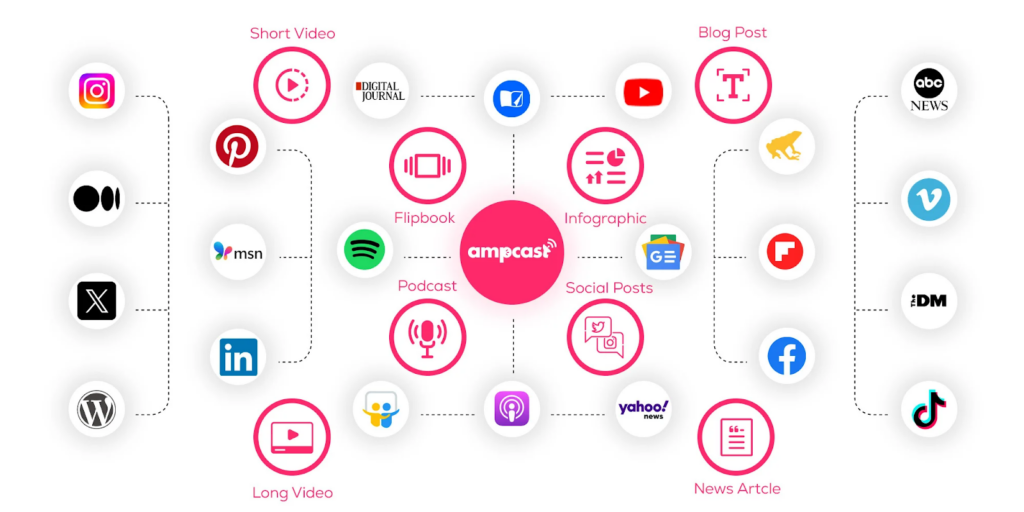
- AmpiFire’s AmpCast AI distributes your announcement across 300+ high-authority platforms in eight content formats (news articles, blog posts, interview podcasts, longer informational videos, reels/shorts, infographics, flipbooks/slideshows, and social posts) simultaneously, giving your press release reach that a traditional wire service cannot match.
What Is a Press Release Bio?
A press release bio is a short, third-person description of the key person behind the announcement, typically the author, spokesperson, executive, or expert being quoted. It gives journalists the context they need to assess your credibility and decide whether your story fits their audience.
The bio is different from a boilerplate. The bio establishes individual credibility. The boilerplate describes the organization. Both appear at the end of a press release, but a strong bio does specific work: it positions the person, not just the company.
A well-written press release bio is in third person, leads with the single most impressive credential relevant to the announcement, and stays under 150 words. It typically sits after the main body content and any quotes, just before or alongside the contact information.
The sections below cover all you need to know about writing effective press release bios, including examples to guide you and templates you can use.
Why Press Releases Don’t Work Anymore
Smart Businesses Are Moving Beyond Traditional PR
• The Problem: Press releases reach one audience through one channel, while your customers are everywhere online. Most get buried within days with poor ROI.
• The Solution: AmpiFire’s AmpCast creates 8 content formats (news articles, blog posts, interview podcasts, longer informational videos, reels/shorts, infographics, flipbooks/slideshows, and social posts) from a single topic and distributes them across 300+ high-authority sites, including Fox affiliates, Spotify, and YouTube.
What You’ll Learn on PR Zen:
✓ Why multi-channel content delivers 10x better results than press releases
✓ How to amplify your PR efforts across multiple platforms
✓ Real case studies of businesses dominating search, social, video, and podcasts
✓ Cost-effective alternative to expensive PR agencies
Ready to Replace Press Releases? Learn the AmpiFire Method →
What to Include in a Press Release Bio
Name, Title, & Company
Start with the full name, current title, and company or organization. This trio is non-negotiable. It immediately orients the reader and establishes the professional context for everything that follows. Always use the full formal title (“Chief Marketing Officer” rather than “CMO”) on first reference.
Relevant Credentials & Achievements
This is where you earn credibility. Include only the credentials that are directly relevant to the story. If you’re issuing a release about a new healthcare product, lead with medical credentials or industry tenure. Specificity wins here. “15 years of experience in pharmaceutical compliance” is far stronger than “extensive experience in the industry.”

A Quote or Personal Statement
Some press release bios incorporate a brief personal quote or professional statement that reflects the individual’s perspective or mission. It’s a human element that adds dimension to an otherwise factual bio and can make the person more quotable and approachable to the media.
Keep any embedded statement to one sentence. It should reflect a clear point of view, not generic enthusiasm.
Contact Information
The bio section should always be paired with or immediately followed by clear media contact details. This includes a full name, a direct phone number, a professional email address, and, optionally, social media handles if they’re actively maintained and relevant.
7 Tips to Write a Press Release Bio That Gets Noticed
1. Write in Third Person

Always write your press release bio in third person (“Sarah is the founder of…” not “I am the founder of…”). Third person creates journalistic distance and reads as if someone else is vouching for you, which carries more authority than self-promotion.
It also makes the bio directly reprintable by media outlets without any editing. Journalists can lift it straight into their article, which dramatically increases the chances they will.
2. Lead With the Most Impressive Credential
Structure your bio with an inverted pyramid. Lead with the single most impressive, relevant fact about this person, then layer in supporting details.
One practical test: read only the first sentence of your bio and ask whether it alone communicates why this person is credible. If the answer is no, rewrite it until it does.
3. Keep It Under 150 Words
A bloated bio signals that you don’t know what’s important, which raises doubts about whether your news judgment is reliable either. Trim aggressively. If a credential doesn’t directly reinforce the announcement’s narrative, cut it.
4. Match the Tone to Your Industry
A tech startup bio can carry a sharper, more casual edge. A legal or medical bio demands formality. A nonprofit bio can be warmer and mission-driven. Mismatching the tone to the industry is subtle, but journalists notice it, and it can make a release feel off, even if the reader can’t immediately identify why.
5. Avoid Clichés & Buzzwords
Phrases like “visionary leader,” “passionate advocate,” “dynamic professional,” and “results-driven executive” appear in thousands of press release bios, and they communicate nothing specific.
Replace every cliché with a concrete fact. Instead of “passionate about innovation,” write “holds four patents in machine learning applications.” Specificity is the only thing that separates a forgettable bio from one that builds real credibility.
6. Update It Every Time You Send a New Release
Your bio should never be a copy-paste job from the last release you sent. Each press release exists in a specific context, and your bio needs to reflect the version of you that’s most relevant to that story.
7. Always Include a Clear Media Contact
Even the most compelling bio fails if a journalist can’t immediately reach the person or their PR representative. Your media contact block should include a full name, a direct phone number that will actually be answered during business hours, and a professional email address.
Press Release Bio Examples
Below are real-world-style examples built around the most common press release scenarios.
Executive or CEO Bio Example
Executive bios should lead with authority and track record. Keep it formal, lead with title and company, and anchor at least one claim with a measurable result.
Michael Torres is the Chief Executive Officer of Vantage Capital Group, a New York-based investment firm managing over $2.3 billion in assets. With more than 20 years of experience in institutional finance, Michael has led the firm through three major acquisitions and guided its expansion into sustainable infrastructure investments. He previously served as Managing Director at Blackstone’s real estate advisory division and holds an MBA from the Wharton School of Business. Michael is a frequent speaker at the Urban Land Institute’s annual conference and has been featured in The Wall Street Journal and Bloomberg Markets.
Author or Speaker Bio Example
For authors and speakers, the bio is your credibility stack. Publications, speaking engagements, audience reach, and area of expertise are all fair game here.
Dr. Angela Frost is a behavioral psychologist, keynote speaker, and author of the bestselling book The Rewired Mind, which has sold over 85,000 copies worldwide since its release in 2022. She has delivered keynote presentations at TEDxBoston, the Society for Human Resource Management Annual Conference, and the World Economic Forum’s mental health symposium. Dr. Frost’s work focuses on the neurological impact of workplace stress and has been cited in Harvard Business Review, Psychology Today, and The Atlantic. She is currently a visiting professor at Johns Hopkins University’s Bloomberg School of Public Health.
Press Release Bio Templates You Can Use Today
Short-Form Bio Template (50–75 Words)
The short-form bio is ideal when space is limited or when the announcement is straightforward. This format works especially well for product launches, event announcements, and partnership releases where the company’s story carries more weight than the individual.
[Full Name] is the [Title] of [Company Name], a [one-line company description]. With [X] years of experience in [industry/field], [Last Name] has [key achievement or credential directly relevant to the announcement]. [Optional: One sentence about current focus or upcoming initiative.]
Long-Form Bio Template (100–150 Words)
The long-form bio gives you room to build a fuller picture of who this person is and why they matter to the story. It’s best suited for thought leadership releases, book or course launches, executive appointments, and any release where the individual is the news.
[Full Name] is the [Title] of [Company/Organization], a [brief company description including location, size, or mission]. With [X] years of experience in [industry], [Last Name] has [specific achievement #1] and [specific achievement #2]. Prior to [current role], [he/she/they] served as [previous title] at [previous organization], where [relevant accomplishment]. [Full Name] holds a [degree] from [institution] and has been featured in/recognized by [media outlet or award]. [Optional: one sentence on current mission or upcoming work that connects directly to the press release topic.]
Why Your Press Release Bio Is Only Half the Work
A strong press release bio gets journalists to pay attention. But attention alone does not move the story. The bio earns credibility; distribution determines reach. Writing the best version of your bio matters most when it actually lands in front of the right audience.
AmpiFire’s AmpCast AI takes your press release and repurposes it into eight content formats (news articles, blog posts, interview podcasts, longer informational videos, reels/shorts, infographics, flipbooks/slideshows, and social posts), then distributes them simultaneously across 300+ high-authority platforms. This approach turns a single announcement into a network of content that builds search visibility over time. If you want to see how far your next press release can go, try the AmpiFire method.
Ready to Go Multi-Channel? Try the AmpiFire Method →
Frequently Asked Questions (FAQs)
How long should a press release bio be?
A press release bio should typically be between 50 and 150 words. Short-form bios in the 50–75 word range work well for straightforward announcements where the company story carries more weight than the individual. Long-form bios in the 100–150 word range are better suited for thought leadership releases, executive appointments, or author launches where the individual’s background is central to the news.
Should a press release bio be written in first or third person?
Always third person. Journalists cannot reprint a press release bio written in the first person without editing, as it reads immediately as self-promotional and signals a lack of familiarity with press release conventions. Third-person bios read as an objective endorsement, carry more authority, and can be lifted directly into a news article without modification. This is one rule with no exceptions.
What is the difference between a press release bio and a boilerplate?
A bio is about a specific person, their credentials, role, and relevance to the announcement. A boilerplate is about the company and typically a standardized 100–200-word paragraph that describes what the organization does, where it operates, and what it stands for. Both appear at the end of a press release, but they serve different purposes.
How does AmpiFire’s AmpCast AI amplify brand visibility beyond press releases?
AmpiFire’s AmpCast AI goes beyond traditional press release distribution by repurposing core announcements into eight content formats (news articles, blog posts, interview podcasts, longer informational videos, reels/shorts, infographics, flipbooks/slideshows, and social posts) and distributing them simultaneously across 300+ high-authority platforms. This gives your brand exposure across media types and audience segments that a text-only press release distributed through a conventional wire service would never reach.
*Note: Pricing and/or product availability mentioned in this post are subject to change. Please check the retailer’s website for current pricing and stock information before making a purchase.