PR in healthcare is the art and science of managing communication to build and protect trust between healthcare organizations and everyone they serve—patients, providers, and even regulators. It’s far more than just marketing. It’s about shaping reputation, carefully navigating the maze of regulations like HIPAA, and turning complex medical jargon into stories that are clear, human, and empathetic. This is what keeps public confidence intact, especially when the stakes are as high as our health.
What Is PR in Healthcare and Why It Matters Now

Think of a healthcare PR pro as a trust architect. While a building architect works with steel and glass, a PR expert builds the communication framework that holds up an organization's most critical asset: its relationship with the public. This isn’t about spin. It’s about laying a foundation of credibility, transparency, and genuine empathy, brick by brick.
Every press release, patient success story, and public statement is another one of those bricks. The goal is a structure so solid it can weather the intense pressures of the health industry, from a public health crisis to tough regulatory scrutiny.
The Core Purpose of Healthcare PR
At its heart, PR in healthcare has one main job: to build and maintain trust. This is done by strategically managing the flow of information between a healthcare organization and its many stakeholders. A hospital, a biotech startup, or a public health agency simply cannot function without it.
Key activities boil down to:
- Reputation Management: Proactively building and defending the public image of the organization.
- Stakeholder Communication: Crafting clear, consistent messages for different audiences, from patients and doctors to investors and government officials.
- Media Relations: Cultivating relationships with journalists to ensure new research, initiatives, and company news are covered fairly and accurately.
- Crisis Management: Preparing for and responding to the inevitable bumps in the road—like a data breach or a negative clinical trial result—with honesty and compassion.
This work runs much deeper than advertising. Marketing might run a campaign for a new surgical wing to get more patients. PR is the work that builds the underlying reputation that makes patients trust that hospital in the first place.
Healthcare PR is not just about getting media coverage. It is the deliberate, planned, and sustained effort to establish and maintain mutual understanding between an organization and its publics.
Why Strategic Communication Is Essential in 2026
The demand for skilled PR in healthcare has never been higher. The industry is navigating a perfect storm of challenges that makes smart communication an absolute necessity, not a "nice-to-have." Rising operational costs and critical workforce shortages are straining providers, and this reality needs to be communicated carefully to manage public expectations.
At the same time, new technologies are arriving at a dizzying pace, from widespread telehealth services to AI-powered diagnostics. Patients and doctors alike need to understand the real-world benefits and limitations of these tools to get on board. Without effective PR, fear and misinformation can spread like wildfire, killing progress before it even starts.
Take a hospital rolling out an AI tool that helps spot diseases earlier. It’s not enough to just issue a press release announcing the tech. The PR team has to build a narrative that tackles patient privacy concerns head-on, explains how the tool empowers doctors (not replaces them), and highlights tangible benefits. That’s how you build the confidence needed for people to embrace it, and it's a perfect example of modern PR in healthcare.
Navigating the Rules of Healthcare Communications
Doing PR in healthcare isn't like any other industry. It’s like driving a high-performance race car; you have incredible power to do good, but one wrong move can cause a catastrophe. You’re operating inside a maze of strict regulations and ethical duties that are non-negotiable.
These rules aren't just suggestions. Ignoring them won't just get you a slap-on-the-wrist fine—it can absolutely demolish your organization's reputation and, worse, put patients at risk. The two biggest players you need to understand inside and out are HIPAA and the FDA. Let's break down what they actually mean for your day-to-day work.
Understanding HIPAA in Practice
The Health Insurance Portability and Accountability Act (HIPAA) is the bedrock of patient privacy in the U.S. For communicators, its main job is to guard Protected Health Information (PHI). This is any piece of data that could potentially identify a patient.
PHI includes the obvious stuff like names, addresses, and social security numbers. But it also covers less obvious details, like medical record numbers, photos, or even specific dates related to their care.
This means you simply cannot share a patient’s story, use their picture, or mention their health status without getting their explicit, written permission first.
Securing Patient Consent: A generic media release form won't cut it here. Your consent form has to be crystal clear, spelling out exactly what information will be shared, where it will appear (e.g., a specific news station, a social media post), and for what reason. The patient also needs to know they can pull their consent at any point.
Anonymizing Data for PR: If you're using patient data for a press release or a broader report, you must de-identify it completely. HIPAA outlines 18 specific identifiers that must be stripped out, including names, specific dates, and any geographic location smaller than a state. The end goal is to make it impossible for anyone to trace that data back to a single person.
Demystifying FDA Regulations for Promotion
If your work involves pharmaceuticals, medical devices, or new treatments, you've got another set of rules to follow from the Food and Drug Administration (FDA). The FDA’s mission is to make sure any promotional material is truthful, balanced, and not misleading in any way.
The core principle of FDA regulation is fair balance. You have to present both the benefits and the risks of a product with equal weight. Burying the risks in the fine print while shouting the benefits from the rooftops is a surefire way to get a warning letter.
This means you can’t make claims about a product that haven't been scientifically proven and officially approved by the FDA. You can't say a drug "cures" an illness if it's only been approved to "manage symptoms," for instance. Nailing this kind of nuanced language is a critical skill. To get a better feel for it, you can check out our guide on how to write a pharmaceutical press release.
Walking the Ethical Tightrope
Beyond the black-and-white legal lines, healthcare PR requires a rock-solid ethical compass. Your work directly influences how people think about their health, and that's a huge responsibility. Ethics often pick up where the law leaves off.
The pressure is intense. The industry is grappling with rising costs and major workforce shortages, making it tempting to over-promise. Yet, a recent Deloitte outlook found that 72% of healthcare leaders are optimistic, banking on innovation to solve these issues. As a PR pro, your job is to communicate these new care models and cost controls without creating hype.
Here are three ethical pillars that should guide every decision you make:
Avoid Sensationalism: Health news is emotional by nature. Your role is to inform, not to scare people or give them false hope. Always frame your stories with accuracy and provide context, especially when talking about new treatments or public health threats.
Ensure Scientific Accuracy: Before you hit "send" on anything, have it vetted by your medical and scientific experts. Misinterpreting study data or exaggerating its importance is a fast way to lose all public trust.
Manage Conflicts of Interest: Be completely transparent about funding, partnerships, or any other potential conflicts. If your company funded the study you're promoting, that needs to be disclosed loud and clear. Credibility hinges on this kind of honesty.
Building Your Healthcare PR Strategy and Message
Now that you know the rules, it’s time to build your game plan. A solid healthcare PR strategy isn’t something you stumble into; it’s built from the ground up, starting with a crystal-clear understanding of who you’re talking to and what you need to say. This is where we shift from just following the rules to making real connections.
Think of it this way: a one-size-fits-all message in healthcare is a recipe for disaster. Each group you communicate with has its own unique concerns, priorities, and language. Your job is to speak to all of them effectively, without losing the core of your message.
Mapping Your Key Stakeholders
The first step is stakeholder mapping. This is simply the process of identifying every single group that has a stake in your organization’s success. You have to think way beyond just “patients” and get specific.
For a hospital, this list could look something like this:
- Patients and Their Families: They need compassionate, easy-to-understand information about their care options, safety protocols, and potential outcomes.
- Physicians and Nurses: This group is focused on clinical excellence, the tools that make their jobs easier, and the hospital's professional reputation.
- The Local Community and Policymakers: Their interests lie in public health initiatives, community benefits, and the economic role your organization plays.
- Investors and Donors: They are laser-focused on the financial stability, long-term vision, and the tangible impact of their contributions.
- Insurance Payers: This group needs to see hard evidence of high-quality, cost-effective care.
Once you’ve got your list, you need to figure out who matters most right now. A biotech startup breaking into the market will probably prioritize investors and regulatory bodies. A long-standing community clinic, on the other hand, will put its energy into patients and local media.
Crafting a Core Messaging Architecture
After you’ve figured out your "who," it's time to nail down your "what." A messaging architecture is your official playbook—a central framework that keeps every communication, from a social media post to a major press conference, perfectly on-brand. It’s what turns complicated medical goals and business objectives into language that actually connects with people.
Think of it as a messaging GPS. No matter what channel you're using, it always steers you back to your core mission and values, which is absolutely vital for building a brand people recognize and trust.
A successful messaging plan also has to work hand-in-hand with a patient-first digital marketing strategy for healthcare to make sure your messages are reaching people where they already are.
A strong message in healthcare PR isn't just about what you say. It’s about translating complex science into human impact, turning data points into stories of hope, and building an emotional connection that fosters deep-seated trust.
To show how this works, let's look at a new telehealth service. The core message is simple: "We offer convenient, high-quality virtual care." But you can't just say that to everyone. You have to tweak the angle.
Stakeholder Messaging Matrix
This table shows how to tailor a core message about a new telehealth service for different key stakeholders.
| Stakeholder Group | Primary Concern | Key Message Angle |
|---|---|---|
| Patients | Convenience and access to care | "Get expert medical advice from the comfort of your home, on your schedule." |
| Physicians | Workflow efficiency and patient outcomes | "A secure, integrated platform that helps you manage patient care more effectively." |
| Employers/HR | Reducing healthcare costs and absenteeism | "An affordable benefit that keeps your team healthy, productive, and on the job." |
| Insurers | Cost-effectiveness and quality metrics | "Delivering high-quality outcomes at a lower cost per encounter than in-person visits." |
See how the core idea remains, but the focus shifts to address what each group cares about most? That's effective messaging in action.
From Jargon to Human Connection
One of the biggest traps in PR in healthcare is getting bogged down in medical jargon. Nobody cares about "synergistic platforms for optimized clinical outcomes." They care about whether a new drug will give them more birthdays with their grandkids.
This is where storytelling becomes your most important skill. Data gives you credibility, but stories give you meaning.
The two pillars of your messaging strategy—the rules you have to follow—are the regulatory and ethical guidelines.
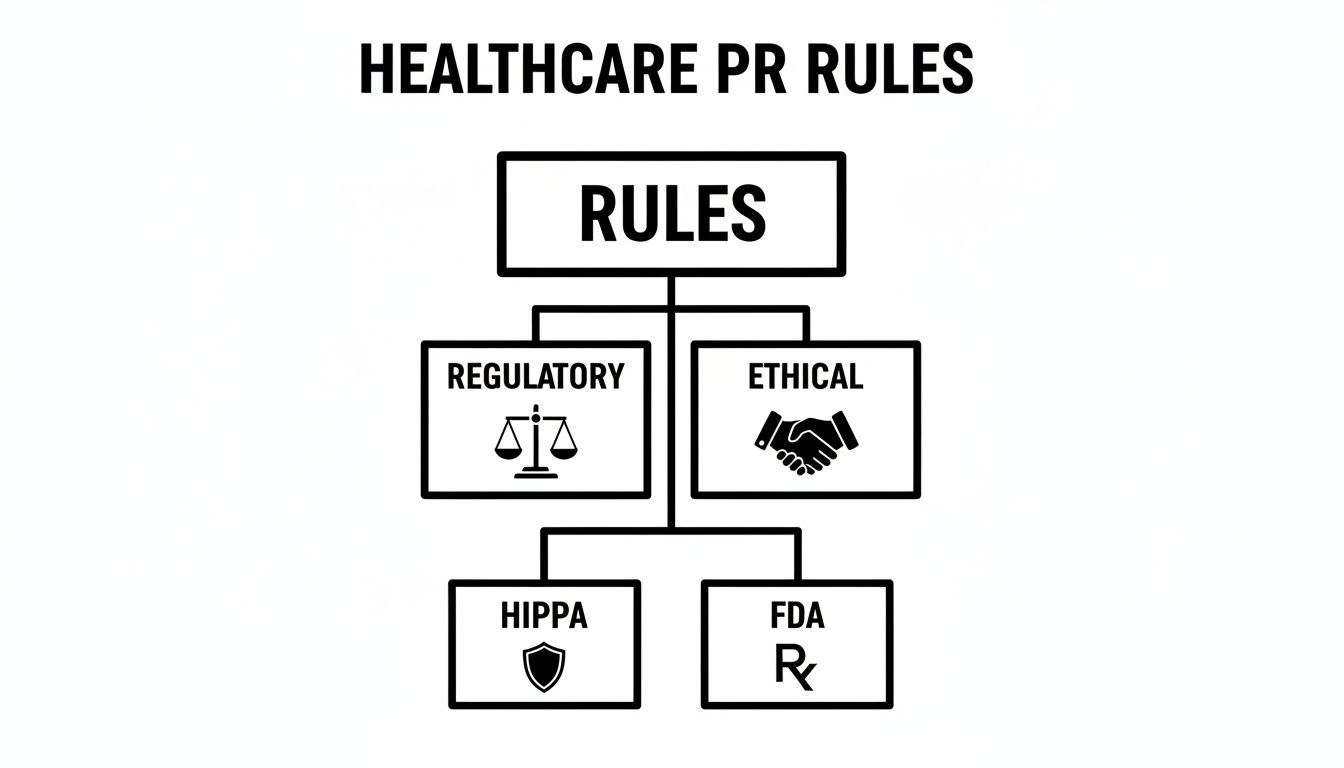
As you can see, the hard-and-fast legal rules like HIPAA and FDA guidelines are the foundation. But just as important are the ethical rules that build trust. Every message you put out there has to pass both tests. For example, a patient testimonial must be fully compliant with HIPAA consent forms, but it must also be framed ethically to respect their dignity and avoid turning their story into a cheap marketing gimmick.
Putting Your Plan Into Action: Media Outreach and Digital PR

You’ve got your strategy and messaging framework locked down. Now for the fun part: bringing it all to life. This is where the rubber meets the road—moving from planning to doing and getting your stories in front of the right people through both old-school media and new-school digital channels.
After all, a brilliant message is useless if it’s only heard within your own walls. The goal here is to make sure your announcements—whether it's a new clinical trial, a community health initiative, or a C-suite hire—actually land with journalists and the public.
How to Write a Healthcare Press Release That Gets Noticed
The press release remains a core tool in PR in healthcare, but let's be clear: it has to be more than a dry, formal announcement. A health reporter’s inbox is a warzone for attention. Your release needs to be sharp, newsworthy, and get straight to the point. Think of it as the key that unlocks the door to a much bigger story.
To stand out, your release must answer the "so what?" question immediately. Don't just announce a new medical wing; explain how it will slash wait times for critical procedures in your community. For a deeper dive, our press release templates for the healthcare industry are a great place to start.
An effective healthcare press release always includes these key pieces:
- A Killer Headline: State the most important news clearly and concisely. No fluff.
- A Human Angle: Frame the story around its impact on patients, providers, or the community. People connect with people, not buildings.
- An Expert Quote: A quote from a physician or leader adds credibility and a human voice to the news.
- Hard Data: Back up your claims. Use specific, verifiable numbers like patient outcome statistics or research findings.
- Boilerplate and Contact Info: Always end with a standard paragraph about your organization and provide clear contact details for any media follow-up.
Building Real Relationships With Health Journalists
Just blasting a press release into the void and hoping for the best is a strategy doomed to fail. The best PR pros build genuine, long-term relationships with the journalists who live and breathe the health beat. This isn't about spamming reporters with pitches; it’s about becoming a trusted, reliable source they can turn to.
Start by identifying the reporters, editors, and freelancers who cover your specific niche, whether that's oncology, medtech, or health policy. Follow their work on social media, read their articles, and understand what they care about. Only reach out when you have something that genuinely fits their beat. This thoughtful approach shifts the dynamic from transactional to collaborative.
A great PR professional doesn't just pitch stories; they provide solutions. By understanding a journalist's needs, you can offer them expert sources, unique data, or a fresh angle that helps them do their job better.
When you do land an interview, your job is only half done. You have to prep your experts to communicate clearly and confidently. This means media training where they learn to break down complex medical topics into simple, compelling soundbites, stay on message, and handle tough questions without breaking a sweat.
Using Digital PR and SEO to Amplify Your Message
In today's world, a good media plan has to look beyond traditional newspapers and TV. Digital PR is all about using online channels to boost your visibility and connect directly with your audience. This is where PR in healthcare powerfully intersects with search engine optimization (SEO) and content marketing.
When you issue a press release or publish a blog post, optimize it with keywords that patients, providers, or investors are actually typing into Google. This simple step helps your news show up in search results, driving valuable traffic to your site long after the initial announcement buzz fades.
The money trail confirms this shift. A recent report revealed that digital ad spending in pharma is projected to hit a staggering $26.2 billion by 2026. In contrast, traditional ad spending is expected to be just $6.9 billion. You can discover more insights in the full 2026 Health Marketing Trends Report from PulsePoint.
This massive investment in digital proves one thing: the conversation has moved online. Your PR strategy needs to be there, too, using a smart mix of tactics to get your message heard:
- Social Media: Share key takeaways, media wins, and patient stories (always with consent!) on platforms like LinkedIn, X (formerly Twitter), and Facebook to engage directly with your community.
- Influencer Collaborations: Team up with credible patient advocates, respected medical professionals, or health influencers who can share your story with their established, trust-based audiences.
- Owned Media: Use your own blog and website as a home base for in-depth content that expands on your PR announcements. This provides a valuable resource for your audience and gives your SEO a serious boost.
Integrating AI into Your Healthcare PR Workflow
Artificial intelligence isn't some far-off concept from a sci-fi movie anymore. It’s here, and it's a set of real-world tools that can completely reshape your healthcare PR workflow.
Think of AI not as a robot coming for your job, but as a super-smart assistant. It’s built to chew through the tedious, data-heavy work, which frees you up to focus on what humans do best: strategy, creative storytelling, and building solid relationships.
For any PR team—but especially smaller ones—this is a massive advantage. AI can put a biotech startup on equal footing with a pharma giant, allowing them to track media mentions with the same power and precision. Plus, just announcing that you’re using AI in your medical innovations has become a powerful PR angle in its own right, grabbing the attention of both media and investors.
Supercharging Your Daily Tasks with AI
The real magic of AI in healthcare PR is how it handles massive amounts of information with speed and accuracy. It makes every part of your job, from initial research to measuring campaign results, faster and smarter.
Here are a few practical ways you can plug AI tools into your work today:
- Media Monitoring and Sentiment Analysis: Forget manually digging through articles. AI platforms can track every mention of your brand, your competitors, and key industry trends as they happen. They can also instantly tell you if the coverage is positive, neutral, or negative, giving you a real-time snapshot of your reputation.
- Content Creation and Personalization: AI can be a great starting point for drafting press releases, social media updates, and patient education materials. Even better, it can analyze audience data to help you tailor your messaging, making sure it truly connects with different stakeholder groups.
- Predictive Analytics: This is where it gets really interesting. More advanced AI can actually forecast media trends or flag potential reputational risks before they blow up into a full-blown crisis. It helps your team get out of a reactive mode and into a proactive one.
To see how this works in the real world, check out this AI-powered healthcare communications case study. It’s a great example of how these technologies are already making a difference.
Positioning Your Organization as a Forward-Thinking Leader
Using AI behind the scenes is one thing, but talking about it is a whole other opportunity. The industry is buzzing with AI talk. Insights from J.P. Morgan’s 2026 Healthcare Conference revealed that a huge chunk of new global healthcare startups now have AI built into their core.
And it's not just startups. A recent Deloitte survey found that over 80% of health system executives are optimistic about their organizations, largely because of the growth they see coming from AI. Discover more on 2026 healthcare trends from J.P. Morgan.
By embracing AI in your PR operations, you not only improve efficiency but also signal to the market that your organization is innovative and future-ready. This positions you as a leader in a sector being reshaped by technology.
This gives you a dual opportunity in PR for healthcare. First, you get to use AI to make your own communications sharper and more impactful. Second, you can build powerful stories around how your company uses AI—whether in the lab or in the back office—to boost your brand, attract the best talent, and earn trust with investors. It shows you’re not just keeping up with the times; you’re leading the charge.
Managing a Healthcare Communications Crisis

In healthcare, a crisis isn’t a question of if, but when. It could be a patient data breach, a troubling clinical trial result, or a sudden product recall. Any one of these can shatter public trust in a heartbeat.
What separates the organizations that weather the storm from those that get swept away? Preparation. A solid crisis communications plan is your fire drill—you practice it when things are calm so that when the real alarm sounds, your team moves with purpose, not panic.
The goal is to respond quickly, transparently, and with genuine empathy. This isn't just about damage control; it's about protecting the trust you worked so hard to earn.
Assembling Your Crisis Response Team
When a crisis erupts, there’s no time to debate who’s in charge. Your first move, long before any incident, is to build a dedicated crisis response team with crystal-clear roles. This team is your command center.
Think of it as your own rapid-response unit. This core group needs leaders from key departments to make sure every angle is covered:
- Communications Lead (PR): Owns all external and internal messaging. This person steers the narrative.
- Legal Counsel: Vets every statement to keep you compliant with HIPAA and other regulations.
- Medical or Clinical Expert: Provides the technical facts and crucial context to ensure accuracy.
- Executive Leadership (CEO/COO): The final decision-maker and, often, the public face of the organization.
- IT/Security Lead (for data breaches): Manages the technical side of the response and leads the investigation.
Every member must know their job and the chain of command. This structure is what prevents mixed signals and chaotic responses when every single second counts.
Preparing for Action: The First 60 Minutes
The first hour of a crisis is everything. It sets the tone for all that follows. Your immediate goal isn’t to have all the answers—it’s to take control of the narrative and show you’re on top of the situation.
This is where a holding statement comes in. It’s a pre-approved, brief message you can push out almost instantly. It acknowledges the problem, shows empathy for those affected, and promises more information will follow.
A holding statement buys you critical time while proving you aren’t hiding. It can be as simple as: “We are aware of an incident and are investigating with the utmost urgency. Our primary concern is for the safety of our patients. We will share more information as soon as we can confirm the facts.”
This simple, proactive step goes a long way in calming public fear and positioning your organization as the credible source of information. If you're building out a more comprehensive strategy, you can get more ideas from these crisis communication best practices.
The Principles of Effective Crisis Communication
After the initial holding statement is out, your team's ongoing communications must be guided by three unshakable principles. Sticking to these will help you maintain trust, even when the news is bad.
Be Timely and Transparent: Give regular updates, even if it’s just to say you're still investigating. Silence is a vacuum that gets filled with rumors and misinformation. Be honest about what you know and, just as importantly, what you don't know yet.
Show Empathy: Always acknowledge the impact on patients, their families, and your own staff. A cold, clinical tone reads as uncaring and can inflict massive damage on your reputation. People need to know you care.
Provide a Single Source of Truth: Funnel all questions and media inquiries to one designated spokesperson or a dedicated page on your website. This prevents conflicting information from getting out and ensures everyone gets consistent, accurate updates directly from the source.
Frequently Asked Questions About Healthcare PR
Getting to grips with PR in healthcare can feel like a maze, especially when you’re trying to stretch a tight budget, jump through regulatory hoops, and hit your growth targets. We get it.
Here are some no-nonsense answers to the questions we hear most often from healthcare leaders and marketing pros on the front lines.
How Can a Small Clinic with a Limited Budget Do PR Effectively?
You don’t need a seven-figure budget to get noticed. The trick is to go local and embed yourself in the community. First, pinpoint what makes your clinic stand out. Is it a specialized service, your incredible patient-first philosophy, or a new community health program you’re running?
Write press releases aimed squarely at local news outlets and start building real relationships with those reporters. You can also:
- Own your digital storefront: Max out your Google Business Profile. Post updates, share good news, and showcase patient testimonials (just be sure you have signed consent, always). It's free and powerful.
- Team up with local players: Partner with area non-profits or get a booth at community health fairs. These are fantastic, low-cost opportunities to build a stellar reputation right where it counts.
What Is the Difference Between Marketing and PR in Healthcare?
It’s easy to lump marketing and PR together, but they play for different teams. The main goal of marketing is to promote services and drive revenue—think running an ad campaign for a new MRI machine.
PR, on the other hand, is all about building your organization’s reputation and earning trust with everyone from patients to regulators.
Here’s a simple way to think about it: marketing is asking someone on a date. PR is building a reputation so they ask you out. PR is about earning credibility through news stories, while marketing pays for attention with ads.
How Do You Measure the ROI of Healthcare PR?
Measuring the return on your PR investment isn’t just about counting news clips. It’s about figuring out if your message actually landed and made a difference.
To get the full picture, you need to track both the numbers and the nuance:
- Quantitative Metrics: Look at the hard data. This includes the sheer volume of media mentions you get, your "share of voice" compared to competitors, how much referral traffic news articles send to your website, and any bumps in your SEO rankings for key search terms.
- Qualitative Metrics: This is where you assess the quality of the coverage. Did the article actually include your key messages (message pull-through)? Was the tone positive (sentiment analysis)? And what are stakeholders saying directly?
Ready to build trust and amplify your message? Press Release Zen provides the expert guides, templates, and strategies you need to master healthcare communications. Visit https://pressreleasezen.com to get started.