Key Takeaways
- A compelling cybersecurity press release follows a specific structure with headlines that convey urgency.
- Technical details must be balanced with accessibility. Too much jargon can alienate journalists, while oversimplification undermines credibility among industry experts.
- Cybersecurity press releases should not employ phrases such as “devastating” or “catastrophic,” as this constitutes fear-mongering.
- First paragraphs should always remain newsworthy by answering the key questions: who, what, when, where, why, and how.
- AmpiFire’s AI-powered AmpCast platform empowers cybersecurity companies to maximize their reach by transforming announcements into eight distinct content formats and distributing them across 300+ high-traffic sites. This approach delivers far greater visibility than traditional press release distribution.
The Perfect Cybersecurity Press Release Structure

Headline Formulas That Grab Attention
Your headline serves as the gateway to your entire press release, with most journalists deciding whether to read further based solely on these few words. Effective cybersecurity headlines incorporate specific elements that signal newsworthiness: urgency, impact, specificity, and relevance.
Avoid vague claims about being “leading” or “revolutionary” in favor of concrete statements about what your news actually delivers. Always use active voice and present tense to create immediacy, and keep headlines under 80 characters to ensure they display properly in email clients.
First Paragraph: The Critical 5W+H Formula
The first paragraph must answer who, what, when, where, why, and how in approximately 25 words. This paragraph essentially functions as a standalone micro-story that journalists can quickly scan to determine relevance.
Start with your company name, the announcement type, and then immediately connect it to industry impact or significance. Aim to keep this opening paragraph under three sentences while still addressing all key newsworthy elements.
Body Content: Building Your Narrative
The body of your cybersecurity press release should expand on the essential information established in the opening paragraph, following a logical flow that progressively adds detail and context.
Begin with the highest-impact information, such as the security implications of your announcement, then move to more specific technical details. Include at least one paragraph that explicitly connects your news to current industry trends or challenges, establishing relevance beyond your organisation.
Incorporate one or two strategic quotes from key stakeholders, ensuring they add substantive insights rather than generic promotional statements. Conclude with clear next steps and availability information.
Quotes That Actually Add Value
Speaking of quotes, effective ones should provide a genuine perspective, insight, or context that cannot be conveyed through standard reporting. They should sound like something a person would actually say, reflecting authentic speech patterns rather than marketing-speak.
For maximum impact, include quotes from both internal leadership (e.g., CTO, CISO, or founder) and external sources (e.g., customers, partners, or independent security researchers) whenever possible.
Boilerplate: Your Company in 50 Words or Less
The boilerplate section provides essential background about your company and should be crafted with extreme precision. In just 2–3 sentences, communicate your company’s core focus, key differentiators, founding year, and significant achievements or clients (without naming specific customers unless you have permission).
Update your boilerplate quarterly to reflect current positioning, funding status, or major milestones, while maintaining a consistent structure.
Why Press Releases Don’t Work Anymore
Smart Businesses Are Moving Beyond Traditional PR
• The Problem: Press releases reach one audience through one channel while your customers are everywhere online. Most get buried within days with poor ROI.
• The Solution: AmpiFire’s AmpCast creates 8 different content formats from one topic and distributes across 300+ high-authority sites including Fox affiliates, Spotify, and YouTube.
What You’ll Learn on PR Zen:
✓ Why multi-channel content delivers 10x better results than press releases
✓ How to amplify your PR efforts across multiple platforms
✓ Real case studies of businesses dominating search, social, video, and podcasts
✓ Cost-effective alternative to expensive PR agencies
Ready to Replace Press Releases? Learn the AmpiFire Method →
Cybersecurity Press Release Template for a Product Launch
Product Launch Press Release Template
[Your Company Logo]
FOR IMMEDIATE RELEASE
Headline: [Company Name] Launches [Product Name] to [Address Specific Cybersecurity Challenge]
Subheadline (Optional): New [product type] enables organizations to [key benefit] amid rising [threat type] attacks
Dateline: [City, State] — [Month Day, Year]
Opening Paragraph: With [relevant industry statistics about threat landscape or market need], enterprises face mounting pressure to [address specific challenges]. [Product Name] addresses this gap by delivering [2-3 key capabilities], enabling security teams to [desired outcome].
Key Features of [Product Name]: [Feature 1]: [Brief description of feature and its benefit], [Feature 2]: [Brief description of feature and its benefit], [Feature 3]: [Brief description of feature and its benefit], [Feature 4]: [Brief description of feature and its benefit]
Quote from Company Leadership: “[Quote about the market problem and how the product solves it],” said [Executive Name], [Title] at [Company Name]. “[Additional statement about company vision or customer impact].”
Additional Product Details: [Product Name] is built on [underlying technology or methodology] and integrates seamlessly with [existing tools, platforms, or workflows]. Organizations can [deployment options, e.g., “deploy in minutes through a cloud-based dashboard” or “integrate with existing SIEM solutions”].
Customer Quote (Optional):“[Quote from beta customer or design partner about their experience],” said [Customer Name], [Title] at [Customer Company].
Availability and Pricing: [Product Name] is available [immediately/starting date] through [purchase channels]. Pricing starts at [pricing information or “contact sales for custom pricing”]. Organizations can [trial offer, demo option, or free tier information] by visiting [URL].
About [Company Name]: [Company Name] is a [company description including founding year, headquarters, and mission]. The company’s [product portfolio or platform] helps [target customers] to [primary value delivered]. [Company Name] is trusted by [customer proof points, e.g., “over 500 enterprises worldwide” or “Fortune 100 companies”]. For more information, visit [website URL].
Media Contact:
[Name]
[Title]
[Email]
[Phone Number]
Language Do’s & Don’ts for Cybersecurity Press Releases
Technical Terms to Use Carefully
Technical terminology requires particular attention in cybersecurity press releases to ensure accuracy while maintaining readability. Terms like “zero-day,” “backdoor,” or “attack surface” have precise technical meanings that differ from their colloquial usage and should only be used when technically accurate. When introducing technical terms, provide brief parenthetical definitions on first mention for journalists who may not have specialised security knowledge.
Avoiding Fear-Mongering While Conveying Urgency
Responsible security communications present threats accurately without resorting to scare tactics that damage industry credibility. Instead of apocalyptic language like “devastating” or “catastrophic,” use precise impact descriptions such as “could allow unauthorized access to customer records” or “may permit privilege escalation in affected systems.”
Regulatory & Compliance Terminology Best Practices
Always specify exactly which aspects of a regulation your solution addresses rather than making blanket compliance claims. For complex regulations like GDPR, HIPAA, or PCI DSS, indicate specific requirements or controls supported rather than implying comprehensive compliance enablement. Use phrases like “designed to help organisations meet requirements for” rather than “ensures compliance with” unless you have specific certifications to substantiate such claims.
Real-World Examples: Analyzing Successful Cybersecurity Press Releases
Cloudflare: Breach Notification Done Right
When Cloudflare experienced a serious security incident in 2017 (the “Cloudbleed” vulnerability), their press release approach set the standard for responsible breach communication.
Rather than waiting until a perfectly crafted statement was prepared, they released an initial technical blog post within hours of verification, followed by progressively detailed updates. Their approach prioritized transparency, providing comprehensive technical details and clearly explaining the real-world impact in an accessible language.
The release succeeded by striking a balance between technical thoroughness and clear explanations of what happened, who was affected, and what actions were being taken. They avoided downplaying the issue while preventing unnecessary panic by precisely defining the scope and providing specific evidence of their containment efforts.
The communication included a detailed timeline, specific technical details for security teams, and clear guidance for customers. Their proactive transparency ultimately strengthened their security reputation despite the incident.
Forescout & JSOF: Security Research Announcement That Went Viral
When security researchers at Forescout and JSOF discovered “NAME:WRECK” affecting millions of IoT devices, their press release strategy transformed complex technical findings into broadly covered news. The release succeeded through strategic naming (creating a branded vulnerability), precise quantification (100 million affected devices), and compelling visual assets, including an infographic explaining the vulnerability chain in visual terms accessible to non-technical journalists.
The release structure provided multiple entry points for different journalist types – headline statistics for mainstream coverage, technical details for security publications, and business impact framing for industry verticals.
By coordinating the simultaneous release of the technical research paper, media-friendly summary, mitigation guidance, and visual assets, they enabled journalists to quickly produce comprehensive coverage. The resulting coverage spanned technical security publications, mainstream technology outlets, and even general business press, demonstrating how technical research can achieve broad relevance when properly communicated.
Amplify Your Press Release with AmpiFire’s Multi-Channel Content & Distribution
In the cybersecurity industry, traditional press releases are no longer enough. Threats evolve in real time, news cycles move fast, and stakeholders expect immediate, accurate updates across multiple platforms.
Relying on a single press release distributed through wire services creates delays and visibility gaps, while analysts, customers, and security teams are actively searching for information on search engines, social media, forums, videos, and podcasts. In a fast-moving industry, communication has to work fast and at scale.
This is where multi-format, multi-channel content powered by AI becomes essential.
How AmpiFire Works
AmpiFire’s AI-powered AmpCast platform doesn’t fit into traditional PR or SEO categories because it solves a fundamentally different problem.
While PR agencies focus on getting journalists to write about you and SEO services optimize your website for search engines, AmpiFire creates a multi-channel content ecosystem that puts your message directly in front of prospects wherever they search and consume content.
The platform combines research, creation, and distribution into one seamless system.
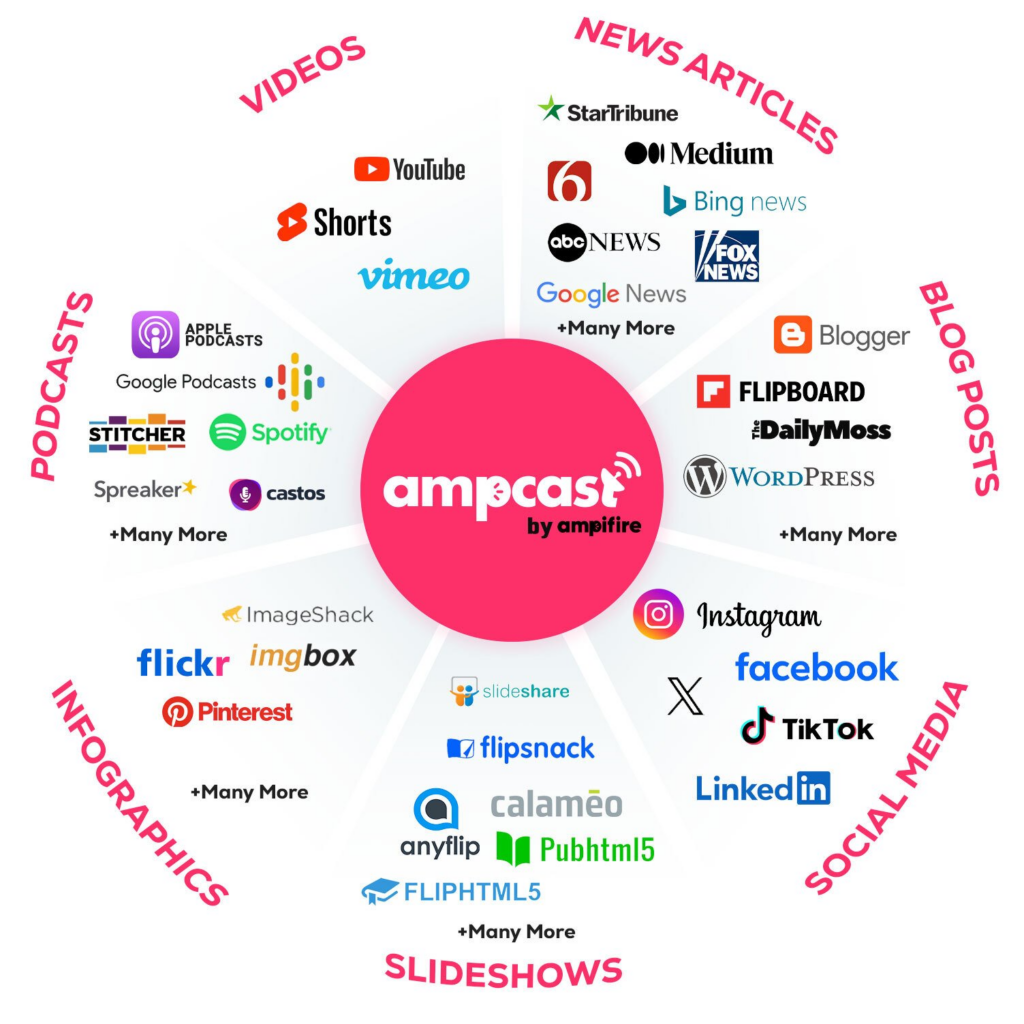
It researches what your audience searches for across platforms, transforms your announcement into eight distinct content formats optimized for each channel, and then distributes everything across 300+ high-authority sites, including Google News, YouTube, Spotify, Pinterest, FOX affiliate sites, and influential blog networks.
This results in ongoing organic traffic from search, social media, video, podcasts, and news sites simultaneously, which neither traditional PR nor SEO alone can achieve.
Cost-Effectiveness AmpiFire
Traditional distribution methods come with high costs and uncertain returns. A mid-tier PR agency charges $5,000–10,000 monthly for press release writing and distribution, with no guarantee of coverage or lasting traffic.
Building an in-house content team requires a writer, a video editor, and a distribution specialist, easily exceeding $165,000 annually, in addition to other costs. SEO agencies run $3,000–8,000 monthly and typically focus only on your website’s search rankings.
However, AmpiFire offers a far more accessible entry point: a DIY credit at $397 or an upgraded AI AmpCast credit starting at $495, each with a $27/month maintenance fee that includes unlimited AI content creation, syndication, and distribution.
You get multi-format content creation, AI-powered optimization, and distribution across hundreds of platforms at a more cost-effective price compared to traditional PR methods.
The Long-Term Effectiveness of AmpCast
Traditional press releases treat each announcement as an isolated event; you send it out, get temporary coverage for 24–48 hours, then start from zero with your next announcement. This approach fails to build the cumulative digital authority that drives sustained organic traffic, especially important for cybersecurity companies.
AmpCast works differently because content marketing is a compounding strategy. Your first campaign establishes your brand across multiple platforms. The second builds on that foundation, creating more connection points for prospects to discover you. By the third and fourth campaigns, you’ve created a comprehensive digital footprint that dominates search results, video platforms, and podcast directories for topics your customers care about.
Real-Life Results
One AmpiFire customer was struggling to gain a competitive edge in the crowded content marketing field. After discovering AmpiFire, he adopted its content amplification campaigns as his standard operating procedure, and the results spoke for themselves.
Within a couple of months of launching campaigns on one of his blogs, the site accumulated 9,000 views and began ranking for high-quality search keywords. On another project management blog, he ran just two Amp campaigns and let them sit for 3–4 months without any additional work. This resulted in first-page Google rankings and approximately 8,000 views, achieved entirely through AmpiFire’s automated distribution.
Notably, this case study is unique to one AmpiFire customer. Results will typically vary based on your implementation, business, and competition. The long-term results often speak for themselves, as each campaign builds your digital authority and strengthens your brand voice.
Ready to Replace Press Releases? Try the AmpiFire Method →
Frequently Asked Questions (FAQs)
How long should a cybersecurity press release be?
While general business press releases typically run 300–400 words, cybersecurity announcements often require additional technical context; as such, the core release should remain under 500 words.
Should I include technical details about vulnerabilities in my press release?
Technical detail inclusion should follow responsible disclosure principles while providing sufficient information for accurate reporting. The press release should include sufficient technical information to establish credibility and facilitate a basic understanding, while avoiding details that could facilitate the exploitation of unpatched systems.
What’s the best day of the week to distribute a cybersecurity press release?
Tuesday and Wednesday mornings (8:00–10:00 a.m. Eastern Time) typically yield optimal coverage results for cybersecurity announcements, avoiding both Monday’s news congestion and Friday’s declining attention.
How do I handle sensitive information in a press release?
When handling sensitive security information, apply the principle of “necessary disclosure” – provide enough detail for accurate understanding while withholding specific information that could enable active exploitation.
How does AmpiFire’s multi-channel distribution enhance press release effectiveness?
AmpiFire amplifies your content reach and eliminates the need to rely on traditional PR by creating and distributing eight different content formats from a single topic. These formats include podcasts, blog posts, news articles, social media posts, slideshows, infographics, long-form videos, and short-form videos.
Once optimized for different platforms, they are distributed through targeted reach to over 300 high-authority sites. This approach eliminates the need for journalists and amplifies your content’s reach.