Key Takeaways
- Your SaaS press release headline must clearly communicate value in under 10 words to capture journalists’ attention in crowded inboxes.
- Including specific data points and measurable outcomes increases your chances of media coverage.
- Most successful SaaS press releases follow a structured formula that balances newsworthiness with strategic positioning.
- Timing your press release around industry events or in response to competitor announcements can significantly boost visibility.
- AmpiFire’s AI-powered AmpCast repurposes your press releases into 8 content types and distributes them across 300+ authoritative platforms, converting one-time announcements into sustained digital presence and continuous organic traffic.
SaaS Press Releases That Actually Get Media Coverage
Tech journalists receive hundreds of SaaS press releases every day, but only a tiny fraction make it to publication. What separates the winners from the ignored? It’s not luck or connections. It’s strategic storytelling that aligns with what media outlets actually want to cover.
The harsh reality is that most SaaS companies approach press releases the wrong way. They focus on features instead of impact, use jargon-filled headlines, and fail to demonstrate why their announcement matters in the broader market context. This approach lands your carefully crafted announcement straight in the digital trash bin.
A successful SaaS press release transforms company news into a compelling narrative that helps journalists write stories their audiences will read. When done right, your press release positions your SaaS brand as a significant player solving real problems in your industry.
Why Press Releases Don’t Work Anymore
Smart Businesses Are Moving Beyond Traditional PR
• The Problem: Press releases reach one audience through one channel while your customers are everywhere online. Most get buried within days with poor ROI.
• The Solution: AmpiFire’s AmpCast creates 8 different content formats from one topic and distributes across 300+ high-authority sites including Fox affiliates, Spotify, and YouTube.
What You’ll Learn on PR Zen:
✓ Why multi-channel content delivers 10x better results than press releases
✓ How to amplify your PR efforts across multiple platforms
✓ Real case studies of businesses dominating search, social, video, and podcasts
✓ Cost-effective alternative to expensive PR agencies
Ready to Replace Press Releases? Learn the AmpiFire Method →
7 Tips for Writing High-Converting SaaS Press Releases
1. Headlines That Hook Tech Journalists
Your headline determines whether your press release gets opened or ignored. The most effective SaaS press release headlines follow a simple formula: [Company Name] [Verb] [Innovation] to [Solve Problem] for [Target Audience].
For example, “Acme SaaS Launches AI-Powered Analytics Platform to Cut Decision-Making Time by 75% for E-commerce Brands” immediately communicates what’s new, why it matters, and who benefits.
2. Data-Driven Storytelling
Press releases backed by original data are more likely to get media coverage. Journalists need to justify why their story matters now, and data provides that justification. Include specific metrics that demonstrate either the problem your solution addresses or the impact your announcement will have.
3. Customer Impact Metrics
The most successful SaaS press releases quantify exactly how customers benefit from the announcement. Vague statements about “improved efficiency” fall flat compared to specific impact metrics. When possible, include a brief customer success story that humanizes these metrics.
4. Industry Context & Relevance
Media outlets don’t just want to know what you’re announcing. Instead, they need to understand why it matters in the broader industry landscape. Effective SaaS press releases connect company news to larger market trends, creating context that helps journalists position your story.
5. Clear Product Differentiation
Effective press releases explicitly address how your solution differs from alternatives in ways that matter to users. Don’t be afraid to directly compare your offering to existing solutions, highlighting specific differentiators. The most successful SaaS press releases include a single paragraph dedicated to differentiation, with bullet points highlighting 2–3 key advantages.
6. Executive Quotes That Actually Say Something
Generic, jargon-filled quotes are the quickest way to signal that your press release is formulaic. Effective quotes provide genuine insight, vision, or context that adds value to the announcement. They should sound like something a real person would actually say.
7. Call-to-Action With Immediate Value
Every press release should end with a clear call-to-action that provides immediate value to both journalists and readers. The most effective CTAs offer resources that help journalists develop their stories while simultaneously driving engagement with your announcement.
Instead of simply directing people to your homepage, offer something specific: access to a demo, a research report, an interview opportunity, or exclusive data.
When To Send a Press Release (And When Not To)

Newsworthy Events That Deserve Announcement
Major product launches that introduce significant new capabilities or enter new markets almost always warrant press releases. These announcements should focus on market problems solved and customer outcomes rather than feature lists.
Similarly, funding rounds signal market validation and a growth trajectory worthy of media attention, but the announcement should emphasize how the capital will accelerate specific aspects of the roadmap or expansion plans rather than simply celebrating the investment.
Minor Updates That Should Skip the Press Release
Small feature updates, minor version releases, or incremental improvements rarely justify press releases unless they address highly visible market problems or represent significant technological breakthroughs. Instead, communicate these updates through product blogs, customer newsletters, or targeted sales outreach where they’ll be better appreciated by the right audience.
Timing Your Release for Maximum Impact
The timing of your press release can significantly impact its success. Avoid major industry events unless your announcement is directly related. Otherwise, you’re competing with hundreds of other companies for limited media attention. Analyze recent coverage patterns to avoid releasing news when similar companies have just made major announcements, as journalists rarely cover similar stories in close succession.
SaaS Press Release Samples That Work
Example 1: Notion’s Series C
Notion’s $275M Series C announcement immediately connects the funding to customer impact. The opening paragraph stated how the capital would expand global infrastructure and accelerate product development for their 20 million users. The release included specific growth metrics and customer testimonials showing real-world adoption. Rather than just celebrating the valuation, founder Ivan Zhao’s quote focused on the mission: making software toolmaking ubiquitous.
Example 2: Shopify & TikTok Integration
Salesforce’s Slack acquisition announcement immediately explained the strategic vision: creating “the operating system for the new way to work.” The release connected the acquisition to specific customer outcomes: unified communication, workflow automation, and CRM integration. Both CEOs provided quotes focused on customer value and market opportunity rather than deal structure. The announcement included concrete integration plans and timelines.
SaaS Press Release Template
[Your Company Logo]
FOR IMMEDIATE RELEASE
Headline: [Company Name] Launches [Product/Feature Name] to [Solve Specific Problem/Transform Specific Process]
Subheadline (Optional): [New solution/funding/partnership] enables [target customer] to [achieve specific outcome] with [key differentiator]
Dateline: [City, State] — [Month Day, Year]
Opening Paragraph:
[Company Name], a [brief company description], today announced [the launch of/funding round/major milestone]. [Product/announcement] addresses [specific market problem] by [how it solves the problem], enabling [target customers] to [achieve measurable outcome].
Problem & Solution Paragraph:
[Describe the market problem your announcement addresses]. According to [credible source/statistic], [relevant data point that demonstrates problem scale]. [Your solution/announcement] solves this by [specific capabilities], resulting in [customer outcomes like time saved, costs reduced, revenue increased].
Quote from Leadership:
“[Quote explaining why this announcement matters to customers and the market, focusing on impact rather than features],” said [Executive Name], [Title] of [Company Name]. “[Additional sentence about company vision or what this enables for customers].”
Product/Announcement Details:
[Expand on key capabilities, features, or details of the announcement]. [Include specific technical innovations, integrations, or unique approaches if relevant]. [For funding: explain how capital will be used. For partnerships: explain what the collaboration enables. For product launches: describe key use cases].
Customer/Partner Quote (Optional but Recommended):
“[Quote from customer, partner, or investor explaining real-world impact or why they’re excited about this announcement],” said [Name], [Title] at [Company].
Availability & Next Steps:
[Product Name/announcement] is [available now/coming in Q_/in beta] at [pricing model if applicable]. [Call to action: Learn more at URL / Sign up for early access / Schedule a demo]. [If applicable: The first customers include X, Y, Z].
About [Company Name]
[Company Name] is a [category] platform that helps [target customers] [achieve primary outcome]. Founded in [year] and based in [location], the company serves [customer type/size] across [industries/regions].
Media Contact:
[Name]
[Title]
[Email]
[Phone]
AmpiFire: Turns Your Press Release Into a Multi-Channel Distribution Strategy
Traditional press releases follow a predictable path: you send them out, maybe a few journalists pick them up, coverage appears for 24-48 hours, then it disappears. Your announcement reaches one audience through one channel while your potential customers are scattered across search engines, YouTube, podcasts, social media, and industry blogs. By the time prospects search for solutions like yours next month, your press release will be buried among hundreds of newer announcements, with minimal lasting impact on your organic traffic or brand visibility.
Here’s How AmpiFire Works
AmpiFire’s AI-powered AmpCast doesn’t fit into traditional PR or SEO categories because it solves a fundamentally different problem. While PR agencies focus on getting journalists to write about you and SEO services optimize your website for search engines, AmpiFire creates a multi-channel content ecosystem that puts your message directly in front of prospects wherever they search and consume content.
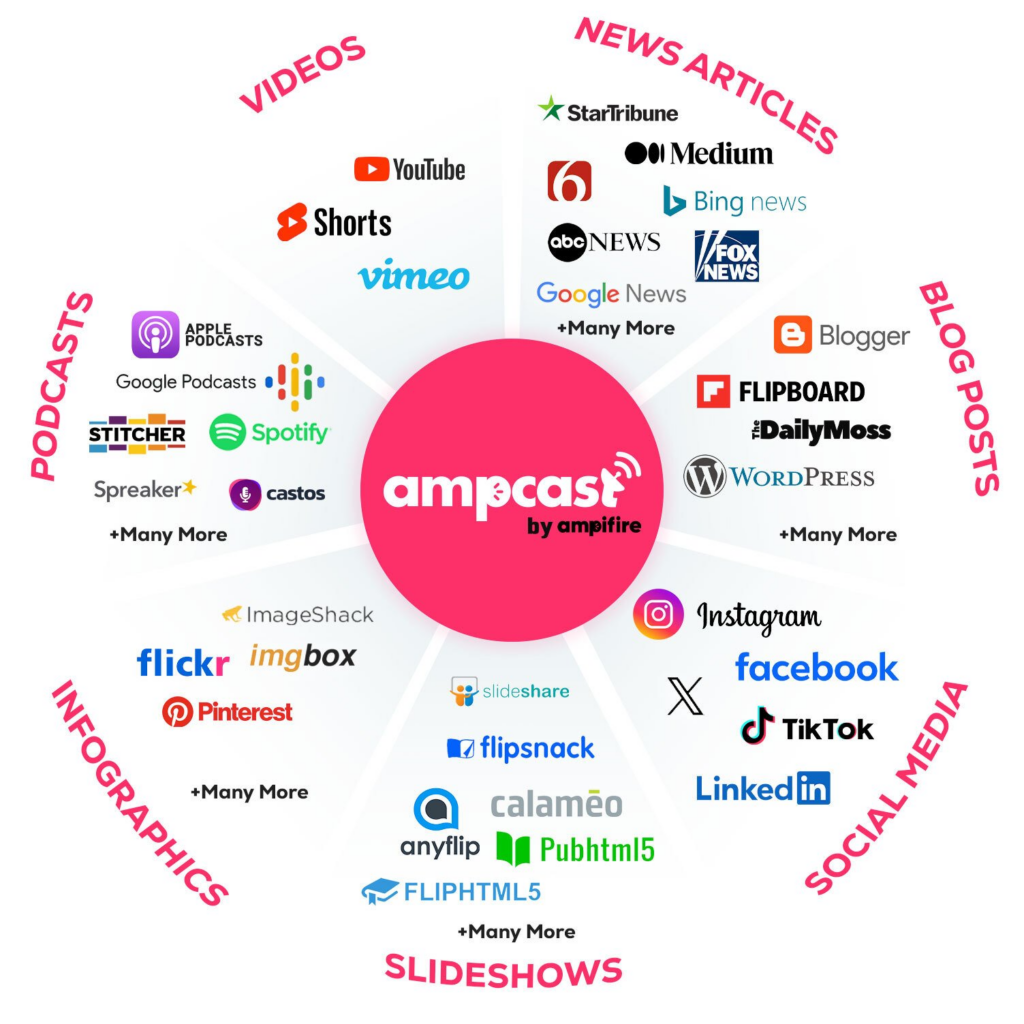
It’s content amplification that combines research, creation, and distribution into one system—researching what your audience searches for across platforms, creating content in 8 formats optimized for each platform, then distributing everything across 300+ high-authority sites (e.g., Google News, YouTube, Spotify, Pinterest, FOX affiliate sites, influential blog networks).
This approach generates ongoing organic traffic from search, social media, video, podcasts, and news sites simultaneously, something traditional PR or SEO alone cannot achieve.
- Media professionals conducting research encounter your content in news feeds
- Potential investors evaluating opportunities discover you across business platforms
- Potential customers comparing solutions find it through organic search and video content
- Podcast listeners discover it during their regular consumption
How AI Makes Multi-Channel Distribution Possible
Creating quality content in 8 different formats for every announcement would be impossible to do manually at scale. A human team would need days or weeks to transform one press release into a news article, blog post, long-form video, short-form video, podcast, infographic, slideshow, and social posts—each properly optimized for its platform.
AmpCast automates this transformation while maintaining quality and consistency across formats. The AI analyzes your core message, identifies platform-specific optimization opportunities, and generates content that performs well on each channel.
This isn’t just repurposing—it’s intelligent adaptation that understands how audiences consume content differently on YouTube, podcasts, and news sites. Without AI, this level of multi-channel distribution at speed and scale simply isn’t viable for most businesses.
Why AmpiFire Costs Less Than Traditional Alternatives
Compare the math: a mid-tier PR agency charges $5,000–10,000 monthly for press release writing and distribution to media contacts, with no guarantee of coverage or lasting traffic. Building an in-house content team requires, at a minimum, a writer ($60,000/year), a video editor ($55,000/year), and a distribution specialist ($50,000/year)—over $165,000 annually before tools and overhead. An SEO agency runs $3,000-8,000 monthly and typically focuses only on your website’s search rankings.
AmpiFire offers two entry options: a DIY credit at $397 or an upgraded AI AmpCast credit starting at $495, each requiring a $27/month maintenance fee that includes unlimited AI content creation, with syndication and distribution services included. For a fraction of traditional costs, you get multi-format content creation, AI-powered optimization, and distribution across hundreds of platforms—delivering traffic from multiple sources rather than depending on a single channel that may or may not work.
One-Time Announcements Don’t Build Long-Term Visibility
Traditional press releases treat each announcement as an isolated event. You send it, get temporary coverage, then start from zero with your next announcement. This approach fails to build the cumulative digital authority that drives sustained organic traffic.
Content marketing works differently—it’s a compounding strategy where each campaign strengthens your overall presence. Your first AmpiFire campaign establishes your brand across multiple platforms. The second campaign builds on that foundation, creating more connection points for prospects to discover you. By the third and fourth campaigns, you’ve created a comprehensive digital footprint that dominates search results, video platforms, and podcast directories for topics your customers care about.
The businesses seeing the strongest results from AmpiFire aren’t running one-off campaigns—they’re implementing consistent monthly content strategies that accumulate authority over 6-12 months. Each new piece of content attracts fresh traffic while previous campaigns continue generating results, creating exponential rather than linear growth in visibility and leads.
Real-Life Results
One AmpiFire customer case study revealed how campaigns outranked big competitors and dominated Google’s front page. This is one specific case study result and not a guarantee of performance. Individual results will vary based on your market, competition, and implementation.
The real advantage emerges over time. Each successive campaign strengthens your digital authority, creating a self-reinforcing presence that continues to attract prospects long after launch day, unlike standard press releases, which lose momentum within 48 hours.
Ready to Amplify your Announcement? Try the AmpiFire Method →
Frequently Asked Questions (FAQs)
How much should a SaaS company spend on press release distribution?
Distribution costs vary dramatically based on your goals, from $300 for basic wire services to $3,000+ for premium distribution with targeted industry reach. For early-stage SaaS companies, a tiered approach often works best: allocate $500–800 for announcements with broad market appeal (funding, major product launches) and use free or low-cost distribution for minor updates.
Should we write our own press releases or hire a PR firm?
This decision depends on your internal resources, budget, and the significance of your announcement. For major announcements, professional PR assistance typically yields better results through established media relationships and expertise in effectively positioning your news. For smaller updates, self-authored press releases can be effective when following the guidelines outlined in this article.
How far in advance should we prepare a press release?
Begin preparing your press release 3–4 weeks before your target distribution date. This allows for multiple revision rounds, executive approvals, quote collection, and coordination with any external parties mentioned in the release. For funding announcements or partnerships, allow additional time to navigate approval processes with investors or partner companies, which often take longer than anticipated.
How can AmpiFire help me get more visibility from my press release?
AmpiFire’s AmpCast software converts your press release into 8 content formats and distributes it across 300+ platforms. Rather than relying entirely on journalists to pick up your story, your announcement appears directly on Google News, YouTube, podcasts, and prominent blogs, ensuring your SaaS news reaches your target audience wherever they search and consume content, not just in traditional media outlets.
*Note: Pricing and/or product availability mentioned in this post are subject to change. Please check the retailer’s website for current pricing and stock information before making a purchase.