Public relations is more than just managing a company's image; it's about capturing public imagination. The most legendary brands understand this, using audacious, clever, and sometimes even accidental public relations stunts to dominate news cycles and etch their names into cultural history. But what separates a fleeting headline from a legacy-defining moment? It’s not just about budget or scale, it’s about strategy, authenticity, and the courage to take a calculated risk. A well-executed stunt can generate massive amounts of attention without a direct media spend, which is the core principle of earned media. For those unfamiliar with the concept, understanding What Is Earned Media is key to grasping why these campaigns are so valuable.
In this deep dive, we dissect 10 of the most iconic PR stunts ever executed. We'll go beyond the surface-level story to uncover the strategic blueprint behind each one: the goals, the tactical execution, the measurable outcomes, and the critical takeaways you can adapt. You will get an inside look at the planning that turned a space jump into a global phenomenon and how a simple tweet for chicken nuggets became a case study in viral marketing. For each example, we provide a short, adaptable template to help you transform these insights into your own media-capturing campaigns. Prepare to learn how these brands turned creative ideas into monumental, long-lasting success.
1. Red Bull Stratos Space Jump (2012)
Red Bull's Stratos project is the quintessential example of a brand-owned media event, a high-stakes endeavor that transcends traditional advertising to become a cultural moment. Instead of merely sponsoring an event, Red Bull built one from the ground up, centered on a narrative of human achievement and scientific progress. The stunt involved Austrian skydiver Felix Baumgartner ascending to the stratosphere in a helium balloon and free-falling back to Earth, breaking multiple world records in the process.

This campaign was a masterclass in long-term storytelling and content creation. The entire journey, from scientific preparation to the final jump, was documented and shared, building anticipation over several years. This meticulous documentation allowed Red Bull to own a story about pushing human limits, perfectly aligning with its "gives you wings" slogan and solidifying its brand identity with extreme sports and innovation.
Strategic Analysis
The genius of Stratos was its ability to merge a live, high-tension event with rich scientific context, making it one of the most compelling public relations stunts ever conceived. By partnering with Google for a live stream on YouTube, Red Bull ensured global accessibility, resulting in over 8 million concurrent viewers and shattering previous records. This digital-first approach guaranteed massive organic reach far beyond what a traditional media buy could achieve. The event generated an estimated 8.7 billion media impressions on launch day alone, with coverage spanning every major global news outlet.
The core strategy was not just to perform a stunt, but to create a legitimate scientific mission. This provided the depth and credibility needed for serious media outlets to cover it as a news story, not just a marketing campaign.
Actionable Takeaways
While a space jump is beyond most budgets, the principles behind Stratos are scalable.
- Own the Narrative: Create an event or initiative that your brand can own entirely, from conception to execution. This allows you to control the story and messaging.
- Document Everything: Produce behind-the-scenes content, expert interviews, and technical explainers. This material provides fuel for social media and secondary press pushes long after the main event.
- Emphasize "Firsts": Frame your project around a record-breaking or "world-first" angle to capture media attention. Even a small, local "first" can generate buzz.
- Build Multimedia Press Kits: The visual and emotional power of Stratos was key. Equip journalists with high-quality photos, b–roll video, and infographics. For a guide on maximizing your media outreach, you can learn more about using multimedia in press releases.
2. Red Bull Stratos Space Jump (2012)
Red Bull's Stratos project is the quintessential example of a brand-owned media event, a high-stakes endeavor that transcends traditional advertising to become a cultural moment. Instead of merely sponsoring an event, Red Bull built one from the ground up, centered on a narrative of human achievement and scientific progress. The stunt involved Austrian skydiver Felix Baumgartner ascending to the stratosphere in a helium balloon and free-falling back to Earth, breaking multiple world records in the process.
This campaign was a masterclass in long-term storytelling and content creation. The entire journey, from scientific preparation to the final jump, was documented and shared, building anticipation over several years. This meticulous documentation allowed Red Bull to own a story about pushing human limits, perfectly aligning with its "gives you wings" slogan and solidifying its brand identity with extreme sports and achievement.
Strategic Analysis
The genius of Stratos was its ability to merge a live, high-tension event with rich scientific context, making it one of the most compelling public relations stunts ever conceived. By partnering with Google for a live stream on YouTube, Red Bull ensured global accessibility, resulting in over 8 million concurrent viewers and shattering previous records. This digital-first approach guaranteed massive organic reach far beyond what a traditional media buy could achieve. The event generated an estimated 8.7 billion media impressions on launch day alone, with coverage spanning every major global news outlet.
The core strategy was not just to perform a stunt, but to create a legitimate scientific mission. This provided the depth and credibility needed for serious media outlets to cover it as a news story, not just a marketing campaign.
Actionable Takeaways
While a space jump is beyond most budgets, the principles behind Stratos are scalable.
- Own the Narrative: Create an event or initiative that your brand can own entirely, from conception to execution. This allows you to control the story and messaging.
- Document Everything: Produce behind-the-scenes content, expert interviews, and technical explainers. This material provides fuel for social media and secondary press pushes long after the main event.
- Emphasize "Firsts": Frame your project around a record-breaking or "world-first" angle to capture media attention. Even a small, local "first" can generate buzz.
- Build Multimedia Press Kits: The visual and emotional power of Stratos was key. Equip journalists with high-quality photos, b-roll video, and infographics. For a guide on maximizing your media outreach, you can learn more about using multimedia in press releases.
3. IKEA's Billy Bookcase 75th Anniversary Campaign (2024)
IKEA celebrated the 75th anniversary of its iconic Billy Bookcase by transforming a product milestone into a narrative-rich cultural event. Rather than a simple sale or ad campaign, the brand launched the "Billy Museum," a pop-up installation in Paris. This exhibit featured reimagined bookshelves of famous fictional characters, like Don Quixote and the protagonists of Little Women, all built using the versatile Billy system.
The campaign was a brilliant exercise in connecting a mass-produced item to the deeply personal worlds of literature and imagination. By showing how the Billy could house the stories of beloved characters, IKEA elevated its product from a piece of flat-pack furniture to a vessel for culture and personality. This stunt effectively merged product design with pop culture, generating widespread media coverage and viral social media engagement.
Strategic Analysis
The strength of the Billy Museum stunt was its ability to tell a story about the product's legacy through a creative, shareable medium. It was a tangible experience that tapped into the public's love for literature, making the campaign accessible and emotionally resonant. The pop-up format created a sense of urgency and exclusivity, driving foot traffic and online conversation from those who couldn't attend in person. By partnering with its innovation lab, SPACE10, and local cultural institutions, IKEA added layers of credibility and artistic merit.
The core strategy was to celebrate the customer's story, not just the product's. By showing what the Billy bookcase contains – the personalities, dreams, and histories of its owners (even fictional ones) – IKEA made the campaign about people, not just furniture.
Actionable Takeaways
While a Parisian pop-up may be ambitious, the underlying strategy is adaptable for many brands.
- Humanize Your Product's History: Instead of just stating a product's age, create a narrative around its role in people's lives. Connect it to culture, history, or personal stories.
- Create a Tangible Experience: Pop-ups, installations, and interactive exhibits give journalists and influencers a physical event to cover, which often generates more compelling content than a press release alone.
- Leverage Fictional Narratives: Align your product with beloved stories or characters from pop culture to borrow their emotional equity and create an instant connection with the audience.
- Encourage User Participation: The campaign included the #MyBilly hashtag, inviting users to share their own bookcase stories. This turns a one-way stunt into a two-way conversation and generates valuable user content.
4. Wendy's #NuggsForCarter Twitter Campaign (2017)
The #NuggsForCarter phenomenon demonstrates the power of reactive, real-time engagement in creating some of the most memorable public relations stunts. It all started when teenager Carter Wilkerson tweeted at Wendy's, asking how many retweets he'd need for a year's supply of free chicken nuggets. Wendy's quipped back with an astronomical number: "18 Million." This simple, authentic interaction sparked a viral movement that transcended the platform, becoming a global news story.
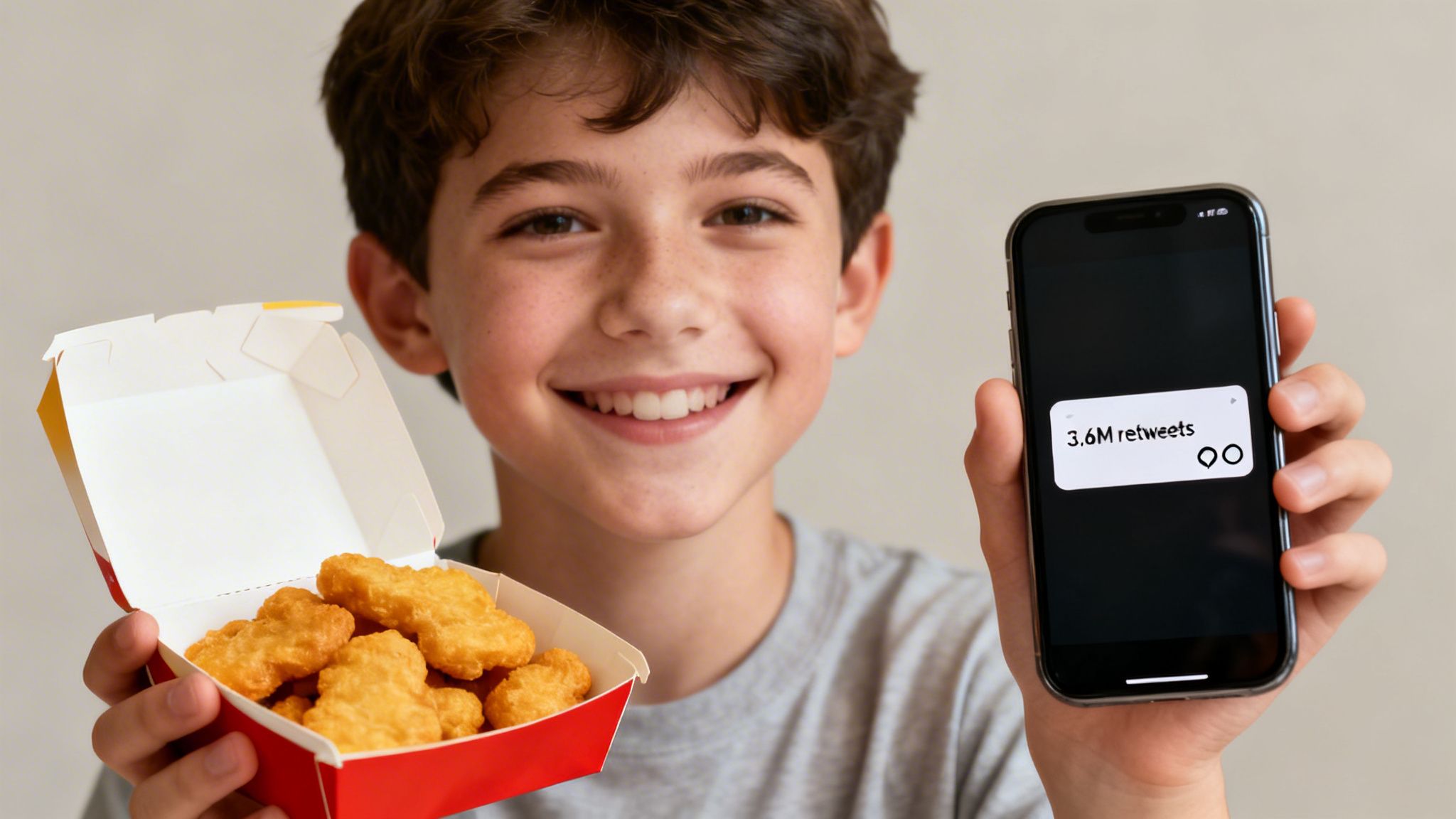
Unlike pre-planned campaigns, this stunt was entirely organic. Wendy's didn't orchestrate the initial request; it simply responded in a way that was true to its established sassy and playful brand voice. The campaign's success relied on the brand's ability to let go of control and embrace the spontaneity of social media, turning a customer's whim into a record-breaking cultural event that generated immense positive sentiment.
Strategic Analysis
The brilliance of the #NuggsForCarter campaign was its low cost and high authenticity. Wendy's spent nothing on media buys, instead capitalizing on a moment that perfectly fit its brand persona. Wilkerson’s tweet ultimately garnered over 3.6 million retweets, becoming the most retweeted tweet of all time and landing coverage on major outlets like CNN and NBC. Wendy's honored the effort by giving Carter his nuggets and making a $100,000 donation to charity in his name, adding a layer of goodwill to the viral fun.
The core strategy was to lean into an unplanned opportunity with a human, on-brand voice. By not treating the interaction as a corporate transaction but as a playful challenge, Wendy's created a story people wanted to be a part of.
Actionable Takeaways
While you can't force a viral moment, you can create the conditions for one to happen.
- Develop a Distinct Brand Voice: Train your social media team to interact with authenticity and personality. A clear voice guide is essential for quick, on-brand responses.
- Monitor Social Media for Opportunities: Use social listening tools to spot conversations where your brand can naturally participate. This kind of real-time engagement is a key component of trendjacking.
- Be Prepared to Act Fast: Viral moments have a short lifespan. Empower your team to respond and escalate opportunities without getting bogged down in lengthy approval processes.
- Amplify with Follow-Up Actions: The stunt didn't end with the retweets. Wendy's charity donation created a second wave of positive press, extending the story's reach and impact.
5. Dollar Shave Club's Disruptive Launch Video (2012)
Dollar Shave Club's launch video is a powerful testament to how personality-driven, low-budget content can topple industry norms. In 2012, the startup entered a market dominated by giants like Gillette and Schick. Instead of competing on their terms with massive advertising spends, founder Michael Dubin starred in a crude, hilarious, and refreshingly honest 90-second YouTube video titled "Our Blades Are F***ing Great." It directly mocked the over-engineered, overpriced razors of its competitors with a simple value proposition.
This video was not just an advertisement; it was a manifesto. It established a brand voice that was authentic, irreverent, and spoke directly to a generation of consumers tired of traditional marketing. The stunt's success was rooted in its perfect alignment of message, medium, and audience, proving that a strong idea and bold execution could generate more buzz than a multi-million dollar campaign.
Strategic Analysis
The brilliance of the Dollar Shave Club video was its ability to turn a product launch into a viral media event. By choosing YouTube as its primary platform and embracing a "David vs. Goliath" narrative, the company created a story that was inherently shareable. The video's crude humor and direct-to-camera style made it feel personal and authentic, not corporate. This strategy yielded immediate, measurable results: the video gained over 12 million views, and the company acquired 12,000 customers in the first 48 hours.
The core strategy was to weaponize humor and authenticity against an established, self-serious industry. The video wasn't just selling razors; it was selling membership into a club that rejected the status quo, making early customers feel like insiders.
Actionable Takeaways
While not every brand can pull off this level of irreverence, the underlying principles are widely applicable for creating impactful public relations stunts.
- Lead with Personality: Don't be afraid to inject a strong, authentic voice into your marketing. A memorable personality can be more powerful than a polished but forgettable corporate message.
- Embrace the Underdog Story: If you are challenging a larger competitor, make that narrative central to your PR efforts. Media outlets and consumers love a story of a small upstart taking on an industry giant.
- Create Shareable Video Assets: Focus on creating content that people will want to share with their friends. Humor, surprise, and a strong point of view are key ingredients for virality.
- Build Press Materials Around the Founder: Position your founder as a thought leader and a character. Develop interview opportunities and press releases that highlight their disruptive philosophy and personal story.
6. Old Spice's 'The Man Your Man Could Smell Like' Campaign (2010)
Old Spice's 2010 campaign was a masterstroke in brand reinvention, turning a legacy men's grooming product into a viral sensation. The core of the campaign was a series of fast-paced, surreal commercials featuring actor Isaiah Mustafa as "The Old Spice Guy." His direct-to-camera monologue, delivered with unwavering confidence while transitioning from a shower to a boat to riding a horse, became an instant cultural touchstone. The campaign skillfully blended traditional TV advertising with a pioneering interactive social media element.

This was far more than just a funny commercial; it was a conversation. The campaign extended its life by having "The Old Spice Guy" respond directly to comments and questions from social media users in real-time. This interactive phase generated 181 personalized video responses in just two weeks, creating an unprecedented level of direct engagement and media buzz. The effort successfully shifted Old Spice's brand perception from dated to witty and modern, capturing a new, younger audience.
Strategic Analysis
The brilliance of this campaign was its two-pronged approach that combined mass-media reach with personalized digital interaction. The initial TV spot created widespread awareness and a central character, while the social media response element built a dedicated community and generated massive secondary press coverage. This made Old Spice one of the first brands to truly prove the power of real-time social media engagement as a core public relations tool. The campaign earned over 55 million views on YouTube and led to a 125% increase in body spray sales, demonstrating a clear return on investment.
The core strategy was to create a brand personality so compelling that it could interact directly with its audience. This broke the fourth wall between brand and consumer, turning passive viewers into active participants and brand evangelists.
Actionable Takeaways
While not every brand can create a viral icon, the underlying tactics are highly adaptable.
- Personify Your Brand: Develop a distinct voice or character for your brand that can engage with audiences on a personal level. This doesn't have to be a person; it can be a specific tone or style.
- Bridge Traditional and Digital: Launch your main message through a broad-reaching channel like TV or a major publication, then use social media to continue the conversation with a more personal touch.
- Plan for Real-Time Interaction: Prepare your team to respond quickly and creatively to audience feedback. This "always-on" approach can turn a one-off announcement into a sustained event.
- Create Shareable Content: The humor and surrealism of the ads were built for sharing. Focus on creating content that is entertaining and easily digestible on social platforms.
7. Tesla's Cybertruck Reveal Event Stunt (2019)
Tesla's Cybertruck reveal offered a masterclass in turning an apparent failure into a viral public relations victory. The event was designed to showcase the truck's radical design and supposed indestructibility. The centerpiece of this demonstration was a test of its "armor glass" windows. What happened next has become the stuff of PR legend: when lead designer Franz von Holzhausen threw a steel ball at the window, it shattered, not once, but twice.
Instead of a polished demonstration of strength, the global audience witnessed a live, unscripted moment of fallibility. Yet, this "failure" generated more conversation and media coverage than a successful test ever could have. The incident dominated social media, news cycles, and late-night television, making the Cybertruck an instant cultural icon defined by its authentic, if flawed, introduction.
Strategic Analysis
The unexpected window break transformed the event from a standard product launch into a highly memorable, humanized story. While likely unintentional, the gaffe played perfectly into Elon Musk’s and Tesla's brand persona of being unpredictable, boundary-pushing, and transparent. The moment generated billions of social media impressions and ensured every major news outlet covered the launch. It became one of the most effective, albeit accidental, public relations stunts in recent history.
The core strategy, intended or not, was authenticity over perfection. The flaw made the event relatable and shareable, proving that in the age of social media, a genuine "oops" moment can be more powerful than a flawless presentation.
Actionable Takeaways
While orchestrating a "successful failure" is risky, the principles behind the Cybertruck's viral moment are applicable.
- Embrace Imperfection: A polished presentation can be forgettable. A moment of genuine, unscripted reality can create a strong emotional connection and make your brand more human.
- Lean Into the Narrative: Tesla didn't hide from the incident; Musk's candid "room for improvement" reaction and subsequent jokes amplified the story. Own unexpected moments and incorporate them into your brand’s narrative.
- Plan for Contingencies: For any live event, prepare for both best-case and worst-case scenarios. Have rapid-response social media statements and crisis communication drafts ready to go.
- Prioritize Shareability: The shattered window was an instantly recognizable and highly shareable visual. Create moments, planned or not, that are built for memes, GIFs, and social media commentary.
8. Rent the Runway's 'Try Before You Buy' Pop-Up Stores (2010-Present)
Rent the Runway (RTR) turned the traditional retail model on its head by building a business around renting designer fashion. To overcome customer apprehension about fit and quality-a major hurdle for an online-only service-RTR launched a series of "Try Before You Buy" pop-up stores. These temporary, experiential showrooms were more than just retail spaces; they were highly effective public relations stunts designed to generate media buzz and direct customer engagement. Each pop-up became a local event, allowing customers to touch, feel, and try on high-end garments before committing to a rental.
This campaign was a brilliant fusion of physical retail and digital service, creating a tangible brand experience that was inherently shareable. By bringing their "closet in the cloud" to the ground in cities across the nation, RTR generated significant local news coverage and powerful word-of-mouth marketing. The pop-ups acted as press events, product trial centers, and content creation hubs all in one.
Strategic Analysis
The power of RTR's strategy was in making a digital service tangible and local. By launching city-specific pop-ups, they created dozens of localized "grand opening" news cycles instead of one national story. This allowed them to dominate local fashion and lifestyle media in each new market, with reports of over 50 articles per location. The pop-ups became Instagram-friendly destinations, driving millions of social media impressions and converting online followers into paying customers, with many locations generating over 1,000 trial sign-ups.
The core strategy was to treat each pop-up not as a simple store but as a media-first event. This approach guaranteed that each new location launch was framed as a news story, turning an operational expansion into a sustained, multi-market PR campaign.
Actionable Takeaways
While building a national network of pop-ups is a significant undertaking, the core principles can be applied by many businesses.
- Create Physical Touchpoints: If you run a digital or service-based business, create a temporary physical experience. A pop-up shop, a workshop, or an interactive kiosk can make your brand tangible.
- Localize Your Media Pitch: Frame your initiative as a local story. Draft city-specific press releases and target local journalists and influencers who are keen to cover what's new in their area.
- Design for Social Sharing: Make your physical space visually appealing and interactive. Include branded backdrops, unique props, or "Instagrammable" moments that encourage visitors to share their experience online.
- Merge PR with Acquisition: Structure your event to directly support business goals. Offer an exclusive sign-up discount or a special gift for attendees to convert buzz into measurable customer growth.
9. GoPro's First-Person Extreme Sports Content Strategy (2010-Present)
GoPro fundamentally shifted the paradigm of product marketing by creating an ecosystem where its customers became the stars of its public relations stunts. Instead of staging singular, high-cost events, the company armed athletes, adventurers, and everyday users with its durable cameras and empowered them to capture their own thrilling experiences. This strategy transformed customers into a global network of content creators, providing an endless supply of authentic, first-person footage that served as the brand's primary marketing asset.
This approach blurred the lines between advertising and genuine storytelling. GoPro's marketing was not a commercial; it was a highlight reel of human achievement, passion, and adventure, captured by the very people who loved the product. The result was a continuous stream of viral content that felt more like a shared cultural experience than a corporate campaign, building a loyal community and generating immense organic press coverage.
Strategic Analysis
The brilliance of GoPro's strategy lies in its scalability and authenticity. While a single brand-produced stunt has a limited lifespan, GoPro built a self-sustaining content engine. By featuring user-submitted videos in its official marketing channels, including its wildly successful YouTube channel (now with over 10 million subscribers and billions of views), GoPro gave its customers a platform and an incentive to create high-quality content. This user-generated content (UGC) model was a key driver in its 2014 IPO, which valued the company at over $3 billion, proving that brand advocacy could be a core business asset.
The core strategy was to make the user the hero, not the product. By celebrating the achievements and stories of its community, GoPro created an emotional connection that transcended technical specifications. The camera became a tool for self-expression, and buying a GoPro was an entry ticket into an aspirational lifestyle.
Actionable Takeaways
This community-centric content model offers a powerful framework for brands in any industry.
- Empower Your Users: Create programs, contests, or platforms that encourage your customers to share their experiences with your product. This could be as simple as a branded hashtag campaign.
- Curate and Amplify: Don't just collect UGC; actively curate the best content and feature it prominently on your official channels. Celebrate the creators to foster a sense of community and reward participation.
- Build a Content Flywheel: Use standout user content to fuel press releases, social media campaigns, and even traditional advertising. Pitch stories about your most creative customers to media outlets.
- Focus on the "How-To": GoPro’s success wasn't just about extreme sports. Many popular videos showed everyday uses, from a musician's perspective to a chef's-eye view. This demonstrates the product's versatility and broadens its appeal.
10. Patagonia's Environmental Activism as Brand PR (1980s-Present)
Patagonia has turned the traditional concept of public relations on its head by making sustained, authentic environmental activism the core of its brand identity. Rather than executing singular stunts, the company has engaged in a 40+ year campaign of consistent, mission-driven action. This approach treats activism not as a marketing tactic, but as the company’s reason for being, generating continuous, positive press coverage as a byproduct of genuine commitment.
From co-founding the 1% for the Planet initiative to suing the federal government to protect public lands, Patagonia’s actions provide an endless stream of newsworthy events. The ultimate expression of this strategy came in 2022 when founder Yvon Chouinard transferred ownership of the entire company, valued at approximately $3 billion, to a trust and a nonprofit dedicated to combating the climate crisis. This was not a temporary stunt; it was the permanent fusion of brand and cause.
Strategic Analysis
Patagonia’s strategy is a masterclass in authenticity, creating a brand so intertwined with its values that its actions become its most powerful PR. By taking strong, often controversial stances, the company attracts a deeply loyal customer base that shares its beliefs. This long-term commitment has built immense brand equity and credibility, allowing Patagonia to earn media coverage in business, fashion, and environmental news outlets simultaneously.
The core strategy is to make the business a vehicle for the mission, not the other way around. Every corporate decision, from supply chain management to political lawsuits, is filtered through its environmental purpose, creating a consistent and believable narrative that journalists and consumers trust.
Actionable Takeaways
While donating an entire company is not replicable, the underlying philosophy of value-driven PR is.
- Commit to a Cause: Identify a core value that aligns with your business and make a long-term, public commitment to it. Authenticity is built over time.
- Translate Values into Action: Don't just talk about your mission; demonstrate it. This could mean donating a percentage of sales, organizing volunteer days, or changing a business practice to be more sustainable.
- Document and Report Impact: Create press releases and content focused on tangible outcomes (e.g., funds donated, acres saved, policies changed). This provides journalists with concrete, newsworthy information.
- Embrace Advocacy: Don't be afraid to take a stand on issues relevant to your mission. While it may alienate some, it will forge a stronger bond with your core audience. For more ideas on communicating your mission, explore guides on creating cause marketing campaigns.
10 Iconic PR Stunts Compared
| Campaign | Implementation Complexity 🔄 | Resource Requirements ⚡ | Expected Outcomes 📊 ⭐ | Ideal Use Cases 💡 | Key Advantages ⭐ |
|---|---|---|---|---|---|
| Dove's Real Beauty Campaign (2004–Present) | High — multi‑channel, long horizon | High — sustained budget, production, partnerships | 📊 Long‑term earned media & trust; ⭐⭐⭐ | Repositioning, social impact, credibility building | Authentic storytelling; sustained loyalty |
| Red Bull Stratos Space Jump (2012) | Very high — technical, regulatory, multi‑year | Very high — ~$50M+, specialist partners | 📊 Global blockbuster reach; ⭐⭐⭐⭐ | Brands with extreme positioning and huge budgets | Unparalleled visibility; record‑setting PR |
| IKEA Billy Bookcase 75th Anniversary (2024) | Medium — experiential pop‑up curation | Moderate — location, fabrication, PR | 📊 Viral social & cultural coverage; ⭐⭐ | Product anniversaries, lifestyle/retail storytelling | Highly shareable visuals; scalable low‑tech stunt |
| Wendy's #NuggsForCarter (2017) | Low — opportunistic real‑time engagement | Low — team monitoring, rapid response | 📊 Massive viral reach at low cost; ⭐⭐⭐ | Social agility, trendjacking, community engagement | Cost‑effective; humanizes brand; high ROI |
| Dollar Shave Club Launch Video (2012) | Low–Medium — single creative execution | Low — inexpensive production, distribution push | 📊 Fast customer acquisition & press; ⭐⭐⭐ | Startups/challengers with bold voice | Low cost, high ROI; disruptive narrative |
| Old Spice "The Man Your Man Could Smell Like" (2010) | Medium — scripted creative + interactive follow‑up | High — production + rapid personalized responses | 📊 Major earned media & sales lift; ⭐⭐⭐ | Heritage brand refresh, humor‑led repositioning | Rejuvenates brand; pioneering interactive PR |
| Tesla Cybertruck Reveal (2019) | Medium — live demo risk, founder‑led | Moderate — event production, PR crisis prep | 📊 Massive attention; sentiment mixed; ⭐⭐ | High‑profile product reveals, founder spectacle | Authenticity from unscripted moments; conversation driver |
| Rent the Runway Pop‑Ups (2010–Present) | Medium — logistical coordination per market | Moderate — pop‑up costs, staffing, local PR | 📊 Consistent local coverage & trials; ⭐⭐ | Retail testing, experiential customer acquisition | Tangible trials; replicable local PR |
| GoPro UGC Content Strategy (2010–Present) | Low–Medium — programmatic UGC & curation | Moderate — partnerships, platform distribution | 📊 Continuous content volume & advocacy; ⭐⭐⭐ | Product brands leveraging customers as creators | Low per‑asset cost; authentic ambassador network |
| Patagonia Environmental Activism (1980s–Present) | High — corporate alignment & long‑term action | High — financial commitments, legal campaigns | 📊 Multi‑decade credibility & loyalty; ⭐⭐⭐⭐ | Mission‑driven brands seeking principled differentiation | Unmatched credibility; attracts loyal customers and talent |
Your Blueprint for a Breakthrough PR Stunt
As we've journeyed through some of the most memorable public relations stunts in recent history, a clear pattern emerges. These campaigns did not merely shout from the rooftops; they built a stage and gave the audience a reason to listen, participate, and share. From Red Bull’s audacious Stratos jump to Wendy's grassroots #NuggsForCarter phenomenon, the underlying principle is consistent: successful stunts are not random acts of marketing but carefully orchestrated events that tap into core human emotions and brand truths.
The examples in this guide, from Dove's purpose-driven "Real Beauty" to Patagonia's unwavering environmental activism, show that impact is not solely dependent on budget. A powerful idea, executed with precision and authenticity, can achieve more than millions in ad spend. Dollar Shave Club proved this with a single, hilarious video, while GoPro built an empire by empowering its users to become the heroes of its brand story.
Synthesizing the Core Strategies
Reflecting on these diverse campaigns, we can distill their success into a few foundational pillars. Mastering these is critical for any team aiming to create their own moment in the spotlight.
- Authenticity as a North Star: Every successful stunt was an extension of the brand's genuine identity. Patagonia's activism works because it’s baked into their DNA. Wendy's snark resonates because it’s consistent with their established social media voice. A stunt that feels disconnected from your brand’s core values will be perceived as hollow and opportunistic.
- Audience Participation is Rocket Fuel: The most explosive stunts invited the audience to be part of the story. Wendy's didn't just give Carter his nuggets; they created a public quest. GoPro turned customers into a global content creation team. The key is to move from a monologue, where you speak at your audience, to a dialogue, where you create something with them.
- Calculated Risk and Contingency: Not every stunt goes perfectly, and that’s okay. Tesla’s Cybertruck window smash became one of the most talked-about parts of the reveal. The lesson is not to avoid risk, but to manage it. Understand the potential downsides, have a crisis communication plan ready, and be prepared to embrace the unexpected. Sometimes, the imperfection is what makes the story memorable.
Building Your Action Plan
Moving from inspiration to execution requires a structured, deliberate approach. The strategic breakdowns and adaptable templates provided for each example in this article serve as your initial toolkit. But to truly craft a breakthrough campaign, you must adopt a methodical creative process. To create your own breakthrough PR stunt, it's essential to follow a structured approach, similar to the Design Thinking process steps that guide innovation from concept to execution. This framework helps ensure your big idea is not just creative but also audience-centric, viable, and aligned with your strategic goals.
Start by defining your "why." What is the single most important message you want to convey? What feeling do you want to leave with your audience? Then, brainstorm without limits before grounding your ideas in the reality of your brand, budget, and resources. Use the takeaways from campaigns like Old Spice and IKEA as a guide: connect emotionally, be bold, and make sure the stunt clearly links back to your product or mission.
The world of public relations stunts is not about luck; it's about courage, creativity, and meticulous planning. The campaigns we've analyzed offer a blueprint for creating moments that don't just capture attention but also build lasting brand equity. Your brand has a story to tell. The only question is: how will you make the world want to listen?
Ready to turn your big idea into a media sensation? Press Release Zen provides the expert-designed templates and strategic distribution network you need to amplify your message. Stop guessing and start getting noticed with Press Release Zen today.