Think of an AP style press release as your direct line to the media. It’s a standardized format that signals professionalism, and honestly, it makes it far easier for journalists to pick up your story. Using a proper press release template ap style tells a reporter you respect their time and understand their world.
Why AP Style Is Your Secret Weapon for Media Coverage
Let's be honest—a journalist's inbox is a battlefield. They are absolutely flooded with hundreds of pitches every single day, and each one is fighting for a sliver of attention. So, how do you make your announcement stand out? It all starts with speaking their language, and in the news business, that language is AP Style.
This isn't just about following some arbitrary rules. It's about signaling credibility and making a reporter's job easier from the moment they open your email. Sending a release that ignores AP Style is like showing up to a job interview in flip-flops—it immediately communicates a lack of professionalism and often gets your pitch tossed in the trash.
Building Instant Credibility with a Universal Standard
The Associated Press (AP) has been the backbone of journalism since the 1840s. Today, it’s a global news giant with around 3,700 journalists in over 100 countries, supplying content to more than 1,300 news outlets. That massive reach is exactly why its style guide became the gold standard for the entire industry.
When your release follows this universal standard, it does more than just look polished. It builds immediate trust. One PR firm even reported A/B testing AP-compliant releases against more casual versions and found the AP Style formats got 3x more media mentions. That effort directly boosted their clients’ visibility on platforms like Google News, proving the real-world benefits of getting the format right. You can dig into the details of how AP Style boosts media pickup in their analysis.
The Core Principles That Earn Media Attention
AP Style is really built on three core ideas that line up perfectly with what journalists need to do their jobs. If you can get these right, your press release will be far more newsworthy and effective.
- Brevity: Journalists are always on a tight deadline. AP Style forces you to be concise, cutting through the marketing fluff to get straight to the most important information first. No warm-ups needed.
- Accuracy: The style guide has very specific rules for things like numbers, dates, job titles, and locations. Getting these small details correct from the start shows you’re a reliable source they can trust.
- Objectivity: AP Style demands a neutral, fact-based tone. It pushes you to ditch the hype words like "revolutionary" or "groundbreaking" and stick to provable facts—which is exactly what a reporter needs to build their story.
In my experience, a properly formatted release can be the difference between getting published and getting ignored. I’ve seen great stories get completely buried simply because they were sent in a format that created more work for the editor.
By embracing these principles, you’re no longer just sending another pitch. You are delivering a nearly finished story component. This simple shift in your approach makes journalists far more likely to consider your announcement, turning your press release from an ignored email into a valuable asset for their news desk.
Anatomy of an AP Style Press Release With a Downloadable Template
Moving from theory to practice is where the rubber meets the road. A great press release template ap style is more than just a list of rules; it's a road map built for speed and clarity, designed to walk a journalist through your news in the most efficient way possible.
Let’s break down a perfect AP style press release, piece by piece. We'll start at the top and work our way down, explaining the why behind each element so you can build your next announcement with total confidence.
Essential Structural Components
Think of these as the non-negotiables. Getting these foundational elements right is an immediate signal to any editor or reporter that you understand their world and respect their workflow.
Release Timing: The Green Light for Reporters
Every AP style press release kicks off with a simple, powerful instruction. It’s always aligned to the left and in all caps:
FOR IMMEDIATE RELEASE
This is the universal green light. It tells reporters the information is fair game and can be published right now. You’re removing any guesswork about embargoes, which helps them act on your news fast.
Headline: Your First and Best Impression
Your headline has one job: hook the reader with the most critical piece of news. It must be direct, factual, and incredibly clear. A common rookie mistake is to use title case (capitalizing every major word). AP style demands sentence case—you only capitalize the first word and any proper nouns.
- Good Example:
InnovateTech launches AI-powered platform to reduce manufacturing waste by 30% - Bad Example:
InnovateTech Is Proud to Announce a Revolutionary New AI-Powered Platform
See the difference? The first example is packed with verifiable facts. The second is all hype and buries the actual story.
The Heart of Your Story
With the top matter handled, it's time to get into the core narrative. This is where you’ll apply the inverted pyramid principle—a non-negotiable journalism practice where you put the most important info first.
Dateline and Lead Paragraph (The Lede)
The dateline grounds your story in a specific time and place. The format is strict, so follow it precisely:
CITY, State – Month Day, Year –
Note the all-caps city, the proper state abbreviation, the comma, and the em dash (—) before your first sentence.
Right after the dateline comes your lead paragraph, or "lede." This is, without a doubt, the most important part of your entire release. In just one or two sentences, you have to answer the classic "Five Ws": Who, What, When, Where, and Why. A journalist should be able to grasp the whole story from this opening alone.
A reporter on a tight deadline might only read your lede. If it doesn't contain the core news, the rest of your release—no matter how well-written—might never get read. Make it count.
Body Copy: Building the Narrative
Once you've delivered the essential news in the lede, the body paragraphs add color, context, and supporting details. This is your chance to expand on the problem you're solving, introduce key product features, or provide background on an event.
Keep your paragraphs short and focused. Each one should introduce a new piece of information. For instance, your second paragraph could drop a powerful statistic that highlights why your announcement is so important.
"Direct quotes bring a human element and credibility to your announcement," said Jane Doe, CEO of InnovateTech. "A great quote should offer perspective or insight, not just rehash facts you've already stated in the body copy."
This is also the spot to sprinkle in supporting data points or milestones. You might mention that a new initiative is projected to create 50 new jobs or that a recent funding round totaled $2.5 million.
Finalizing Your Professional Press Release
The end of your release is just as critical as the beginning. These final elements provide essential context and make it incredibly easy for journalists to follow up.
The Boilerplate: Your Company Snapshot
Your "About Us" section, formally known as the boilerplate, is a short, standardized paragraph about your organization. It needs to be under 100 words and should clearly state what your company does, its mission, and where it fits in the market. Think of it as a cheat sheet for a reporter who’s never heard of you.
Media Contact Information
This section is absolutely vital. You need to provide the full name, professional title, direct email, and phone number for the person journalists should contact. Make it as easy as possible for them to reach a real, live human for more information, quotes, or an interview.
The End Mark
Finally, to signal that the press release is officially over, place three hash symbols (###) on their own line, centered. This is the universal sign-off that tells a journalist there's no more information to follow.
To help you put all this into action, you can download our free, ready-to-use Press Release Template AP Style in both Word and PDF formats. It’s pre-formatted and annotated, so you can apply what you’ve learned instantly. For more detailed instructions, check out our guide on best practices for press release formatting.
Mastering the Tricky AP Style Rules for Impact
Getting the structure right is half the battle, but the nitty-gritty details are what really make a press release shine. Think of it as a secret handshake with journalists—when you follow the AP Style rules they live by, you're signaling that you're a professional who respects their time.
Here’s a quick look at how a journalist typically scans your release. If the headline and lede don’t immediately deliver the goods, they’re not likely to dig deeper.
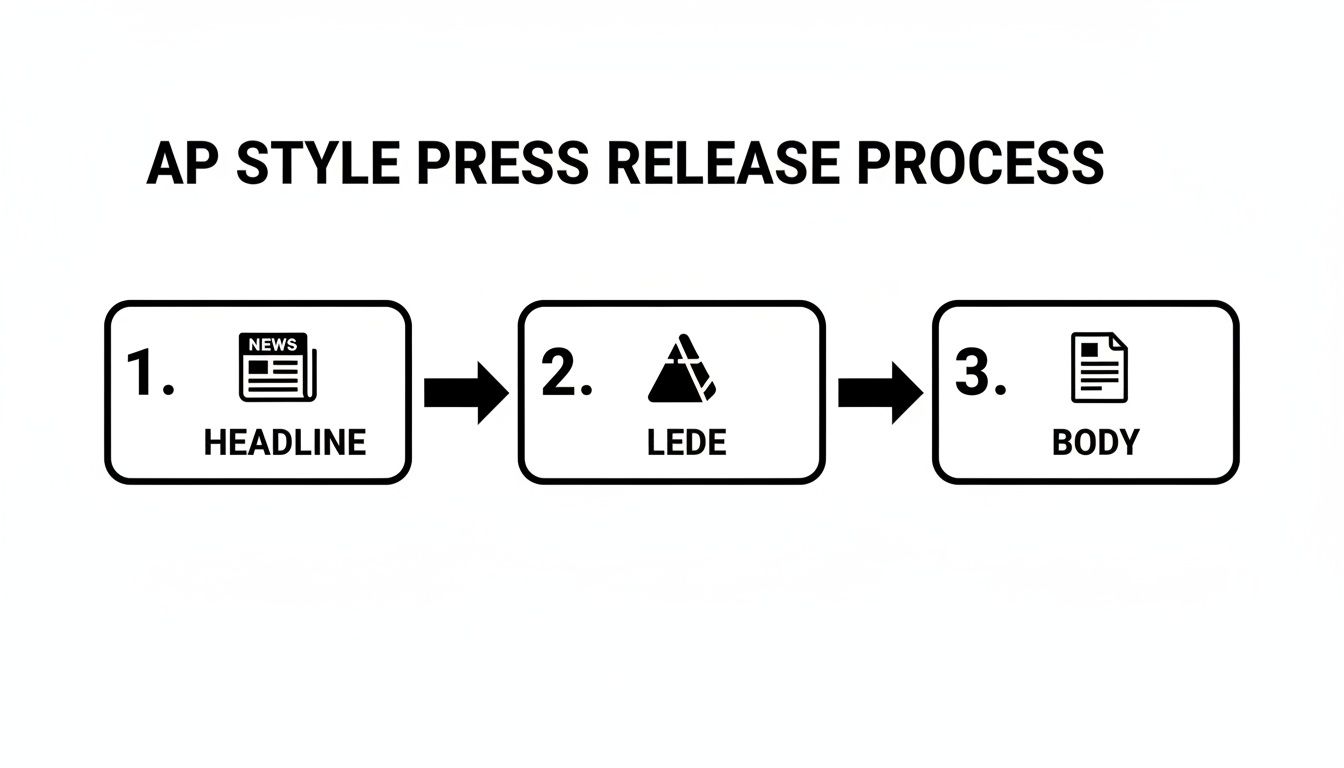
This visual really drives home the importance of the inverted pyramid. You have to land the most critical information first.
To help you get it right every time, I’ve put together a quick reference table for the most common AP Style rules that trip people up.
Quick Guide to Common AP Style Rules
This table covers the essentials for numbers, dates, and titles. Keep it handy, and you'll avoid the most frequent mistakes.
| Category | AP Style Rule | Correct Example | Incorrect Example |
|---|---|---|---|
| Numbers | Spell out one through nine; use numerals for 10 and up. | The company hired five new developers and has 12 open positions. | The company hired 5 new developers. |
| Dates | Use numerals without st, nd, rd, th. Abbreviate months (Jan., Feb., Aug., etc.) with a specific date. | The launch is scheduled for Aug. 22, 2025. | The launch is scheduled for August 22nd, 2025. |
| Times | Use numerals with lowercase a.m. or p.m. and periods. | The press conference begins at 10 a.m. | The press conference begins at 10:00 AM. |
| Titles | Capitalize formal titles only when they appear directly before a name. | CEO Jane Doe will give the keynote. | The CEO, Jane Doe, will give the keynote. |
Getting these small details right sends a powerful message: your announcement is credible, professional, and ready for publication.
Getting Numbers and Data Right
If there's one thing that screams "amateur," it's getting numbers wrong. Journalists are trained to spot these errors from a mile away, and it can instantly tank your credibility.
The basic rule is simple enough: spell out numbers one through nine, and switch to numerals for 10 and above. So you’d write about nine new features but 25 new markets.
But it's the exceptions where people usually get tangled. For the sake of clarity and scannability, you should always use numerals for:
- Ages: The 6-year-old company secured a new patent.
- Percentages: Always write it out as a 15 percent increase. Never use the % symbol.
- Money: It’s always figures, like $5 million in funding or a $29.99 subscription.
- Dimensions: The new prototype is 8 by 11 inches.
This isn't just about being picky. Clean, consistent formatting makes it easy for a reporter to pull key data points. In fact, some distribution services have found that poorly formatted releases can see media pickup drop by as much as 50%. Editors are busy, and they'll always gravitate toward the content that’s easiest to work with.
Handling Titles and Names Correctly
Job titles are another common minefield. AP Style is all about reducing clutter, and that means being very specific about capitalization.
The rule of thumb is to capitalize a formal title only when it comes directly before the person's name. If it comes after the name, it's lowercase.
- Correct: Chief Technology Officer John Smith led the project.
- Correct: John Smith, the chief technology officer, led the project.
- Incorrect: The Chief Technology Officer, John Smith, led the project.
Here’s an easy way to remember it: think of the title as part of their name when it’s listed first, like "President Lincoln." This little trick keeps your sentences clean and professional.
This rule also applies to descriptive roles, which are never capitalized. Think brand ambassador Taylor Swift or founder Steve Jobs.
Perfecting Dates, Times, and Locations
Nothing shows you've done your homework like getting dates, times, and locations perfect. It's a hallmark of a polished press release template ap style.
Dates: Always use numerals without any extras like st, nd, or th. When you use a month with a specific date, you abbreviate it (Jan., Feb., Aug., Sept., Oct., Nov., Dec.). The only exceptions are March, April, May, June, and July—those are always spelled out.
- Correct: The beta program will conclude on Oct. 5, 2026.
- Incorrect: The beta program will conclude on October 5th, 2026.
If you’re just mentioning a month and year, spell the month out completely. For instance, The project first launched in November 2024.
Times: The AP Style rule for time is wonderfully simple. Use figures with lowercase a.m. and p.m., and be sure to include the periods.
- Correct: The livestream will start at 2 p.m.
- Incorrect: The livestream will start at 2:00 PM.
State Names: This one catches a lot of people. AP Style has its own state abbreviations that are completely different from postal codes (so no CA, TX, or FL). For example, you’d write Los Angeles, Calif., or Miami, Fla. When a state name stands alone in a sentence, you spell it out.
Want to go even deeper? Our complete press release style guide with more examples and writing tips has you covered. Mastering these details is what will make your press release look like it belongs in the news.
Real-World AP Style Press Release Examples
Theory is one thing, but seeing the rules play out in the real world is where the learning really clicks. Now that we’ve walked through the structure and the nitty-gritty details, let's look at how it all comes together.
We're going to break down three of the most common announcements you'll write: a new product launch, a key executive promotion, and a community event partnership. Each example is written to AP style standards, but I won’t just show you the finished release. I’ll use annotations to highlight why specific choices were made. The small details are what separate a professional release from one that gets ignored.
Example 1: New Product Launch
Product launches are everywhere, but so many of them read like thinly veiled sales pitches. The real trick is to sound objective while still building excitement. Watch how this example anchors itself in facts, figures, and benefits instead of just hype. A solid press release template ap style is your best friend for striking this balance.
FOR IMMEDIATE RELEASE
InnovateTech launches AI-powered platform to reduce manufacturing waste by 30%
SAN FRANCISCO – Oct. 26, 2024 – InnovateTech today announced the launch of "Effi-Bot," a new AI-driven software platform designed to help manufacturers reduce material waste by up to 30%. The platform uses predictive analytics to optimize supply chain logistics and production line efficiency, addressing a critical pain point in the $10 trillion global manufacturing industry.
- Annotation: The headline is in sentence case and leads with the most newsworthy angle. The dateline is formatted perfectly. The lede gets straight to the "Five Ws" and uses a powerful, verifiable stat (30%) to hook the reader.
Effi-Bot integrates with existing factory management systems to identify patterns of inefficiency that are invisible to human operators. The software has been in a pilot program with five major U.S. manufacturing firms for the past nine months, showing consistent waste reduction and an average 15% decrease in energy consumption.
- Annotation: This paragraph adds the supporting proof. Notice that numbers one through nine are spelled out ("five," "nine"), while numbers 10 and above are numerals (15%).
"Our goal was to create a tool that delivers tangible financial and environmental returns from day one," said Chief Executive Officer Jane Doe. "Effi-Bot isn't just about saving money; it's about building more sustainable and resilient manufacturing operations for the future."
- Annotation: A great quote gives perspective, not just a rehash of the facts. The title "Chief Executive Officer" is capitalized here because it comes right before the name.
About InnovateTech
Founded in 2018, InnovateTech is a leader in developing artificial intelligence solutions for industrial applications. The company’s mission is to make manufacturing smarter, more efficient, and environmentally sustainable.
- Annotation: The boilerplate is short, sweet, and factual—stick to under 100 words.
Media Contact:
John Smith
Director of Communications
415-555-0199
###
- Annotation: The three pound signs (or "end mark") clearly tell the journalist the release is over.
Example 2: Executive Promotion Announcement
When you're announcing a new hire or promotion, the story is all about the person's expertise and the impact they'll have. The tone needs to be professional, framing the announcement around the strategic value of the appointment.
FOR IMMEDIATE RELEASE
Acme Corp appoints Dr. Aliza Chen as chief science officer
BOSTON – Nov. 5, 2024 – Acme Corp today named Dr. Aliza Chen as its new chief science officer, effective Dec. 1. Chen, a renowned biochemist with more than 20 years of experience in pharmaceutical research, will oversee the company's global research and development division.
- Annotation: Notice the title "chief science officer" is lowercase in the headline and after the name in the body. That's classic AP style. The start date, Dec. 1, is also formatted correctly (abbreviated month with a numeral).
Chen joins Acme Corp from BioGen Inc., where she was the vice president of research and led the team responsible for developing three blockbuster drugs. Her work has been published in numerous scientific journals, and she holds 12 patents in molecular biology.
- Annotation: This is where you build credibility. Specific, quantifiable achievements always win.
"Aliza's expertise will be critical as we expand our focus on genetic therapies," said Mark Reynolds, president of Acme Corp. "Her leadership and proven track record will accelerate our pipeline and strengthen our position in the market."
- Annotation: The quote from the company president, Mark Reynolds, connects the dots for the reader, explaining why this hire is a big deal for the company's future.
Example 3: Community Event Partnership
For a nonprofit collaboration or community-focused event, your goal shifts. You're trying to highlight the partnership's purpose and the public good it creates. The language should be clear and aimed at getting people in the community to take notice and participate.
FOR IMMEDIATE RELEASE
River City Bank partners with GreenSpace for city-wide park cleanup on April 22
DENVER – March 3, 2025 – River City Bank is partnering with local nonprofit GreenSpace to host the second annual City-Wide Park Cleanup event on Earth Day, April 22. The event will begin at 9 a.m. at City Park and aims to bring together 500 volunteers to beautify public spaces across Denver.
- Annotation: The dateline is in the past, which is correct for an announcement about a future event. Time is written as 9 a.m. (lowercase with periods). The date, April 22, doesn't need the year since it's clear from the context.
Volunteers will be provided with all necessary supplies and assigned to one of seven designated parks. Last year's inaugural event attracted more than 300 participants and removed two tons of litter from city parks.
- Annotation: Using specific numbers from a past event like this gives the story credibility and shows momentum.
"This partnership embodies our commitment to the communities we serve," said Maria Garcia, community relations manager at River City Bank. "It's a wonderful opportunity for residents to make a visible, positive impact."
- Annotation: This quote connects the event back to the company's core values, which is great for brand building.
Interested volunteers can register online at greenspacedenver.org before the April 15 deadline.
- Annotation: Never forget the call to action! Tell people exactly what to do next and give them a deadline.
These examples should give you a practical blueprint to work from. By following this press release template ap style, your announcements will look polished, earn you credibility, and make a journalist’s job a whole lot easier.
Your Pre-Launch Checklist and Distribution Strategy
Your press release is written. So the hard part's over, right?
Not so fast. Before you even think about hitting "send," you need a solid pre-flight check. This goes way beyond a quick grammar scan—it’s a strategic review to make sure every single element is dialed in for maximum impact.
A fantastic release is just a document if it never reaches the right people. Having a clear structured content creation process is a huge help, ensuring your message is sharp and consistent before it ever goes out the door.
Final Proofreading and Formatting Check
First things first: give your release one last, ruthless proofread. Seriously. Read it out loud to yourself. It’s the best way to catch clunky phrasing or sentences that don't land right.
Then, do a final check against those critical AP Style rules.
- Headline: Is it in sentence case? Does it immediately state the news?
- Dateline: Is the format perfect? (e.g.,
CITY, State – Month Day, Year –) - Numbers & Titles: Did you spell out numbers one through nine? Are job titles capitalized only when they appear before a name?
- End Mark: Did you pop the
###at the very bottom?
These tiny details are what separate the pros from the amateurs. They make a reporter's job easier, which is always your goal. It's the final polish on your press release template ap style execution.
Building Your Targeted Media List
Sending your release to a generic "news@outlet.com" email is the fastest way to get ignored. Success comes from reaching a specific person who actually cares about what you have to say.
Start by identifying the publications your audience genuinely reads. Then, use tools like LinkedIn or the outlet's own masthead to find the names of relevant reporters. Look for titles like "Tech Reporter," "Business Editor," or "Lifestyle Correspondent"—whoever covers your beat.
A smaller list of 20 highly relevant, hand-picked journalists will always outperform a generic blast to 500 random email addresses. Personalization and relevance are everything in media outreach.
Crafting the Perfect Email Pitch
Think of your email as the gatekeeper to your press release. Keep it short, direct, and to the point. Journalists are drowning in emails, so your subject line has to work hard.
Try a simple, clear format like: PITCH: [Your Company Name] Launches [Brief News Summary]
In the body of the email, add a short, personalized intro and then paste the plain text of your press release directly below it. Never, ever make a journalist open an attachment to get the story. That’s just creating an extra step they won’t take.
We dive deeper into this in our guide on how to submit a press release to the Associated Press.
Timing and SEO for Maximum Reach
Timing can make or break your announcement. Avoid Mondays—everyone’s inbox is a war zone. And don’t bother with late Fridays, as your news will just get buried over the weekend.
The sweet spot? Most PR pros agree it’s Tuesday, Wednesday, and Thursday mornings between 9 a.m. and 11 a.m. ET. That's primetime for media pickup.
Finally, don't sleep on basic SEO. Weave your main keyword (like "AI-powered manufacturing software") naturally into your headline and first paragraph. Adding one or two valuable links back to your site—maybe to a product page or a supporting report—also helps your announcement gain traction on Google News and other search platforms long after the initial blast.
Common Questions About AP Style Press Releases
Even with a perfect press release template ap style, you're bound to have a few questions as you start writing. That’s a good thing—it means you’re thinking through the details that separate an amateur release from a professional one.
I get these questions all the time. Let's walk through the most common ones so you can send your next announcement with absolute confidence. One of the first things people ask about is their own company's style guide. While your "house style" is great for marketing copy, a press release is different. You must adhere strictly to AP Style. Remember, journalists live in the AP world, and your job is to make their job easier.
How Long Should a Press Release Be?
Keep it tight. The sweet spot for a modern press release is between 400 and 500 words.
This gives you just enough room to cover the "Five Ws" (Who, What, When, Where, and Why), drop in a compelling quote, and include your boilerplate. Anything longer and you risk losing the journalist's attention. If your release is spilling onto a second page, that’s a red flag that you’ve included too much fluff. Brevity forces you to be ruthless about what's truly newsworthy.
How Should I Include Photos and Videos?
This is a big one, and it trips a lot of people up. Whatever you do, never embed images or videos directly into the body of your email or attach them as files. This is a surefire way to clog an editor's inbox and get flagged by spam filters.
So what’s the right way? The professional standard is to simply include a line of text before your media contact details that points them to an online media kit.
For a complete media kit, including high-resolution images and video files, please visit: [YourLinkToAnOnlineFolder.com/Media-Kit]
This keeps your pitch clean and lightweight while giving reporters one-click access to all the visual assets they need. It’s the best of both worlds.
What Are the Most Common Mistakes?
Beyond the big stuff, a few small but common errors can instantly mark you as an amateur. Watch out for these little details:
- The Dateline: The format is incredibly specific:
CITY, State –. It’s so easy to forget the comma or use a simple hyphen instead of a proper em dash (—). Journalists spot this immediately. - Headline Case: AP headlines use sentence case, not the title case you see in blog posts. Only the first word and any proper nouns should be capitalized.
- Hype Words: Language like "groundbreaking," "revolutionary," or "one-of-a-kind" is a one-way ticket to the trash folder. Stick to objective, verifiable facts and let the journalist decide if it's groundbreaking.
Nailing these conventions shows you understand the rules of the game and respect the reporter’s craft.
Ready to master your media outreach? Press Release Zen provides the expert guides, checklists, and templates you need to create impactful announcements that get noticed. Explore our resources at https://pressreleasezen.com.