Is any publicity good publicity? Let's get one thing straight: The honest answer is a resounding no.
While the old saying has a certain ring to it, banking your brand's future on it is a huge gamble. The truth is, the wrong kind of attention can do permanent damage, shatter customer trust, and tank your reputation in ways that are nearly impossible to come back from.
Debunking The Publicity Paradox

The phrase “any publicity is good publicity” is probably one of the most dangerous adages in business. It contains a sliver of truth—getting noticed is better than being invisible—but it ignores a much bigger, more menacing reality. This creates what we call the Publicity Paradox: the razor-thin line between visibility that builds your brand and attention that burns it to the ground.
Think of publicity as fire. A small, controlled campfire can provide warmth and light. This is your "good" publicity—the strategic buzz that draws people in, sparks conversation, and strengthens your market position.
But when you misjudge the situation or a crisis gets out of hand, that same fire can morph into an uncontrollable wildfire. It will scorch your reputation, incinerate consumer trust, and leave your brand looking like a wasteland. The outcome depends entirely on whether you're holding the matches or the fire hose.
Brand-Building Buzz Vs Brand-Destroying Backlash
So, what separates a brilliant PR move from a career-ending catastrophe? This table gives you a quick reference for understanding the critical differences between publicity that helps and publicity that hurts.
| Attribute | Brand-Building Buzz (Good) | Brand-Destroying Backlash (Bad) |
|---|---|---|
| Intent | Strategic, calculated, and aligned with brand values. | Unintentional, reactive, or a poorly calculated risk. |
| Audience Reaction | Positive engagement, increased loyalty, and organic sharing. | Outrage, boycotts, and widespread public condemnation. |
| Sentiment | Perceived as authentic, clever, or valuable. | Seen as tone-deaf, offensive, or exploitative. |
| Media Tone | Favorable, curious, or neutral-to-positive coverage. | Critical, negative, and focused on the controversy. |
| Business Impact | Drives sales, attracts talent, and increases market share. | Triggers a stock drop, customer loss, and long-term revenue decline. |
| Long-Term Effect | Strengthens brand identity and builds positive equity. | Creates lasting reputational damage that is difficult to repair. |
Ultimately, knowing which side of the line you're on comes down to a few key factors. Getting this right is the first step to mastering the high-stakes game of public perception.
When Attention Helps and When It Hurts
Context Is King: Does the publicity come from a calculated risk, or does it completely misread the room? A cheeky marketing stunt is one thing; an ad campaign that makes light of a serious social issue is a whole different beast.
Know Your Audience: Will your core customers see the attention as edgy and authentic, or will they find it clueless and offensive? Alienating the people who pay your bills is always a bad move.
Your Response Matters—A Lot: How you react to attention, especially the negative kind, is just as important as the event itself. A quick, honest, and human response can contain the damage and sometimes even win you a little respect. On the other hand, silence or denial just adds fuel to the fire.
Publicity is a powerful tool, but it's neither good nor bad on its own. Its impact is decided by the person using it. The goal isn't just to get attention at any cost; it's to cultivate intentional, strategic visibility that actually helps your brand.
This guide will give you a clear framework for telling the difference. We’ll walk through some high-impact examples—both the wins and the epic fails—to help you learn when to fan the flames and when it's time to call the fire department.
The Shock Value That Started It All

To really get why the phrase "any publicity is good publicity" has such a dangerous grip on our imagination, you have to go back. Way back, before digital news cycles and social media pile-ons, to the sawdust-filled circus tents of the 19th century.
This wasn't an idea cooked up in a modern PR agency. It was perfected by showmen like P.T. Barnum, who were absolute masters of the headline.
Barnum knew something that's still true today: being talked about is its own form of currency. It didn't matter if the stories were true, wildly exaggerated, or flat-out scandalous. The only thing that mattered was getting his name in the paper. In an age with only a handful of media channels, any mention could build a reputation from scratch and, more importantly, sell tickets.
The philosophy was simple: get attention, no matter what it takes. The more outrageous the story, the more papers flew off the stands and the more people lined up for his show. It was a strategy that treated all publicity as a single, powerful force where the only thing worth measuring was reach.
Richard Branson and the Art of Brilliant Mayhem
That daredevil spirit found its modern-day heir in Richard Branson, a man who literally built an empire by refusing to play by the rules. His launch of the band Wham! for Virgin Records is a classic example of turning a complete disaster into a publicity goldmine.
Back in 1984, Virgin threw a launch party for Wham!'s single 'Wake Me Up Before You Go-Go' on a boat cruising the River Thames. It was meant to be a chic, glamorous media event. Instead, the boat crashed straight into a pier, tossing guests—including big names like Boy George—into the river. By all accounts, it should have been a career-ending PR catastrophe.
But the chaos did something a polite, well-behaved party never could have: it guaranteed front-page news across the country. The story of the sinking boat and water-logged celebrities was simply too good for the press to ignore. Branson himself later called it one of the best PR stunts he ever pulled off. The single shot to No. 1 in the UK, proving that sometimes, a little mayhem pays off.
This kind of thinking still has its place. A recent report showed that 48% of PR professionals see AI-driven buzz as a huge opportunity, and 74% of journalists still prefer getting news from a press release. The tools are changing, but as Branson showed, human fascination with drama is a constant. You can see how press releases fit into today's media landscape in this 2026 PR strategy report from 24-7pressrelease.com.
Why Shock Value Is a Double-Edged Sword
The problem is, the Barnum and Branson model relied on a media world that just doesn't exist anymore. What worked for them is incredibly risky today for a few key reasons:
- Media Scarcity vs. Abundance: Back then, just getting into the news was the whole battle. Today, everyone has a platform, and the news cycle is a 24/7 beast that’s always hungry.
- A More Forgiving Audience: Audiences in the past might have been shocked, but there was no Twitter mob or global hashtag to channel that outrage instantly.
- Narrative Control: A showman could spin a story and face few competing voices. Now, a single viral video or tweet can completely hijack the official narrative before your press release even goes out.
The classic model of 'any publicity' was built for a world with fewer megaphones. Today, a misstep doesn't just create a story; it can trigger a global conversation you have no control over.
Looking back at this history shows us exactly why playing with fire is so tempting for brands—it can work. But it also comes with a serious warning. While people's love for a good story hasn't changed one bit, the consequences of becoming the story have exploded. The same shock value that once built empires can now bring them down in a matter of hours.
When Bad Press Accidentally Drives Growth
While nobody aims for a PR firestorm, there are bizarre moments in history where a total catastrophe accidentally led to growth. It’s a strange outcome that goes against everything we’re taught, but it shows that under the right (and very specific) circumstances, the answer to “is any publicity good publicity?” can sometimes be a reluctant “yes.”
These aren’t strategic wins. They’re almost always the messy aftermath of a crisis that spirals so far out of control that the brand becomes impossible to ignore. The sheer volume of attention somehow manages to drown out the original negative story.
One of the most famous examples of this is the 2017 United Airlines passenger removal incident. You’ve probably seen the video. A passenger was forcibly dragged off an overbooked flight, and the footage instantly triggered global outrage. The company's stock took a beating, and its reputation was shredded by accusations of being a heartless corporate machine.
By all accounts, it was a PR apocalypse. But then something completely unexpected happened. The wall-to-wall media coverage, while overwhelmingly negative, also created an unbelievable amount of brand exposure.
The Mere Exposure Effect in Action
This isn't just a fluke; there's a psychological principle at play here called the mere exposure effect. The idea is simple: people tend to prefer things just because they’re familiar with them. Even if the first time you hear about something is negative, hearing it over and over can soften that initial reaction, replacing it with a weird sense of familiarity.
For United, the endless news cycles, late-night TV monologues, and social media dogpiling meant their name was everywhere for weeks. The crisis, paradoxically, ended up highlighting the airline's massive scale. People who hadn't thought about United in years were suddenly hearing about its routes and operations constantly, even if it was through the lens of a scandal.
When a brand becomes so embedded in the public consciousness, even through controversy, it can achieve a level of name recognition that marketing budgets can't buy. The initial negative association can fade, leaving behind only the memory of the name itself.
This intense spotlight became a huge, if unintentional, awareness campaign. All that coverage translated into an estimated 2.5 billion media impressions. And despite the public outcry, after the initial stock dip, the company bounced back. By the second quarter of 2017, United's passenger revenue had actually grown by 7.9% year-over-year to $9.8 billion.
The incident showed how even during a crisis, official statements and optimized press releases can turn scrutiny into engagement—which is vital when 89% of journalists still rely on them for stories. You can see just how essential press releases still are with this data-driven analysis from ereleases.com.
Turning Disaster into Data
So, what’s the real lesson for PR pros from this messy, complicated case? It’s certainly not to court disaster, but to understand the mechanics of attention.
- Massive Brand Recall: The sheer scale of the coverage hammered home United's status as a major global airline. When it comes time to book a flight, that top-of-mind awareness is a powerful factor.
- Short-Term Outrage vs. Long-Term Behavior: While tons of people voiced their anger online, it didn't translate into a sustained boycott that could actually cripple the company. For most people, price and convenience still win, and a huge carrier like United has a built-in advantage there.
- The Narrative Can Be Reshaped: After a clumsy initial response, United eventually took real steps to apologize and change its policies. That allowed them to slowly pivot the conversation from the problem to the solution.
This case is a fascinating look at finding a silver lining in a media catastrophe. It proves that while you should never, ever aim for bad press, you have to understand its potential side effects. For a huge, established brand, the power of sheer name recognition can sometimes be enough to weather a storm that would sink a smaller company.
The Point Of No Return For Your Brand
Sure, some brands stumble into accidental success, but the much more common outcome of a major PR misstep is permanent damage. Not all attention is good attention. When a brand completely misreads the room—or the entire cultural moment—the publicity it gets can become the point of no return.
This is where the old saying "any publicity is good publicity" officially goes to die.
We’re not talking about a buggy product launch or a one-off customer service flub. This is about a brand tying itself to something that comes across as deeply inauthentic, exploitative, or just plain tone-deaf. The backlash from this kind of mistake doesn’t just generate negative buzz; it shatters consumer trust in a way that’s almost impossible to piece back together.
A textbook case is the infamous Pepsi-Kendall Jenner ad from 2017. The campaign was meant to send a message of unity, but it was immediately slammed for trivializing serious social justice movements, especially Black Lives Matter. The ad showed Jenner ditching a photoshoot to join a protest, where she seemingly defuses all societal tension by handing a cop a can of Pepsi.
When Buzz Becomes A Brand-Killer
The ad got a ton of attention, but it was exactly the kind you don't want. It quickly became a masterclass in what not to do. The fallout wasn’t just a few angry tweets; it was a profound alienation of the very people Pepsi was trying to connect with.
In a world driven by values, publicity that feels inauthentic doesn't just get you noticed—it gets you cancelled. It signals to consumers that your brand either doesn't understand them or, worse, doesn't care.
The campaign perfectly illustrates how controversial publicity can blow up your reach while simultaneously cratering your reputation. It sparked over 150,000 negative tweets and widespread condemnation.
While the earned media value shot past $135 million and sales saw a tiny, fleeting bump, the long-term cost was severe. Even though 68% of businesses see a jump in visibility from press releases during buzzworthy moments, this scenario proves that negative sentiment causes lasting harm when it violates what consumers believe in. You can explore more about media trends in this 2025 report from Cision.
The Anatomy Of A Permanent Wound
What made the Pepsi ad so damaging wasn't just its cringeworthy execution; it was the story it told about the brand itself. Here’s why this kind of publicity leaves such deep scars:
- It Betrays Trust: People felt their genuine passion for social justice was being hijacked and turned into a cheap gimmick to sell soda.
- It Reveals a Lack of Awareness: The ad exposed a massive disconnect between the corporate boardroom and the real world, making the brand look completely out of touch.
- It's Hard to Apologize For: How do you genuinely say you're sorry for something so fundamentally misguided? Pepsi pulled the ad and apologized, but its credibility was already shot.
To keep from hitting a crisis point where your brand's reputation is damaged for good, you must have effective social media crisis management strategies ready to go. Think of them as your first line of defense.
This whole incident is a critical lesson for modern marketers. Short-term sales spikes and vanity metrics like "buzz" are worthless if you destroy the trust you’ve spent years building. The right crisis plan can help you navigate these treacherous waters. To learn more, check out our guide on crisis management in PR for actionable steps and examples.
Knowing when bad press might accidentally help—or when it will cause irreversible damage—can feel like a high-stakes gamble. So how do you trade guesswork for a strategic decision? You need a reliable playbook. A framework to help you evaluate risky campaigns or manage a crisis with a clear head.
This is where theory meets action. Instead of just reacting to whatever comes your way, you can get ahead of the situation with a simple, memorable tool.
Your Decision Framework For Navigating Publicity
To figure out if a piece of publicity is a calculated risk or a brand-ending mistake, you need a system. A checklist that forces you to ask the tough questions before you act, not after the damage is done.
We've developed a framework for this exact purpose. It helps you see the bigger picture and move beyond the "any publicity is good publicity" trap.
Introducing The V.I.R.A.L. Publicity Decision Framework
Use this checklist to assess the risks and rewards of a potential PR campaign or crisis response.
| Framework Element | Key Question to Ask | Green Light (Low Risk) | Red Flag (High Risk) |
|---|---|---|---|
| V – Values | Does this align with our core brand principles and the promise we’ve made to our customers? | The action is a clear reflection of our long-standing company values. | This feels out of step with our brand identity and what we stand for. |
| I – Impact | What’s the best- and worst-case scenario for our audience and stakeholders? | Our core audience will feel seen and validated. Minimal negative impact on others. | A significant portion of our customer base or key stakeholders will feel alienated or harmed. |
| R – Response | Are we prepared to manage the fallout? Do we have the resources and messaging ready? | We have a pre-approved comms plan, a dedicated response team, and clear messaging. | Our team is unprepared, and we don't have the resources to manage a high volume of feedback. |
| A – Authenticity | Will our audience see this as genuine, or will it come across as an opportunistic stunt? | This move is consistent with our past actions and brand voice. | This feels like a desperate, tone-deaf attempt to jump on a trend. |
| L – Longevity | How will this affect our brand in one year? Is this a funny footnote or a permanent stain? | This will be remembered as a bold, on-brand moment that strengthened our identity. | We'll be explaining and apologizing for this for years to come, eroding trust. |
By walking through these questions, you're not just hoping for the best—you're preparing for reality.
This decision tree illustrates a critical truth: media buzz can go one of two ways. When your actions are perceived as authentic, you can turn attention into a win. When they’re not, the outcome is almost always brand damage.
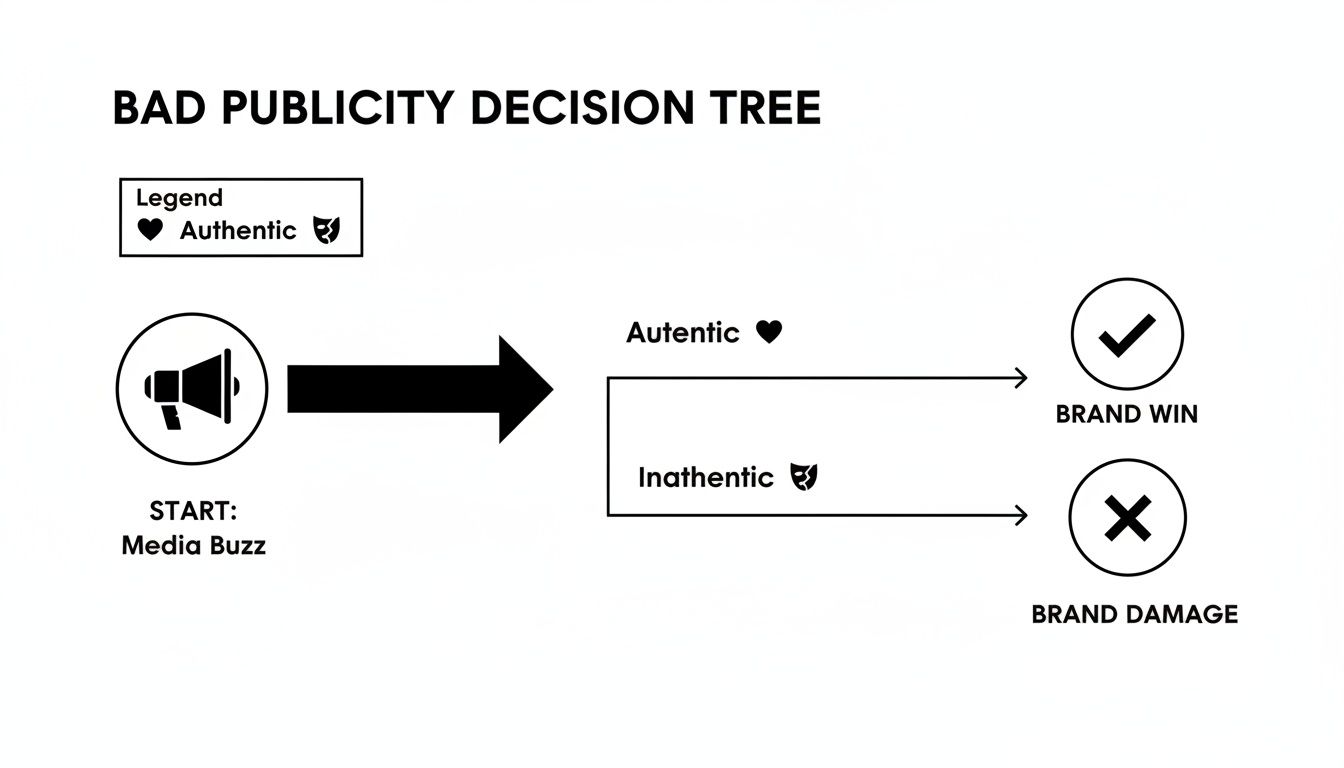
As you can see, authenticity is the pivot point. When your message connects with your core brand identity, the buzz can work in your favor. But inauthentic actions almost always backfire.
Putting The Framework Into Practice
Let's say your team is weighing a bold, politically charged marketing campaign. Using the V.I.R.A.L. framework, you can start to map out the consequences.
If the campaign genuinely aligns with your company's long-held Values, will resonate positively with your target demographic (Impact), and you have a solid comms plan ready (Response), it might be a smart risk.
But if it feels opportunistic (Authenticity) and risks alienating a huge chunk of your customer base for years (Longevity), the framework flashes a clear red flag.
The point of the V.I.R.A.L. framework isn't to avoid risk entirely. It's to make sure you're taking the right risks for the right reasons, with your eyes wide open to the potential outcomes.
To truly manage public perception, implementing solid online reputation management best practices is non-negotiable. These strategies help you monitor the conversation and protect your brand before, during, and after any big publicity push.
And when a crisis does hit, knowing how to write an apology press release can be a critical part of your response, giving you a structured way to take accountability and start rebuilding trust.
How To Turn Attention Into Measurable Results
Getting your name in the news is one thing. Turning that flash of attention into something that actually helps your business—like more traffic, new leads, or a bump in sales—is a completely different ball game.
It doesn’t matter if the story is a glowing feature or a critical takedown. Having a plan in place means you can make any mention work for you. It’s less about debating the old "any publicity is good publicity" cliché and more about being prepared to act.
When the press is positive, you want to shout it from the rooftops. When it’s negative, you need to get ahead of the story and control the damage.
Amplify The Good, Control The Bad
When a positive story about your brand breaks, your job isn't over; it’s just getting started. Now’s the time to milk that good press for all it's worth using your own channels.
- Share It Everywhere: Get the link to the article up on all your social media accounts right away. Don’t forget to tag the publication and the journalist—it’s a nice way to say thanks and can get you more shares.
- Showcase It on Your Site: Add the coverage to a "Press" or "In the News" page on your website. This is instant social proof for anyone visiting your site and keeps all your best hits in one place.
- Write a Follow-Up Post: Craft a blog post that builds on the story. This is your chance to add more context, drop in a few strong calls-to-action, and work in keywords to help your SEO.
When you’re in a crisis, you have to move fast and be crystal clear. Your own website and social media are your direct lines to your audience, letting you bypass the media noise.
When you're dealing with negative press, an SEO-optimized blog post or press release is your best friend. It gives you a platform to tell your side of the story, and with a little luck, you can get your official response to rank right alongside—or even above—the negative articles in search results.
Create Your Crisis Communications Go-Kit
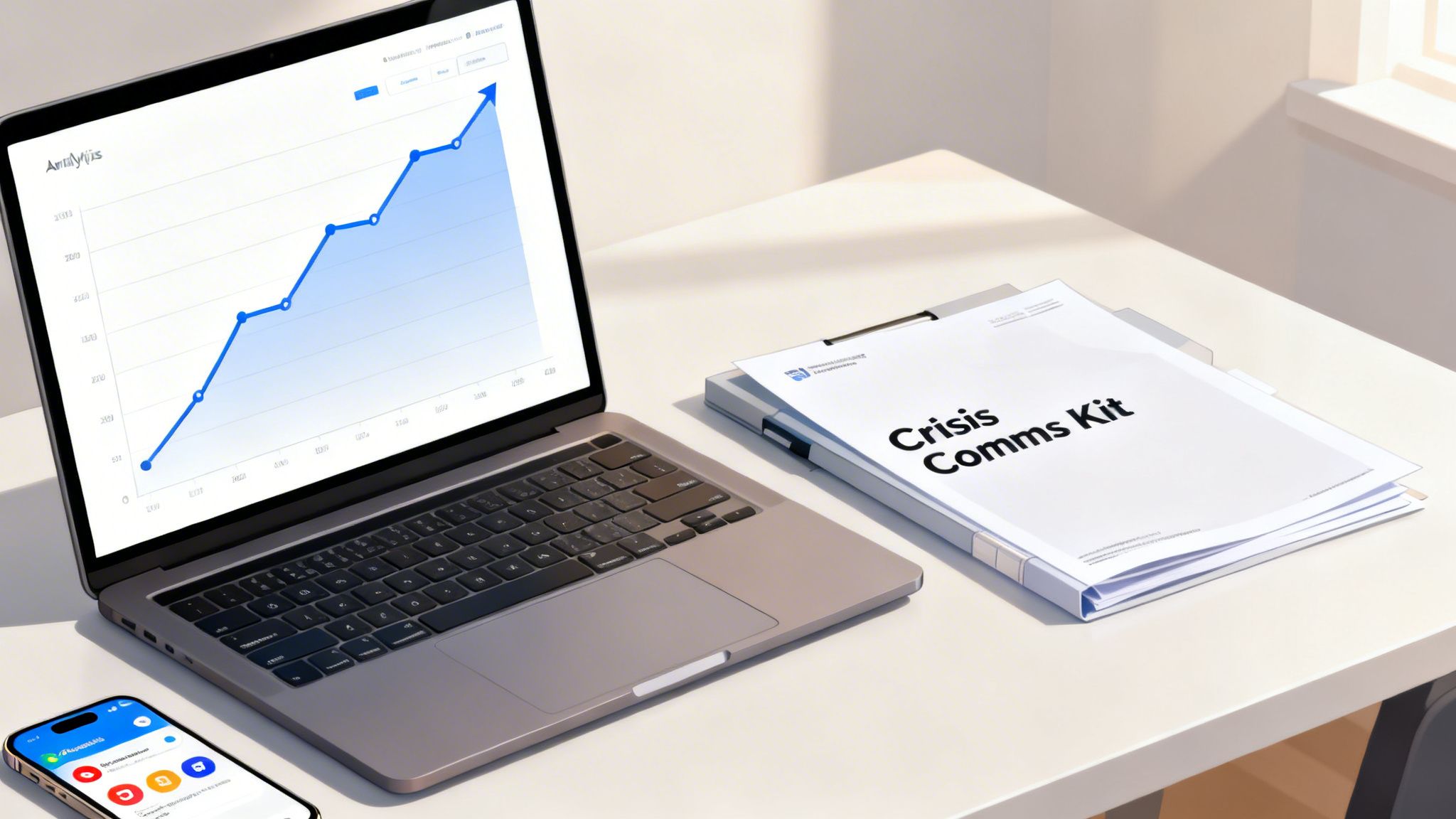
The middle of a firestorm is the worst possible time to be figuring out your response plan. A prepared "Go-Kit" lets you react quickly and professionally when the pressure is on. Think of it as your emergency binder for when unplanned—and unwanted—attention comes your way.
Here are the must-haves for your kit:
- Holding Statement Templates: Have some pre-approved, fill-in-the-blank statements ready for different situations, like a data breach or a negative product review. It allows you to put out a quick, initial response like, "We are aware of the situation and are investigating. We will provide more information as it becomes available."
- Key Personnel Contact List: This list should have the names, roles, and after-hours contact info for everyone on your crisis team—think CEO, legal counsel, and your PR and marketing leads.
- Clear Response Protocol: Map out exactly who needs to be told what, who has the final say on statements, and who will be the official spokesperson. This prevents internal chaos when the stakes are sky-high.
With these assets ready to go, you stop being a victim of bad press and start managing your brand’s reputation. At the end of the day, properly tracking and measuring the success of your press releases is what separates a PR team that's just busy from one that’s actually driving business.
Frequently Asked Questions
When you're dealing with public perception, especially when things get heated, tough questions are bound to come up. Here are some straightforward, practical answers to help you navigate real-world publicity challenges.
How Can a Small Business Handle Negative Press?
For a small business, a wave of negative press can feel like a tidal wave. But you’re not powerless. The trick is to act fast and be radically transparent. You don’t need a six-figure PR budget to get a handle on it.
Your best tools are the channels you already own—your company blog and your social media accounts. Get out in front of the story by publishing a direct, honest statement that acknowledges the problem. Admitting there's an issue is always better than pretending there isn't one. On top of that, a well-written press release can help you regain control of the search results for your brand's name.
Does This Idea Differ for B2B and B2C Companies?
It absolutely does. The old saying, "any publicity is good publicity," plays out very differently for B2B and B2C brands. Consumer-facing (B2C) companies can sometimes weather a controversy, or even benefit from the name recognition, because consumer buying habits can be impulsive and memories are often short.
But in the B2B world, reputation is everything. Business-to-business relationships are built on a foundation of trust, long-term reliability, and proven expertise. Any negative publicity that puts your company's integrity or competence in doubt isn't just a PR headache—it can be a fatal blow to the partnerships that keep you afloat.
What Is the First Step When a Negative Story Breaks?
The moment a negative story hits, your number one priority is to pause and gather the facts. The absolute worst thing you can do is fire off an emotional or half-baked response. Your first official move should always be to issue a brief "holding statement."
This is a short, neutral announcement that simply says you're aware of the situation and are looking into it. This one simple move does two critical things:
- It Fills the Information Vacuum: It stops rumors and speculation from spiraling out of control while you figure out what to say next.
- It Buys You Time: It gives your team the breathing room they need to investigate what actually happened, agree on a strategy, and put together a response that is accurate, thoughtful, and complete.
At Press Release Zen, we give you the templates and guides you need to manage your reputation, whether you're celebrating a win or navigating a crisis. Get your free resources now at Press Release Zen.