Key Takeaways
- A compelling video game press release needs a strong headline, release date, platforms, pricing, and eye-catching media assets to cut through industry noise.
- Structure matters: keep your press release between 300–500 words with the most critical information in the first paragraph.
- Media outlets receive hundreds of pitches daily – avoid common mistakes like overhyping features or burying the lead.
- Real-world examples show successful press releases use concise language, highlight unique game features, and include quotable material.
- AmpiFire’s AI-powered AmpCast helps indie developers compete with major studios by transforming game press releases into eight content formats and distributing them across 300+ authority sites. This expanded distribution significantly increases visibility, allowing more players, creators, and media outlets to discover new games.
Grab Attention With Your Video Game Press Release
The gaming industry is fiercely competitive, with thousands of new games released annually. Your press release is often your only chance to capture media attention. As your game’s first impression, you need to make it count.
A well-crafted press release can be the difference between industry-wide coverage and complete obscurity. Studios like Devolver Digital and Supergiant Games have mastered the art of the press release, creating documents that journalists actively look forward to receiving because they’re informative, well-structured, and engaging.
But what makes a great video game press release? It combines the right elements, proper structure, and avoids common pitfalls that send your announcement straight to the trash folder.
Why Press Releases Don’t Work Anymore
Smart Businesses Are Moving Beyond Traditional PR
• The Problem: Press releases reach one audience through one channel while your customers are everywhere online. Most get buried within days with poor ROI.
• The Solution: AmpiFire’s AmpCast creates 8 different content formats from one topic and distributes across 300+ high-authority sites including Fox affiliates, Spotify, and YouTube.
What You’ll Learn on PR Zen:
✓ Why multi-channel content delivers 10x better results than press releases
✓ How to amplify your PR efforts across multiple platforms
✓ Real case studies of businesses dominating search, social, video, and podcasts
✓ Cost-effective alternative to expensive PR agencies
Ready to Replace Press Releases? Learn the AmpiFire Method →
Essential Elements Every Game Press Release Must Include
An Eye-Catching Headline That Sells Your Game
Your headline is the most important part of your press release. Journalists often decide whether to keep reading based solely on these few words. A strong headline clearly states what’s being announced while incorporating something unique or exciting about your game.
Avoid generic headlines like “New Game Releases Today.” Instead, try something like “Sci-Fi RPG ‘Stellar Odyssey’ Launches Today, Featuring Industry-First Dynamic Moral System.”
Key Game Details
Clearly state your game’s release date (or expected release window), the platforms on which it will be available, and pricing information. This critical data should appear in the first paragraph to make it immediately accessible. For unreleased games, include whether a demo is available, if there’s an Early Access option, or if press codes are available for review.
Compelling Media
Always include links to high-quality screenshots, gameplay trailers, or GIFs that showcase your game’s best features.
Ensure that all media assets are professionally produced, easily accessible (preferably via a press kit link), and accurately represent actual gameplay. Nothing damages credibility faster than misleading visuals that don’t match the final product.
Quotable Statements From Developers or Publishers
Include at least one compelling quote from a key team member. This quote should offer insight into the game’s development, provide inspiration, or highlight its unique features. A good quote adds a human element to your announcement and gives journalists easy content to include in their articles.
Clear Contact Information & Social Media Links
Always include complete contact details for media inquiries. List a specific person’s name, email address, and phone number. Additionally, include links to your game’s social media accounts, website, and Steam/store pages.
Press Release Structure That Gets Results

The Perfect Press Release Length
Brevity is key. Aim for 300–500 words total. Anything longer risks losing the reader’s attention. This constraint forces you to focus on what truly matters: the newsworthy aspects of your game announcement.
First Paragraph Formula: Hook Journalists Immediately
Your opening paragraph must answer the five W’s (who, what, when, where, and why) in just 2–3 sentences. This concise opener tells readers everything they need to know immediately: who’s making the announcement, what the game is, when and where it’s releasing, and a hint at why it’s interesting. The rest of your press release can then elaborate on these points without risking that critical information being missed.
Middle Sections: Highlight Your Game’s Unique Selling Points
After your opening paragraph, dedicate 2–3 paragraphs to what makes your game special. Focus on unique gameplay mechanics, innovative features, compelling narrative elements, or outstanding visual style. Be specific rather than using generic descriptions like “stunning visuals” or “immersive gameplay.”
Remember to prioritise your strongest selling points first, as journalists may trim your release from the bottom when quoting it.
Boilerplate: Craft a Strong Company Description
The boilerplate is a standardised paragraph about your studio that appears at the end of every press release. It should briefly describe your company’s history, previous titles (if applicable), company size, location, and overall mission or design philosophy. Keep it under 100 words while conveying your studio’s unique identity.
Real-World Video Game Press Release Examples
1. AAA Game Launch Announcement
Sony’s press release for God of War Ragnarök masterfully balanced information with excitement. Their headline was direct: “God of War Ragnarök Launches on PlayStation 5 and PlayStation 4 on November 9.”
The first paragraph established the game’s pedigree by mentioning its predecessor’s sales and awards before confirming platforms and release date. They included a quote from the creative director that provided emotional context about the game’s themes rather than just listing features.
The middle sections highlighted key gameplay enhancements with specific examples rather than vague claims. Most importantly, they included links to high-resolution assets and a new trailer that journalists could immediately embed in articles.
2. Indie Game Reveal
When Hollow Knight: Silksong was announced, Team Cherry’s press release demonstrated how indies can generate major excitement. Their headline clearly communicated what was newsworthy: “Team Cherry Reveals Hollow Knight: Silksong, A Full-Scale Sequel to Their Award-Winning Action Adventure.”
The opening paragraph established the game as a sequel to a critically acclaimed title and immediately clarified that it would be a full game, not DLC. This immediately addressed a question many fans would have.
They also emphasised the new playable character and her unique abilities, highlighted an all-new orchestrated soundtrack, and clearly stated which platforms the game would launch on.
What made this press release particularly effective was how Team Cherry acknowledged their existing fan community, mentioning how player feedback had shaped the new game. This created a story angle beyond just “new game announced” that many outlets picked up on.
The release concluded with clear information on where to find more details and how to wishlist the game, making it easy for interested players to take immediate action after reading coverage.
Sample Video Game Press Release to Use
Now, here’s a sample press release you can use to announce your own video game:
FOR IMMEDIATE RELEASE
Sci-Fi Strategy RPG Echoes of Andromeda Launches June 20, Featuring Player-Driven Faction Evolution
Seattle, WA — May 2, 2026 — Independent studio Nebula Forge Interactive today announced the release of Echoes of Andromeda, a single-player sci-fi strategy RPG launching June 20, 2026 on PC (Steam) and PlayStation 5, priced at $29.99 USD. The game challenges players to shape the political and military future of a distant star system through choices that permanently alter faction behavior, alliances, and technology paths.
Set in a collapsing interstellar region, Echoes of Andromeda blends turn-based strategy with narrative-driven role-playing. Players command a mobile fleet while navigating shifting power structures, where each decision influences how factions evolve over time, from defensive trade coalitions to aggressive expansionist regimes. A free demo is available now on Steam, and press review codes are available upon request.
“At the core of Echoes of Andromeda is the idea that factions shouldn’t feel static,” said Lena Morales, Creative Director at Nebula Forge Interactive. “We wanted every choice to reshape the galaxy in a visible way, so players can see the long-term consequences of their leadership, not just in dialogue, but in how the world responds.”
The game features a dynamic faction evolution system, procedural star maps that change with each campaign, and a modular fleet-building mechanic that allows players to customize ships based on strategic priorities. Story arcs adapt to player decisions, unlocking exclusive missions, characters, and endings based on faction relationships and moral alignment.
High-resolution screenshots, gameplay trailers, and additional media assets are available in the official press kit: www.echoesofandromeda.com/presskit
Echoes of Andromeda will launch globally on June 20, 2026, with additional content updates planned post-launch based on community feedback.
Media Contact:
Daniel Wright
Communications Lead, Nebula Forge Interactive
press@nebulaforgegames.com
(555) 019-4823
Follow the Game:
Website: www.echoesofandromeda.com
Steam: store.steampowered.com/echoesofandromeda
X: @EchoesAndromeda
YouTube: youtube.com/@nebulaforgeinteractive
About Nebula Forge Interactive
Nebula Forge Interactive is a small independent game studio based in Seattle, Washington, focused on creating systems-driven RPGs with meaningful player choice. Founded in 2022, the studio blends strategic gameplay with adaptive storytelling to build worlds that respond to how players think, not just how they play.
Common Press Release Mistakes That Kill Your Coverage

Overhyping Features Your Game Doesn’t Deliver
Avoid superlatives like “revolutionary,” “never-before-seen,” or “genre-defining” unless you can genuinely back them up. Instead, describe your features specifically and accurately, letting the inherent value speak for itself.
Burying the Lead (Putting Important Info Too Far Down)
If your most newsworthy information is hidden in the third paragraph, it might never be discovered. Always lead with your strongest point, whether that’s a release date, a famous team member, an innovative feature, or impressive previous game sales.
Using Industry Jargon & Technical Terms
While you’re deeply familiar with your game’s technical achievements and industry terminology, many journalists cover dozens of games across multiple genres. Excessive jargon creates barriers to understanding and may cause journalists to move on to clearer announcements. Write in plain language that communicates your game’s appeal to someone who may not be an expert in your specific genre or technology.
Take Your Video Game to the Next Level With AmpiFire’s Multi-Channel Distribution
Even the most perfectly crafted press release won’t generate results if it doesn’t reach the right audience at the right time and place. This is where AmpiFire’s multi-content and multi-channel distribution system gives game developers a significant advantage.
Unlike traditional press release services that target only journalists, AmpiFire transforms your announcement into multiple content formats and distributes it across media channels, including news sites, podcasts, videos, and slideshows.
How AmpiFire Works
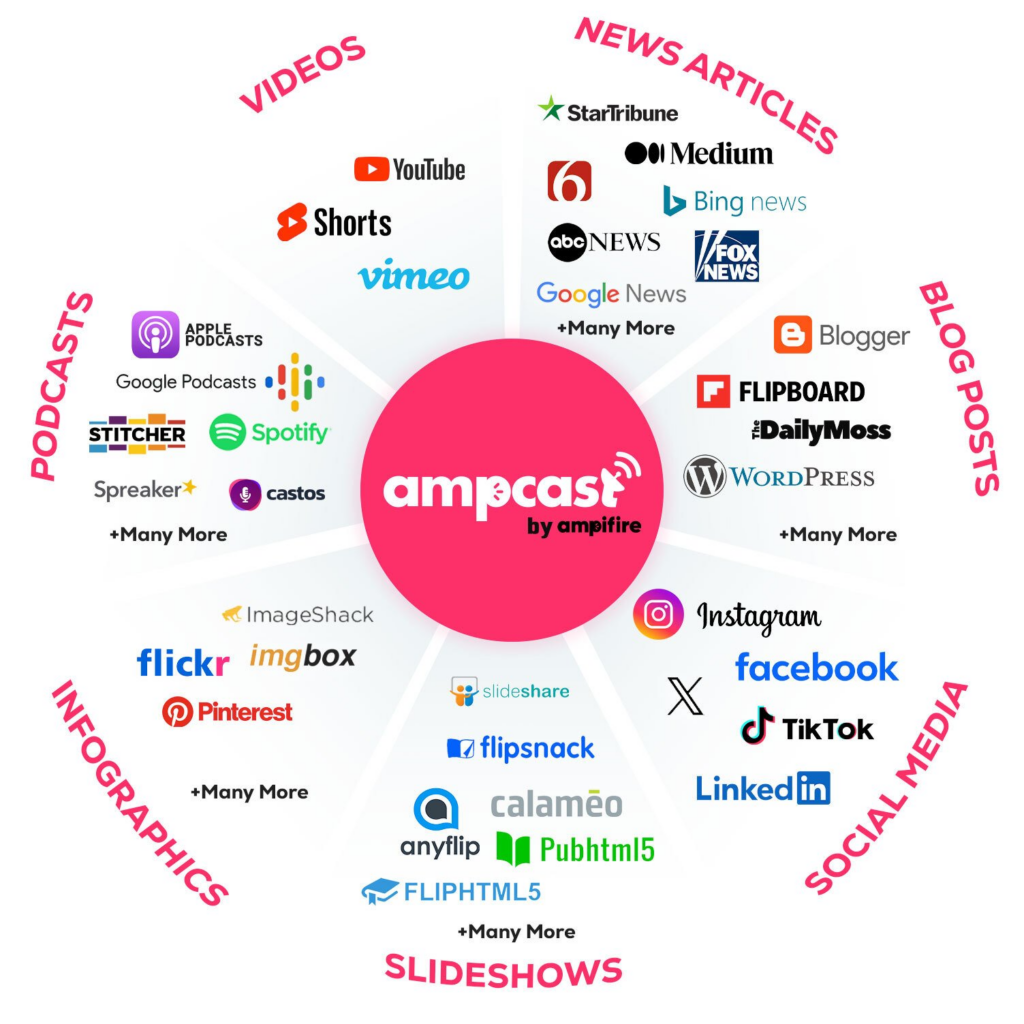
AmpiFire uses its AI-powered AmpCast technology to transform your press release content into eight distinct media formats and distribute them across relevant channels where your target audience already consumes content. AmpCast creates news articles, blog posts, long-form videos, short-form videos, slideshows, social media posts, infographics, and podcast episodes, all highlighting your key game features and announcement details.
This multi-format distribution would typically be cumbersome to achieve manually. However, AmpiFire simplifies the process by utilising AI, which enables the creation of content that outperforms traditional SEO and PR strategies.
The Cost-Effectiveness of AmpiFire
For game developers with limited marketing budgets, AmpiFire offers a cost-effective alternative to hiring a dedicated PR agency. Traditional distribution methods come with high costs and uncertain returns. Mid-tier PR agencies typically charge $5,000–$10,000 monthly for press release writing and distribution, with no guarantee of coverage or sustained traffic.
Building an in-house content team can easily exceed $165,000 annually before accounting for tools, software, and additional overhead. Premium SEO agencies charge $3,000–$8,000 monthly but generally focus only on improving your website’s search rankings, not broader brand visibility.
Meanwhile, AmpiFire offers a more cost-effective alternative: a DIY credit at $397 or an upgraded AI AmpCast credit starting at $495, each with a $27/month maintenance fee that includes unlimited AI content creation, syndication, and distribution.
While traditional PR agencies focus on delivering a single press release that may or may not get picked up by journalists, AmpiFire delivers multi-format content creation, AI-powered optimisation, and distribution across hundreds of platforms at a fraction of the cost.
The Long-Term Effectiveness of AmpiFire’s AI System
Beyond immediate coverage, AmpiFire’s distribution creates lasting digital assets that continue working for your game long after the initial announcement. The diverse content formats created from your press release improve your game’s online presence, making it more discoverable when potential players search for games in your genre.
Each piece of content becomes a permanent pathway for new players to discover your game, generating ongoing traffic and interest that traditional press releases simply cannot match.
Real-Life Results
A founder of a digital agency struggled to gain a competitive edge in the crowded content marketing field until he discovered AmpiFire. After adopting AmpiFire’s multi-format content creation and distribution platform, he experienced remarkable growth. Within just a couple of months of launching content amplification campaigns on one of his blogs, the site accumulated 9,000 views and began ranking for high-quality search keywords.
The results continued with minimal ongoing effort. He ran two AmpiFire campaigns for a project management blog and let it sit for about three to four months without any additional work. By then, the site was ranking on the first page of Google and generating approximately 8,000 views, all from the initial amplification campaigns. This demonstrates how AmpiFire’s approach can deliver sustained visibility and organic traffic growth over time.
Notably, this case study applies to a specific AmpiFire customer, and results may vary depending on implementation, niche competitiveness, market, and other factors.
Ready to Replace Press Releases? Try the AmpiFire Method →
Frequently Asked Questions (FAQs)
How far in advance should I send my game press release?
For major announcements, such as game reveals or release dates, send your press release 1–2 weeks in advance of when you want coverage to appear. This gives journalists time to review your materials, ask questions, and prepare articles.
For time-sensitive news, such as launches or major updates, send your release with a clear embargo date and time, typically 2–3 days before the embargo is lifted.
Should I include quotes from developers in my press release?
Yes, but with a strategic purpose. Include 1–2 quotes that provide genuine insight about your game’s development, inspiration, or vision rather than restating features already covered elsewhere in the release. Quotes should sound authentic and conversational, not marketing-speak.
Should I include review codes with my press release?
Yes, if your game is releasing within 1–2 weeks of your announcement, always offer review codes in your press release. For earlier announcements, include information about when review codes will be available and how to request them.
How do I measure the success of my press release?
Track key metrics, including total media mentions and articles generated, social media engagement (shares, comments, and new followers), and website traffic increases.
You can also track Steam/console store page visits and wishlist additions, demo downloads or newsletter sign-ups, and reach/impressions across all platforms.
Should I invest in multi-format content distribution for video game press releases?
Yes, you should invest in multi-format content creation and distribution through AmpiFire’s AI-powered AmpCast platform. It transforms your content into eight distinct formats and amplifies your game’s reach across over 300 high-traffic platforms, including blogs, news sites, podcasts, and video platforms, without depending on journalists or traditional PR agencies.
This approach also provides long-term visibility, as your content remains discoverable well after launch day, continuing to drive organic traffic to your game.
*Disclaimer: Results may vary based on individual circumstances, business type, and content strategy. The time savings and outcomes mentioned are based on typical user experiences and are not guaranteed. For specific pricing and service details, please visit AmpiFire.