Let’s get straight to it. If you're wondering how long a press release should be, the magic number is between 300 and 500 words.
The Ideal Press Release Length: A Quick Answer
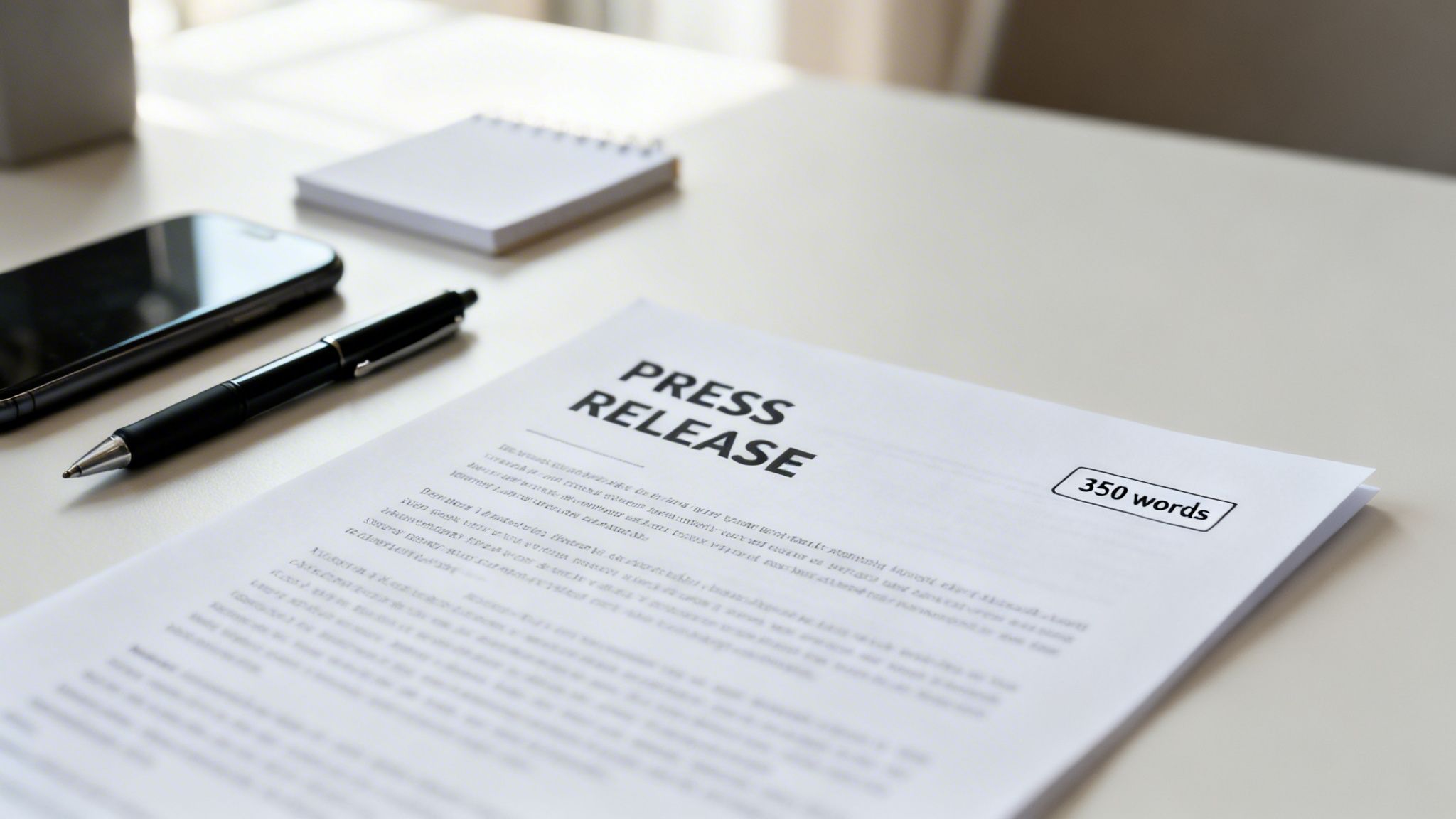
If you’re looking for a direct, no-fluff answer, you’ve found it. While the perfect length can shift a bit depending on your news and where you send it, the most effective press releases almost always hit this specific word count range. Getting this right is a careful balancing act—you need to provide enough detail to hook a journalist without burying them in text.
The industry average hovers around 400 words, but the real sweet spot is that flexible 300 to 500-word window. This isn't just some arbitrary rule we made up; it's backed by data. Releases in this range see much higher pickup rates simply because journalists prefer concise stories they can quickly understand and repurpose. Industry benchmarks from 2026 PR statistics consistently highlight this trend.
The ideal press release is 300 to 500 words long. This length respects a journalist's time while providing just enough detail to be newsworthy.
Why Every Word Counts
Straying too far outside this range has real consequences. A release that's too short might come across as flimsy or insignificant, lacking the meat a journalist needs to build a compelling story. On the flip side, a novel-length announcement is a surefire way to get your email deleted by a busy reporter.
To make it even clearer, let's put these numbers into a quick reference table. This is how different word counts are generally perceived by the media.
Press Release Length At a Glance
| Word Count | Impact | Best For |
|---|---|---|
| Under 300 | Often looks incomplete; risks being overlooked as not truly newsworthy. | Quick updates or as a supplementary note to a much larger story. |
| 300–500 | The "sweet spot"; comes across as professional, concise, and easily digestible. | Most announcements, from product launches and events to new hires. |
| Over 500 | Frequently ignored by journalists; your key message gets lost in the noise. | Highly technical or financial reports where extensive detail is required. |
Ultimately, your goal is to hand a journalist a complete, self-contained story they can use with minimal editing. Hitting that 300-500 word target is the first and most crucial step in making that happen.
Why 300 to 500 Words Is the Magic Number
Think of your press release like a movie trailer. It has one job: deliver the core story, build excitement, and leave the audience—in this case, a journalist—wanting more. All in a matter of seconds.
That 300 to 500-word count isn't just a random number. It's a strategic framework built around the reality of how modern journalists work. They're swimming in hundreds of pitches every single day and simply don't have the time to read a novel. A concise release helps them spot a newsworthy angle fast, which is exactly what you want.
Capturing Journalist Attention
The 300 to 500-word range is the perfect container for the five Ws—who, what, when, where, and why—without a single word of fluff. It forces you to be disciplined, ensuring your most critical information is right at the top where it can't possibly be missed.
Making a reporter's job easier is the fastest way to get their attention, and this direct approach works. In fact, a staggering 72% of reporters rank press releases as their preferred format, but only when they are short and to the point. You can dig into more of these insights by reviewing the comprehensive 2026 press release statistics on ereleases.com.
A journalist's inbox is a battlefield for attention. A short, powerful press release is your best weapon, delivering a clear message that stands out from the noise.
Avoiding Technical Pitfalls
It’s not just about human attention spans. There are real technical reasons to keep things tight. Many newswire services and platforms like Google News automatically cut off longer articles in their previews.
If your key message is buried, it will get hidden behind a "read more" link. That single click is a barrier you can't afford. A shorter release ensures your entire core story is visible from the get-go, making an immediate impact.
Here's why the 300 to 500-word count is so effective:
- Maximizes Scannability: Journalists can absorb the main points in seconds without having to dig through dense paragraphs.
- Forces Clarity: It compels you to ditch jargon and redundant phrases, making your core message stronger and more direct.
- Improves SEO Impact: A focused release helps search engines crawl and index your most important keywords and messages right away.
- Boosts Engagement: Shorter releases, especially when paired with images or video, consistently see higher engagement and share rates.
By sticking to this magic number, you’re not just writing a document. You’re building a tool perfectly engineered to connect with the people who matter most.
Adapting Your Press Release for Different Channels
Thinking your press release length is a one-size-fits-all deal is a recipe for disaster. The ideal word count isn’t a rigid rule; it’s a flexible guideline that needs to bend for every channel you use. Your core message might be gold, but if it’s packaged wrong for the medium, it’s going to fall completely flat.
It’s like dressing for an occasion. You wouldn’t show up to a backyard barbecue in a full tuxedo. In the same way, you shouldn't just blast a 450-word newswire release as a casual email pitch to a busy journalist. Each channel has its own etiquette, its own rhythm, and its own expectations for how much you should write.
The Newswire Release
When you're dealing with traditional distribution services like PR Newswire or Business Wire, the 300 to 500-word standard is your north star. These platforms are built for the full, unabridged announcement. This is your space to tell the complete story, pack in detailed quotes, and include your full boilerplate.
This ensures every essential detail is there for media outlets to pick up and for search engines to index. To really nail that last part, check out our guide on optimizing press releases with SEO keywords and metadata.
The Email Pitch
Here's where you get your foot in the door, and you have about three seconds to do it. An email pitch should never be a copy-paste of your entire release. Instead, you need a tight, compelling 100 to 200-word summary that throws the most newsworthy angle right in their face.
Its only job is to hook a journalist and make them want to know more. Think of it as the key that unlocks the door to your main announcement. It creates intrigue without overwhelming them, which is the best way to avoid that instant-delete reflex.
This flowchart breaks down that core decision-making process for your main press release.
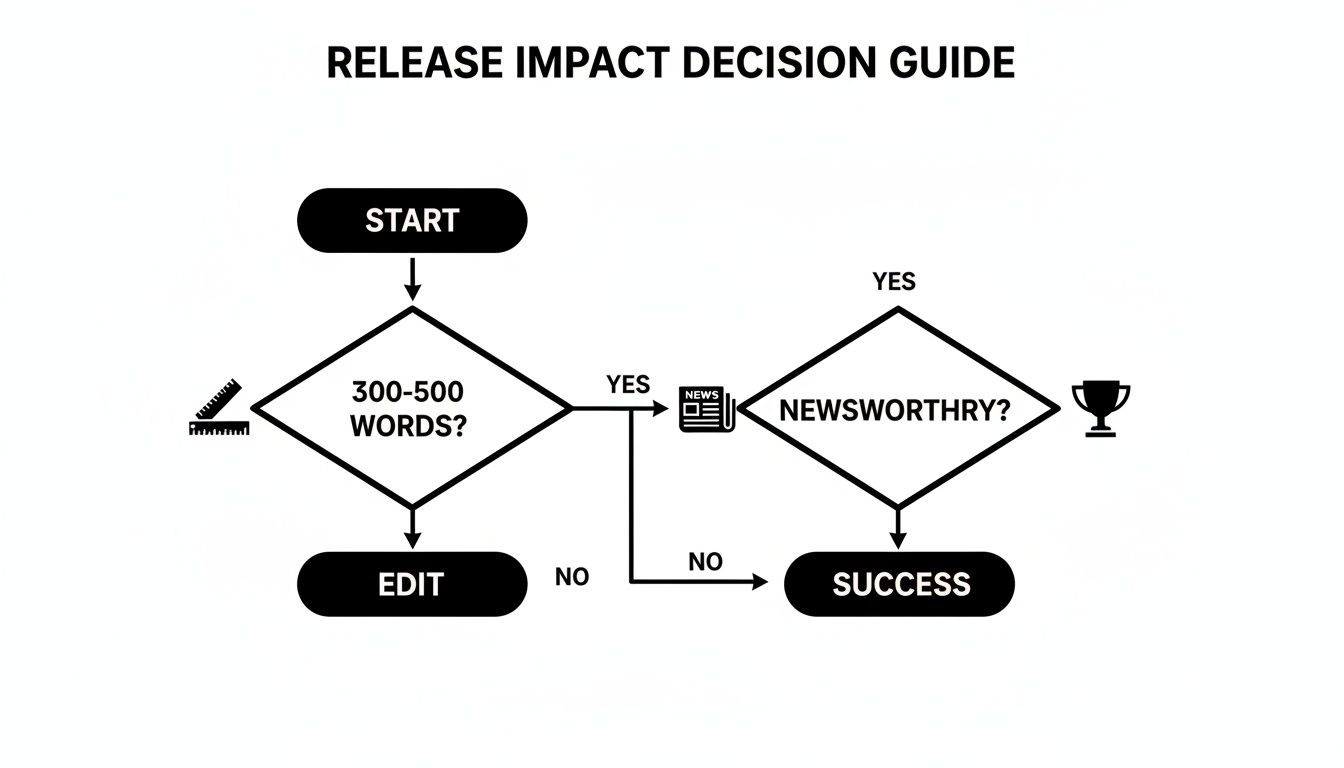
The main takeaway here is simple: hitting that ideal word count is the first, crucial checkpoint on the road to an impactful release.
Social Media Snippets
On platforms like X (formerly Twitter), LinkedIn, or Facebook, brevity isn't just a virtue—it's the law. Your goal is to craft a powerful teaser that funnels traffic to the full release.
- X (Twitter): You have 280 characters. No more. Use a sharp visual and a direct link to your announcement. Make every character count.
- LinkedIn: You've got more room to breathe, but keep your post's opening hook to around 25 to 50 words. This keeps your main point above the dreaded "see more" cutoff. Here, you'll want to focus on the professional impact of your news.
Tailoring your announcement for each platform is a smart form of content repurposing. When you’re slicing and dicing your message for different media, knowing how to repurpose content like a pro helps you craft something effective for every single one.
Once you master how long a press release should be for each format, you stop sending out a single announcement and start launching a multi-channel campaign. That's how you seriously boost your chances of landing valuable media coverage.
How to Write a Powerful Press Release That Fits

Knowing the ideal length for a press release is one thing. Actually writing a powerful story that fits inside that box is a completely different skill. The secret is to be disciplined and strategic, making sure every single sentence earns its place. The best way to pull this off is by using the inverted pyramid structure.
Think of your press release as an upside-down pyramid. All the most critical, newsworthy information—the absolute heart of your story—sits right at the wide top. This means your very first paragraph has to answer the classic questions: who, what, when, where, and why. A journalist should get the gist of your entire announcement just from reading those first few sentences.
This approach is a sign of respect for a reporter’s insane schedule and makes their job infinitely easier. They get the hook immediately, which gives them a reason to keep reading for the supporting details.
Structuring Your Content for Brevity
Once you've nailed that opening paragraph, the rest of the release should flow naturally, providing supporting details in descending order of importance. This isn't just a friendly suggestion; it's a foundational part of crafting a professional announcement that actually gets noticed.
Here’s a simple breakdown of how it works:
- Powerful Headline: Your first, and best, chance to grab someone's attention. Keep it active, clear, and laser-focused on the news.
- Dateline and Lead Paragraph: Right away, state the city, date, and the core of your news in one or two punchy sentences.
- Supporting Body Paragraphs: This is where you add context, background information, and other key details. It's also the perfect spot for a quote.
- Compelling Executive Quote: A great quote adds a human touch and reinforces why your news matters. Make sure it sounds authentic and impactful, not like it was written by a committee full of corporate jargon.
For a deeper dive into this framework, check out our complete guide on structuring the body of a press release for best practices.
Techniques for Concise and Potent Writing
Keeping your press release within that sweet spot requires some sharp editing. Your goal is ruthless clarity—trim any word that doesn't add real value. Recent industry reports confirm the 300-500 word count is still the gold standard. Data shows that 65% of top-performing releases include hyperlinks to provide deeper context without bloating the word count, while 48% feature executive quotes to add authority. You can discover more insights about media relations statistics on amworldgroup.com.
"Your headline is the news, your first paragraph is the story, and everything else is just the detail. If you write with that philosophy, you'll naturally hit the right length."
To tighten up your writing, always use an active voice. It’s far more direct and engaging than a passive one. Hunt down and eliminate unnecessary adjectives, adverbs, and confusing industry jargon. By embedding hyperlinks to your website or a detailed spec sheet, you give reporters a path to more information without wrecking the flow of your announcement. This keeps your release lean and focused on its only job: delivering the news.
From Bloated to Brilliant: Real Editing Examples
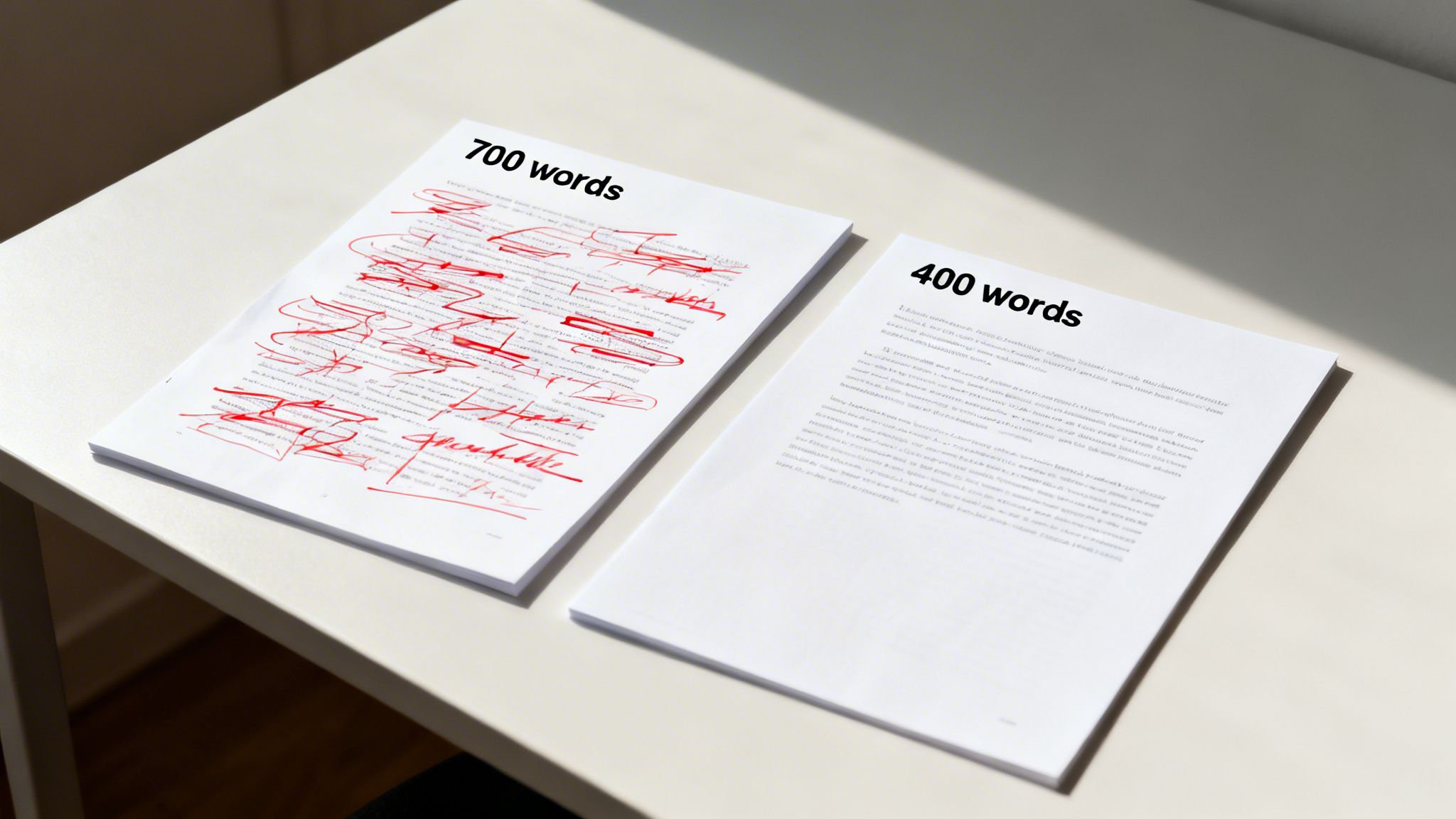
Knowing the rules for press release length is one thing. Seeing them put to work is where the lesson really sticks. Let’s look at how a bloated first draft gets whipped into shape, moving past the ideal 300 to 500-word range.
It’s easy to get carried away and end up with a 700-word monster of a draft, especially for something like a new product launch. You want to shout about every feature and detail the entire development journey. The reality is, a journalist doesn’t have the time—or the need—for all that fluff upfront.
Before the Trim
Most oversized press releases are guilty of the same sins. They tend to be self-congratulatory and packed with details that just don't matter yet.
Here’s what you often find:
- A long, rambling intro: Sometimes it takes three paragraphs just to get to the point.
- Adjective overload: Words like “groundbreaking,” “innovative,” and “world-class” are just filler.
- Echo-chamber quotes: Multiple executives saying the exact same thing in slightly different words.
- Needless backstory: The company’s entire history is included when the focus should be on today's news.
This approach buries the lede under a mountain of text. For a busy reporter scanning their inbox, it’s an instant turn-off that fails to answer the only question that matters: why is this important now?
The editing process isn't about removing information; it's about sharpening focus. Every sentence you cut that doesn't serve the core news makes your message stronger.
After the Trim: A Lean 400-Word Version
Now, let's watch that 700-word draft get sculpted into a tight, powerful 400-word announcement. The editor's job here is to ruthlessly chip away everything that isn't essential. The first things to go are always the fluff and ego.
The lean version gets right to business. A punchy, newsworthy headline leads into a first paragraph that immediately answers the 5 Ws (Who, What, Where, When, and Why). Those empty adjectives are gone, replaced by hard facts and figures that prove the product’s value instead of just claiming it.
A handy word counter tool is your best friend when you're trying to hit that sweet spot of 300-500 words.
The body is now just two concise paragraphs that deliver the must-know context. The two repetitive quotes have been merged into a single, impactful statement from a key leader, adding a human touch without the waffle. Finally, that long company history is trimmed down to a standard boilerplate of under 100 words.
What you’re left with is a scannable, professional, and compelling announcement that respects a journalist's time. By truly understanding how long a press release should be, you can turn a draft that's destined for the trash folder into a story that actually gets read.
Your Final Press Release Length Checklist
Before you even think about hitting “send,” it’s time for one last look. Think of this as your pre-flight check, the final pass that ensures your announcement is perfectly tuned for maximum impact.
This isn’t just about double-checking for typos. It's about confirming you’ve nailed the length and made every single word count. This is that last, critical step before you send your story out into the world.
The Essential Review
Run through these five questions. If you can give a confident "yes" to every single one, you’re ready to launch.
- Is the word count between 300 and 500? This is the proven sweet spot for grabbing and holding a journalist's attention.
- Is your most crucial news in the very first paragraph? Your lead has to instantly deliver the who, what, when, where, and why. No exceptions.
- Are your sentences short and in an active voice? This makes your release scannable and punchy. Passive language just kills momentum.
- Is the executive quote compelling and concise? It needs to add a human perspective, not just rehash facts you’ve already stated.
- Is the boilerplate under 100 words? Keep this final section tight and focused squarely on your organization’s core mission.
This final check is your opportunity to make sure your press release isn’t just written, but engineered for success.
Answering these questions puts the finishing polish on your work, seriously boosting your chances of earning media coverage. For more practical advice, check out our quick tips to create a news release that maximizes media pickup.
Frequently Asked Questions
Even after you’ve polished your draft, a few last-minute questions always seem to surface right before you hit “send.” Let's clear up some of the most common ones about press release length to make sure your announcement is ready to make an impact.
Is a One-Page Press Release Still the Standard?
Yes, absolutely. Think of the one-page rule as a timeless guideline. It started as a physical necessity back in the days of fax machines, but the principle is more relevant than ever in the digital age. A single page almost always clocks in at that sweet spot of 300 to 500 words.
Keeping it to one page means a journalist can see your entire story at a glance without endless scrolling. It’s a subtle but powerful signal that you respect their time and have delivered a tight, self-contained story—not a project they have to untangle.
A one-page release is a professional courtesy. It tells a journalist you’ve already done the hard work of editing so they don't have to. That alone makes your news far more likely to get noticed.
Does the Word Count Include My Headline and Boilerplate?
It sure does. When you're aiming for that 300 to 500-word target, you need to count everything from the first word of your headline to the final period in your boilerplate. This includes every single element:
- Headline and Sub-headline: The hook that grabs their attention.
- Dateline and Introduction: The essential who, what, when, where, and why.
- Body Paragraphs: The supporting details and quotes.
- Executive Quotes: The human voice of your announcement.
- Boilerplate: Your standard "About Us" summary.
- Media Contact Information: The crucial details for follow-up.
A great way to stay on track is to keep your boilerplate lean. Aim for under 100 words. This gives you more room for your core message without sacrificing the essentials.
What Happens if My Release Is Longer Than 500 Words?
Going over the 500-word mark is a big risk. Honestly, your press release will probably be ignored. Busy journalists use length as a quick filter, and a document that looks like a short novel is an easy "no."
Once you go long, your key messages get buried. The odds of a reporter reading all the way to the end plummet. You've spent all this time crafting a story, only to have it tossed aside before it's even read.
How Can I Add More Information Without Increasing Word Count?
This is where hyperlinks become your best friend. You can pack in tons of extra detail without bloating the press release itself.
Link out to things like detailed product spec sheets, full event schedules, high-resolution media kits, or extended executive bios. This keeps your announcement clean and focused on the core news, while giving genuinely interested reporters an easy way to dig deeper. It's the perfect way to satisfy both the skimmers and the deep-divers.
Ready to create press releases that get noticed? At Press Release Zen, we provide the guides, templates, and expert insights you need to master media communications. Visit us at https://pressreleasezen.com to start crafting more impactful announcements today.