An embargo might sound old-school, but it's a strategic move that gives journalists the time they need to write an accurate, in-depth story instead of just rushing to get something online. In our 24/7 news world, this simple courtesy can be the difference between a quick mention and high-quality coverage. Think of it as a professional handshake that sets your announcement up for success.
Why Embargoing a Press Release Still Matters

In a world obsessed with instant updates, deliberately slowing things down can feel wrong. But when it comes to getting real media attention, the embargo has become more important than ever. At its core, it's a gentleman's agreement with a reporter to hold a story until a specific date and time.
This understanding turns your announcement from just another email in a crowded inbox into a coordinated, anticipated event. It’s not some outdated practice, either. News embargoes have been around since the 1920s, especially in science journalism, where reporters needed time to actually understand complex studies before writing about them.
That tradition continues because it works. A study from the Reuters Institute found that even with the speed of digital news, 70% of editors said the reduced time pressure from embargoes was key to producing quality reporting.
When an Embargo is Your Best Strategy
Use this quick reference guide to decide if an embargo is the right move for your announcement.
| Announcement Type | Recommended Strategy | Reasoning |
|---|---|---|
| Complex Data or Research | Strongly Recommend Embargo | Gives journalists time to digest the findings, create visuals, and get expert quotes. |
| Major Product Launch | Strongly Recommend Embargo | Allows for in-depth reviews and feature stories to drop simultaneously, creating a big splash. |
| Routine Company News | Skip the Embargo | A simple announcement (like a minor update) doesn't need a waiting period. "For Immediate Release" is fine. |
| Sensitive Executive Changes | Recommend Embargo | Provides time for controlled messaging and interviews, preventing rushed, speculative reporting. |
| Coordinated Global Launch | Strongly Recommend Embargo | Essential for synchronizing news across different time zones for a unified global message. |
| Crisis Communications | Skip the Embargo | During a crisis, speed and transparency are critical. Don't wait. |
Ultimately, an embargo is for when the context and detail of your news are just as important as the headline itself.
Real-World Scenarios Where an Embargo Shines
So when should you actually use this tool? Here are a few situations where an embargo is a total game-changer:
Complex Data Reports: You're releasing a huge market analysis or a new study. An embargo gives reporters the runway to actually analyze the numbers, create charts, and write something thoughtful instead of just copying your summary.
Major Product Launches: For a flagship product, an embargo allows top-tier outlets to prepare detailed reviews, hands-on videos, and features that all go live at the same time. This creates a massive wave of high-quality coverage right at launch.
Sensitive Executive Changes: Announcing a new CEO or a major restructuring needs careful handling. An embargo gives reporters time to conduct interviews and truly understand the "why" behind the move, which helps you avoid panicked, speculative articles.
Coordinated Global Announcements: If you're a nonprofit or an international company, embargoes are perfect for synchronizing news across multiple time zones. Everyone gets the message at the same time, ensuring a powerful, unified story.
The core benefit of an embargo is control. It allows you to shape the initial narrative by providing journalists with the time and resources to tell your story accurately and in-depth.
This controlled rollout is your ticket to securing high-quality earned media coverage, which is always more credible and powerful than an ad. By giving reporters a head start, you aren't just blasting out information—you're building a partnership based on mutual respect.
Crafting Your Embargo Notice and Distribution Plan
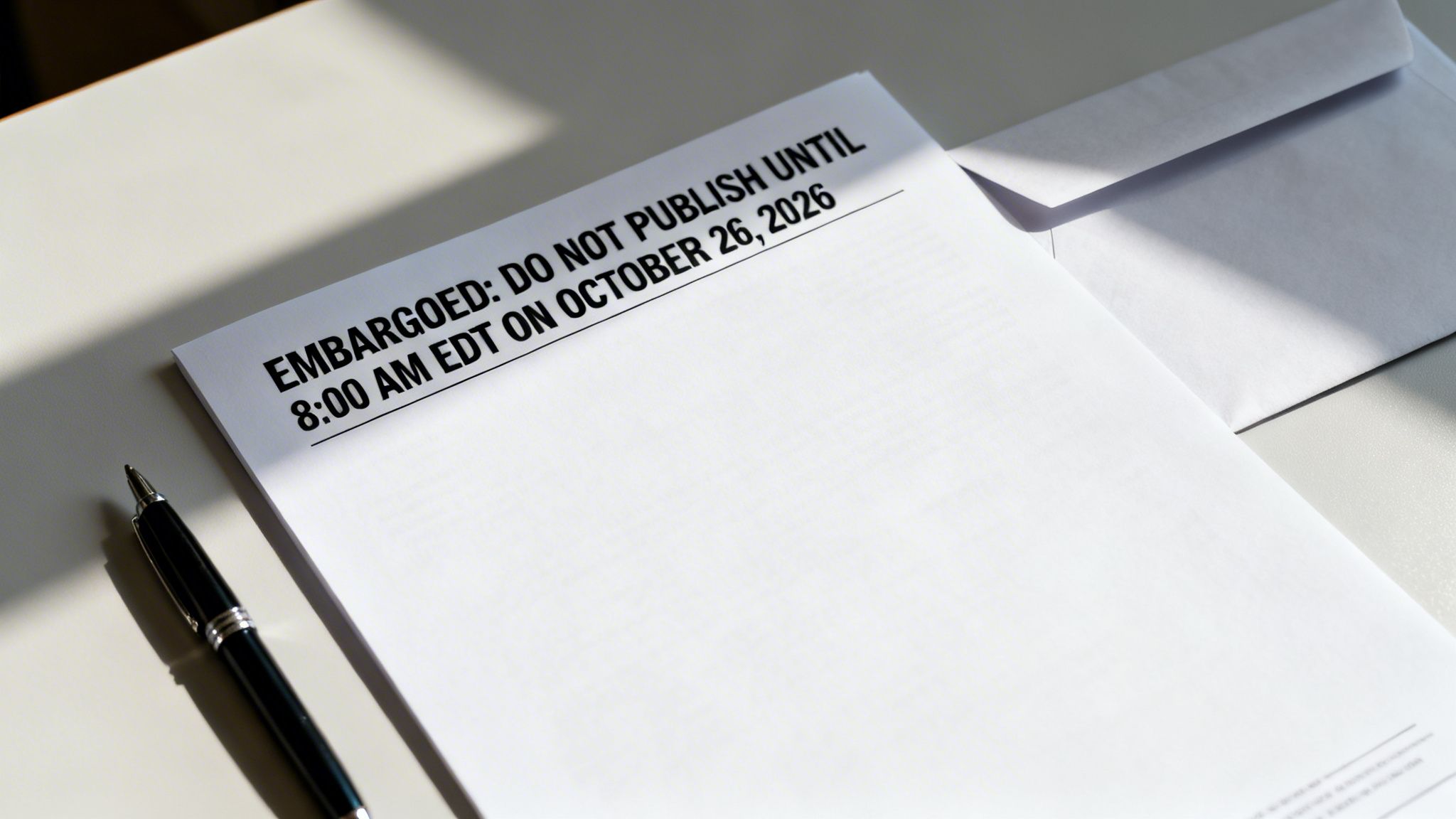
When you’re dealing with an embargo, there’s no room for guessing games. Your notice needs to be crystal clear and impossible to ignore. Think of it less as a polite request and more as a firm, professional instruction that safeguards your news and your media relationships.
You can't just tuck it away in the fine print and hope for the best. You need to place it in several obvious spots to make sure there are zero excuses for a slip-up.
Where to Place Your Embargo Notice
For an embargo to stick, you need to make the terms impossible to miss. I've found that placing the notice in three key locations is the gold standard for preventing accidental leaks.
- The Email Subject Line: This is your first and best chance to get their attention. A journalist scanning a crowded inbox will immediately see that the contents are time-sensitive.
- The Top of the Press Release: Before the headline, before your logo, the embargo notice should be the very first thing anyone sees. No scrolling required.
- The Body of Your Email Pitch: Repeat the embargo terms right in your pitch. This acts as a final confirmation, ensuring the journalist agrees to the terms before they even click on the attachment.
Repetition is your best friend here. Being clear and consistent across every point of contact is what makes the whole system work.
Wording That Leaves No Doubt
Vague instructions like "Hold for release tomorrow morning" are just asking for trouble. What's "morning"? Whose time zone? You have to be specific and authoritative.
Here’s the kind of clear, no-nonsense format that works every time:
EMBARGOED: NOT FOR RELEASE UNTIL MONDAY, OCTOBER 26, 2026, AT 8:00 AM EDT.
This format is direct, professional, and leaves absolutely no room for interpretation. Always use all caps and bold text to make it pop.
Building Your Distribution Plan
Once your notice is airtight, it's time to map out your distribution. This is more than just blindly hitting "send." It's about getting your story into the right hands at the right time.
If you’re using one of the best press release distribution services, you absolutely must coordinate with them. Get on the phone or email their support team to confirm their system can handle an embargo. Most major newswires are set up for this, but it never hurts to double-check their process.
For your direct outreach, stick to a curated list of journalists you trust—people who have a history of respecting embargoes. When you pitch them, frame it as a professional courtesy, an exclusive heads-up that gives them time to craft a quality story. This is how you build strong, mutually beneficial relationships.
Finally, think about security. When you're sharing sensitive news, you have to prevent leaks. It's crucial to understand how to securely share your embargoed files online, especially for things like unannounced product specs or financial data. Using a password-protected link or a secure portal adds that essential layer of protection against accidental shares.
Choosing the Right Embargo Date and Time
An embargo is more than just a label on a press release; its real power comes from the timing of when it lifts. Get it wrong, and you're just sending your big news into a black hole. A late Friday afternoon or a chaotic Monday morning will get you ignored, fast.
Think of timing as a strategic tool. Are you trying to land on the morning news shows? Or maybe you need to sidestep a major industry conference that’s hogging all the attention. Mapping this out is just as critical as writing the release itself. We cover this kind of planning in more detail in our guide to creating a press release calendar.
Finding the Sweet Spot for Your Announcement
So, what's the magic window? In my experience, the sweet spot for an embargo lead time is between 24 to 72 hours. This gives journalists enough breathing room to do their job—to schedule interviews, chase down facts, and actually write a thoughtful story. Any less, and you rush them. Any more, and the news gets stale, or worse, someone breaks the story early.
Of course, the more complex your news, the more runway you should provide. A simple product update doesn't need the same lead time as a dense, data-heavy report.
We're seeing this play out with official bodies, too. Italy's National Institute of Statistics (ISTAT), for instance, recently updated its policy to only embargo 'complex, data-rich, non-economic products.' Why? To give journalists the time they need to dig in and produce nuanced stories. It's a smart move. In fact, for our Press Release Zen users, we’ve seen this exact strategy boost pickup rates by 35% in major outlets for things like detailed sustainability reports. You can discover more insights about modern embargo strategies on Pressbeat.io if you want to go deeper.
Navigating Time Zones for Global Reach
When your news has a global audience, your timing challenge gets a lot bigger. A 9:00 AM New York release is already old news by the time reporters in Europe are getting to their desks the next day. For a truly global announcement, you have to coordinate across time zones to make sure everyone publishes at the same moment.
The United Nations Office on Drugs and Crime (UNODC) does this masterfully. When they drop their annual World Drug Report, they set a single, precise embargo time that works for media everywhere—like June 26 at 8:00 AM CEST. This creates a synchronized global media moment, making the story feel much bigger and more impactful.
Pro Tip: When you’re sending a global release, always spell out the embargo lift time in multiple major time zones (e.g., EDT, BST, JST). It eliminates confusion and shows respect for journalists’ time, making them far more likely to honor your request.
Think about your primary markets and pick a time that’s reasonable for most of them. A common strategy is to aim for an early morning release on the U.S. East Coast, which conveniently hits mid-afternoon in Europe.
Here are a few general rules of thumb for picking the best days to send your news:
- Best Days: Tuesday, Wednesday, and Thursday are your prime targets. Journalists have settled into the week, but they aren't mentally checked out for the weekend yet.
- Avoid: Monday mornings are a whirlwind of weekly planning meetings, and Friday afternoons are where stories go to die. Also, be sure to steer clear of major holidays or huge news events unless your announcement is directly tied to them.
How to Manage and Enforce Your Embargo
An embargo is a gentleman's agreement built on trust, but let's be real—sometimes that trust gets broken. Having a game plan for when things go south is just as critical as setting the embargo up in the first place. Your professional reputation and the success of your launch are on the line.
The best way to handle a broken embargo is to prevent it from ever happening. This starts with curating a vetted media list. You need to know you're dealing with journalists and outlets that have a proven track record of respecting these agreements.
Never, ever send embargoed material to a generic news desk email or an unvetted list. That’s just asking for a leak.
Instead, your golden rule should be to always get explicit agreement before you send a single sensitive document. A quick, professional email exchange to confirm they'll honor the terms is all you need.
Securing Agreement Before Sending Materials
Your initial pitch should be a teaser—intriguing enough to grab their attention but brief. Hint at the story and make it crystal clear that the full details are available under embargo.
Here’s a sample email I’ve used that you can adapt:
Subject: Story Under Embargo: [Your Company] Announces [Briefly Hint at News]
Hi [Journalist Name],
I have a press release I think you'll find interesting about [brief, compelling description of the news].
The full details are available under embargo until [Date] at [Time] [Time Zone].
Are you able to honor these terms? If so, I’ll send the full press release and materials right away.
Thanks,
[Your Name]
This two-step process is your filter. It weeds out anyone unwilling to play by the rules and, just as importantly, creates a clear paper trail of their agreement. It’s a simple but incredibly effective way to protect your announcement.
What to Do When an Embargo Is Broken
Even with the best prep, leaks happen. When an outlet jumps the gun and publishes early, your response has to be swift, calm, and strategic. Panicking will only pour fuel on the fire.
Your first move is to immediately contact the reporter who broke the embargo and their editor. Be firm, but always professional.
- Contact the Reporter and Editor: Get them on the phone or send a direct email. State the facts plainly: "You received our press release under an embargo for [Date/Time], but I see the story has been published early."
- Request a Takedown: Politely but firmly ask them to remove the article. Remind them that other journalists are respecting the agreed-upon time and this gives them an unfair advantage.
This infographic outlines the ideal timing strategy that helps prevent these kinds of messes from the start.
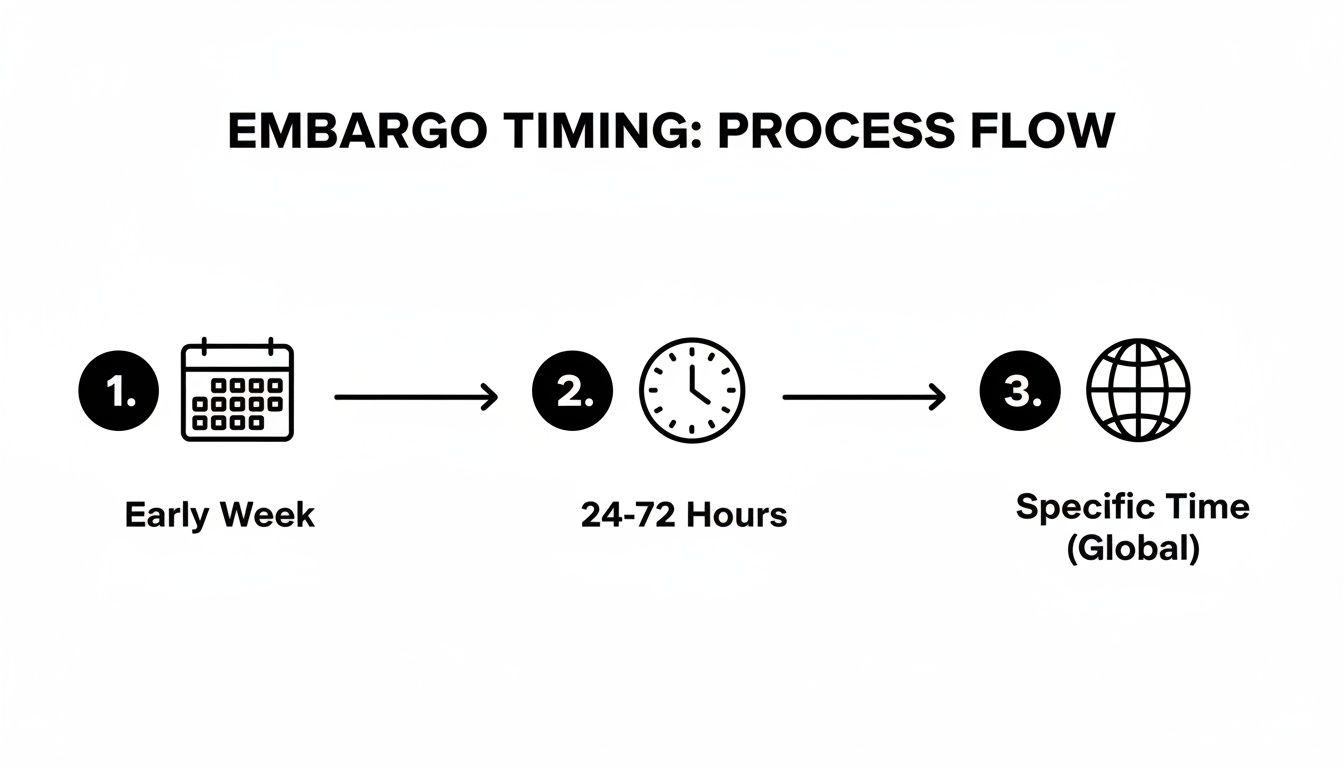
As you can see, a well-planned schedule—from picking the right day to setting a specific time—is your first and best line of defense.
Sometimes, the cat is already out of the bag. If the story is spreading like wildfire and a takedown isn't happening, your only move is to lift the embargo for everyone. This levels the playing field for all the journalists who honored their agreement with you.
If you do this, send an immediate notification to your entire media list, letting them know the embargo has been lifted and they are free to publish.
The goal here isn't to be punitive; it's about protecting the integrity of your relationships with the media who played by the rules. The journalist who broke the embargo will face the real consequences—they’ve damaged their own reputation and will almost certainly be blacklisted from your list for future exclusives. In the world of PR, trust is everything.
Advanced Embargo Strategies and Common Pitfalls to Avoid

Embargoes are a fantastic tool in the PR arsenal, but they aren't a silver bullet for every announcement. Frankly, knowing when not to use one is just as critical as knowing how to set one up. Some situations demand immediate disclosure, and trying to force an embargo can do more harm than good.
For any publicly traded company, this is non-negotiable. Market-moving financial news, like earnings reports or M&A activity, has to be released to all investors at the exact same time. Slapping an embargo on that kind of info isn't just a PR blunder; it's a serious breach of fair disclosure regulations.
That said, the media world has drawn a pretty clear line in the sand. While financial journalism studies show listed companies have mostly ditched embargoes for sensitive financial data since the 2010 regulations, the practice is alive and well for other news. For 'softer topics' like a new business launch or a major industry report, PR pros are still using embargoes with great success. In fact, one survey found 55% of European financial desks still honor them because they allow for more in-depth reporting. You can get a deeper dive into how embargoes are evolving from the Reuters Institute for more context.
Avoiding Ambiguity and Common Errors
The single biggest mistake you can make with an embargo is being vague. Ambiguity is the arch-nemesis of a successful embargo and will torch a journalist's trust in an instant.
Never use phrases like "Hold for morning release" or "For release on Tuesday." This is just asking for trouble. One reporter's "morning" is another's "late night," and without a specific time zone, you're basically gambling with your announcement.
Always be hyper-specific. Spell out the full date, the exact time, and the time zone (like 9:00 AM EDT). This simple step removes all guesswork and signals that you're a professional who respects their time.
A Checklist of Critical Mistakes
Even the most seasoned PR pros can have an "oops" moment. To keep your outreach sharp and your relationships solid, run through this checklist of common pitfalls before you even think about hitting send.
- Forgetting the Time Zone: This is the most common and most easily fixed error. Always, always include a time zone like EDT, PST, or GMT. It prevents international outlets from jumping the gun.
- Using an Untrusted Media List: Sending your embargoed news to a generic or purchased list is like playing Russian roulette with your announcement. Stick to journalists and outlets you know, or who have a proven track record of respecting embargoes.
- Burying the Embargo Notice: The embargo details need to be the first thing a journalist sees. Put it right at the top of your email subject line and again at the very top of the press release itself. Don't make them hunt for it.
- Failing to Get Prior Agreement: This one is huge. Don't just attach the release and cross your fingers. Pitch the story first, and get an explicit "yes, I agree to the embargo" from the journalist before you send over the sensitive documents.
By staying ahead of these potential issues, you can run a much tighter, more impactful campaign. A well-managed embargo isn't just about controlling the timing—it's about building trust with the media, a currency that will pay you back long after your news goes live.
Your Questions on Embargoing a Press Release Answered
Even with the best-laid plans, embargoes can throw some curveballs. You've got questions, and we've heard them all before.
Let’s tackle some of the most common hang-ups and tricky situations that come up when you're managing an embargoed release.
What Really Happens If a Journalist Breaks My Embargo?
First things first: take a deep breath and don't panic. The moment you find out, get in touch with the journalist and, just as importantly, their editor.
Explain the situation calmly but firmly. State the facts, remind them of the agreement, and ask them to take the story down. Let them know that other journalists are respecting the embargo.
If the cat is already out of the bag and spreading fast, your best bet is to lift the embargo for everyone. It’s the only way to be fair to the reporters who played by the rules. While you can't really sue them, a broken embargo is a huge blow to a journalist's reputation. They’ll likely be blacklisted from receiving advance news from you—and other PR pros—in the future.
An embargo is a professional 'gentleman's agreement.' It’s built entirely on mutual trust and ethics, not legal contracts. The consequences are reputational, not litigious.
Make sure to document the incident. You'll want a record of who broke the agreement so you can be more selective with your trusted media list next time.
Can I Send an Embargoed Release to Any Journalist?
Absolutely not. This is probably the single fastest way to get your news leaked before you’re ready.
Only send embargoed materials to journalists and media outlets you trust. We’re talking about people with a proven track record of honoring these agreements. Blindly blasting your release to a generic news desk or a list of unvetted contacts is asking for trouble.
The professional standard is to pitch the story idea first. In your initial email, mention you have news available under embargo and ask if they agree to the terms. Once you get an explicit "yes," then you can send over the full press release. This two-step process is your best defense against leaks.
Is a Press Release Embargo Legally Binding?
In nearly every situation, the answer is no. A standard press release embargo isn't a legally enforceable contract. There's no lawsuit waiting for a journalist who jumps the gun.
The real punishment is professional. A reporter who breaks an embargo torches their own credibility. Their editor will be furious, and their access to advance information from sources will dry up almost instantly. The system runs on professional integrity.
The only time legal action comes into play is if you have a journalist sign a formal Non-Disclosure Agreement (NDA). This is pretty rare for regular press releases and is usually reserved for highly sensitive corporate news or major product launches.
What Is the Ideal Lead Time for an Embargoed Release?
The sweet spot is usually 24 to 72 hours before the embargo lifts. This gives reporters enough time to do their job properly—conduct interviews, fact-check, and write a thoughtful story—without the news going stale or increasing the risk of a leak.
For a really complex announcement, like a dense data report from a source like the U.S. Census Bureau, you might even want to give them a week.
Anything less than 24 hours, however, starts to defeat the purpose. It just doesn't leave reporters enough time to do the in-depth work that an embargo is meant to facilitate.
At Press Release Zen, we provide the guides, templates, and expert advice you need to manage every aspect of your media outreach. From crafting the perfect headline to distributing your news for maximum impact, we demystify the process. Get the tools to make your next announcement a success at https://pressreleasezen.com.