An embargoed press release is a secret weapon in the PR world. It's where you give journalists your news in advance, but with one crucial condition: they agree not to publish it until a specific date and time. This simple act of coordination turns a potential media free-for-all into a powerful, synchronized announcement.
Understanding Embargoed Press Releases

Think of an embargo as a handshake deal between a PR pro and a reporter. It's a system built entirely on mutual trust and professional respect. You're handing over a finished story before anyone else sees it, and in return, the journalist honors your request to hold off on publishing.
This lead time is where the magic happens. Instead of getting your news and immediately scrambling to be the first to post, journalists get some breathing room. And that’s when they can do their best work.
The Value of Advance Notice
An embargo shifts the whole dynamic from reactive to proactive. It gives reporters the time they need to put together a story that’s far more detailed and thoughtfully crafted. With this head start, they can tackle the kind of work that’s just not possible on a tight deadline:
- Lining up extra interviews with your executives or other industry experts.
- Sourcing relevant data, images, or B-roll to make the story more compelling.
- Writing a deep-dive article that goes way beyond the surface-level facts.
- Fact-checking all the complex details, which is especially critical for financial or scientific news.
When you make it easier for them to produce quality journalism, you're far more likely to get high-quality, accurate, and impactful coverage in return. It’s a win-win: they get a better story, and you get better press.
The purpose of an embargo is to give reporters time to digest complex information and prepare an accurate story. It’s not a tool for controlling the narrative but for improving its quality and accuracy.
This controlled release also creates a massive splash on your launch day. When a dozen different outlets all publish their stories at the same time, you create a huge wave of media attention. This synchronized burst can completely dominate the news cycle.
That kind of concentrated coverage is what gets you trending on news sites and social media, sending your visibility through the roof.
Embargoed Release vs Standard Release At a Glance
Before you jump in, it’s critical to understand the difference between an embargoed release and a standard "for immediate release" announcement. They both aim to get you media coverage, but their methods—and results—couldn't be more different.
Here’s a quick breakdown of how they stack up.
| Feature | Embargoed Press Release | Standard (Immediate) Press Release |
|---|---|---|
| Timing | Sent to journalists in advance with a specific future publication date and time. | Sent and published simultaneously, creating an immediate news blast. |
| Journalist Experience | Allows for in-depth research, interviews, and quality story preparation. | Creates a competitive rush to publish first, often resulting in shorter, less-detailed stories. |
| Coverage Impact | Generates a coordinated, high-volume wave of coverage at a specific moment. | Coverage is sporadic and spread out as different outlets publish at different speeds. |
| Relationship Building | Fosters trust and strong relationships with key media contacts who value the lead time. | Is purely transactional and doesn't inherently build a deeper rapport with journalists. |
Ultimately, the choice to use embargoed press releases is a strategic one. It elevates your media outreach from simply sending out information to orchestrating a full-blown media event, making sure your big news lands with the biggest possible impact.
So, you might be wondering: is coordinating an embargoed press release worth the extra hassle? The short answer is yes. In a media landscape this competitive, an embargo can be the one thing that makes your announcement a massive success instead of a total flop.
Giving journalists a heads-up isn't just a nice gesture; it's a strategic move to get way more stories published. When reporters have time to actually dig into your news, set up interviews, and write a solid story, they are far more likely to produce a high-quality piece.
This simple step can transform a routine announcement into a full-blown media event. Instead of a few articles trickling out, you get a coordinated blast of coverage right when you want it. This creates a sense of urgency, helps your story start trending, and gets your message out there in a big way.
Amplify Coverage and Build Trust
The numbers don't lie. Data clearly shows a direct link between using an embargo and getting more media pickup. A 2024 analysis of 60 research releases found that embargoed stories achieved an incredible 80% more coverage than those sent for immediate release. This proves that a well-run embargo gives your news the best shot at cutting through the noise.
But it's not just about the numbers. Embargoes also have a powerful effect on your long-term media relationships. At its core, this strategy is all about trust. When you offer a reporter a story under embargo, you're treating them like a valued professional partner.
Journalists remember that. They appreciate sources who respect their workflow and give them what they need to do their jobs well.
An embargo is an investment in your media relationships. It builds a foundation of mutual respect that pays dividends long after a single story is published, making reporters more receptive to your future pitches.
This collaborative vibe almost always leads to more accurate and in-depth reporting. When a journalist isn't scrambling against the clock, they have the breathing room to understand complex information, double-check facts, and ask smart questions. This is crucial for announcements with tricky data, scientific news, or major financial details where a small mistake can cause big problems. For anyone trying to get more press, this is a key part of learning how to get a press release picked up by the big players.
Control Your Narrative and Timeline
Finally, an embargo puts you in the driver's seat of your own story. You get to decide the exact date and time the news goes public, lining it up perfectly with a product launch, marketing campaign, or a partner's announcement.
This kind of synchronization creates a strong, consistent message across every channel—from major news outlets to your company's blog and social media.
This level of control lets you get ahead of the public reaction, have your spokespeople prepped for interviews, and manage the story from a position of strength. Instead of just reacting to random coverage, you're conducting a powerful, coordinated launch that ensures your announcement lands with maximum impact.
When to Deploy an Embargoed Press Release
Deciding to use an embargoed press release isn't something you do for every piece of news. Think of it less as a default setting and more as a special weapon in your PR arsenal.
If you start slapping an embargo on every minor update, you'll quickly erode the trust you have with journalists. The key is to save it for when the benefit of coordinated, detailed coverage is far greater than what a standard "for immediate release" announcement could ever achieve.
Think of it like this: a standard press release is like a talented street performer. It’s spontaneous, can definitely grab attention, but you never know exactly who will stop to watch. An embargoed press release, on the other hand, is a Broadway show on opening night. It requires meticulous planning, advance coordination, and a synchronized curtain-raise that guarantees the entire audience feels the full impact at the exact same moment.
You pull out the embargo when your news truly deserves that Broadway treatment. This approach is also crucial for figuring out who reads your press releases and making sure your biggest stories land with the right people, giving them the runway they need to do great work.
For Complex and Data-Heavy News
One of the best times to use an embargo is when your announcement is complicated or swimming in data. If your news needs more than a quick skim to be understood, an embargo is your greatest asset.
It gives journalists the breathing room they desperately need to really dig into the details, check the facts, and write a story that’s both accurate and insightful.
This is particularly true for:
- Scientific Breakthroughs: A release about new research or a medical study needs to be handled with care. An embargo gives reporters a chance to talk to the scientists, understand the methods, and report the findings without causing a panic or misinforming the public.
- Detailed Financial Reports: Quarterly earnings, annual reports, or huge funding announcements are filled with numbers and projections that need real analysis. Giving journalists a head start prevents rushed, shallow reporting that could easily misread the data.
- In-depth Market Research: If you’re dropping a big industry report with game-changing statistics, an embargo lets reporters pull out the most compelling trends and explain what they actually mean for their audience.
Without that lead time, you're rolling the dice and risking sloppy, inaccurate coverage that completely misses the point of your announcement.
For Major Coordinated Launches
Another perfect scenario for an embargo is a massive launch or event with a lot of moving parts. When your announcement is the grand finale of months, or even years, of hard work, you want it to make a huge splash.
An embargo transforms a launch from a simple announcement into a synchronized media event. It aligns external coverage with your internal marketing efforts, creating a powerful wave of attention that is impossible to ignore.
Think about using an embargoed press release for these kinds of moments:
- New Product or Service Launches: You can time the media coverage to go live at the exact second your product hits the virtual or physical shelves, creating an instant rush of traffic and sales.
- Mergers and Acquisitions: These are incredibly sensitive and complex deals. An embargo makes sure that every single stakeholder—from employees and investors to customers—gets a clear, consistent message from credible news outlets all at once.
- Multi-Partner Announcements: When your news involves several different companies or organizations, an embargo is the glue that holds everything together. It ensures every partner gets their credit and the joint message is delivered consistently across the board.
Your Playbook for a Flawless Embargoed Release
Pulling off a successful embargoed release is all about precision and a clear game plan. It’s not enough to just email an advance copy of your news and hope for the best. You need a rock-solid process for drafting, targeting, distributing, and following up.
Think of it as your step-by-step guide to making sure your big announcement lands with maximum impact, not with a chaotic leak. Every detail matters, from the first draft to the final follow-up, because it all comes down to building and keeping the trust of your media contacts.
The flowchart below breaks down the key scenarios where an embargo is your best move.
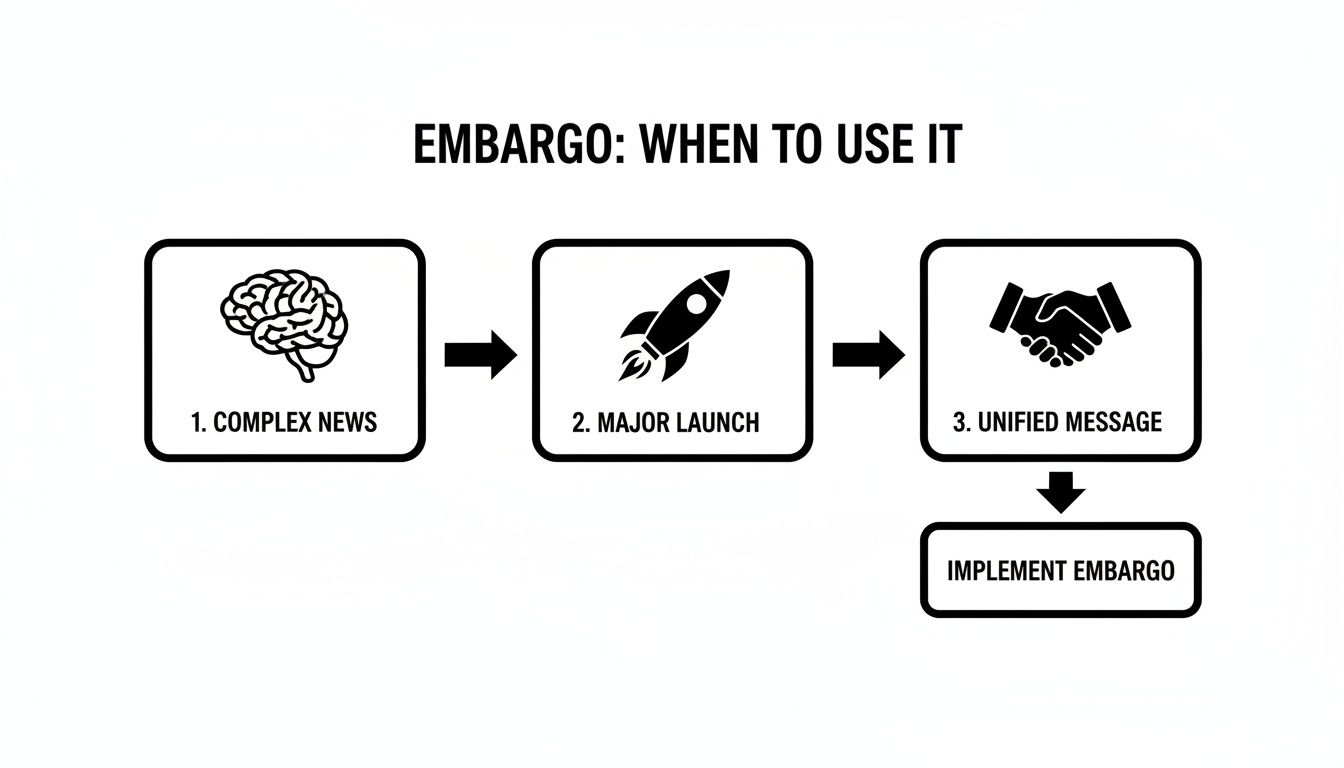
As you can see, embargoes are a strategic play for stories that need a coordinated, well-prepared launch.
Drafting with Absolute Clarity
The entire embargo hinges on one thing: an unmissable notice. If a journalist has to hunt for the embargo terms, you’re setting yourself up for failure. Your embargo statement must be the very first thing they see.
Seriously, put it right at the top of the document, even before the headline. Use clear, bold formatting that screams "read me first."
Example Embargo Statement:
EMBARGOED: NOT FOR IMMEDIATE RELEASE
FOR RELEASE ON WEDNESDAY, NOVEMBER 12, 2025, AT 10:00 AM EST
DO NOT PUBLISH OR DISTRIBUTE BEFORE THIS DATE AND TIME.
This format leaves zero room for error. Always specify the date, time, and time zone (EST, PST, GMT, etc.) to prevent any confusion, especially when you're working with reporters across the globe. When your announcement involves legal details, like mergers or financial results, accuracy is paramount. Many firms are now using specialized legal AI tools for lawyers to ensure every detail is compliant and correct.
Curating Your Trusted Media List
An embargo is a gentleman's agreement built on trust. That means you can't just blast it out to a massive, untargeted list—that's a recipe for a broken embargo.
You need to build a curated list of journalists who you have a relationship with or who have a professional reputation for respecting embargoes. Focus on reporters who cover your specific beat. Before you send them a single thing, you need to get their buy-in.
A simple, direct email is your best bet:
"Hi [Journalist Name], I have some news under embargo lifting on [Date] at [Time]. Are you interested in receiving the details under these terms?"
Only send the full press release after you get an explicit "yes." This two-step confirmation is the single most important thing you can do to prevent leaks. Securing this agreement is what makes embargoed press releases a powerful tool instead of a risky gamble.
Nailing the Timing and Follow-Up
Your outreach timeline is just as critical as the content of the release itself. Send it too early, and it gets buried in a crowded inbox. Send it too late, and you rob journalists of the exact thing you were trying to give them: time to prepare.
To help you stay on track, we've put together a checklist that lays out the ideal outreach schedule. This timeline is your guide to ensuring your news stays top-of-mind without being overwhelming.
Embargo Timing and Outreach Checklist
| Timeline | Action Item | Key Consideration |
|---|---|---|
| 3–5 Business Days Out | Send initial pitch email to your curated list. | Ask for explicit agreement to the embargo terms before sending anything else. |
| 2–4 Business Days Out | Distribute the full press release and assets. | Send only to journalists who have confirmed they will honor the embargo. |
| 1 Business Day Out | Send a brief, polite reminder email. | Restate the lift time and ask if they need anything further. No new information. |
| Embargo Lift Time | Monitor for coverage as it goes live. | Be ready to share published stories and engage with reporters. |
Following this simple schedule keeps your news on the reporter's radar and reinforces the terms of your agreement, paving the way for a smooth and successful launch day.
For more on making sure your story gets seen after the embargo lifts, check out our guide on optimizing your press releases with SEO keywords and metadata.
How to Handle Embargo Breaks and Other Issues

Even with the most careful planning, things can go sideways with an embargoed press release. The one issue that gives PR pros nightmares is an embargo break—when a journalist publishes your story before the agreed-upon time. It’s a gut-wrenching moment, but panic is not a strategy.
The second you find out a story has broken early, your first move is to take a breath and figure out what just happened. Who published it? Was it a major news site or a small, niche blog? A leak on a top-tier outlet is a completely different fire to put out than one on a low-traffic website.
Once you know the who and where, get on the phone with the journalist or their editor immediately. An email won't convey the same urgency. Keep it professional, not accusatory—your goal is to solve the problem, not burn a bridge. Always assume it was an honest mistake, like a time zone mix-up or a simple scheduling error.
Your Embargo Break Action Plan
When a story leaks, you need to act fast to regain control of the narrative. Every minute counts. Having a ready-to-go protocol means you can be decisive instead of getting swept up in the chaos. The main goal here is to protect your relationships and be fair to all the other journalists who played by the rules.
Here are your immediate steps:
- Contact the Outlet: Politely ask them to take the story down. Explain that it was under a strict embargo that other outlets are still respecting. Most reputable journalists will pull the story right away once they realize their mistake.
- Assess the Damage: You need to figure out how far the news has spread. Has it been picked up by other outlets? Is it all over social media? If you've managed to contain the leak quickly, you might be able to stick to your original plan.
- Decide Whether to Lift the Embargo: If the cat is truly out of the bag and the news is spreading like wildfire, the only fair move is to lift the embargo for everyone. Send a short, clear email to your entire media list letting them know the embargo is lifted and they are free to publish. This is how you maintain goodwill with the reporters who honored their agreement.
An embargo break feels like a full-blown crisis, but how you handle it defines your professionalism. Responding with grace and fairness protects your long-term media relationships, which are far more valuable than any single announcement.
Managing Other Common Issues
Embargo breaks are the big one, but they aren't the only headache you might run into. Internal leaks or reporters who simply refuse your terms can also throw a wrench in your plans.
- Internal Leaks: Sometimes, the leak comes from inside the house. An excited employee might post the news on their personal social media, not realizing the problem. To head this off, your embargo communication plan needs to include clear instructions for all employees, not just the media.
- Refusal of Terms: What if a journalist says they won't honor an embargo? Simple: you thank them for their honesty and do not send them the information. An embargo is a mutual agreement. It's far better to have one less publication on your list than to risk a deliberate leak that sinks your entire launch.
The Evolution of the Press Embargo Strategy
To really understand the power of an embargoed press release today, it helps to look back at where it came from. This isn't some new-fangled strategy cooked up for the digital news cycle; it’s a time-tested approach with roots stretching back over a century. The fact that it’s still around proves just how valuable it is for both PR pros and journalists.
The embargo first showed up as a practical way to manage sensitive information in a world that was changing fast. Its history goes all the way back to around World War I, when governments desperately needed a way to control the release of data that could tank financial markets or compromise national security. By giving journalists info ahead of time under a strict timing agreement, they stopped disastrous leaks while making sure reporting was accurate when the news finally broke. You can dive deeper into this early history with these findings on the origins of institutional PR.
This system worked so well that other major institutions quickly started using it. It was no longer just for government secrets.
From Scientific Discoveries to Corporate Announcements
By the mid-20th century, the scientific community had adopted the embargo as a way to responsibly share complex breakthroughs. Big U.S. agencies like NASA became a perfect example, using embargoes to coordinate massive announcements about space missions and scientific findings. This gave reporters the breathing room they needed to talk to experts, get the details right, and write stories that actually educated the public instead of just sensationalizing early data.
It wasn't long before the corporate world caught on. Companies launching game-changing products or announcing major financial news saw how powerful a coordinated media push could be. An embargo let them build a single, unified narrative and generate real excitement for a specific launch moment.
Thriving in the Digital Age
You'd think that the rise of instant communication and the 24/7 news cycle would have killed the embargo. In a world of live-tweeting and constant updates, how could an agreement to "hold for release" possibly survive?
Well, the exact opposite happened. The embargo has become more valuable than ever.
In today's chaotic media environment, an embargo offers a rare moment of control and coordination. It transforms a scattered burst of information into a focused, high-impact media event that cuts through the noise.
The core idea is the same, but how we use it has adapted. Here’s how a modern embargo strategy pays off:
Synchronized Impact: When multiple outlets publish at the same time, it creates a massive wave of coverage that can dominate social media trends and news aggregators like Google News.
Quality Over Speed: It pushes back against the "publish first, ask questions later" mentality. It gives journalists the time to produce accurate, in-depth, and well-researched stories.
Relationship Building: In an increasingly transactional media world, offering an embargo is a sign of respect. It shows you trust a reporter, and that’s how you build solid, long-term relationships.
From its start as a government tool for controlling sensitive data, the embargo has grown into a sophisticated PR strategy. Its history shows a remarkable ability to adapt and get results, proving that a well-played embargo is a tough and essential tactic for anyone looking to make a real impact with their news.
Common Questions About Embargoed Press Releases
Even the most seasoned PR pros can get tripped up on the finer points of embargoed press releases. It's a powerful tool, but the rules of engagement can feel a little confusing at first. Let's clear up some of the most common questions so you can use embargoes with total confidence.
Getting these details right is what separates a smooth, coordinated launch from a major media relations headache. It all starts with understanding exactly what an embargo is—and what it isn't.
Is an Embargo Legally Binding?
No, an embargo is not a legally binding contract. Think of it as a professional handshake, an agreement built completely on mutual trust and respect between you and a journalist.
There are no lawyers or courts involved if someone breaks an embargo. However, the professional fallout can be massive. A reporter who jumps the gun risks torching their reputation, getting blacklisted by your company, and finding that other organizations are suddenly unwilling to give them advance information.
What Is the Difference Between an Embargo and an Exclusive?
While both are great strategic tools, they accomplish very different things. The one you choose depends entirely on what you’re trying to achieve.
Embargo: You give advance information to multiple journalists or outlets, with the understanding that they will all publish at the exact same time. This creates a big, synchronized splash of coverage for maximum, widespread impact.
Exclusive: You give the story to just a single journalist or media outlet. This grants them the sole right to break the news first, a tactic often used to lock in a deep, high-profile feature with a top-tier publication.
Think of it this way: an embargo is like a chorus singing in unison for a powerful, collective sound. An exclusive is a solo performance designed to spotlight one single, powerful voice.
How Do I Write an Embargo Notice?
Your embargo notice has to be impossible to miss. Place it at the very top of your press release, even before the headline. Make it stand out with bold, all-caps letters—using red text is also a common practice.
The notice needs to be crystal clear, leaving zero room for doubt. Always include the full date, a specific time, and the correct time zone.
Example:
EMBARGOED. NOT FOR IMMEDIATE RELEASE.
FOR RELEASE ON TUESDAY, OCTOBER 26, 2026, AT 9:00 AM ET.
What If a Journalist Refuses the Embargo?
This one's simple: if a reporter tells you they won't agree to the embargo, you do not send them the information. The agreement has to be mutual and confirmed before you share anything sensitive.
Just politely thank them for their honesty and take them off that specific distribution list. Building and maintaining a trusted list of journalists who consistently honor embargoed press releases is one of the cornerstones of a successful PR strategy.
Ready to create press releases that get noticed? At Press Release Zen, we offer a comprehensive suite of free guides, checklists, and templates to help you craft and distribute announcements with confidence. Visit us to elevate your PR game: https://pressreleasezen.com