When the phone starts ringing from unknown numbers, screenshots are moving faster than facts, and your leadership team wants a statement in ten minutes, you're not shopping for a vendor. You're trying to protect the company from making the second mistake after the first one already happened.
That’s why most advice on crisis management pr firms falls short. It gives you lists of agencies, broad service descriptions, and polished language about reputation protection. What it usually doesn’t give you is a way to decide whether you need outside help at all, how to hire fast without hiring badly, and how to judge whether the firm you picked is earning its keep.
The market has a blind spot here. Miller Ink notes the scarcity of data-backed comparisons on crisis management PR firm outcomes and ROI, and adds that 55% of crises self-resolve via strategic press releases within 72 hours if issued proactively, per 2025 global surveys. That single point matters more than most agency pitch decks. It tells you two things at once. First, not every issue needs a large outside team. Second, when you do hire, you need a performance lens, not a prestige lens.
Navigating the Chaos When a Crisis Hits
The early hours of a crisis create pressure to act loud instead of act well. A CEO wants to show command. Legal wants silence. Marketing wants brand consistency. HR wants employee language. Reporters want a quote now.
That mix is how companies end up saying too much, too little, or the wrong thing in the wrong channel.

The first useful move is usually not to publish a dramatic statement. It’s to decide what kind of event you're facing. Some situations need a disciplined internal response and a well-built press release. Others need outside crisis counsel with media, stakeholder, and executive support running at the same time.
If your issue touches litigation, public allegations, regulatory attention, or executive exposure, legal and communications need to move together. For that kind of overlap, Crisis Management: Strategy for High-Profile Legal Battles is a useful reference because it reflects that public narrative and legal posture can't be managed in isolation.
What leaders get wrong in the first hour
Most bad outcomes start with one of these errors:
- Treating uncertainty as a reason to disappear: Silence creates a vacuum. Someone else will fill it.
- Treating speed as a reason to speculate: If you don’t know, say you’re confirming facts.
- Treating every problem as a five-alarm fire: That can waste money and escalate attention.
- Treating every fire as a routine issue: That’s worse.
A practical primer on what qualifies as a PR crisis helps anchor that judgment. This overview of what is crisis management in PR, including types, benefits, and examples is worth keeping close if your team is debating whether the issue is operational, reputational, or both.
Practical rule: In the first hour, your job isn't to look polished. Your job is to stop confusion from turning into contradiction.
What a useful hiring framework should answer
Before you call firms, answer three internal questions:
- What harm are we trying to contain right now
- Who can make final decisions without committee drift
- What outcome would make this engagement worth the cost
If you can’t answer those, the agency will spend your money organizing your internal chaos before it starts managing the external crisis.
Deciding When to Call in a Crisis PR Firm
Not every reputational problem justifies an outside crisis team. Some do. The difference usually comes down to consequence, complexity, and speed.
A customer complaint thread, a local service failure, or a short-lived social flare-up can often be handled in-house if the facts are clear, the affected audience is narrow, and leadership can approve messages quickly. In those cases, a strong statement, direct customer outreach, and disciplined follow-up often work better than parachuting in a large firm.
The threshold changes when the issue can spread across stakeholder groups at once.
Call a firm when the problem crosses functions
Bring in outside crisis support if the event affects more than one of these at the same time:
- Legal exposure: litigation risk, regulatory inquiry, or allegations that require careful wording
- Operational disruption: outages, closures, recalls, breaches, or executive departures that affect continuity
- Public safety: anything involving injury risk, physical harm, or consumer protection
- Sustained scrutiny: repeated press interest, coordinated online criticism, or a story with national potential
- Leadership vulnerability: a founder, CEO, or senior executive is central to the story
When two or more of those show up together, internal teams usually lose time to coordination. That’s when a crisis firm earns its value by building one operating rhythm across legal, HR, operations, and media relations.
Manage internally when the issue is contained
Keep it in-house, at least initially, when the situation looks more like this:
- The facts are known: there isn’t material uncertainty about what happened.
- The audience is specific: customers, one location, or one partner group.
- You have a spokesperson ready: someone credible can speak without improvising.
- Approvals are tight: one decision-maker can clear language fast.
- The issue isn’t compounding: no sign yet that media, regulators, or advocacy groups are joining.
Many companies overspend here. They hire for fear, not for fit.
A firm should solve a capacity and judgment problem. If you only need drafting help and distribution, buy that instead of a full crisis machine.
BP is still the cautionary example
The reason this decision matters so much is simple. A weak early response can multiply the original damage. The BP Deepwater Horizon oil spill in April 2010 remains the cleanest example of how poor crisis handling worsens consequences. The explosion killed 11 workers and released approximately 4.9 million barrels of oil over 87 days. BP’s slow acknowledgment of the scale of the spill, along with tone-deaf executive remarks, deepened the reputational fallout and contributed to over $65 billion in total costs, including a $20.8 billion settlement with the U.S. government in 2016 and $4.5 billion in criminal fines, as detailed by Everything PR’s review of major crisis PR failures.
The lesson isn’t that every company needs a global crisis agency on speed dial. It’s that delay, minimization, and poor executive messaging can become part of the crisis itself.
A simple escalation test
Ask these questions in order:
| Question | If yes | If no |
|---|---|---|
| Is there possible legal or regulatory exposure | Involve outside counsel and consider a crisis firm | Continue internal assessment |
| Are multiple stakeholder groups demanding answers now | Likely time to hire | Prepare internal comms first |
| Is the CEO or founder part of the story | External coaching is often worth it | Use internal spokesperson if appropriate |
| Are reporters calling before facts are fully confirmed | Build a holding line fast, likely with outside support | Draft a direct response internally |
| Could the issue affect trust for months, not days | Treat as a strategic crisis | Handle as an incident |
A good CEO doesn’t ask, “How bad does this look?” A good CEO asks, “What operating model does this situation require?”
How to Evaluate and Select the Right Firm
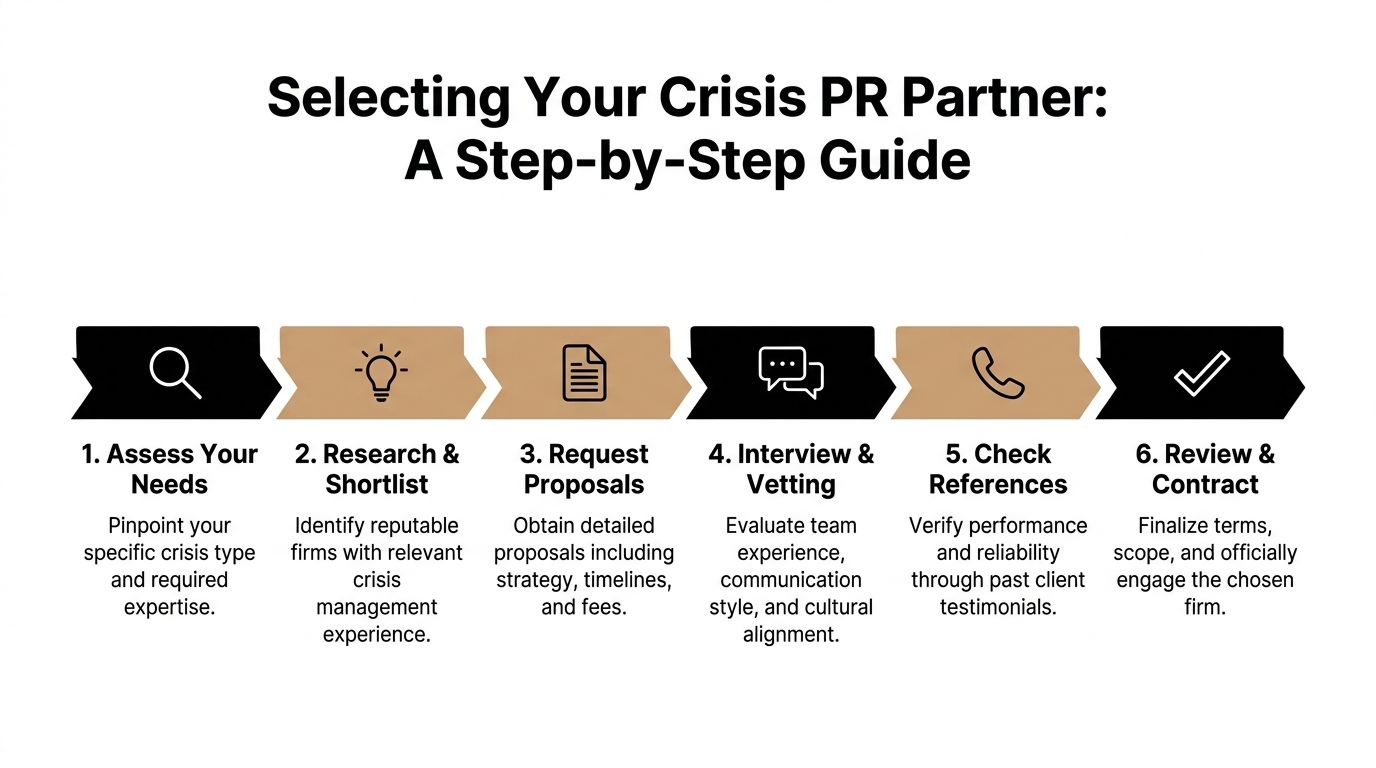
Once you decide to hire, speed matters. Panic doesn’t help. The best selection process is short, hard-edged, and based on capability you can test in conversation.
Most firms sound competent on their websites. Very few show you how they’ll behave at 9:40 p.m. when legal has objections, a reporter has new allegations, and employees are texting screenshots internally.
Start with fit, not fame
A recognizable agency name can help with board confidence. It doesn’t guarantee performance on your issue.
Shortlist firms based on four filters:
- Issue match: data breach, executive misconduct, litigation, labor issue, product failure, activist pressure, or operational accident
- Sector familiarity: healthcare, retail, nonprofit, financial services, SaaS, manufacturing, public sector
- Stakeholder complexity: whether they can handle employees, customers, regulators, investors, and media at once
- Leadership access: whether senior counselors stay involved after the pitch
If a firm can’t explain similar pressure patterns, move on. Industry knowledge matters less than issue pattern recognition. A product recall and a software outage are different operationally, but the stakeholder choreography can be similar.
The modern baseline is a digital war room
One capability now sits above the rest. The firm must be built for real-time monitoring and adjustment, not just statement drafting. The Square’s roundup of crisis management PR agencies notes that modern firms use 24/7 war rooms with real-time digital sentiment analysis, a capability that can reduce negative media coverage by up to 40-60%, and that 70% of crises now originate online.
That doesn’t mean you need a giant agency. It means you need a team that can see the narrative forming as it happens.
A credible firm should be able to show how it handles:
- Social monitoring: key terms, brand mentions, executive names, and issue language
- News tracking: local, trade, and national pickup
- Narrative shifts: whether the conversation is moving from event to blame, or from blame to remedy
- Internal intelligence: what employees, partners, and customers are reporting back to the company
- Search visibility: whether harmful headlines are becoming the dominant result set
Questions that expose real capability
Don’t ask, “Have you handled crises?” Every firm says yes.
Ask questions that force process detail:
- Who leads the account at midnight on day two
- What decisions can your team make without waiting for a formal meeting
- How do you separate confirmed facts from working assumptions
- What does your first six-hour action list look like
- How do you handle disagreement between legal and communications
- What monitoring stack do you use for social, news, and stakeholder feedback
- How do you coach a CEO who wants to speak before the facts are complete
- What does success look like after the first statement
- What would make you recommend a narrower response instead of a full engagement
- What do you need from us in the first twelve hours
The right firm answers clearly and concretely. The wrong firm drifts into jargon about brand narrative, integrated excellence, and bespoke reputation architecture.
If a firm can’t describe the first day in operational terms, it probably hasn’t run enough bad days.
Compare firms with a simple scorecard
Use a weighted matrix. Don’t overcomplicate it.
| Criterion | What strong looks like | Warning sign |
|---|---|---|
| Team seniority | Senior counselor and decision-maker visible from first call | Junior-heavy delivery after senior-led pitch |
| Monitoring capability | Always-on tracking with clear escalation rules | Manual checks and vague listening claims |
| Message discipline | Distinguishes acknowledgment from admission | Drafts language that creates legal risk |
| Executive coaching | Can prep leaders for hostile questions | Focuses only on written statements |
| Cross-functional fluency | Works well with legal, HR, IT, ops | Treats communications as a silo |
| Reporting cadence | Defines update rhythm and decision windows | “We’ll keep you posted” |
| Scope judgment | Knows when not to overbuild | Sells maximum package immediately |
What to review before you sign
Look at public materials, but read them skeptically.
Check for:
- Specificity in case descriptions: not confidential details, but evidence of real operating experience
- Named disciplines: crisis media relations, employee comms, executive prep, litigation support, digital monitoring
- Response structure: who’s on call, who approves, who briefs leadership
- Tone under pressure: if their own marketing sounds inflated, that’s a clue
This is also the stage where one practical content resource can complement agency support. Press Release Zen provides templates and step-by-step guidance for crisis statements and distribution workflows. For small teams that need a usable drafting framework alongside agency counsel, that can be a practical operational tool rather than a substitute for strategy.
Red flags that should end the conversation
Walk away if the firm does any of the following:
- Promises control of coverage: no serious firm can guarantee that
- Overstates media relationships: access helps, facts matter more
- Minimizes legal coordination: dangerous
- Can’t name the working team: also dangerous
- Sells confidence instead of process: common and expensive
The best crisis management pr firms don’t sound theatrical. They sound organized.
Onboarding Your Firm and Launching the Response
Signing the engagement letter doesn’t create momentum by itself. The first day with a crisis firm usually determines whether the rest of the week feels controlled or chaotic.
A competent team will try to establish one operating picture fast. Your job is to give them facts, access, and decision rights before internal noise overwhelms useful work.

What the firm needs in the first few hours
Send a briefing packet. Keep it factual. Don’t make it pretty.
Include these items:
- Known timeline: what happened, when, who knew, and what action has already been taken
- Open questions: facts still being verified
- Risk map: legal, regulatory, customer, employee, partner, and operational concerns
- Key people: final decision-maker, legal lead, HR lead, operations lead, spokesperson
- Existing materials: prior statements, screenshots, media inquiries, customer complaints, internal memos
- Channel access: social teams, website contacts, press inbox, executive calendars
If you hide embarrassing details to “protect the agency from confusion,” you’ll force them to build strategy on partial facts. That always surfaces later, usually at the worst moment.
The first communications asset is often a holding statement
A good firm won’t wait for every detail before drafting. It will create a holding statement, which confirms awareness and action without speculating or admitting liability. YouScan’s overview of PR crisis management explains that effective firms use pre-approved holding statements followed by transparent updates, preventing the delayed response pitfall that lets speculation fill the void within hours.
That statement needs five things:
Acknowledgment
Confirm that the company is aware of the issue.Seriousness
Signal that the matter is being treated with urgency.Action
State what the company is doing now, such as investigating, contacting affected parties, or coordinating with relevant teams.Audience care
Address the people most affected, not just the institution.Update commitment
Tell stakeholders when or how more information will follow.
A basic structure looks like this:
We’re aware of the situation involving [issue]. We’re reviewing the facts urgently and coordinating with the appropriate internal teams. Our immediate focus is on [affected group or priority]. We’ll share further updates as soon as we can confirm additional information.
That’s not elegant copy. It’s not supposed to be. It’s a bridge between silence and verified detail.
Set the operating rhythm immediately
Most client-agency friction starts because no one defines cadence. Do it on day one.
Use a simple response structure:
| Workstream | Owner | Immediate output |
|---|---|---|
| Facts and verification | Internal lead plus legal | Confirmed timeline |
| Media handling | Agency lead | Inquiry tracker and response lines |
| Employee communications | HR plus agency | Internal note or manager guidance |
| Digital monitoring | Agency | Live issue summary |
| Executive prep | Agency plus CEO office | Talking points and Q&A |
| Approval process | Single final approver | Clear sign-off path |
If three executives are editing every line, your response will stall. If legal is reviewing after drafts are already socially circulated, you’re already behind.
The strongest client in a crisis is not the loudest one. It’s the one that can make a final call quickly on incomplete but verified information.
Build one source of truth
Create a live internal document or secure workspace that tracks:
- Confirmed facts only
- Pending verification items
- Approved messages
- Questions from media and stakeholders
- What has been published and where
- Next update time
This prevents the classic failure mode where customer support says one thing, HR says another, and the spokesperson uses a third version in an interview.
For teams that need help shaping consistent response language, this guide to crisis communication best practices is a practical complement to agency onboarding because it focuses on message clarity, empathy, and execution discipline.
What clients should not do after hiring
Three habits sabotage even strong firms:
- Editing for tone before facts are stable
- Adding new approvers because the issue feels important
- Withholding side issues that may become tomorrow’s headline
Your agency can’t defend what it doesn’t know. It also can’t move faster than your internal decision chain allows.
Understanding Pricing Models and Measuring ROI
Crisis work gets expensive fast because the labor is senior, compressed, and unpredictable. That doesn’t mean you should accept vague pricing or soft definitions of success.
The better question isn’t “What does a crisis PR firm cost?” It’s “What are we buying, under what structure, and how will we know whether it worked?”
Crisis PR Firm Pricing Models Compared
| Model | Best For | Typical Cost Structure | Pros | Cons |
|---|---|---|---|---|
| Retainer | Organizations with recurring risk exposure or ongoing preparedness needs | Monthly fee for access, planning, and response capacity | Faster activation, relationship continuity, prep work before a crisis hits | Can feel underused during quiet periods |
| Project-based | A defined incident with a clear start and likely end point | Fixed scope tied to specific deliverables or phases | Budget visibility, easier internal approval | Scope can break if the crisis expands |
| Hourly | Narrow assignments, advisory support, or overflow help to internal teams | Billing by time spent across senior and junior staff | Flexible for limited needs | Costs can grow quickly if governance is weak |
None of these models is better. The right one depends on how volatile the issue is and how much internal capability you already have.
A mature company with recurring exposure may prefer a retainer because its primary value is readiness. A smaller organization facing a contained incident may do better with a project scope focused on response drafting, monitoring, and spokesperson prep.
The KPI set that matters
Most agency reporting overweights activity. You’ll see lists of calls made, statements drafted, and media targets contacted. That’s operationally useful, but it’s not enough.
Use those benchmarks as anchors, then build a scorecard around your specific event.
Track:
- Containment speed: how quickly coverage and conversation stop expanding into new audiences
- Message pull-through: whether the company’s key point appears accurately in coverage and stakeholder discussion
- Sentiment direction: whether perception is stabilizing or deteriorating after your response
- Media pickup quality: not just volume, but whether updates reflect your framing
- Internal confidence: whether employees are staying informed and aligned
- Leadership performance: whether executives are reinforcing, not undermining, the agreed message
How to judge ROI in plain terms
Think about ROI across three layers.
First, damage avoided. Did the firm help prevent a legal, operational, or reputational problem from widening?
Second, time saved. Did leadership regain the ability to run the business instead of improvising communications all day?
Third, trust preserved. Did customers, employees, partners, or donors get enough clarity to keep engaging?
That’s where a metrics framework matters. A reference point like press release KPIs and how to measure performance helps teams separate distribution activity from actual communication results.
What to require in agency reporting
Ask for a daily or agreed-interval report that includes:
- Narrative status
- What changed since the last update
- Top stakeholder concerns
- Published outputs
- Risks for the next cycle
- Recommended decisions from leadership
If the report is long and still doesn’t tell you whether the situation is stabilizing, the reporting isn’t working.
Common Pitfalls and Lessons from the Field
The client-agency relationship can either shorten a crisis or stretch it. The pattern is predictable. The winning teams create one decision path, share bad facts early, and let specialists do their jobs. The struggling teams add politics, delay, and ego.
When the partnership works
A regional organization faced a public allegation tied to leadership conduct. The facts were incomplete on day one, but the client did three things right.
First, the CEO named one final approver. Second, legal joined every key call. Third, the organization gave the agency the unvarnished internal record, including items that might become damaging if leaked later.
The response stayed disciplined. The company acknowledged the issue, set an investigation path, briefed employees before the rumor cycle overtook them, and updated stakeholders on a steady rhythm. Reporters still pushed hard, but the organization stopped creating new angles through contradiction.
That’s what good crisis work often looks like. Not flashy. Just coherent.
When the relationship makes the crisis worse
A consumer-facing company hired outside counsel and a PR firm after online criticism escalated into press attention. The agency asked for internal facts and got selective summaries instead. Three executives revised language independently. Customer support kept answering from an old FAQ. The founder posted a personal defense before the formal statement cleared review.
Nothing in that scenario required a dramatic external attack to fail. The client created its own operational disorder.
A crisis firm can improve judgment, speed, and message discipline. It cannot compensate for a client that treats facts as negotiable and approvals as political theater.
The recurring mistakes
These are the errors that show up most often:
- Withholding information: clients fear embarrassment and create larger exposure later
- Too many approvers: every added voice slows response and increases inconsistency
- Micromanaging specialists: if you hire experienced counsel, use them
- Confusing legal safety with public silence: those are not the same thing
- Letting executives freelance online: personal posts can undo a day’s careful work
The practical lesson is simple. Hire a firm for judgment, then build internal conditions that let judgment operate.
Building Resilience Beyond the Current Crisis
A well-run engagement with crisis management pr firms should leave your organization stronger than it was before the event. If all you bought was emergency drafting, you missed part of the value.
The output after the immediate response is a better operating system. You should come away with a cleaner approval path, clearer spokesperson rules, updated templates, stronger coordination between legal and communications, and a sharper sense of which risks can become public fastest.
Just as important, leadership should understand where the first breakdown occurred. Most crises don’t become expensive only because of the triggering event. They become expensive because organizations discover, under stress, that no one agreed on authority, timing, or message discipline.
That’s where broader risk planning belongs. If your team is rebuilding governance after a difficult episode, an enterprise risk management framework is a useful companion resource because it connects crisis response to the larger system of risk ownership, escalation, and resilience.
The strongest companies don’t treat crisis communications as a side function. They treat it as leadership infrastructure.
If you need practical help drafting crisis statements, planning response workflows, or measuring press release performance, Press Release Zen offers templates, guides, and operational resources that support in-house teams and agency-led responses alike.