The best time to send a press release is almost always on a Tuesday, Wednesday, or Thursday between 10 AM and 2 PM in the journalist's local time zone. This “golden window” is your best bet for avoiding the Monday morning inbox avalanche and the Friday afternoon ghost town, giving your news the best possible chance of being seen.
Understanding the Rhythm of the Newsroom
Sending a press release is a lot like trying to catch a perfect wave. Time it right, and you ride it all the way to shore, landing valuable media coverage. Time it wrong, and your big announcement gets swallowed by an endless sea of other emails. Great news isn't enough; you have to deliver it when journalists are actually looking for it.
Think of the newsroom's week as having its own unique pulse. This rhythm dictates when reporters are most open to hearing new pitches. Sending your release at a random time is like showing up to a party just as everyone is leaving—you've completely missed your moment. The trick is to sync your announcement with their natural workflow.
The Weekly Pulse of Media Attention
The good news is that a journalist's week is fairly predictable, which is a huge advantage for you. Each day offers a different level of opportunity for your pitch to land.
- Monday: This is recovery day. Inboxes are a disaster zone from the weekend, and editorial meetings are held to map out the week. Your release is at high risk of being deleted in the morning email purge.
- Tuesday & Wednesday: You've hit the sweet spot. The Monday mess is cleaned up, and reporters are now actively hunting for new stories to fill their week. They're focused and ready for fresh ideas.
- Thursday: This is a very strong contender. Journalists are often looking for stories to wrap up their week or to get a head start on next week's cycle. A solid press release sent on Thursday morning still has a great shot at getting picked up.
- Friday: The week is winding down. The focus shifts to finishing existing assignments and planning for the weekend. Unless your news is specifically about a weekend event, a Friday send will likely be ancient history by Monday morning.
"Sending a press release at the right time respects the journalist’s workflow and positions your news as professional and relevant, not just more noise. This timing is a key part of any successful content distribution strategy.”
To help you get a better feel for the ideal timing, we've pulled together data from across the industry into this quick guide.
Quick Guide The Best Days and Times to Send a Press Release
The table below summarizes the best (and worst) times to distribute your press release, based on aggregated industry data on journalist behavior and email open rates.
| Day of the Week | Recommended Time Window (Local Time) | Reasoning & Open Rate Potential |
|---|---|---|
| Tuesday | 10 AM – 12 PM | Optimal. Past the Monday rush, journalists are actively seeking stories. Peak open rates. |
| Wednesday | 10 AM – 2 PM | Optimal. Midweek focus is high. Reporters are in content production mode. Strong open rates. |
| Thursday | 10 AM – 12 PM | Excellent. Great for stories that can be developed for Friday or early next week. Open rates are over 26%. |
| Monday | Avoid if possible | Inboxes are flooded. High risk of your release getting lost or deleted. Lowest open rates. |
| Friday | Avoid after 12 PM | Attention shifts to weekend prep. News sent now is often forgotten by Monday. |
| Weekends | Avoid entirely | Journalists are off. Your release will be buried under dozens of other emails by Monday. |
Sticking to these windows dramatically increases your chances of getting noticed. Midweek sends between 10 AM and 2 PM can see open rates of nearly one-third, while attention drops like a rock after 2 PM.
Once you get the hang of this rhythm, you can move from a "spray and pray" approach to a truly strategic one. For especially big or sensitive news, you might also consider using a press release embargo, which gives select journalists a heads-up under specific conditions.
The Data-Backed Guide to Ideal Days and Times
While knowing the newsroom's weekly rhythm gives you a leg up, the real secret sauce is mixing that intuition with hard data. It turns out that some days and times consistently crush others, moving your timing strategy from an art form to more of a science. The aim isn't just to dodge bad times; it's to nail the exact moments when journalists are actually looking for stories.
Most PR pros will tell you there’s a clear “golden window” for sending a release: midweek. This isn't just a gut feeling. It's a strategy built on the very predictable flow of a typical workweek.
Why Midweek Reigns Supreme
Just picture a journalist's inbox on a Monday morning. It’s a complete disaster zone, overflowing with weekend emails, meeting invites, and internal chatter. By Friday, their brain has already switched to weekend mode, and they're just trying to clear their desk. Your press release, no matter how great, just isn't getting the attention it deserves on those days.
Tuesday, Wednesday, and Thursday? That's a different story. These days are the workweek's peak, where reporters are laser-focused and hungry for new content.
- Tuesday: The Monday madness is over. Journalists are now actively on the hunt for fresh stories to develop for the rest of the week. Dropping your release in their inbox on a Tuesday morning makes it a prime, timely opportunity.
- Wednesday: This is often the high point of productivity. Reporters are deep in their workflow, and a well-timed, compelling story can slot perfectly into their schedule.
- Thursday: A great day to capture attention as journalists start thinking about wrapping up the week or even planning for the one ahead. A strong Thursday morning send can get your story on their radar for either Friday or the following Monday.
This chart lays out the most effective days, showing you exactly where to focus your efforts.
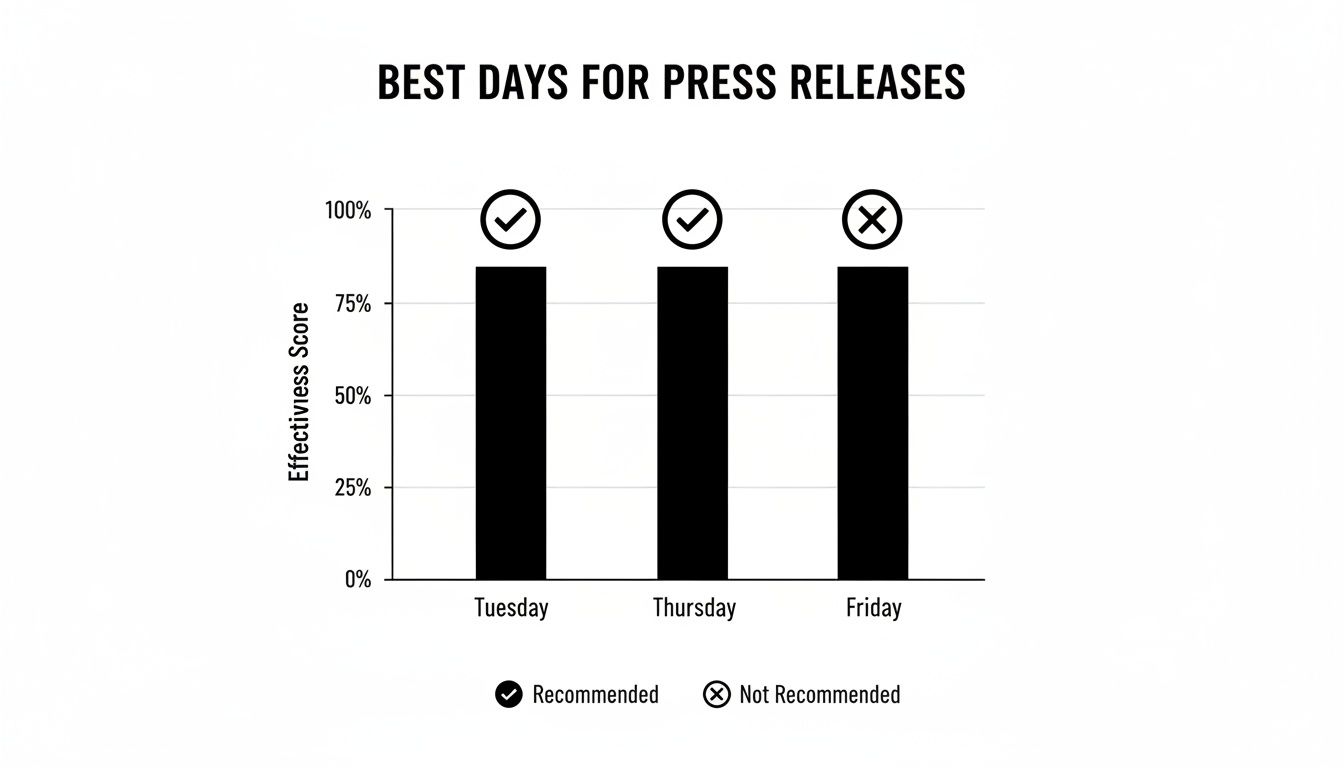
As you can see, Tuesday and Thursday offer the best shot at getting noticed. Fridays, on the other hand, are where releases go to die.
The Golden Hours for Sending Your Release
Just like the day you send matters, the exact time you hit "distribute" is also a huge deal. The difference between an 8 AM and a 10 AM send is massive, and the open rates prove it.
The sweet spot, according to PR experts, is between 10 AM and 2 PM. Studies have shown that editors open roughly one-third of all pitches that land in their inbox during this four-hour window. Send before 10 AM, and you’re fighting for survival during the great morning email purge. Send after 2 PM, and you’re up against the afternoon slump, where looming deadlines and meetings kill any chance of your email getting opened.
Sending your release at 10 AM local time for your target audience is the single most effective tactic for improving open rates. It ensures your news appears at the top of their inbox just as they're ready to look for new stories.
This is especially critical for national or global campaigns. If you're targeting reporters in California, you send at 10 AM PDT. For an announcement in London, you schedule it for 10 AM GMT. It’s a simple tweak that respects the journalist’s workday and stops your news from being an inconvenience.
The Downside of Mondays and Fridays
It's so tempting to start the week with a bang on Monday or try to slide in a last-minute story on Friday. But the data shows this is almost always a mistake.
The Monday "Delete-Fest"
A reporter's Monday inbox is a warzone. They're wading through a weekend's worth of emails, internal requests, and other noise. Your perfectly crafted release just becomes another casualty, likely to be archived or deleted without a single read.
The Friday "Forgotten News" Effect
By Friday afternoon, the news cycle is winding down. Reporters are filing their last stories for the week, and their appetite for new pitches is at an all-time low. A release sent on a Friday gets buried over the weekend and is old news by the time Monday morning comes around. Unless your announcement is tied to a weekend event, just hold it.
This same logic applies to your other content channels, too. If you want a broader look at content timing, you can find great insights on the best time to post on social media to drive engagement. The core idea is identical: meet your audience when and where they're most active. By aligning your strategy with these data-backed rhythms, you give your story its best shot at being seen, read, and shared.
Mastering Time Zones for Global and National Campaigns
Imagine your company in Los Angeles has some groundbreaking news. You hit "send" at 10 AM, feeling great. But for journalists in New York, it’s already 1 PM, and in London, it’s 6 PM—long after they've filed their stories for the day. Your huge announcement just landed with a thud.
This is one of the most common and easily avoidable mistakes in PR today. In a world this connected, sending a press release based on your own clock is a recipe for getting ignored. The golden rule couldn't be simpler: always schedule your send for the recipient's local time.

Building Your Time Zone Strategy
A one-size-fits-all blast pretty much guarantees your release will arrive at the wrong time for most people on your list. Instead, you need to think of your distribution as a series of coordinated, targeted drops. It takes a little extra planning, but it massively boosts your chances of actually getting noticed.
Let’s go back to our Los Angeles company trying to reach media in New York and London. Instead of one big send, they should plan three separate distributions.
- London Media: The release gets scheduled for 10 AM GMT.
- New York Media: The release gets scheduled for 10 AM EST.
- Los Angeles Media: The release gets scheduled for 10 AM PST.
This staggered approach makes sure every single journalist receives the news right at the start of their own workday, just when they're hunting for new stories. It shows you respect their time and workflow, which positions your announcement for immediate consideration—not as some inconvenient late-night ping.
The best time to send a press release is a local phenomenon. A national campaign isn't one send; it's multiple, localized sends synchronized to the ideal window in each target market.
How to Plan a Multi-Time Zone Campaign
Pulling off a multi-time zone strategy is pretty straightforward once you have the right process. It's less about fancy tech and more about being organized. Break your campaign down into these simple steps to make sure every journalist gets your news at just the right moment.
- Segment Your Media List by Location: First things first, divide your contact list into geographical buckets. Group your journalists by their primary time zone (e.g., EST, CST, PST, GMT). This is the foundation that makes scheduling manageable.
- Identify the Core Send Time: Stick to that golden window we’ve talked about—usually between 10 AM and 12 PM. This will be your target send time for every single time zone you're going after.
- Use a Distribution Platform with Scheduling: Trying to manually send emails across different time zones is a nightmare and a recipe for mistakes. Modern press release distribution services like those from Press Release Zen let you schedule sends for specific dates and times in different regions. You just upload your release once and set the delivery times for each of your segmented lists.
- Verify Holiday and Regional Calendars: Before you hit "schedule," do a quick check for any local holidays or major regional events in your target areas. A statutory holiday in Canada or a bank holiday in the UK will bring the news cycle to a screeching halt, so just plan to send on the next business day.
Automating for Accuracy
For organizations doing a lot of national or global outreach, automation is an absolute lifesaver. The tools built into professional PR platforms are designed for exactly this kind of challenge.
They let you:
- Automatically detect a contact's time zone based on their location.
- Schedule one single campaign to deploy at "10:00 AM local time" for every recipient.
- Get analytics broken down by region to see which markets responded best.
By mastering time zones, you elevate your PR strategy from amateur to professional. It’s a simple but powerful shift that guarantees your news gets a fair shot, no matter where your target journalist is. This thoughtful approach shows respect for the media, and it’s a hallmark of any campaign that successfully figures out the best time to send a press release.
Tailoring Your Timing to Industry and News Type
That old chestnut about the “best time” to send a press release? It’s not a secret code. While the Tuesday-to-Thursday, 10 AM to 2 PM window is a solid default, the real pros know that strategic timing is all about your specific industry and the story you’re telling.
Think of it like this: sending your news is like choosing the right soundtrack for a movie scene. What works for a dramatic action sequence is all wrong for a quiet, emotional moment. A tech blog’s news cycle is worlds apart from a lifestyle magazine’s, and to get noticed, you have to sync up with their rhythm.
A one-size-fits-all send time is better than nothing, sure. But a customized approach is what separates good PR from great PR.
Aligning with Industry-Specific News Cycles
Every industry has its own tempo. A financial journalist is chasing different deadlines than an entertainment reporter. Getting a handle on these nuances is the key to making sure your announcement lands as a welcome opportunity, not an irrelevant distraction.
Technology: Tech reporters often work in weekly cycles. Sending your release on a Tuesday or Wednesday morning gives them plenty of time to review your launch or funding news for their midweek or end-of-week roundups. Steer clear of Mondays—they’re usually buried in weekend news and internal planning meetings.
Finance: This world runs on a clock tied directly to market hours. For earnings reports or major financial news, you have to send your release just before or after the market opens or closes. This isn't just strategic; it’s often required to comply with regulations and grab the attention of analysts when it counts.
Healthcare: Healthcare stories can be complex and often require more digestion time for journalists. A Tuesday or Wednesday send gives reporters the breathing room they need to do their homework and line up interviews for a more in-depth piece. Of course, breaking medical news is the exception—that goes out immediately.
Entertainment & Lifestyle: This beat is more event-driven and flexible. Promoting a weekend festival or a gallery opening? A Thursday morning send is perfect, giving journalists and their readers enough lead time to make plans. Album drops and movie premieres typically follow their own industry-specific schedules.
The most effective timing strategy adapts to the media you are targeting. The best time to send a press release to a tech blogger is not the same as the best time for a financial analyst.
Matching Timing to the Type of Announcement
Beyond your industry, the nature of your news itself should guide your send time. A major crisis and a planned product launch require completely different playbooks.
Hard News vs. Soft News
Hard news covers timely, factual events—think acquisitions, major hires, or a new data report. These perform best in that standard midweek, mid-morning window to give journalists time to report on them the same day.
Soft news, on the other hand, covers your feature or human-interest stories. These pieces have a longer shelf life, which makes them perfect for a Thursday or even early Friday morning send. Reporters are often on the hunt for lighter content to round out the week.
Event Announcements
When it comes to events, it's all about giving people enough notice to show up.
- For a webinar or virtual event: Send the first announcement 1-2 weeks out. Follow up with a reminder 24-48 hours before the event goes live.
- For a physical event (like a conference or grand opening): Announce it 3-4 weeks in advance to give people time to plan. Thursday is a great day for these sends, as people are starting to think about their upcoming week and weekend.
Industry-Specific Press Release Timing Cheat Sheet
While the general rules are a great starting point, different sectors move at different speeds. We’ve put together this cheat sheet to help you pinpoint the optimal timing for your specific announcement.
| Industry / News Type | Optimal Day(s) | Optimal Time Window (Local) | Strategic Consideration |
|---|---|---|---|
| Technology (Product Launch) | Tuesday, Wednesday | 9:00 AM – 11:00 AM | Catches tech journalists as they plan their midweek stories. Avoids the Monday crunch. |
| Finance (Earnings Report) | Varies | Immediately before or after market hours | Time this precisely with market open/close (e.g., 8:30 AM or 4:05 PM ET for NYSE). |
| Healthcare (Research Study) | Tuesday, Wednesday | 10:00 AM – 12:00 PM | Gives reporters time to digest complex information and schedule expert interviews. |
| Retail (New Store Opening) | Thursday | 9:30 AM – 11:30 AM | Aims for weekend coverage and gives local media time to plan a visit or feature. |
| Entertainment (Event) | Thursday | 10:00 AM – 1:00 PM | Capitalizes on people making weekend plans. Perfect for "What to do this weekend" columns. |
| Non-Profit (Fundraiser) | Tuesday | 10:00 AM – 12:00 PM | Hits early in the week to build momentum. Good for morning show and midday news consideration. |
| B2B / SaaS (New Feature) | Wednesday | 10:00 AM – 1:00 PM | Targets a professional audience during their peak productivity hours, avoiding Friday "check-outs." |
Use this table as your go-to guide, but always remember to research the specific journalists and outlets on your list. A little recon goes a long way in making sure your timing is perfect.
Handling Crisis Communications and Embargoes
Sometimes, you have to throw the standard rulebook out the window. In a crisis, for example, speed is everything. If your company is dealing with a negative event, you need to release a statement immediately, regardless of the day or time. Your goal is to get ahead of the story and control the narrative.
On the flip side, an embargo is a powerful tool for planning a major announcement. It allows you to send a press release to trusted journalists days or even weeks in advance with a strict agreement that they won't publish before a specific date and time. This gives multiple outlets the chance to prepare thoughtful, in-depth stories that all go live at once, creating a huge wave of coverage.
Embargoes are perfect for a major product unveiling, a landmark scientific discovery, or a high-profile partnership you want to launch with a bang.
The Art of the Follow-Up Without Annoying Journalists
Hitting "send" on your perfectly timed press release isn't the finish line; it’s the starting gun. Your news is now just one of hundreds of pitches a journalist might see that day. A polite, professional follow-up can be the nudge that turns your release from just another email into a published story.
This is a delicate dance, though. The line between helpful persistence and outright annoyance is razor-thin. An impulsive follow-up call or a second email just hours after the first is a surefire way to get blacklisted. The key is to wait, add value, and respect their time.
The 24-48 Hour Rule
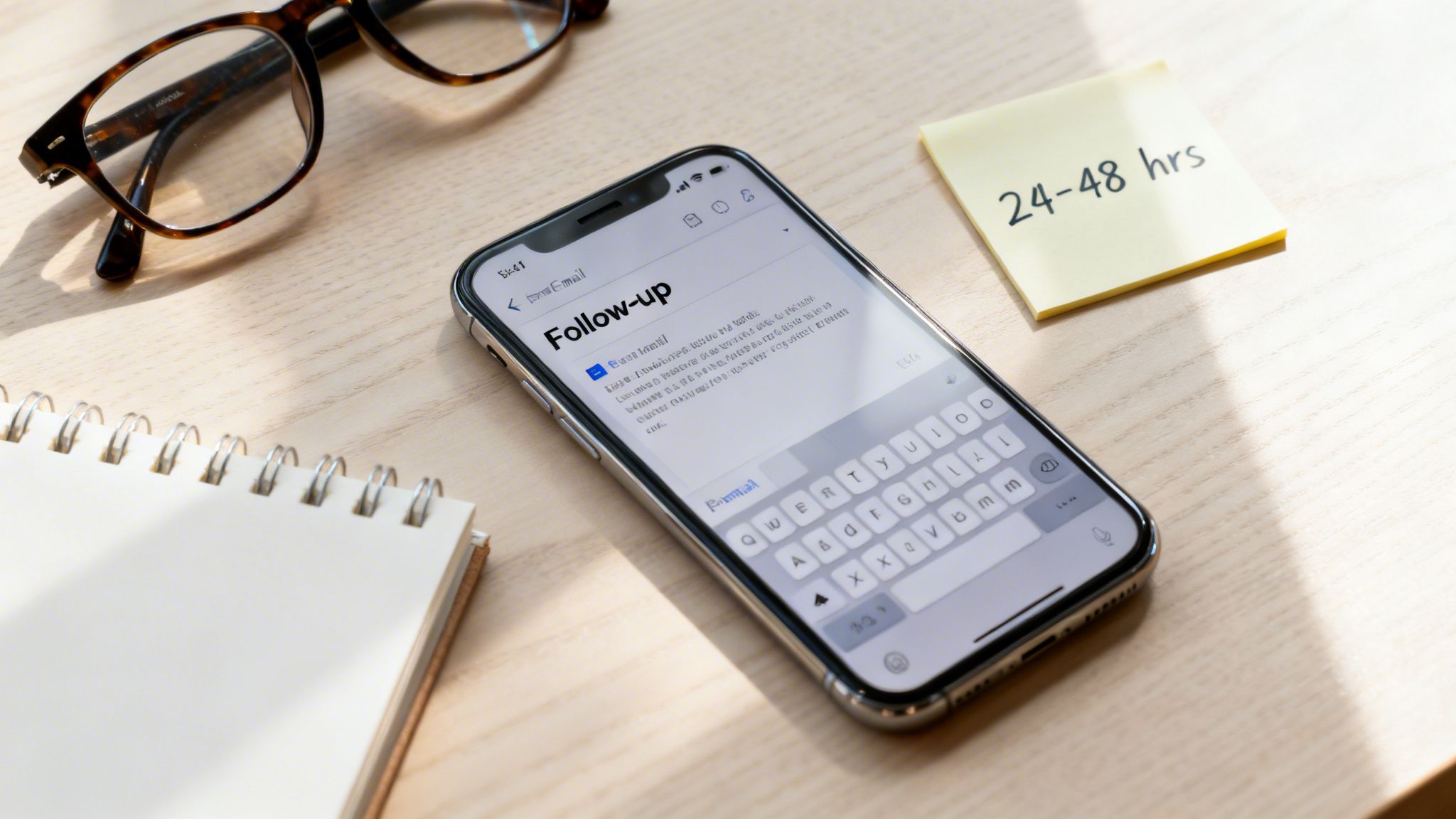
Patience is your greatest asset here. Journalists need time to read, digest, and figure out if your news fits their beat. The professional standard is to wait at least 24 to 48 hours before circling back. This gives them a full business day to review your pitch without feeling pressured.
Following up any sooner sends a clear message: you don't understand their workflow. It can come across as desperate and unprofessional, chipping away at the credibility you worked so hard to build. A well-timed press release deserves an equally well-timed follow-up.
Crafting the Perfect Follow-Up Email
Your follow-up shouldn’t be a generic "just checking in" message. Think of it as another opportunity to show why your story is a great fit for their audience. A great follow-up email is concise, helpful, and makes the journalist’s job easier.
Here are the essential components:
- Reply to Your Original Email: Keep the conversation in one neat thread. This gives them instant context so they can quickly find the original press release without having to search for it.
- Use a Simple Subject Line: Something as simple as "Re: [Original Subject Line]" works perfectly. No need to overthink it.
- Offer Additional Value: This is the most important part. Don't just ask if they saw your email. Offer something new, like access to an expert for an interview, a link to high-resolution photos, or a new data visualization.
- Briefly Reiterate the Story Angle: In a single sentence, remind them why this news is relevant to their specific audience. Frame it as a story, not just an announcement.
- Keep It Short: Respect their time. A few sentences are all you need to get your point across.
Follow-Up Email Example:
Subject: Re: [Original Press Release Subject]
Hi [Journalist’s Name],
I’m just following up on the press release I sent yesterday about [Company Name]’s new community recycling initiative. We think the story angle on how local businesses are driving sustainability could really resonate with your readers.
To help with the story, our CEO is available for a brief interview this week. We also have a gallery of high-res images of the program in action.
Thanks for your time and consideration.
What to Avoid at All Costs
Building positive, long-term relationships with the media is the name of the game. The best time to send a press release is totally irrelevant if your follow-up tactics burn bridges. Steer clear of these common mistakes:
- Don't Spam Their Inbox: One follow-up is enough. If you don't hear back, it's time to move on.
- Never Call Their Personal or Cell Number: Unless you have an established relationship and explicit permission, this is a major boundary violation.
- Avoid Vague Questions: "Did you get my email?" is a pointless question that puts the burden on them. Assume they did and focus on adding value instead.
- Don’t Follow Up on Weekends or After Hours: Respect their personal time just as you respected their work schedule with your initial send.
Mastering this art is about being a resource, not a pest. For a deeper dive into turning your release into a story, explore our guide on strategies to get your press release picked up. A thoughtful approach to follow-ups solidifies your reputation as a professional PR partner journalists actually want to work with.
Your Pre-Launch Checklist for Perfect Timing
Success in PR isn’t about luck; it’s about being prepared. All the data in the world won’t do you any good if you’re scrambling at the last minute. The best time to send a press release is a target you hit through meticulous planning, not a happy accident.Think of this final, action-oriented checklist as your pre-flight guide. Use it for every single campaign to make sure your news has the best possible chance of landing with impact.
Two Weeks Before Your Send Date
Your real work begins long before you even think about hitting “send.” Getting a head start prevents that last-minute chaos and ensures every piece of your announcement is polished and ready to go.
- Finalize Your Core Messaging: Is your headline powerful enough to stop a journalist mid-scroll? Is the story angle crystal clear? Get your team in a room and lock down the key messages and quotes.
- Draft the Press Release: Write the full draft now. This gives you breathing room for revisions, fact-checking, and getting those critical approvals from execs or legal without the pressure of a looming deadline.
- Build Your Initial Media List: Start putting together your dream list of journalists, publications, and influencers. Don't stress about segmenting it just yet; the goal here is to cast a wide net and identify everyone who needs to see this.
One Week Before Your Send Date
With your core assets in place, the focus now shifts to refinement and organization. This is where you start adding the strategic layers that turn a decent send into a truly great one.
- Refine and Finalize the Press Release: This is the time for final edits. Double-check that your boilerplate is current and all your contact information is correct.
- Gather Your Supplemental Assets: Start preparing your media kit. This means gathering high-resolution images, executive headshots, company logos, and any relevant videos or data sheets.
- Segment Your Media List: Now it's time to get surgical. Break down your master list into smaller, targeted groups. Segment contacts by their beat (like tech or finance) and, most importantly, by time zone (EST, PST, GMT, etc.).
Meticulous planning transforms your distribution from a hopeful blast into a coordinated, strategic strike. Perfect timing is the direct result of a perfect pre-launch process.
The 48 Hours Before Your Send
This is your final systems check. The goal is to have everything loaded, scheduled, and ready to launch so all you have to do is monitor the results as they come in.
- Check for Conflicting News & Holidays: Take one last look at the news cycle. Is a massive story dominating the headlines? Also, check for any regional holidays in your target zones. If the coast isn't clear, seriously consider a 24-hour delay.
- Schedule Your Distribution: Upload your final release and segmented media lists to your distribution platform. Schedule each list to go out at your target time in its local time zone—for instance, 10:15 AM EST for the East Coast list, then 10:15 AM PST for the West Coast list.
- Prepare Your Pitch: Write the personalized email pitch you’ll send to your top-tier media contacts. Beyond just timing, its effectiveness rides on how it looks. Make your subject line pop by reviewing email subject line capitalization best practices.
- Final Review: Give everything one last look—the release text, the scheduled times, the contact lists. A simple typo in a send time can derail your entire effort. For a more structured approach, think about creating a press release calendar to map out your strategy for the long haul.
Even with a solid plan, you're going to run into tricky timing questions. It happens to everyone. Let's tackle some of the most common ones that pop up when you're on the verge of hitting "send."
What if My News Is Urgent and Breaking?
For genuinely urgent news—think crisis communications or a major event that moves the market—you can throw the standard rulebook out the window.
In these situations, your only job is to get ahead of the story and control the narrative. Send the release immediately, no matter the day or time. The goal is to ensure your version of events is the first one reporters see.
Should I Send a Press Release on a Holiday?
My short answer? Don't do it. On major holidays, newsrooms are running on skeleton crews, and most journalists have the day off. Your announcement will almost certainly get lost in the flood of emails they return to.
The only time this makes sense is if your news is directly tied to the holiday itself, like a Thanksgiving charity drive. Otherwise, you’re far better off waiting for the next business day. It’s a simple move that gives your release the shot at attention it deserves.
How Does an Embargo Affect Timing?
Using an embargo completely flips your timing strategy on its head. It’s a powerful tool, but it comes with its own set of rules.
An embargo is basically a trust agreement. You give journalists the press release ahead of schedule, and they agree not to publish the story before a specific date and time. It's a fantastic way to coordinate a huge launch across multiple outlets.
This lets you send your news to trusted media contacts days, or even weeks, before the public announcement. It gives them a proper runway to research, conduct interviews, and prepare high-quality, in-depth stories that can all drop at once, creating a massive wave of coverage.
But a word of caution: use embargoes sparingly. They aren't for every announcement. Save them for your biggest news—a game-changing product launch, a landmark discovery, or a high-profile merger. The kind of news where giving journalists a head start helps them tell a much better, more detailed story.
Planning your next big announcement requires more than just a great story; it needs flawless execution. Press Release Zen provides the templates, checklists, and expert guides to ensure your news lands with maximum impact every time. Discover our free resources at https://pressreleasezen.com.