Key Takeaways
- Press releases have two core audiences: media gatekeepers and end readers, and in 2025, those groups increasingly overlap as consumers, investors, and stakeholders access releases directly through search and social.
- Journalists still matter, but they’re overwhelmed, so only relevant, newsworthy, and clearly written press releases break through and get covered.
- Investors and stakeholders actively seek out press releases, primarily financial or regulatory updates, making accuracy, numbers, and strategic clarity essential.
- Consumers now discover press releases directly via Google, social media, and company newsrooms, so announcements must be written in accessible, reader-friendly language that serves both informational and marketing purposes.
- To reach all these audiences effectively, your announcement needs to appear across multiple channels. AmpiFire distributes your content in 8 formats across 300+ platforms, ensuring journalists, investors, and consumers find your news wherever they search.
The Two Audiences Every Press Release Must Reach
When you send out a press release, who actually reads it? The answer is more complex than most people realize. Every press release serves two distinct audiences.
The first is media professionals: journalists, editors, bloggers, and influencers who act as gatekeepers. They decide whether your news deserves coverage and broader distribution.
The second is end readers: consumers researching products, investors evaluating opportunities, and stakeholders monitoring company developments. These people may never see your original press release, but they consume the articles and coverage that result from it.
Here’s what’s changed: in 2025, these audiences increasingly overlap. Consumers now find press releases directly through search engines and social media. Investors read announcements on the company’s newsrooms.
The line between “pitching journalists” and “reaching your audience” has blurred significantly. Understanding both audiences is essential for making your press release work harder.
Why Press Releases Don’t Work Anymore
Smart Businesses Are Moving Beyond Traditional PR
• The Problem: Press releases reach one audience through one channel while your customers are everywhere online. Most get buried within days with poor ROI.
• The Solution: AmpiFire’s AmpCast creates 8 different content formats from one topic and distributes across 300+ high-authority sites including Fox affiliates, Spotify, and YouTube.
What You’ll Learn on PR Zen:
✓ Why multi-channel content delivers 10x better results than press releases
✓ How to amplify your PR efforts across multiple platforms
✓ Real case studies of businesses dominating search, social, video, and podcasts
✓ Cost-effective alternative to expensive PR agencies
Ready to Replace Press Releases? Learn the AmpiFire Method →
Journalists & Media Professionals

Journalists remain the primary target for most press releases. When a reporter at a major publication covers your announcement, their article reaches thousands of readers you couldn’t access directly. But here’s the uncomfortable reality: journalists are overwhelmed.
Research shows that more than one in four journalists receive over 100 pitches per week—and most are irrelevant. With that volume, most releases never get opened. So what makes journalists actually read a press release?
Relevance comes first. If your announcement doesn’t connect to the journalist’s beat, it’s immediately deleted. A technology reporter doesn’t care about your restaurant opening. A consumer lifestyle writer isn’t interested in your B2B software update.
Newsworthiness matters. Journalists distinguish between actual news and promotional fluff. A new logo isn’t news. A routine product update isn’t news. A significant funding round, acquisition, or regulatory development? That’s news. Industry surveys show 78% of journalists want press releases, but only newsworthy ones.
Clarity seals the deal. If a journalist can’t understand your announcement within the first few sentences, they move on. One reporter put it bluntly: “99.9% are utterly useless.” The press releases that break through lead with the news, avoid jargon, and make it immediately clear why readers should care.
Investors & Stakeholders
While journalists may be the traditional audience, investors are often the most engaged readers of press releases, especially for publicly traded companies.
Investors actively seek out press releases because these announcements directly impact financial decisions. Quarterly earnings, mergers and acquisitions, leadership changes, and strategic initiatives all signal where a company is headed.
For public companies, this isn’t optional. The SEC requires companies to publicly disclose earnings and material news. These press releases are required by regulatory authorities to keep shareholders informed and markets fair.
But even private companies benefit from treating investors as a key audience. Announcing funding rounds, partnerships, or milestones through press releases builds credibility and keeps stakeholders engaged.
Financial press releases require a specific approach:
- Include concrete numbers and avoid speculation
- Quote executives on strategic implications, not just achievements
- Release market-sensitive information outside trading hours
- Ensure legal compliance and accuracy
The audience extends beyond individual investors. Financial analysts, institutional investors, board members, and potential acquirers all monitor press releases to evaluate opportunities and risks.
Consumers & the General Public
Here’s what’s changed dramatically: consumers now find press releases directly, without journalists as intermediaries.
Research shows 92% of journalists use search engines to research stories. Consumers do the same thing. When someone searches Google for information about a product or company, they may land directly on a press release in Google News or a company newsroom.
Each month, Google Search and Google News link people to publishers’ websites more than 24 billion times. Press releases distributed through reputable channels appear in these results and are discoverable by anyone searching related topics.
Social media amplifies this further. When companies share announcements on LinkedIn or Twitter, followers see the news directly. When journalists share coverage, their audiences engage with it.
This shift has practical implications for how you write. Your press release may be read by potential customers, job candidates, partners, competitors, and journalists. The language should be accessible. The value proposition should be clear so that even someone unfamiliar with your company can understand it.
Think of your press release as marketing content that follows a journalistic format, because increasingly, that’s exactly how it functions.
Industry-Specific Audiences

Technology Journalists
Technology journalists look for innovation, specifications, and market impact. They want to understand how your product differs from competitors and what technical advantages it offers. Data and benchmarks strengthen technology releases.
Business Journalists
Business journalists prioritize financial performance, market trends, and leadership changes. They care about business implications—how your news affects the competitive landscape and what it means for stakeholders. Revenue figures, market share data, and strategic partnerships grab their attention.
Consumer Media
Consumer media focuses on human interest, lifestyle benefits, and community connections. If your announcement affects everyday people, lead with that impact. These outlets want stories that their audiences can relate to personally. Emphasize practical benefits, emotional appeal, and real-world applications. Testimonials and relatable scenarios work well here.
B2B vs. B2C
B2B and B2C require different approaches. B2B releases can assume industry knowledge and focus on professional benefits like efficiency gains, cost savings, and workflow improvements. B2C releases need simpler language and emotional hooks. Focus on personal benefits, ease of use, and lifestyle enhancement rather than technical specifications.
Geographic Scope
Location matters too. Local announcements should target regional media and emphasize community impact, job creation, and neighborhood relevance. Highlight connections to local culture and economy.
The most effective strategies segment audiences and tailor distribution accordingly. A single announcement might generate multiple versions; one for trade publications, one for business media, one for local outlets, each emphasizing angles most relevant to that audience.
Why Your Press Release Isn’t Reaching Its Full Audience
Understanding who reads press releases reveals a frustrating gap: most announcements fail to reach their potential audience.
Traditional distribution focuses heavily on journalists, but journalists ignore most of what they receive. If your press release doesn’t land with the right reporter at the right time, it never gets covered. And if it never gets covered, consumers and stakeholders never see it.
Even when journalists do cover your news, you’re dependent on their interpretation. They choose the angle, the quotes, and the framing. The story they write may emphasize different points than you intended.
Meanwhile, direct-to-consumer channels remain underutilized. Most press releases get posted to a company newsroom and distributed through a wire service, then forgotten. They don’t get repurposed for social media, blog posts, videos, or podcasts. They exist in one format, in limited places, for a brief window.
The result? Your announcement reaches a fraction of the people who might care about it.
Investors who don’t follow traditional press release distribution services miss it. Consumers searching Google weeks later don’t find it. Potential customers listening to podcasts never encounter it.
Reaching every audience requires more than a single press release sent to a media list.
Reaching Every Audience: How AmpiFire Expands Your Press Release’s Reach
What if your announcement could reach journalists researching stories, investors monitoring developments, and consumers searching for solutions, all at once?
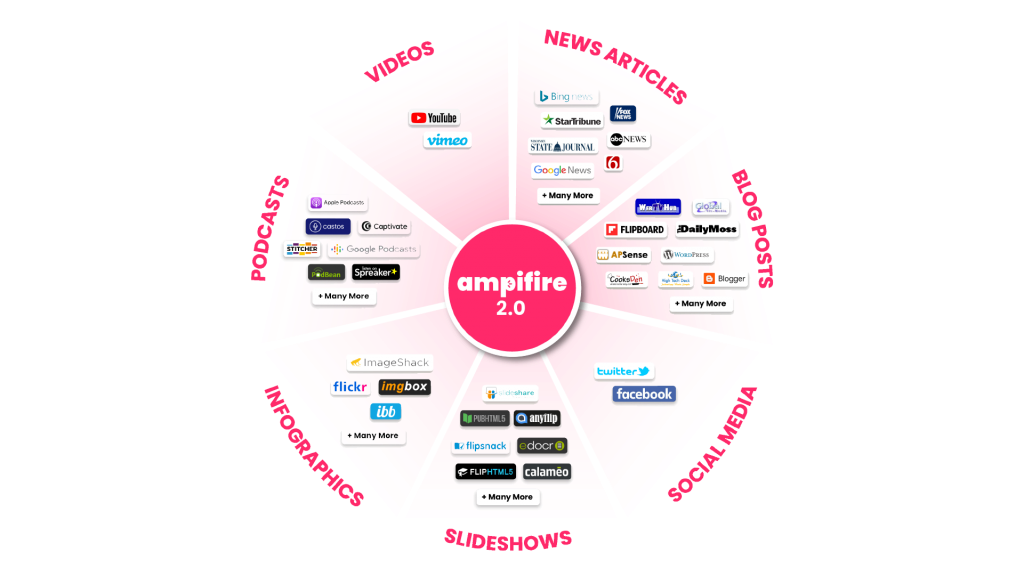
AmpiFire, using its innovative Ampcast Technology, makes this possible by transforming a single announcement into eight different content formats: news articles, blog posts, interview-style podcasts, long-form videos, short-form videos, infographics, slideshows, and social posts.
This content is then automatically published across 300+ high-authority sites, including Google News, YouTube, Spotify, Pinterest, FOX affiliate sites, and major blog networks.
This multi-channel approach ensures your news reaches every audience segment:
- Journalists researching stories find your content in Google News
- Investors monitoring industries encounter it on business platforms
- Consumers searching for products discover them through blog posts and videos
- Podcast listeners hear about it during their commute
One AmpiFire customer case study demonstrated how campaigns secured multiple page 1 rankings and achieved significant increases in visibility. This shows what multi-channel distribution can achieve, though individual results vary based on industry and competition.
The compounding effect matters most. Each campaign builds on previous ones, creating an expanding digital footprint that attracts readers months after the initial announcement, unlike traditional press releases that fade within days.
Ready to Reach Every Audience? Try the AmpiFire Method →
Frequently Asked Questions (FAQs)
Do journalists actually read press releases?
Yes, but selectively. Research shows that 78% of journalists want press releases, but they receive hundreds each week and ignore most of them. Journalists read releases that are relevant to their beat, genuinely newsworthy, and clearly written. Targeted pitches significantly outperform mass distribution.
Can consumers find press releases directly online?
Absolutely. Press releases distributed through reputable channels appear in Google News and search results. Company newsrooms get indexed by search engines. Consumers increasingly discover announcements directly rather than waiting for journalist coverage.
How do I know which audience to target with my press release?
Consider who benefits from your news. Product launches target consumers and consumer media. Financial announcements target investors and business journalists. Industry developments target trade publications. Most releases serve multiple audiences—structure content to address each group’s interests.
Should I write different press releases for different audiences?
For major announcements, yes. A technology launch might warrant one version for trade publications (emphasizing specifications) and another for consumer media (emphasizing benefits). At a minimum, tailor your distribution list so each journalist receives relevant news.
How does AmpiFire help my press release reach more readers?
AmpiFire transforms your announcement into eight content formats and distributes it across 300+ platforms. Instead of hoping journalists cover your news, your content appears directly where audiences search: Google News, YouTube, podcasts, and social media, reaching journalists, investors, and consumers simultaneously.