So, what exactly is media training? Think of it as a flight simulator for public relations. It gives your key people a safe space to practice navigating tough questions and high-pressure interviews before they face the real deal.
Understanding Media Training and Its Modern Importance
Media training is the hands-on process of preparing someone to be a confident and credible spokesperson. It’s so much more than just memorizing a few talking points. The goal is to give your team the strategic skills to control the narrative, stay on message, and represent your brand perfectly, even when the pressure is on.
At its core, this training transforms your spokesperson from a passive interviewee into a proactive leader of the conversation. They don't just learn what to say, but how to say it. This means mastering everything from body language and tone to the subtle techniques needed to handle any question a journalist might throw their way.
Media Training at a Glance
To really grasp what's involved, it helps to break down the core components. This isn't just about practicing for a camera; it's a comprehensive process.
Here’s a quick look at the fundamental pillars of any effective media training program:
| Component | What It Is | Why It's Critical |
|---|---|---|
| Message Development | Crafting clear, concise, and memorable key messages that align with company goals. | Ensures consistency and keeps the spokesperson focused on what truly matters, preventing them from getting sidetracked. |
| Interview Practice | Simulated interviews (on-camera and off) that mimic real-world scenarios, from friendly chats to tough cross-examinations. | Builds "muscle memory" and confidence, allowing the spokesperson to practice bridging, blocking, and flagging techniques under pressure. |
| Crisis Drills | Intense, realistic simulations of potential PR crises, testing the spokesperson's ability to communicate effectively in a high-stakes situation. | Prepares the team to respond swiftly and professionally during an actual crisis, minimizing reputational damage. |
These elements work together to build a spokesperson who can not only survive a media encounter but actually use it to the brand's advantage.
Why Media Training Is No Longer Optional
In a world where a single misspoken word can go viral in minutes, the stakes have never been higher. One poorly handled interview can do serious damage to your brand’s reputation, create confusion, and hit your bottom line hard. The global PR market is booming, set to reach $112.98 billion by 2025, because savvy companies know they can't afford a misstep.
The data tells a sobering story. Studies have shown that a shocking 70% of PR crises spin out of control specifically because of a spokesperson's poor performance. On top of that, a staggering 62% of untrained executives fumble during live interviews, highlighting the massive gap between knowing your business and knowing how to talk about it.
The goal of media training isn't to create a robot who recites memorized lines. It's to build the confidence and strategic muscle memory needed to communicate authentically and effectively, no matter the situation.
Who Truly Needs This Training?
It’s a common mistake to think media training is just for the C-suite. The truth is, anyone who might speak on behalf of your company needs to be prepared. One rogue comment from an unprepared employee can undo months of careful PR work.
Consider who might end up in the spotlight:
- Subject Matter Experts: Your brilliant engineers or scientists who need to explain complex ideas in simple, compelling terms without getting lost in jargon.
- PR and Communications Staff: The very people managing media relations should be ready to step in as spokespeople themselves.
- Project and Product Managers: When launching something new, they are often the best people to communicate its value and features.
- Frontline Leaders: In a localized crisis, a regional manager might be the most credible and authentic voice for the community.
If someone's words could end up quoted in an article or broadcast, they're a candidate for media training. Getting them ready is a core part of any solid PR plan, ensuring your message stays consistent and professional. If you're just starting to build out your communication strategy, getting a firm handle on what PR stands for in business is the perfect first step.
The Core Components of Effective Media Training
To really get what media training is, you have to look under the hood. Any solid program is built on three practical pillars that work together to turn an anxious speaker into a polished pro. These aren't just abstract theories; they're skills you practice until they feel like second nature.
This is how you get to the point where you can confidently steer any media conversation.
This infographic lays out the who, what, and why in a nutshell.
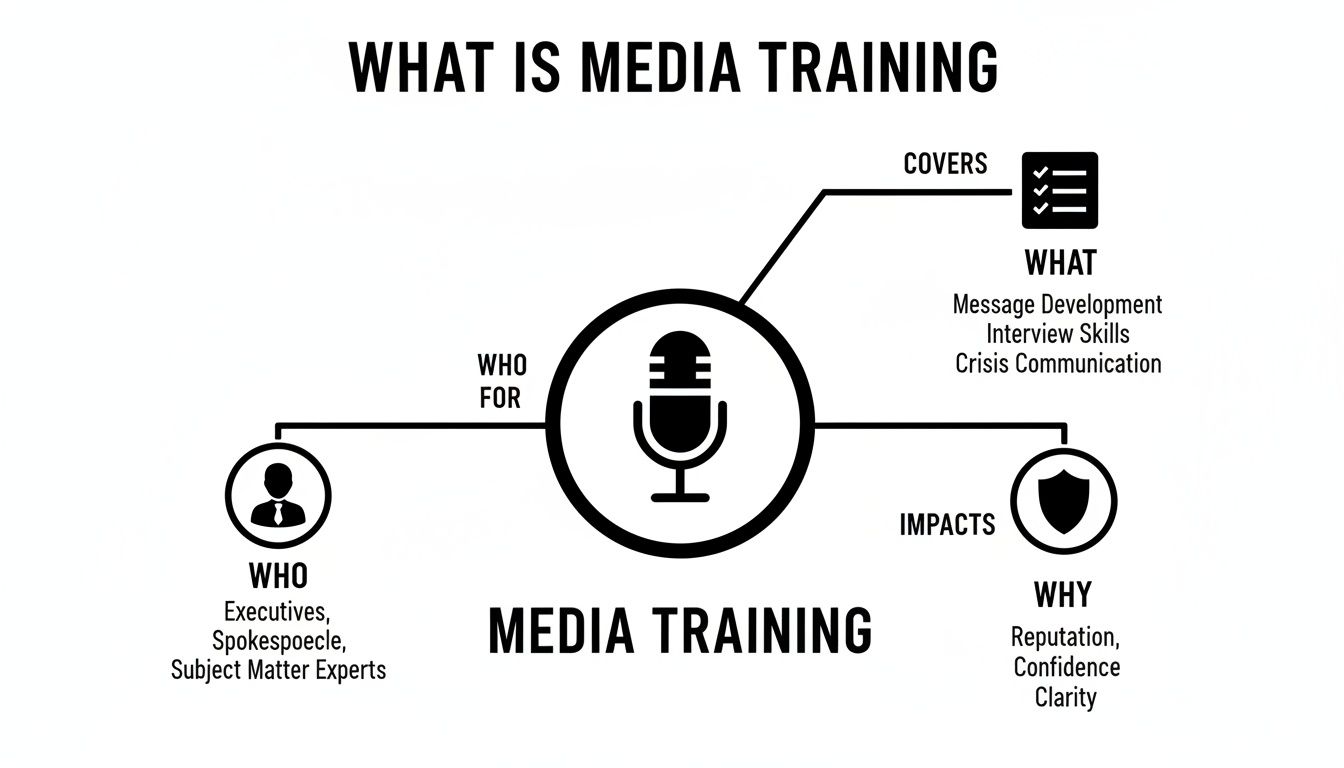
As you can see, media training acts as a strategic shield for your leaders. It’s all about building specific skills to both protect and project your brand’s reputation.
Mastering Your Message
The first piece of the puzzle is message development. This is where you boil down all your complex business goals, product features, or crisis talking points into just a few clear, concise, and compelling messages. Without this foundation, even the most naturally gifted speaker will end up rambling.
A go-to framework for this is the Message Triangle. It’s a simple tool that helps you lock in three core messages that are powerful and easy to remember. Each message needs to be backed up by a proof point—a solid statistic, a fact, or a quick anecdote that makes it believable.
The goal here isn't to create a rigid script you have to memorize. It’s about building a "home base" of key ideas. No matter where a reporter tries to take the conversation, your spokesperson has a consistent narrative to return to. You can learn more about how to create a compelling brand story in our detailed guide.
The Art of Bridging and Pivoting
Once your core messages are set, it’s time to learn how to actually deliver them during an interview. This is where bridging and pivoting come in. Think of it as conversational judo—you use the momentum of a question to guide the discussion back to your turf.
A "bridge" is just a transitional phrase that lets you acknowledge the reporter's question and then smoothly shift the focus to one of your key messages.
Key takeaway: Bridging isn’t about dodging tough questions. It’s about answering them sufficiently and then strategically redirecting the conversation to make sure your most important information gets the airtime it deserves.
Here are a few classic bridging phrases you'll hear:
- "That's an important point, and what it really comes down to is…"
- "I don't have the specific data on that, but what I can tell you is…"
- "While that's one aspect, the bigger issue here is…"
Pivoting is your defense against hostile or completely off-topic questions. It allows you to stay on-message and in control, even when you're under pressure. Mastering this is what separates a trained spokesperson from an unprepared one, ensuring the interview serves your agenda, not just the journalist's.
Perfecting On-Camera Presence and Delivery
The final component is all about on-camera drills and non-verbal communication. In today's video-first world, how you look and sound often matters more than the specific words you choose. A spokesperson’s body language, tone, and eye contact can build—or completely shatter—credibility in a matter of seconds.
This is the part of training where things get real. Drills are recorded and played back for no-holds-barred feedback. It’s the best way to catch subconscious bad habits like fidgeting, darting your eyes away from the camera, or peppering your sentences with "ums" and "ahs."
The focus is on developing a presence that screams confidence and authority:
- Body Language: Keeping an open posture, using hand gestures to add emphasis, and avoiding defensive signals like crossed arms.
- Vocal Tone: Projecting your voice, varying your pitch so you sound engaged, and speaking at a measured, deliberate pace.
- Appearance: Simply choosing an outfit that looks professional and won't be distracting on camera.
By practicing these elements in mock interviews, spokespeople build the muscle memory they need to look cool, calm, and collected when the bright lights of a real media hit turn on.
How Media Training Prepares You for Any Scenario
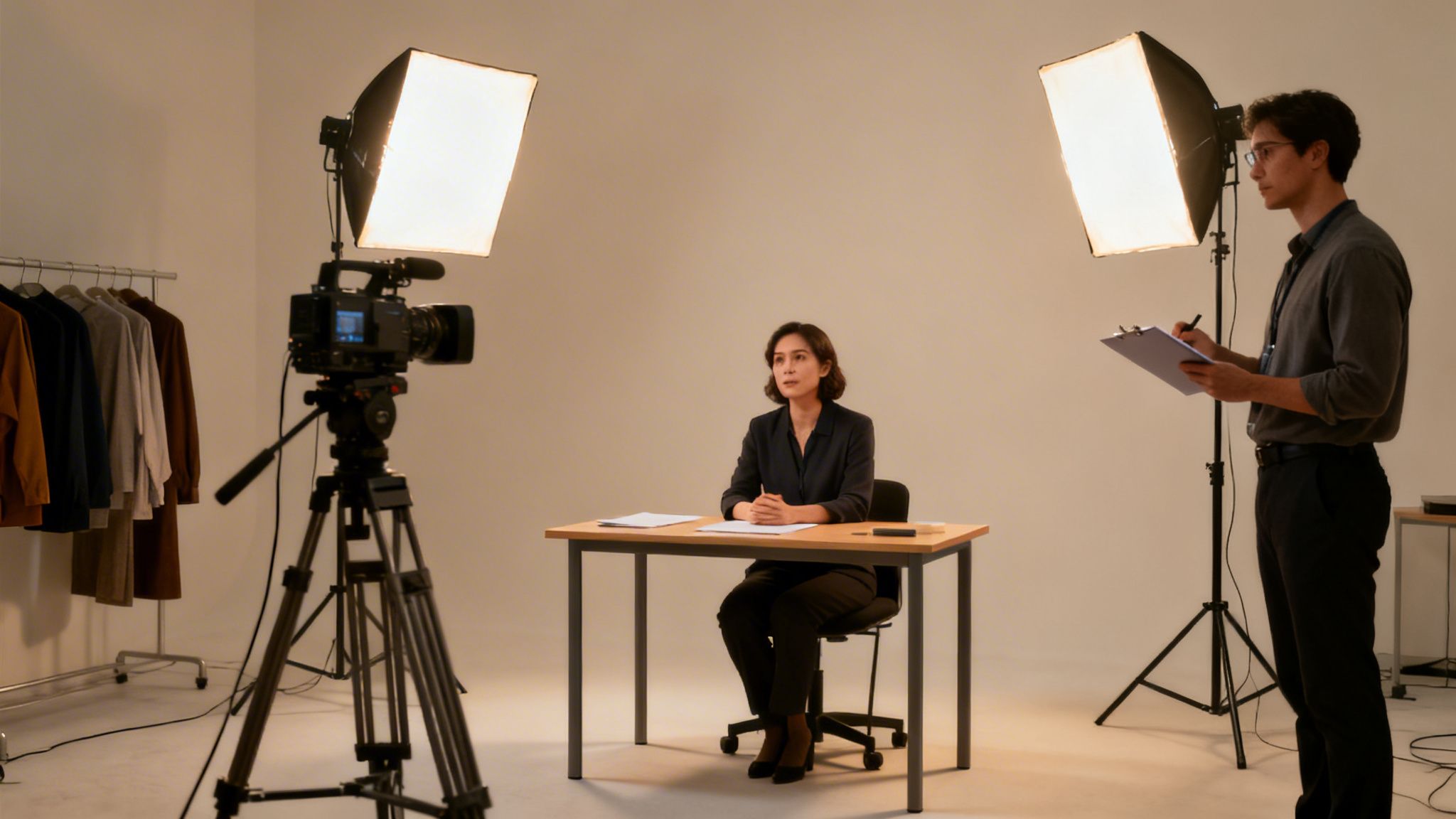
Not all media interviews are the same. A friendly podcast chat is a world away from a tense, live TV segment, and proper media training gets you ready for absolutely everything in between. This is where theory gets left behind and you’re dropped into realistic simulations designed to build unflappable confidence and control.
The real goal is to make you adaptable. You’ll practice tweaking your tone, energy, and delivery to fit any interview format. For that casual podcast, the focus is all about weaving great stories and keeping the conversation flowing. For a hard-hitting news spot, training hones your ability to nail concise, powerful answers when the clock is ticking.
Adapting to Different Media Formats
Think of comprehensive media training as a playbook for every possible media appearance. It gives you an inside look at the unique demands and unwritten rules of each platform, so you can tailor your performance and walk in with confidence. This kind of versatility is non-negotiable for any spokesperson.
Here’s a look at how training helps you adjust to specific formats:
- Live Television: This format is all about discipline. Training drills you on delivering your key messages in tight soundbites, keeping steady eye contact with the right camera, and managing your body language under the glare of bright lights and intense pressure.
- Recorded Interviews (TV or Radio): You might have more time to expand on your points here, but the big risk is getting your words edited out of context. Training teaches you to speak in complete thoughts and stay on track, making sure your quotes are clean and can’t be easily twisted.
- Podcast Conversations: These are often long-form and can feel laid-back, but that’s a potential trap. Media training helps you stay on-message for the long haul, using stories to make your points while gently guiding the conversation back to your agenda.
- Print or Digital Journalism: In these interviews, every single word counts. The focus shifts to absolute precision in your language, knowing how to give background without creating unwanted headlines, and mastering bridging techniques to stay in control of the narrative.
Beyond these traditional formats, modern media training also prepares you for today's digital world, including skills like how to elevate your professional presence in self-recorded videos for your website or social channels.
Building Resilience with Crisis Communication Drills
The most challenging—and frankly, most valuable—part of any advanced media training is the crisis communication drill. This is no simple Q&A. It's a full-throttle simulation of a PR nightmare. Trainees are thrown into the hot seat and forced to respond to a sudden, damaging event, like a product recall, a data breach, or a customer complaint going viral.
These drills are designed to build the mental and emotional muscle memory needed to respond with calm authority when everything is on fire. It's not just about having the "right" answers; it's about being unshakable when faced with the toughest, most aggressive questions imaginable.
The classic 1982 Tylenol crisis serves as the gold standard for this. Johnson & Johnson CEO James Burke’s transparent and trained media responses successfully limited damage and restored public trust, with the company seeing a 20% sales recovery within just a few months of the incident. Explore more statistics on how training impacts the digital media market with this research from grandviewresearch.com.
A well-handled crisis can turn a potential catastrophe into a moment that actually strengthens your brand's integrity. To dive deeper into this topic, you can also read our guide on crisis communication best practices. By practicing these brutal scenarios in a safe environment, your team learns to think clearly, communicate with empathy, and take decisive action—all while the cameras are rolling.
Putting Theory into Practice with Sample Exercises

Knowing the theory behind media training is a great start, but it’s only half the battle. The real magic happens when you get on your feet and start practicing. This is where you build the muscle memory to stay cool, calm, and on-message when the camera is rolling and the questions get tough.
Let's pull back the curtain on how a professional session actually works. It isn’t just a random Q&A; it’s a structured climb from refining your message to facing intense, realistic interview scenarios.
Sample Half Day Media Training Agenda
A typical four-hour session is a focused sprint, not a marathon. It’s designed to be an immersive experience that builds skills one on top of the other, getting your spokesperson ready for the hot seat.
- Hour 1 Message Workshop: It all starts with the message. The trainer will pressure-test your existing key messages, sharpening the language and locking down the most powerful proof points. The goal is for everyone to walk away with a crystal-clear and concise core narrative.
- Hour 2 On-Camera Fundamentals: Now, it's all about delivery. Participants get their first taste of being on camera while the trainer gives immediate, direct feedback on everything from body language and tone of voice to where to look. It’s about building a credible and confident presence.
- Hour 3 Mock Interview Round 1: Time for the first real test. Trainees face a simulated interview with moderately challenging questions. This is their chance to practice bridging techniques and weave in those key messages they just polished. Every second is recorded.
- Hour 4 Playback and Final Drill: The group watches the tapes. It can be cringe-worthy, but this is where the biggest lessons are learned. The trainer offers constructive critiques, and the session wraps with a final, tougher mock interview so everyone can apply the feedback immediately.
This structure ensures you don’t just learn what to do—you actually do it, get feedback, and do it better. To make the most of these sessions, check out a modern guide to better notes in an interview for tips on capturing actionable feedback.
DIY Media Training Drills for Your Team
Don't have the budget for a professional coach just yet? No problem. You can start building your team's media readiness right now with these simple, effective drills.
- Elevator Pitch Perfecter: Challenge each person to deliver a 30-second summary of your company's mission or a new product launch. Record it on a smartphone, then play it back and critique for clarity, confidence, and punch.
- The Bridging Challenge: One person plays the journalist and lobs a series of tough or off-topic questions. The spokesperson's only job is to give a brief answer and then smoothly "bridge" back to one of three pre-agreed key messages.
- The "Murder Board": This one is intense. A panel of colleagues acts as a hostile press corps, firing the toughest, most aggressive questions they can imagine at the spokesperson. The goal isn't to have a perfect answer—it's to practice staying calm and on-message under fire.
These drills are powerful because they mimic the stress of a real interview in a safe space, letting you work out the kinks before the stakes are high.
With video ad spending forecasted at over $236 billion in 2026 and short-form video ranked as the top format for 49% of marketers, the need for polished on-camera skills is more critical than ever. Find out more about the growth of training within the digital media market.
Preparing for Every Type of Question
A fully prepared spokesperson needs to be ready for anything a journalist might throw at them. To get there, you have to practice handling the full spectrum of questions—from friendly softballs to tricky "gotchas."
Below is a matrix of different question types to incorporate into your mock interviews. This will help your spokesperson recognize the tactic behind the question and respond strategically, not just reactively.
Sample Mock Interview Question Matrix
| Question Type | Example Question | Objective |
|---|---|---|
| The Softball | "What makes your company culture so unique?" | A friendly, open-ended question designed to help you relax and share a positive story. Use it to deliver a key message. |
| The Leading Question | "Wouldn't you agree that this new feature is years behind your competitors?" | A question that tries to steer you toward a specific answer. Avoid agreeing and instead reframe the premise. |
| The "Gotcha" | "Your CEO said X last year, but now you're saying Y. Which is it?" | Designed to expose a contradiction or create conflict. The goal is to stay calm, clarify context, and pivot back to your message. |
| The Hypothetical | "What would you do if a massive data breach occurred tomorrow?" | An attempt to get you to speculate. Avoid making promises and instead talk about the processes and values you have in place. |
By drilling with this mix of questions, your spokesperson will learn to identify a reporter's angle in real time and stay in control of the interview, no matter what comes their way.
Choosing a Media Trainer and Measuring Your Success
Finding the right media training consultant is every bit as critical as the training itself. A good fit means your investment will pay you back in confidence and control when the cameras are rolling. But not all trainers are cut from the same cloth; the best ones bring a very specific kind of experience to the table.
Think of it like hiring a coach. You wouldn't ask a tennis pro to teach you football. In the same way, you need a media trainer who has lived and breathed journalism or public relations. They’ve been on the other side of the notepad, so they know exactly what reporters want and the tactics they use to get it.
What to Look for in a Media Trainer
The best media trainers almost always have "journalist" on their resume. This hands-on experience is gold because it gives them an insider's view of how newsrooms work, how stories get framed, and how quotes are pulled. They get the pressure and the process because they've been there.
When you're vetting potential trainers, make sure to ask these questions:
- What’s your background in journalism or PR?
- Can you share some case studies of clients you’ve prepped for high-stakes interviews?
- How do you tailor your training for different industries and potential crises?
- What’s your feedback process like for the mock interviews?
A solid trainer will have clear, confident answers and an obvious command of the media landscape.
The right media training professional doesn't just teach you what to say. They build your strategic reflexes so you can handle any question with poise and steer the conversation back to your core message.
This kind of specialized coaching is becoming standard practice. In the US, the largest market for this kind of work, 60% of online businesses have already outsourced their digital PR. Those projects frequently include getting their spokespeople ready for the interviews that come after a big announcement. You can dig into more data on the global digital media market and its training applications.
Demystifying the Cost of Media Training
Media training costs can vary wildly depending on the format, how long it runs, and the trainer's pedigree. It’s better to see this as an investment in your brand’s reputation, not just another expense.
Here are some typical budget ranges you can expect:
- Group Workshops: These are often the most budget-friendly choice, perfect for getting a whole team of experts or PR staff up to speed. Costs usually fall between $5,000 to $15,000 for a half-day session.
- One-on-One Executive Coaching: For C-suite leaders, a highly personalized and intense session is the norm. You should plan to invest $7,500 to $25,000+ for a full day of dedicated coaching, which often includes crisis drills.
Measuring the Return on Your Investment
So, how do you know if the money was well spent? Measuring success is about looking at both the tangible results and the not-so-tangible improvements.
Qualitative Metrics (The "Feel")
- Increased Spokesperson Confidence: Does your spokesperson seem more prepared and less rattled before an interview? That’s a win.
- Improved on-Camera Presence: Is their body language more open? Is their delivery more assured during practice and real interviews?
- Enhanced Message Control: How good are they at bridging away from tough questions and back to your key messages?
Quantitative Metrics (The "Numbers")
- Key Message Penetration: Start tracking the percentage of your core messages that actually make it into the final article or broadcast. After good training, this number should jump significantly.
- Reduction in Negative Mentions: Keep an eye out for a drop in misquotes or statements taken out of context.
- Positive Sentiment Shift: Use your media monitoring tools. Has the tone of the coverage become more favorable since the training?
By tracking these metrics, you can draw a straight line from your investment to real-world results, proving the value of media training to your overall PR strategy.
Integrating Media Training with Your PR Strategy
A great press release is just a conversation starter. It’s the hook you use to get a journalist’s attention, but the real work starts the moment they decide to follow up. This is where media training becomes the critical link between your announcement and its actual success.
Think of it like this: your press release gets you in the door, but it’s your spokesperson’s performance in the interview that closes the deal. An unprepared speaker can sink a fantastic PR campaign by fumbling questions, going off-message, or just looking nervous. A trained spokesperson, on the other hand, turns that initial interest into the kind of powerful, positive coverage that actually shapes how the public sees your brand.
Aligning Training with PR Goals
Media training isn’t a one-size-fits-all workshop. To be effective, it has to be custom-built around the specific goals of your PR campaign. Before you even think about booking a session, you need to ask: what’s the single most important thing we want to achieve with this announcement? That answer drives everything.
For example, the focus of your training should shift dramatically based on the goal:
- Announcing a New Product? The training needs to be laser-focused on nailing the product's unique value, heading off questions about competitors, and telling a great story about the problem it solves.
- Managing a Crisis? The priorities flip completely. Training has to prepare your spokesperson to show genuine empathy, be transparent, and clearly lay out the exact steps you’re taking to fix the problem.
This kind of alignment makes sure that when a reporter calls, your spokesperson is strategically reinforcing the core message of your campaign, not just winging it. The difference is huge, and you can actually measure it.
Trained spokespeople can boost media pickup rates by as much as 40%, which directly pumps up the SEO value of your coverage on platforms like Google News. This turns a press release from a simple announcement into a launchpad for confident interviews that drive real growth. To see the full scope of these findings, read more about the latest public relations statistics on prlab.co.
A Simple Pre-Campaign Checklist
To make sure your media training and PR strategy are perfectly in sync, run through this quick checklist before every major announcement. It helps guarantee your spokesperson is ready for the right conversation.
- Define the Core Objective: What is the #1 outcome we need from this coverage (e.g., drive sales, rebuild trust, announce a key partnership)?
- Solidify Key Messages: What are the three non-negotiable points our spokesperson must land in every single interview, no matter what?
- Anticipate Tough Questions: What are the five worst, most hostile questions a journalist could throw at us? And what are our crisp, clear answers?
- Simulate the Format: Will interviews be live on TV, over the phone, or for a podcast? Practice in the exact format you're going to face.
When you treat media training as a non-negotiable step in every campaign, you’re not just sending your spokespeople into the ring—you’re equipping them to win. This approach transforms your PR from a simple broadcast into a strategic machine for building a powerful and resilient brand.
Common Questions About Media Training
Okay, so you're sold on the 'what' and 'why' of media training. But what about the practical side? Let's tackle some of the most common questions that pop up when organizations start thinking about getting their spokespeople ready for the spotlight.
How Often Should Our Spokespeople Get Media Training?
Think of it like a yearly check-up for your brand’s voice. At a minimum, your team should go through a comprehensive session annually. But you'll also want to schedule brief refreshers before any big moment, like a major product launch, a new campaign, or a big announcement.
For leaders in fast-moving industries or anyone who's constantly in the public eye, quarterly refreshers are a smart move. These shorter sessions keep key messages sharp and prepare them for any tough questions that might be brewing. Media readiness is a skill, and like any skill, it gets rusty without practice.
Key Takeaway: The single most damaging mistake an untrained spokesperson can make is trying to "wing it." They ramble, they guess, they drown reporters in jargon, or they miss their key messages entirely. Media training swaps that reactive chaos for a disciplined, message-driven strategy.
Is Media Training Only for C-Suite Executives?
Not a chance. While your CEO and other top execs are definitely a priority, the real question is: Could their words end up in an article? If the answer is yes, they need training.
This wider group of potential spokespeople almost always includes:
- Technical Experts who have to break down complex ideas into simple, clear language.
- Project Leads who are the face of a new initiative.
- PR and Communications Managers handling the day-to-day media relationships.
- Key Partners or Brand Ambassadors speaking on your company's behalf.
Training this broader team ensures your brand has one consistent, professional voice, no matter who is doing the talking. It’s about protecting your reputation from the ground up.
Can We Conduct Media Training on a Tight Budget?
Absolutely. While hiring a professional coach brings invaluable outside perspective, don't let a tight budget stop you from starting. You can build a solid foundation internally.
Using the DIY exercises we covered earlier in this guide can dramatically boost your team's confidence and performance without a huge investment. Record practice interviews on a smartphone and play them back for review. Have team members role-play as journalists firing off tough questions. Taking these first steps makes a world of difference—doing something is always better than doing nothing.
At Press Release Zen, we provide the tools and templates to help you build a strong foundation for all your PR efforts. With our expert guides, you can create press releases that grab attention and prepare your team for the conversations that follow. Discover our free resources at https://pressreleasezen.com.