You send a press release, post it on your site, maybe share it on LinkedIn, and then wait.
That waiting period is where a lot of PR campaigns stall. The announcement is real. The story matters. But nothing much happens because the release was treated like the campaign itself, not the campaign asset.
A strong public relations tactic is rarely a one-off move. It works better as part of a system. The press release is often the hub of that system because it gives you an official narrative, approved language, quotable statements, and a concrete reason to contact media, creators, customers, partners, and your own audience at the same time.
Used well, one release can power several related actions. It can become a media pitch, a founder LinkedIn post, an email to customers, a briefing note for influencers, a blog article, a talking point sheet for sales, and the basis for a community event. That is how PR starts compounding.
Why Your PR Strategy Needs More Than Press Releases
A press release is like the key that starts a car. It matters, but it does not take you anywhere by itself.
Too many teams stop at publication. They write the release, distribute it, and hope visibility follows. In practice, that approach leaves most of the value on the table. The release should trigger outreach, content, social proof, and relationship building.

The need for a broader approach is easy to understand when you look at the market around you. The global public relations market is projected to grow from $100.06 billion in 2024 to $132.52 billion by 2029, and 116,236 people are employed in PR firms in the US as of 2025, reflecting how much digital and data-driven communications now shape brand visibility, according to Ranko Media’s PR statistics roundup.
What a release should do
A release works best when it handles three jobs at once:
- Set the official message: It gives your team one approved version of the news.
- Create campaign fuel: It supplies facts, quotes, and framing for every follow-on tactic.
- Support credibility: It signals that this is a real business update, not just a promotional post.
What happens when teams rely on it alone
The most common failure mode is passivity. Teams confuse publishing with promotion.
They also make the release carry work it cannot do by itself. A release can announce. It cannot personally build journalist relationships, answer objections, warm up local partners, or make a creator care about your launch. People do that work.
Practical rule: If your release goes live without a pitch list, a social plan, a repurposing plan, and a follow-up schedule, you have published an asset, not built a campaign.
A better PR system treats the press release as the center of gravity. Everything else pulls from it. That keeps your message consistent and saves time because each tactic supports the others instead of competing for attention.
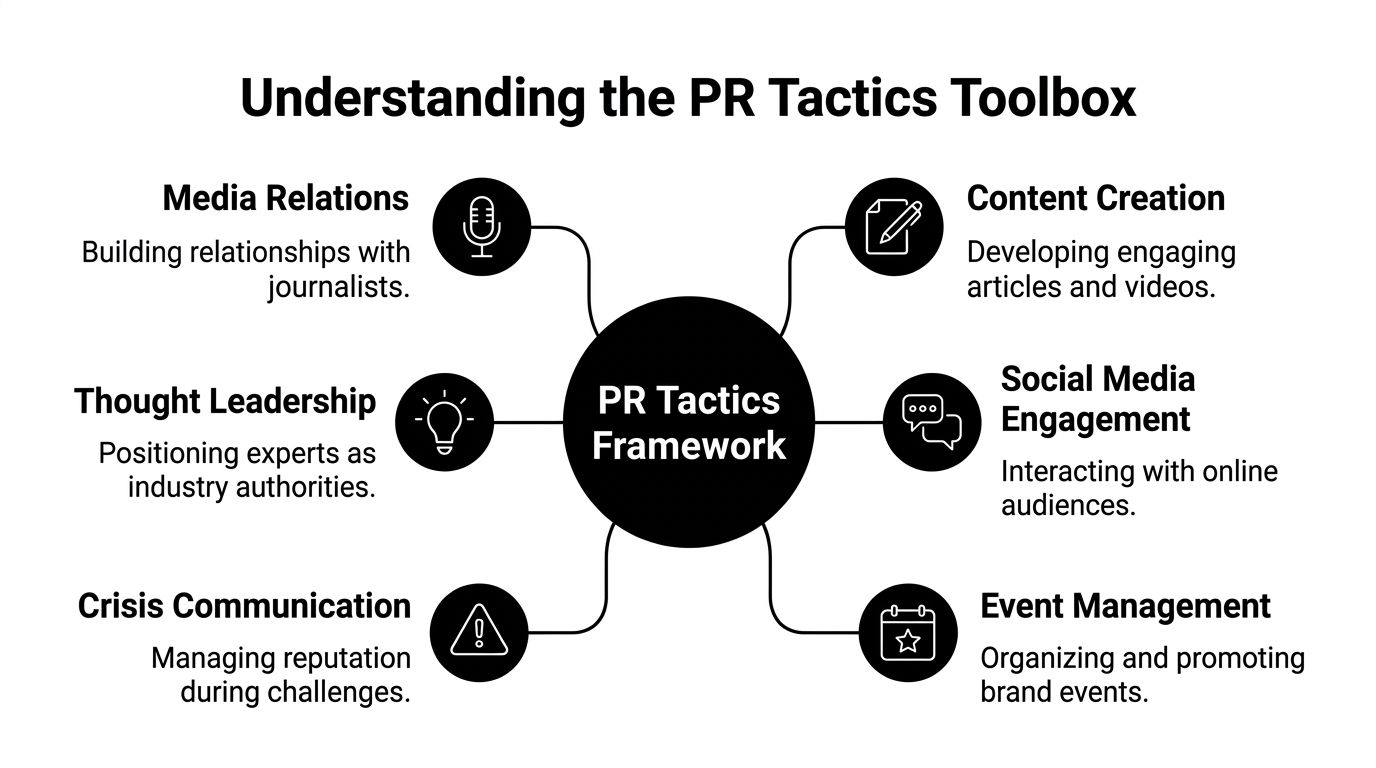
Understanding the PR Tactics Framework
Strategy and tactics get mixed together constantly. That creates messy campaigns.
A strategy is the blueprint. It defines the audience, the message, the objective, and the business reason the campaign exists. A public relations tactic is the tool you use to execute that plan. If the strategy says, “Build trust for a new service among local business media and customers,” the tactics might include a press release, targeted pitching, customer case content, and a local launch event.
Think in media buckets
A simple way to organize your toolbox is to sort tactics into three buckets.
Earned media
This is coverage and attention you do not directly control. Journalists, podcasters, newsletter writers, and industry publishers decide whether to include you.
Examples include media pitching, contributed commentary, interview outreach, award entries, and reactive expert responses. Earned media is powerful because it carries third-party credibility. It is also the least predictable.
Shared media
This is what happens on social platforms and community spaces where your audience can respond, repost, and shape the conversation.
Examples include LinkedIn posts tied to a release, Instagram story cutdowns from an event, founder commentary threads, and creator collaborations. Shared media is where momentum becomes visible. It can also expose weak messaging fast.
Owned media
This is everything you control directly. Your website, newsroom, blog, email list, webinar, downloadable guide, and release archive all belong here.
Owned media gives you permanence. Even when a journalist passes on the story, your company still has a place to publish the announcement, add context, and support search visibility.
The press release sits in the middle
Many teams think of the press release as only earned media support. That is too narrow.
A release is also an owned media asset because it lives in your newsroom. It supports shared media because its language can be turned into posts, clips, and visuals. That central role is why it works so well as the campaign hub.
Consider how one announcement travels:
- For earned media: You extract a sharper angle and send specific pitches.
- For shared media: You pull one quote, one stat-free takeaway, and one customer-facing benefit into social posts.
- For owned media: You expand the release into a blog article, FAQ, or landing page.
Build for coordination, not activity
The mistake junior teams often make is choosing tactics because they sound impressive. The better question is whether each tactic helps the same story travel further.
A scattered campaign looks busy. An integrated one looks credible.
Useful test: Before adding any tactic, ask, “Does this move the same core message to a different audience or a different context?” If not, it may be noise.
That filter keeps your campaign disciplined. It also makes measurement easier because every tactic connects back to the same announcement.
Your Guide to Essential Public Relations Tactics
Most PR tactics fail for one of two reasons. Teams either choose the wrong tool for the job, or they choose the right tool and execute it as a generic blast.
That second problem shows up constantly in media relations. The average journalist response rate to PR pitches is 3.43%, only about 8% of pitches lead to published coverage, and PR professionals pitch an average of 31 journalists per campaign to secure a single response, according to PRLab’s public relations statistics for 2026. Those numbers explain why lazy outreach burns time and goodwill.
Media relations
Media relations is the direct work of identifying relevant reporters, understanding what they cover, and giving them a reason to care now.
Its primary job is credibility. When a publication covers your business, the story carries more weight than a brand-owned post. But credibility comes with friction. Journalists ignore vague company updates, overhyped product claims, and emails that show no awareness of their beat.
Use media relations when you have one of these:
- actual news
- a strong local angle
- useful expert commentary
- a trend your team can explain clearly
- customer or community impact that goes beyond self-promotion
Do not use it as a substitute for content marketing. If your update is not newsworthy, forcing it into a pitch usually harms future outreach.
Press releases
The press release remains the anchor asset because it creates a formal version of the story. It gives you structure. It also forces internal discipline because someone has to define the headline, the quote, the facts, and the audience.
Its primary job is message control.
Use a release when the news has enough substance to justify a formal announcement. Good examples include new funding, new locations, executive changes, partnerships, product launches, event announcements, major hires, certifications, acquisitions, and crisis responses.
Do not use it for every small internal update. If nothing meaningful changed for an outside audience, write a blog post or customer email instead.
Social media PR
Social media PR takes the core announcement and turns it into conversation.
Its primary job is reach and engagement. The release says what happened. Social media helps people react, discuss, and share. The best social PR is not a pasted headline with a link. It adapts the story for platform behavior.
On LinkedIn, that may mean a founder perspective on why the announcement matters. On Instagram, it may be behind-the-scenes content from an opening or event. On X or Threads, it may be a sharper commentary angle tied to industry relevance.
Use this when speed matters and when your audience already follows your brand or leadership team. It is also useful for giving journalists proof that the story has community interest.
Influencer outreach
Influencer outreach is PR when it is handled as relationship-based credibility transfer, not just paid promotion.
Its primary job is trusted amplification. A creator can help your message land with an audience that does not read trade coverage or local business media. This works best when the release provides a real hook, such as a launch, event, initiative, or collaboration.
Use this when the creator’s audience matches the exact people you want to influence. For a local retail opening, neighborhood creators can matter more than a broad media list. For a software launch, niche B2B creators or operators may outperform general business influencers.
The trade-off is control. You can brief creators, but you cannot expect them to sound like a press release. If your team cannot tolerate adaptation, this tactic will feel uncomfortable.
Community engagement and events
Some stories need a room, not just an inbox.
Community engagement includes local partnerships, open houses, speaking appearances, nonprofit involvement, customer gatherings, and launch events. Its primary job is relationship depth. People remember a useful experience longer than a generic announcement email.
Use this when geography matters, when local trust matters, or when you need visual moments that can feed media and social content. A ribbon cutting, founder talk, workshop, or charity tie-in gives your release something tangible behind it.
If your organization faces sensitive public scrutiny, event planning should also connect with your issue-response playbook. For that, review these crisis communication best practices.
Content marketing as a PR tool
Content marketing supports PR when it extends the life of the announcement.
Its primary job is context and staying power. The release states the news. Content explains why it matters, how it works, what changes for customers, and what the broader industry implication might be.
Use content marketing when your story needs more education than a release can hold. Examples include explainers, FAQs, founder essays, customer stories, webinar recaps, and short videos. This is especially useful in technical, regulated, or unfamiliar categories.
Key takeaway: If the press release is the formal statement, content marketing is the explanation layer that helps audiences understand and remember it.
Choosing the right public relations tactic
| Tactic | Primary Goal | Best For… | Typical Effort Level |
|---|---|---|---|
| Press release | Message control | Official announcements, launches, executive news | Moderate |
| Media relations | Credibility | Newsworthy stories with a clear angle for reporters | High |
| Social media PR | Reach and engagement | Fast amplification and audience interaction | Moderate |
| Influencer outreach | Trusted amplification | Niche audiences and creator-led discovery | Moderate to high |
| Community engagement and events | Relationship depth | Local visibility, partnerships, experiential moments | High |
| Content marketing | Context and longevity | Complex stories that need explanation and search value | Moderate |
A practical selection rule
Start with the release when the news is formal enough. Then ask which tactic closes the gap between your announcement and the audience behavior you need.
- Need third-party validation. Add media relations.
- Need conversation. Add social media PR.
- Need trust from a niche audience. Add influencer outreach.
- Need local visibility. Add community engagement.
- Need education. Add content marketing.
That sequence keeps tactics aligned with outcomes instead of turning the campaign into a checklist.
A Step-by-Step Press Release Campaign Checklist
Campaigns get stronger when the work is staged. Not because process is glamorous, but because PR breaks when teams rush from draft to distribution without preparing the layers around it.

Pre-launch work
Most results are won or lost in this stage. If the message is sloppy here, no follow-up tactic can save it.
Nail the core message
Write one sentence that answers three questions. What happened, why now, and why should this audience care?
Then build the release around that sentence. If your internal stakeholders cannot agree on it, pause. Mixed messaging shows up immediately in pitches and social posts.
Build the asset pack
A release should not go out alone. Prepare:
- A short pitch version: One tight email angle for each media segment
- Executive talking points: Especially useful if reporters or partners reply quickly
- Visuals: Product images, event photos, logos, founder headshots, short clips
- Supporting links: Newsroom page, product page, event registration, FAQ, or bio page
Segment your audience before distribution
Do not build one giant outreach list. Separate reporters, customers, creators, partners, community contacts, and internal team members.
Each group needs a different version of the same story. Journalists want relevance. Customers want benefits. Creators want an angle their audience will engage with. Partners want co-promotion clarity.
Tip: If you cannot explain why a person is on your outreach list, remove them before launch day.
Launch day execution
Distribution is the midpoint, not the finish.
The strongest teams personalize outreach because generic blasts underperform. Personalized pitches to responsive reporters generate 4x more earned media volume than mass blasts, and top teams A/B test subject lines to achieve open rates over 30% while using analytics to focus on outlets that drive referral traffic and brand sentiment uplift, according to PRLab’s guide to high-impact PR tactics.
Publish the release where you control it
Post it in your newsroom or media page first. That gives everyone a stable link to reference.
Check formatting before anything goes live. Broken links, missing logos, or quote errors weaken confidence fast.
Pitch in waves
Send your most important journalist outreach first. That usually means the small list of reporters who are closest to the beat and most likely to care.
Then move to secondary contacts, trade outlets, local media, newsletters, and podcasts as appropriate. This sequencing gives you a chance to adjust your angle if early feedback is weak.
A quick walkthrough can help if your team prefers to work from a visual process:
Activate social and partner channels
Do not post only the release headline.
Instead, turn it into platform-native updates:
- LinkedIn: leadership perspective
- Instagram: visual proof or behind-the-scenes moment
- Email: customer-facing explanation
- Partner channels: coordinated announcement copy
- Creator briefs: approved facts plus freedom in delivery
Post-launch follow-through
This phase is where campaigns either extend or disappear.
Follow up selectively
Follow-ups should add value, not repeat the original email. Offer a different angle, a new quote, local relevance, availability for interview, or a sharper subject line.
If a journalist clearly is not a fit, stop. Protect the relationship.
Repurpose what you already created
One release can become:
- A blog article that explains the background
- A founder post that adds opinion
- A customer email that addresses practical impact
- A short video with the key message and quote
- A sales enablement note so frontline staff stay consistent
Log what happened
Capture:
- who opened
- who replied
- what angle worked
- which social post got discussion
- which partner shared
- which assets were used
That record matters more than many teams realize. It becomes the basis for the next campaign, and it helps you stop repeating weak outreach habits.
Real-World Examples of PR Tactics in Action
Theory is useful. Pattern recognition is better.
These examples are not performance claims. They show how teams can use one release as the center of a wider PR system.
A tech startup turns funding news into category visibility
A startup closes a funding round and drafts a standard release. Left alone, that release would likely produce a brief spike of attention and then fade.
A stronger version of the campaign uses the release as the official asset, then splits execution three ways. First, the team pitches a short list of reporters who already cover startup funding and the company’s category. Second, the founder posts a plainspoken explanation on LinkedIn about what the funding allows the company to build next. Third, the team sends a creator briefing to a few niche operators and analysts who discuss tools in that market.
The important move is not volume. It is alignment. The press release handles the formal announcement. Media outreach handles credibility. Creator and founder channels handle interpretation.
A nonprofit uses an event release to drive community participation
A local nonprofit announces an upcoming fundraising event. The release gives the organization a clear public statement with date, purpose, leadership quote, and participation details.
Instead of relying only on local media, the nonprofit also asks board members, volunteers, and partner organizations to share adapted social posts based on the release. A community calendar submission extends local reach. The executive director records a short invitation video using the same core message from the release.
This kind of campaign works because the release keeps everyone aligned. No one invents their own wording. The event message stays consistent across local outreach, Facebook posts, email, and in-person asks.
If you want to see how different organizations structure campaigns around announcements, these PR strategy examples are useful reference points.
A retail business uses a store-opening release to support owned content
A retailer opening a new location sends a release with the basics. Address, opening date, leadership quote, and local relevance.
The smart extension is owned content. The team turns the release into a blog post about why they chose the neighborhood, a short staff introduction series on social, and a simple FAQ covering parking, opening offers, and store hours. Local creators get invited for previews based on the same announcement.
That approach does two things well. It gives the media a legitimate local business story, and it gives future customers practical information after the initial announcement passes.
Common thread: In all three examples, the release is not the whole tactic. It is the source document that keeps every other tactic accurate and coordinated.
How to Measure the Success of Your PR Tactics
A lot of PR reporting still stops at activity. Number of releases sent. Number of emails sent. Number of mentions collected.
Those figures are not useless, but they are incomplete. The deeper issue is measurement discipline. While 73% of journalists cite lack of relevance as the primary reason for ignoring pitches, teams also struggle because they lack clarity on which KPIs matter, and analyzing campaign data to identify high-performing outlets can increase media pickup by up to 50%, according to Prowly’s PR strategy analysis.
Use a three-level scorecard
Outputs
These are the visible things your team produced or secured.
Track:
- published release
- pitches sent
- replies received
- placements secured
- social posts published
- creator mentions earned
- event attendance notes
Outputs tell you whether execution happened. They do not tell you whether it mattered.
Outcomes
PR starts getting smarter in this stage.
Look at:
- message pull-through, meaning whether coverage reflected the points you wanted included
- media quality, meaning whether the outlet reaches the audience you care about
- share of voice, often calculated as (brand mentions / total industry mentions) × 100
- referral patterns from coverage or creator posts
- tone and context of earned mentions
A single placement in the right outlet can matter more than several weak mentions in irrelevant places.
Business impact
This is the hardest layer, and the one leadership usually cares about most.
Tie the campaign to signs such as:
- website visits to the relevant page
- demo or inquiry activity after coverage
- event sign-ups
- newsletter subscriptions
- partner outreach
- direct customer replies
- sales conversations influenced by the announcement
Not every campaign will map neatly to revenue. That is normal. But every campaign should at least try to connect visibility to a business behavior.
Build a simple review loop
After each campaign, ask four questions:
- Which outlets or contacts responded best
- Which angle got traction
- Which message appeared in coverage
- Which follow-on tactic extended the story longest
If your team wants a cleaner way to structure this review, this guide to public relations reporting is a practical next step.
Measurement rule: Report fewer metrics, but make each one useful enough to guide the next campaign.
A disciplined PR team improves because it learns from each release. That is how the system gets stronger over time.
Frequently Asked Questions About PR Tactics
What is the difference between PR, marketing, and advertising
PR focuses on reputation, trust, and public visibility. Marketing focuses on demand generation and customer action. Advertising is paid placement.
In real campaigns, they overlap. A press release may support PR, feed marketing content, and give paid media a stronger message. The difference is not the asset. It is the job that asset is doing.
How much should a small business budget for PR tactics
Start with the story, not a fixed menu. A business with one meaningful announcement and good founder availability can do a useful campaign with limited spend. A business that needs video, creator partnerships, events, and ongoing outreach will need more budget and more time.
The smarter question is where to spend first. For most small teams, that means message development, release quality, media list quality, and consistent follow-up before it means flashy extras.
Can I do PR myself or do I need an agency
You can do a lot in-house if you can write clearly, stay organized, and maintain outreach discipline. Many founders and lean comms teams handle early PR well.
Bring in an agency or consultant when stakes are higher, the story is complex, the category is highly competitive, or internal bandwidth is gone. Outside support is also valuable during sensitive announcements and crisis periods.
Are press releases still worth using
Yes, when the news is real. The release still works because it creates the official version of the story that every other tactic can use.
What changed is the surrounding ecosystem. Influencer and creator outreach are now common parts of PR programs. As noted earlier, 86% of US marketers and PR firms offered influencer outreach as a core service in 2025, and 66% of Gen Z consumers discover brands through creator or influencer PR. That shift means the release often needs to support media outreach and creator amplification at the same time, not one or the other.
If you want practical help planning, writing, and distributing better announcements, Press Release Zen offers templates, guides, and tactical resources that make press release campaigns easier to execute and easier to measure.