A lot of public relations plans start the same way. Someone realizes a launch date is close, an event is coming up, or a funding announcement needs attention. The team scrambles, drafts a press release, pulls a media list that is too broad, and sends the same pitch to everyone.
That approach feels productive because it creates activity fast. It rarely creates momentum.
A strong PR plan does something different. It connects your message, audience, timing, channels, and measurement before outreach starts. It gives you a system for deciding what deserves attention, how to frame it, who should hear it first, and what success should look like after the coverage lands. That matters whether you run a startup, a nonprofit, a local retail brand, or a professional services firm.
Public relations plans work best when they are not treated as static documents. The useful ones act more like operating manuals. They help teams make better decisions under deadline pressure, spot weak story angles early, and stay consistent across press releases, interviews, social content, community outreach, and follow-up.
Why Ad-Hoc PR Fails and Strategic Plans Succeed
Reactive PR usually breaks down in three places. The story is weak, the audience is too vague, and the outreach happens without a clear business purpose.
A team might announce a new hire when the true opportunity was the market problem that hire helps solve. Or they pitch national media when a local industry reporter was the smarter first move. Or they celebrate impressions when leadership needed qualified leads, donor interest, retail foot traffic, or investor confidence.
Those failures are not writing problems. They are planning problems.
The case for planning has only become stronger as PR becomes more digital and more accountable. The global public relations market is projected to grow from $88 billion to $129 billion by 2026, driven by the shift toward digital and data-driven PR plans, according to Avaans Media’s cited industry analysis. That growth reflects a practical change in how companies use PR. They are no longer treating it as a one-off publicity function. They are tying it to visibility, reputation, search presence, and business outcomes.
What ad-hoc PR usually gets wrong
A loose, undocumented approach tends to produce the same pattern:
- The team chases moments instead of priorities. Every announcement feels urgent, so nothing gets filtered.
- Messaging shifts from one release to the next. Reporters, customers, and partners hear different versions of the same company story.
- Ownership stays fuzzy. Marketing assumes leadership will approve the message. Leadership assumes marketing has the media angle covered.
- Results stay hard to judge. Without a target, even decent pickup feels random.
What a strategic PR plan changes
A plan forces useful decisions before execution:
| Problem without a plan | Better approach with a plan |
|---|---|
| “We need press” | Define what kind of visibility matters and why |
| “Let’s send it everywhere” | Match outlets and channels to the audience |
| “This sounds important” | Stress-test whether the story is timely and relevant |
| “We’ll measure it later” | Set success criteria before outreach begins |
A documented plan also helps with restraint. Not every update deserves a press release. Not every press release deserves broad distribution. Not every journalist should get the same email.
Tip: Good public relations plans reduce wasted motion. They do not just tell you what to do. They help you decide what not to do.
That is the difference between PR that creates a brief spike and PR that builds authority over time.
Laying the Groundwork Your Goals Audience and Message
Most first PR plans collapse because teams start with tactics. They ask whether they need a press release, a launch event, a LinkedIn post series, or analyst outreach before they have done the slower work underneath.
That foundation has three parts. Goals. Audience. Message. If one is weak, the rest of the plan becomes expensive guesswork.

Set goals that change behavior
“Get more media coverage” is not a goal. It is a wish.
A usable PR objective tells your team what outcome matters, what audience matters, and how long you are willing to work toward it. The simplest way to pressure-test this is the SMART framework: specific, measurable, achievable, relevant, and time-bound.
That does not mean every goal needs complicated reporting. It means the goal should drive choices.
A tech startup might set a PR objective around category awareness before a product launch. A nonprofit may focus on donor trust and event attendance. A retail brand may care most about local visibility before a new store opening. Those are different jobs. Their public relations plans should look different too.
Define the full audience, not just media
A common mistake is reducing “audience” to reporters. Journalists matter, but they are only one audience inside a broader communications map.
Consider building your audience view in layers:
- Primary decision-makers: buyers, donors, partners, investors, patients, applicants.
- Amplifiers: journalists, creators, association leaders, newsletter editors, community organizers.
- Internal stakeholders: executives, staff, board members, store managers, volunteers.
- Local validators: neighborhood groups, event partners, chambers of commerce, nonprofit collaborators.
This helps prevent a lot of mixed messaging. If your CEO wants to emphasize growth, your customer base wants proof, and reporters need a timely angle, the plan should account for all three.
Build lightweight personas
Personas do not need to become a branding exercise. Keep them practical.
For each audience, answer four questions:
- What do they care about right now
- What problem are they trying to solve
- What would make them skeptical
- Where do they already pay attention
A nonprofit gala plan, for example, may include a local business sponsor persona, a community donor persona, and a regional features editor persona. Each one needs a different entry point, even if the core story is the same.
Develop one central message and a few proof points
Your message should be short enough that a spokesperson can repeat it without sounding scripted. It should also be specific enough that a reporter or customer can understand why it matters.
A useful message framework looks like this:
| Element | What it answers |
|---|---|
| Core statement | What are you announcing or standing for |
| Audience relevance | Why should this specific group care |
| Proof | What evidence, example, or result makes it credible |
| Tone | Should this feel authoritative, urgent, local, hopeful, practical |
For a retail opening, the message might center on convenience, neighborhood investment, and product selection. For a B2B software company, it may focus on workflow pain, time savings, and customer demand. For a nonprofit, it may emphasize need, local impact, and trusted community partnership.
Adapt the message for underserved audiences
Adapt the message for underserved audiences. Many public relations plans stay too generic if they fail to do this. They use one polished message for everyone, then wonder why it fails to connect at the community level.
Authentic community engagement matters. PRNEWS reports that underserved groups engage more with culturally aligned campaigns, yet only 20 to 30% of small organization PR plans incorporate grassroots elements. The same source notes that localized language and trusted community channels can boost credibility by 25 to 40% in coverage rates.
That should change how you write and distribute announcements.
A nonprofit serving multilingual neighborhoods may need translated supporting materials, local spokespersons, and outreach through community partners rather than broad media blasting. A healthcare practice announcing a new service may need to explain access, trust, and cultural relevance instead of relying on institutional language. A retail business entering a diverse neighborhood should stress listening and local partnership, not just expansion.
Key takeaway: Relevance is not only demographic. It is contextual. People respond when your message reflects their concerns, language, and lived reality.
A grounding exercise that works
Before approving any PR plan, ask your team to answer this in one sentence for each audience: Why should they care now?
If the answer sounds abstract, the message is not ready. If the answer sounds promotional, the story is not ready. If the answer differs wildly across internal stakeholders, the planning work is not finished.
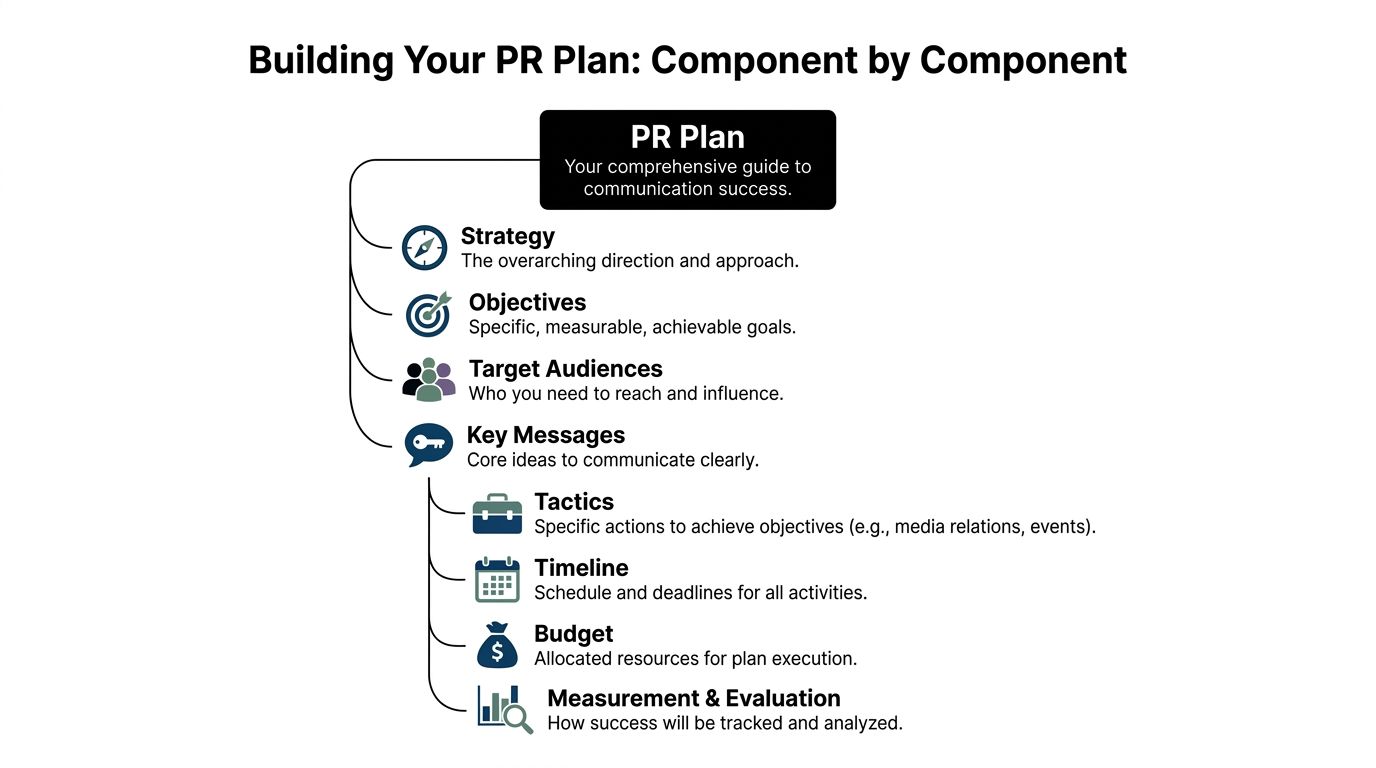
Building Your PR Plan Component by Component
A PR plan becomes useful when it stops being a strategy memo and starts functioning like a working document. Every part should connect to another part. Objectives shape tactics. Tactics affect budget. Budget constrains timeline. Timeline affects what can be measured.
That interdependence is where many first drafts go wrong. Teams often build plans in isolated sections, then discover the parts do not fit together in execution.
The structure below keeps them aligned.
Start with strategy before tactics
The strategy section should answer one question clearly: How will you earn attention in a way that matches your goals and audience?
That is broader than “send press releases.” It may include media relations, executive visibility, partner amplification, community outreach, customer storytelling, owned content, social support, and selective paid promotion.
A practical way to organize tactics is by channel type:
- Owned media: company newsroom, blog, email list, LinkedIn page, founder account
- Earned media: journalist outreach, contributed commentary, interviews, podcast appearances
- Paid support: sponsored content, boosted social posts, event promotion where needed
A founder-led B2B company may put more weight on executive commentary and trade media. A nonprofit may combine local media with community partner channels. A retailer may prioritize local coverage, creator relationships, and store-level social content.
If you need a sharper view of how these choices differ in business-to-business settings, this guide to B2B Public Relations Strategies is a useful companion because it shows how thought leadership, trust, and niche media often matter more than broad visibility.
Use internal data to create stronger story angles
One of the fastest ways to improve a PR plan is to stop asking, “What do we want to announce?” and start asking, “What do we know that others do not?”
That shift turns routine updates into useful stories.
5WPR notes that 70% of reporters want localized data, and campaigns that use data to reveal trends can see up to 40% more media pickups. For smaller organizations, this matters because you may not have brand recognition, but you do have internal information.
Good sources of internal story material
Not all internal data belongs in public. But many teams overlook patterns that can support credible outreach:
- Customer service logs that reveal recurring pain points
- Sales questions that show confusion in the market
- Usage trends from an app, platform, or product line
- Event registration patterns that indicate shifting local interest
- Donation themes that show what motivates supporters
- Location-based demand that makes a retail or real estate story more relevant
A tech company launching a feature could lead with a behavior trend seen among users. A nonprofit could use program intake patterns to frame a local need. A retail chain could tie a new opening to product demand in a specific neighborhood.
Tip: Reporters rarely care that your company is excited. They care when your announcement helps explain a broader pattern.
A story angle should pass three tests. Is it relevant to the outlet’s audience? Is it timely enough to justify coverage now? Is there proof beyond your opinion?
Build a realistic editorial calendar
Most public relations plans fail in the timeline section because they are too optimistic.
Announcements rarely move in straight lines. Legal review slows one release. Product slips another week. An executive becomes unavailable for interviews. A competing news cycle crushes visibility on the original date. The answer is not to abandon the plan. It is to build a calendar with room to adapt.
Your calendar should include:
| Calendar element | Why it matters |
|---|---|
| Launch or announcement date | Anchor point for outreach |
| Draft deadlines | Prevent last-minute approvals |
| Asset readiness | Quotes, bios, images, fact sheet, spokesperson notes |
| Outreach window | Gives media time before public release if appropriate |
| Social support | Reinforces earned coverage once it lands |
| Follow-up dates | Keeps outreach disciplined instead of random |
A timeline should also reflect audience behavior. Trade media may need more lead time than local online outlets. Community partners may need more context than a journalist does. Retail and nonprofit calendars often depend on seasonal dates, event logistics, or local milestones.
To help your team see how practitioners discuss timing and sequencing, this short video is worth a look.
Match budget to decisions, not hopes
Budgeting for PR usually gets distorted in one of two ways. Some teams underfund execution and assume earned media is free. Others pay for distribution without investing in the story quality or follow-up needed to make distribution useful.
A practical PR budget should account for categories such as:
- Content development: writing, editing, data analysis, design
- Distribution tools: press release wire or distribution platform when warranted
- Media database access: if your team uses one
- Creative assets: photography, graphics, spokesperson prep materials
- Events or community activation: venue support, collateral, partner materials
- Measurement tools: analytics, dashboarding, tracking setup
The right spend depends on the job. A nonprofit fundraiser may need stronger event and community communications support. A software launch may need more analyst briefings, customer evidence, and product marketing coordination. A real estate announcement may depend heavily on visuals, local relations, and neighborhood messaging.
Add measurement before launch day
Measurement belongs inside the plan from the start, not in a report created later.
This changes behavior. Teams write better headlines when they know website referral quality matters. They choose better targets when they define the publications and audiences that influence outcomes. They prepare spokespeople better when they know message pull-through will be assessed after interviews.
At minimum, include:
- Output measures: placements, interview opportunities, release pickups
- Engagement signals: message resonance, referral traffic quality, stakeholder responses
- Business indicators: inquiries, registrations, donations, partnership conversations, store visits
A plan does not need to predict everything. It does need to decide what evidence will count.
Keep the document usable
The best public relations plans are detailed enough to guide action and lean enough that people will use them.
A strong working version often includes:
- Business context
- Objectives
- Audience map
- Core messages and proof points
- Story angles
- Tactics and channels
- Timeline
- Roles and approvals
- Budget
- Measurement framework
If your plan reads like a deck written for a board meeting, it may look polished and still fail in practice. The people executing it need a document they can open on a busy Tuesday and use immediately.
Putting the Plan into Practice Sector-Specific Examples
A framework matters because it lets you adapt without starting from zero each time. The plan for a software launch should not look like the plan for a fundraising gala. The logic stays consistent. The execution shifts.

A tech startup launching an app
A startup often wants top-tier coverage immediately. The stronger move is usually narrower.
Say the company is launching a workflow app for operations teams. The weak angle is “we built a powerful new platform.” The better angle is a specific problem in the market, supported by customer patterns, founder credibility, and a clear reason the launch matters now.
The audience may include trade reporters, potential users, early investors, and future hires. Messaging should focus on the pain the product solves, what makes the approach different, and proof from early usage or customer behavior if the company can share it responsibly.
The plan may prioritize:
- targeted trade outreach
- founder interviews
- customer-backed use cases
- LinkedIn thought leadership from the leadership team
- product demo access for selected reporters
A nonprofit promoting an annual gala
A gala is not automatically news. The mission behind it can be.
A stronger nonprofit PR plan frames the event as part of a community need, a response to local conditions, or a milestone in service delivery. Media outreach may focus less on ticket sales language and more on local impact, beneficiary stories, honorees, sponsors, and community relevance.
This plan should also think beyond traditional outlets. Board members, partner organizations, volunteers, local newsletters, and civic groups often become important amplifiers. If the nonprofit serves diverse communities, message adaptation and trusted local channels matter even more.
Useful tactics could include:
- a mission-led media release
- community partner outreach
- localized social content
- spokesperson preparation for beneficiary-sensitive interviews
- post-event follow-up that shares outcomes and gratitude
A real estate agency announcing a new development
Real estate PR works best when it avoids generic project language. “Exciting new development coming soon” is easy to ignore.
A stronger plan identifies what makes the project meaningful locally. That could be neighborhood revitalization, accessibility, mixed-use benefits, business tenancy, design choices, or community partnership. Audience mapping matters here because neighbors, local officials, business groups, and property reporters may all need different information.
The plan might include visual assets early, spokesperson talking points for community concerns, and a staggered communications approach rather than one mass announcement.
A retail business opening a new store
Retail teams often default to promotional messaging. Journalists usually need something more grounded.
A store opening can become more relevant when tied to neighborhood demand, job creation, local sourcing, founder story, or community partnership. The audience includes local consumers, nearby business owners, local media, and community groups. The right plan blends earned media, owned social content, and on-the-ground activation.
A practical sequence could be:
- tease the opening through owned channels
- brief local media with a neighborhood-specific angle
- coordinate community partner mentions
- support opening week with visual content and spokesperson availability
- keep momentum going with follow-up stories tied to customer response or local involvement
Key takeaway: The same PR framework works across sectors, but the story trigger, audience priorities, and channel mix should shift with the business context.
If you want more practical formats to adapt, these PR strategy examples are useful reference points because they show how the same planning logic changes across announcement types.
Activating Your Plan Distribution and Media Follow-Up
Distribution is where many plans lose discipline. Teams spend days refining messaging, then undo the work with generic outreach.
Execution should be deliberate. Every release, pitch, and follow-up should reflect the audience choices already made inside the plan.

Distribute with purpose
Not every announcement needs the same route.
A broad distribution service can help with reach, search visibility, and baseline pickup when the news has broad relevance. Direct pitching works better when the story needs context, exclusivity, or a specific local angle. Often the best approach is a mix. Publish the release in your newsroom, support it with selective distribution if justified, and pitch a targeted list with a customized angle.
Clutch reports that 71% of PR professionals expect earned media to become harder to secure, and the same source recommends aiming for an 8% pitch-to-coverage conversion through personalized outreach and exclusive, data-backed stories. That reinforces a simple rule. Quality beats volume.
Follow up without becoming noise
A good follow-up email is brief, relevant, and easy to ignore if the timing is wrong. It does not guilt the reporter. It does not restate the full release. It offers a useful angle, a source, or an asset.
A workable follow-up rhythm usually looks like this:
- First touch: short personalized pitch tied to the reporter’s beat
- Second touch: concise follow-up with one added reason the story matters
- Third touch if warranted: a final note only if you have something new, such as data, an interview slot, or a local hook
If there is no response, move on professionally. Pushing harder rarely repairs a weak fit.
Support outreach with coordinated content
Media outreach works better when the rest of your channels do not look abandoned. Reporters and stakeholders check LinkedIn pages, company sites, executive profiles, and recent activity.
That is where a simple content planning tool helps. If your plan includes executive visibility or brand support on social, a practical resource like this LinkedIn content calendar template can help your team keep messaging aligned before and after a release goes live.
For teams building a broader publishing rhythm around announcements, this guide to a press release calendar and scheduling process helps keep launches, approvals, and follow-up from colliding at the last minute.
Tip: Follow-up should add value, not pressure. If your second email says exactly what the first one said, it should not be sent.
Measuring What Matters PR Metrics That Prove Value
PR reporting becomes far more useful when it separates activity from impact.
A lot of teams stop at outputs. They count placements, mentions, or impressions and call the job done. Those figures have a place, but they rarely answer the question leadership asks: Did this move anything that matters?
A stronger model uses tiered KPIs. Start with outputs such as placements, release pickups, interview opportunities, and publication quality. Then look at outtakes, which show whether the audience understood and engaged with the message. That may include referral traffic quality, message pull-through in coverage, or responses from donors, buyers, partners, or community stakeholders. Finally, track outcomes, which connect PR activity to business results like inquiries, registrations, donations, qualified leads, or store visits.
Spin Sucks notes that 86% of PR pros deem measurement vital, while 72% struggle to show business impact. The same source warns against vanity metrics and recommends benchmarking against industry averages such as the 3.43% journalist response rate.
What to avoid
- Reporting volume without relevance: ten weak placements may matter less than one strong trade feature
- Using only awareness metrics: visibility matters, but not every mention drives action
- Skipping benchmarks: without context, teams misread weak or average performance as success
- Waiting until the campaign ends: measurement setup should happen before outreach
What to report instead
A concise PR report should show:
- what the team did
- what coverage or response it produced
- what that activity influenced downstream
- what should change next cycle
For teams that want a more detailed framework, this guide on press release KPIs and performance measurement is a practical next step.
The best public relations plans treat measurement as a decision tool. It should help you improve targeting, sharpen stories, and allocate effort better next time.
Frequently Asked Questions About Public Relations Plans
How is a PR plan different from a marketing plan
A marketing plan focuses on demand generation, customer acquisition, and channel performance. A PR plan focuses on reputation, credibility, visibility, and stakeholder trust. They overlap often, especially around launches and campaigns, but they are not interchangeable. Marketing usually controls paid and owned conversion paths. PR often shapes third-party validation and narrative.
How often should public relations plans be updated
Review the plan whenever the business changes direction, launches a major initiative, enters a new market, or faces a reputational issue. Even without a major shift, revisit it regularly enough that messages, audiences, and timing still reflect reality.
Can a small organization build a PR plan without a big budget
Yes. Start with a narrow objective, a clear audience, one strong story angle, and a disciplined outreach list. Many small teams get better results from a focused plan than from a larger, scattered push.
How detailed should the plan be
Detailed enough that another team member could execute it without guessing. If the plan only states broad intentions, it is too thin. If it becomes a long strategy document no one uses, it is too heavy. Aim for a working document with clear decisions, owners, deadlines, and measures.
If you want practical help turning ideas into usable press releases, calendars, templates, and outreach workflows, Press Release Zen is a strong place to start. It offers step-by-step resources for teams that want clearer public relations plans and better execution without unnecessary complexity.