Yes, press releases absolutely still work for SEO in 2026. But let's be clear—their role has changed. They’ve gone from a blunt-force link-building tool to a more sophisticated way to build brand authority, land earned media, and drive referral traffic. All of these things indirectly give your search rankings a major lift.
Do Press Releases Still Work for SEO in 2026

It’s a debate that pops up every year, so let's settle it. Using press releases for SEO is still a smart, strategic move. It's just not the cheat code it used to be.
The old game of stuffing a release with keywords and blasting it to hundreds of low-quality sites is over. In fact, that approach will get you penalized by Google faster than you can say "backlink."
Today, the real power of a press release is in building brand authority and trust—two of the most valuable currencies on the modern web. Think of it less as a direct instruction to Google and more like a megaphone. You're announcing something genuinely newsworthy to journalists, bloggers, and industry leaders who can actually move the needle.
When the right person sees your announcement, they might write their own unique article about it. That's earned media, and it’s the gold standard for both digital PR and SEO.
Building Authority and Trust
In 2026, a press release's main job is to strengthen your site's E-E-A-T profile—that’s Experience, Expertise, Authoritativeness, and Trustworthiness. A consistent flow of real news proves to Google that your brand is a legitimate, active, and credible player in your space.
A press release, when done right, is an incredible tool for increasing visibility. The real benefit is how the content ranks on Google and makes selling dramatically easier by building social proof and authority.
This kind of indirect value is far more sustainable than any outdated backlinking scheme. It's about building a reputation that both people and search algorithms respect. If you want to dig deeper into how this all connects, getting a solid grasp on What Is Search Engine Optimization is a great place to start.
For a quick reference, here’s a breakdown of how modern press releases really help your SEO.
Modern Press Release SEO Benefits at a Glance
This table shows the real direct and indirect SEO benefits of using press releases, giving you a quick reference for their strategic value.
| SEO Benefit Type | Description | Primary Impact |
|---|---|---|
| Brand Mentions | Securing your brand name on reputable news sites, which builds your brand entity and signals relevance. | Indirect SEO |
| Referral Traffic | Pickups on high-traffic news portals send highly relevant visitors directly to your website. | Direct Traffic |
| Earned Media | A single release can spark multiple articles from journalists, leading to powerful, natural backlinks. | Direct SEO |
| Social Proof | Syndicated releases become assets you can share to show customers and partners your brand is making news. | Indirect SEO |
Understanding these distinctions helps you focus your press release strategy on what actually works today.
Driving Real Business Outcomes
It's not just about brand signals. A strategic press release can drive tangible results that you can see in your bottom line, like high-quality referral traffic and valuable leads.
In fact, well-executed press releases can generate up to 1,000% more traffic than organic social media alone. For marketing agencies, folding press releases into campaigns has delivered an impressive 14.6% lead close rate, blowing most other inbound methods out of the water.
Ultimately, a good press release isn't just a marketing task—it’s a sophisticated tool that belongs in every serious SEO toolkit.
Understanding Google's View on Press Release Links
To really get how press releases work for SEO, you first have to get inside Google's head. One of the biggest hangups people have is about links, especially that dreaded rel="nofollow" attribute.
For years, the marketing world was obsessed with "dofollow" links. The thinking was that they were the only type of link that could pass on ranking authority. So, when Google made it clear that press release links should be nofollowed, a lot of people threw their hands up and declared press releases dead for SEO.
That couldn't be more wrong. The game just changed.
The Truth About Nofollow Links
Think of links as recommendations. A "dofollow" link is like a friend giving a glowing, enthusiastic endorsement, passing along some of their credibility—what we often call "link juice."
A "nofollow" link is different. It’s more like a casual mention in a conversation. The site is telling Google, "Hey, check this out, but I'm not putting my full reputation on the line for it."
Google's official stance is that the mass-syndicated links from a press release shouldn't pass PageRank. This was put in place to stop people from spamming their way to the top, not to kill the value of the press release itself.
So while those hundreds of syndicated links from a wire service aren't going to directly pump up your Domain Authority, they have a completely different job to do—one that's just as critical. You can get the full scoop on telling them apart in our guide on how to check for nofollow or dofollow links.
Nofollow Links as Valuable "Hints"
Back in 2019, Google tweaked its system. It announced that it now treats nofollow attributes as "hints" instead of strict commands. This means that even though they don't usually pass ranking credit, Google can still use them for other important things.
Imagine a top expert in your field mentions your company in a speech. They didn't give a formal endorsement, but that mention is still pure gold. Suddenly, everyone in that room knows who you are. That’s exactly how modern press release links work.
Google uses these link "hints" to:
- Discover New Content: When you launch a release, the links act like a roadmap for Google's crawlers, helping them find and index your new announcement or product page much faster.
- Understand Brand Entities: A wave of links and mentions all pointing back to your brand tells Google that something newsworthy is happening. This helps it recognize your brand as a legitimate player in your space.
- Gauge Public Buzz: Widespread syndication across news sites, even with nofollow links, is a massive signal of public interest. This often leads to more people searching for your brand by name, which is a powerful signal to Google.
This change is all about shifting your focus from link equity to brand visibility.
Moving Beyond the Link Juice Myth
Stop obsessing over dofollow vs. nofollow. The modern SEO strategy for press releases is all about generating signals of authority and relevance. Your goal isn't to hoard a pile of low-value links; it's to get your genuine news onto credible platforms where people will see it.
The real jackpot is when a journalist stumbles upon your syndicated press release and decides to write their own, unique story about you. That article is where you’ll likely get a natural, high-authority "dofollow" link—the kind that gives you a direct SEO lift.
The press release was the spark. It was the catalyst that led to that priceless piece of earned media, making it an essential first step in the whole process.
How to Write a Press Release Journalists and Search Engines Love
Let's be honest: writing a press release that actually gets noticed is tough. You're trying to win over two very different audiences at once—a busy journalist looking for a real story and a Google algorithm scanning for relevance.
The secret isn't some complex formula. It’s about having a genuinely newsworthy story and framing it so that both humans and search engines can quickly grasp what’s important.
Your foundation has to be newsworthiness. No amount of clever phrasing or SEO gymnastics can turn a non-event into news. Remember, a press release is an official announcement, not a cleverly disguised ad or blog post.
Before you type a single word, stop and ask: Is this actually news? Great topics include product launches, landing major funding, strategic partnerships, new executive hires, or hitting a significant company milestone. If it's not a real development, it doesn't belong in a press release.
Crafting a Magnetic Headline
Your headline is your first and, often, your only shot to get someone to care. It needs to be clear, concise, and compelling, summing up the entire story in about 10 to 20 words.
For SEO, try to place your primary keyword near the beginning, but only if it feels natural. For example, instead of a vague "Our Company Announces Exciting New AI Software," a much stronger headline would be "Innovate Corp Launches AI-Powered Platform to Automate Business Analytics."
This version immediately tells everyone—from journalists to Google—what the story is about. It strikes the perfect balance between human readability and search engine visibility, which is the whole point of using press releases for SEO.
Building the Body of Your Release
When you get to the body, think "inverted pyramid." This classic journalistic structure puts the most vital information right at the top, with less critical details following.
The Lead Paragraph: This is your MVP. It must summarize the entire story in two or three sentences, answering the 5 Ws: Who? What? When? Where? and Why? Weave your main keyword in here again, but keep it smooth.
Supporting Paragraphs: Now you can flesh out the details. This is the perfect place to drop in a powerful quote from your CEO or a project lead. Quotes give your story a human touch and offer journalists easy-to-lift soundbites for their articles.
Data and Evidence: Back up your claims. Don't just say your new product is great; list its key features. If you're celebrating a milestone, be specific (e.g., "surpassed 1 million active users").
Structuring your release this way makes a reporter's job a breeze. They can grasp the core story in seconds and decide if they want to dig deeper. For more on this, our guide on optimizing press releases with SEO keywords and metadata takes an even deeper dive into these techniques.
Incorporating Links and Media
Use links sparingly. The goal here is to provide valuable context, not to cram in as many backlinks as possible. A good rule of thumb is to stick to two to three links max.
Link to pages that genuinely support your announcement, like a new product page or your company’s homepage. And please, use natural-sounding anchor text. Go with "our new AI-powered platform" instead of a generic and unhelpful "click here."
Multimedia is your friend. Adding high-resolution photos, an infographic, or a short video can make a world of difference. Press releases with visuals get far more views than their text-only counterparts.
- Image Optimization: Give your files descriptive names, like "innovate-corp-ai-platform.jpg."
- Alt Text: Write clear, simple alt text describing the image for accessibility and SEO.
- Captions: Add a caption to explain what the visual shows.
These extra touches give search engines more to work with, opening up new ways for people to discover your announcement.
The Boilerplate and Contact Information
Finally, every press release needs to wrap up with two non-negotiable sections.
First is the boilerplate. This is your company's "about us" blurb—a short, standardized paragraph that explains who you are and what you do. It should be consistent across all your communications and include a link to your website.
Second, you absolutely must include a media contact section. List the name, title, email, and phone number of the person journalists can reach out to for questions. Making it easy for the press to contact you is crucial for building relationships and getting coverage. Without it, you're just shouting into the void.
Choosing Your Press Release Distribution Strategy
A perfectly written press release is pointless if it never gets in front of the right people. Distribution is the make-or-break moment where your announcement either soars or sinks. Getting this step right is absolutely critical for making press releases for SEO deliver real value.
Think of it like this: your press release is a concert ticket. Distribution is how you get those tickets to the most influential people in town. You could just drop them from a plane and hope for the best, or you could hand-deliver them to music critics and die-hard fans. The strategy you choose matters.
You have three main paths to take: free services, paid wire services, and targeted manual outreach. Each has its place, but they all produce wildly different results.
The Trade-Offs Between Free and Paid Services
Free press release distribution sites can look pretty tempting, especially if you're on a tight budget. They offer a no-cost way to get your announcement out there. But this approach has some serious drawbacks.
These free sites often have low domain authority and are absolutely packed with other releases, many of them spammy or low-quality. Your news is unlikely to be spotted by any serious journalists or get indexed by Google in a meaningful way. It's like shouting your news in a chaotic, noisy marketplace—most people will just walk right past.
Paid wire services, however, are a completely different ball game. They have spent years building relationships with a huge network of news outlets, media partners, and financial terminals.
For a fee, they guarantee your press release gets sent to:
- Major News Sites: Think outlets like Yahoo Finance, Business Insider, and MarketWatch.
- Google News: Getting indexed here puts your story right in front of people actively searching for news on your topic.
- Industry-Specific Publications: The best services can aim your release directly at journalists covering your specific niche.
Investing in a premium service is like broadcasting your announcement from the tallest radio tower in the city. You reach a massive, relevant audience almost instantly, giving your news the visibility it needs to make an real impact.
If you're weighing your options, our in-depth comparison of the best press release distribution services can help you make an informed choice based on your specific goals and budget. Picking the right one is crucial for getting the most out of your investment.
Why Targeted Outreach Is the Ultimate Goal
While wire services give you broad visibility, targeted manual outreach delivers precision. This strategy means you identify specific journalists, bloggers, and influencers who cover your industry and send them a personalized pitch. It’s the difference between a mass broadcast and a personal invitation to an exclusive event.
This approach definitely takes more legwork, but the payoff can be huge. When a journalist writes their own unique story based on your announcement, you can earn a powerful, natural "dofollow" backlink. Just one of those links from a high-authority site is worth more for SEO than hundreds of syndicated "nofollow" links combined.
Start by building a media list of reporters who are a good fit. Then, write a short, compelling email explaining why your news is perfect for their readers. Don't just attach the press release; give them the hook in the first two sentences.
Combining broad distribution with targeted outreach creates a powerful one-two punch. The wire service creates the initial "buzz" and gets your news indexed, while your personal pitches lead to high-value earned media. The synergy between these two methods is what truly unlocks the power of press releases for SEO.
Recent data shows just how long this impact can last. Press releases have fantastic SEO longevity, holding onto top-10 Google positions for an average of 18 months after distribution. Releases that use a multi-channel strategy like this appear in 92.58% of relevant Google searches, driving a whopping 53.3% of a site's total organic traffic. You can dig into more of these data-backed trends on ereleases.com.
How to Measure the Real SEO Impact of Your Campaign
So, your press release is out in the wild. If you think the job is done, think again. Now comes the part where you prove your strategy actually worked. It's time to dig into the data and show a real return on investment, moving past vanity numbers to find the metrics that truly matter.
Think of it like this: your press release is a stone you just tossed into a pond. Your job now is to measure the ripples. Some are obvious, like the immediate splash of website traffic. Others are subtler, like how the overall water level—your brand authority—slowly rises over time.
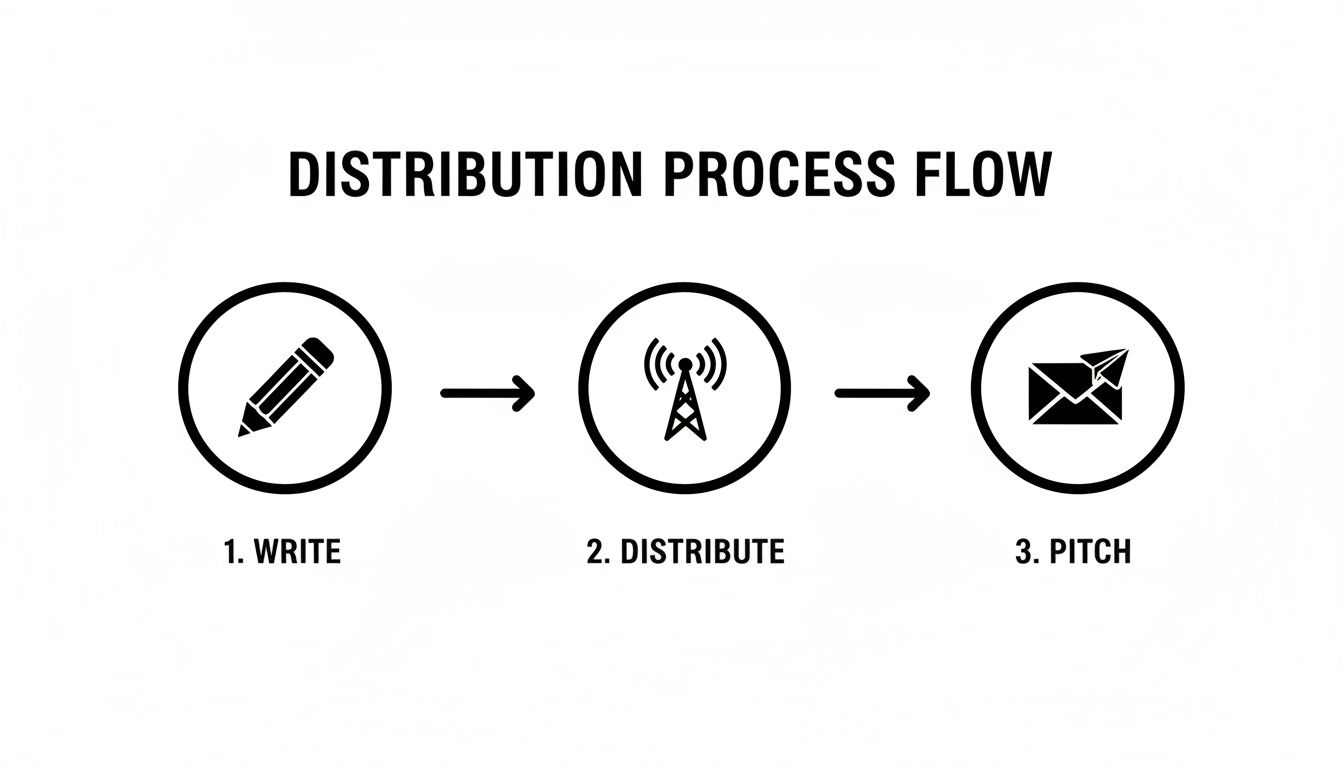
The entire process, from writing to outreach, is what you'll be measuring. Each step feeds into the next, creating a chain of outcomes you can track.
Tracking Immediate Traffic and Engagement
The first and most direct ripple you’ll see is referral traffic. In the days right after your release goes live, you need to be glued to your website analytics.
Jump into Google Analytics and look for spikes in your referral traffic that line up with your distribution date. Dig deeper. See which specific news sites or blogs are sending visitors your way. This is gold—it tells you which parts of your distribution network are actually delivering and which ones are duds.
Pay attention to more than just the number of visitors. The quality of that traffic is what counts. A high time-on-page and a low bounce rate are great signs. It means your press release didn't just get clicks; it attracted a genuinely interested audience.
Also, keep an eye on your direct traffic. A sudden increase in people typing your URL straight into their browser is a strong indicator that your press coverage successfully boosted brand awareness.
Monitoring Brand Visibility and Authority
The long-term value of a press release comes from building your brand’s authority, and that’s something that unfolds over weeks, not days.
This is where Google Search Console becomes your best friend. Check the Performance report for a noticeable uptick in search queries for your company name. When more people start searching for you by name after a release, you know you’ve made an impression.
To get a full picture, you need to consistently measure SEO performance and see how PR fits into the larger puzzle. Another pro move is to set up alerts for unlinked brand mentions. These are instances where a site mentions your brand without linking back. While they don’t pass direct link equity, Google is smart enough to see these as valuable brand signals.
Key Metrics for Tracking Press Release SEO Success
To make sense of the data, you need to know exactly what to look for and which tools to use. This table breaks down the essential metrics for evaluating the SEO impact of your press release campaign.
| Metric | Tool for Measurement | What It Tells You |
|---|---|---|
| Referral Traffic | Google Analytics | Shows which publications and news sites are sending direct traffic to your website. |
| Brand Search Volume | Google Search Console | Measures the increase in people searching for your brand name, indicating brand recall. |
| Unlinked Brand Mentions | Google Alerts, Brand24 | Tracks mentions of your company name without a link, a key brand authority signal for Google. |
| Keyword Rankings | Ahrefs, Semrush | Monitors the ranking changes for target keywords included in your press release over time. |
| Conversion Rate | Google Analytics | Tracks how many visitors from the press release completed a goal (e.g., sign-up, purchase). |
By focusing on these specific metrics, you move beyond guesswork and start making data-driven decisions about where to focus your PR efforts for the best possible SEO outcomes.
Connecting PR to Keyword Rankings and ROI
Ultimately, you need to connect the dots between your press release and tangible business results like better search rankings and a positive return on investment.
Start by tracking the search rankings for the main keywords you embedded in your press release. Don’t expect to hit page one overnight. This is a long game. But you should see a gradual upward trend as Google processes the new signals of relevance and authority from your media placements.
The ultimate measure of success, of course, is ROI. Here’s where it gets exciting. Industry benchmarks show that thought leadership campaigns that include press release distribution can pull in an average ROI of 748%. In some sectors, like financial services, that number can soar as high as 1,031%.
These figures make sense when you consider that 70% of marketers find SEO more effective than PPC for driving sales. Why? Because the trust earned from authentic journalistic coverage generates far more qualified interest than a paid ad ever could.
Common Questions About Press Releases and SEO
Even with a solid plan, a few questions always seem to surface when you start using press releases for SEO. Let's tackle the most common ones head-on.
Think of this as your quick-reference guide for clearing up any last-minute confusion. Getting these practical concerns sorted out ensures your strategy is built on a rock-solid foundation.
Can Google Penalize Me for Using Press Releases?
No, you won't get penalized for sending out a genuinely newsworthy press release through a reputable service. Google's penalties target manipulative tactics, like spamming low-quality sites with keyword-stuffed articles just to build links.
Reputable wire services almost always use "nofollow" links. This is a critical signal telling Google you aren't trying to artificially pump up your site's authority.
The key is to focus on authentic news. As long as your announcement is legitimate and you use respected channels, you'll stay safely within Google's guidelines. This lets you reap the rewards—like brand visibility and referral traffic—without the risk.
Your focus should always be on the quality and truth of your announcement, not on trying to game the system.
How Many Backlinks Will I Get from One Press Release?
It's time for a mindset shift. Stop counting links and start thinking about strategic impact. A single syndicated press release will land you hundreds of "nofollow" links as it gets picked up by news partner sites. The main job of these links is to give you massive visibility and help people discover your content, not to pass direct SEO value.
The real prize is something else entirely. The ultimate goal is for a journalist at a high-authority publication to spot your announcement on the wire and decide to write their own unique story about it.
That original story might only give you one or two high-authority, "dofollow" backlinks. But these are pure gold. A single earned media link from a top-tier news site is worth more to your SEO than a thousand syndicated links combined.
Instead of counting every link, measure what really matters:
- Pickups on major news sites that prove your story has legs.
- A spike in referral traffic from people clicking through to your website.
- Growth in branded searches as more people hear about your company and look you up.
This shift in perspective is absolutely fundamental to using press releases in a modern SEO strategy.
How Often Should I Send Press Releases for SEO?
Your publishing schedule should be driven by one thing and one thing only: having actual news to share. There's no magic number or perfect calendar that guarantees results.
Blasting out releases just to "do SEO" when you have nothing to announce is a waste of money. Even worse, it can destroy your credibility with journalists, who will quickly learn to ignore you if your announcements are all fluff.
For many businesses, a healthy rhythm might be one press release per quarter, which often lines up nicely with major company milestones.
Good reasons to issue a release include:
- Significant new product launches
- Securing a new round of funding
- Announcing a key strategic partnership
- Hiring a high-profile executive
- Reaching a major growth milestone (e.g., one million users)
Always choose quality over a rigid schedule. One powerful press release about a major event will do far more for you than a dozen weak ones sent just to check a box.
Should I Include Images and Videos in My Release?
Absolutely. Throwing high-quality multimedia into your release is a game-changer. It dramatically increases journalist engagement and the odds of your story getting picked up. Releases with visuals consistently get more views and interaction than text-only announcements.
From an SEO perspective, visuals create more doors for people to find you. Optimized images can show up in Google Images, and videos can rank in video search results. It just gives people more ways to discover your news and your brand.
To squeeze the most value out of your media, make sure you optimize the files properly.
- File Names: Use descriptive names like
your-company-new-feature.jpginstead of a genericIMG_1234.jpg. - Alt Text: Write clear, concise alt text for every image. This helps with accessibility and gives search engines more context.
- Captions: Always add a caption explaining what the image or video shows and why it matters to the story.
This little bit of extra effort reinforces your announcement's topic for search engines and makes life easier for the journalists you're trying to win over.
Ready to create a press release that gets noticed? Press Release Zen offers free, easy-to-use templates and step-by-step guides to help you craft a powerful announcement. Start building your brand's authority today at https://pressreleasezen.com.