Key Takeaways
- A press release is a formal, third-person document sent to journalists to earn media coverage. A newsletter is a conversational email sent directly to subscribers who already want to hear from you. They have different audiences, tones, goals, and distribution channels.
- A press release follows a standard format with a dateline, third-person quotes, and a boilerplate. A newsletter uses first-person language, a direct tone, and a clear CTA. This post includes a full example of each so you can see exactly how they read in practice.
- Use a press release for newsworthy announcements, product launches, funding rounds, and awards. Use a newsletter to nurture existing subscribers, drive repeat traffic, and build relationships over time.
- A press release earns new exposure through media coverage, while a newsletter deepens that relationship with your existing audience. Running both in parallel gives you reach and retention at the same time.
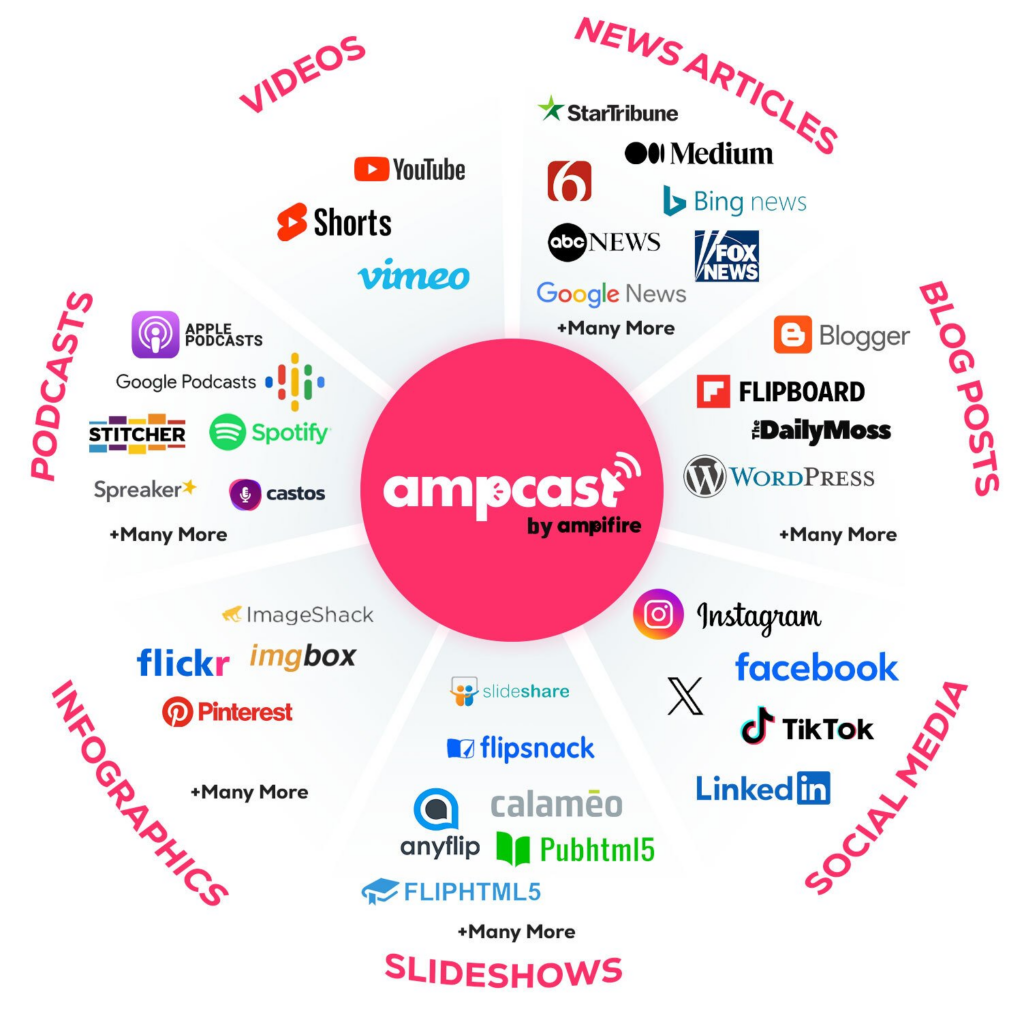
- AmpiFire’s AmpCast AI automatically turns your core message into eight content formats (news articles, blog posts, interview podcasts, longer informational videos, reels/shorts, infographics, flipbooks/slideshows, and social posts) and distributes them across 300+ high-authority platforms, giving you the reach of a press release and the consistency of a newsletter, without running them separately.
Press Release vs Newsletter: What Are They?
Press releases and newsletters are built for different jobs. A press release is a short, formally structured document sent to journalists and media outlets to earn third-party coverage. A newsletter is a recurring email delivered directly to subscribers who have already opted in to hear from you. They differ in audience, tone, goal, structure, and how success gets measured.
Most businesses treat them as separate tools, which they are. The smarter move is knowing when each one fits, and when a multi-channel approach like AmpiFire’s AmpCast AI can do the work of both at scale.
The sections below provide more details about press releases and newsletters, including examples of each.
Why Press Releases Don’t Work Anymore
Smart Businesses Are Moving Beyond Traditional PR
• The Problem: Press releases reach one audience through one channel, while your customers are everywhere online. Most get buried within days with poor ROI.
• The Solution: AmpiFire’s AmpCast creates 8 content formats (news articles, blog posts, interview podcasts, longer informational videos, reels/shorts, infographics, flipbooks/slideshows, and social posts) from a single topic and distributes them across 300+ high-authority sites, including Fox affiliates, Spotify, and YouTube.
What You’ll Learn on PR Zen:
✓ Why multi-channel content delivers 10x better results than press releases
✓ How to amplify your PR efforts across multiple platforms
✓ Real case studies of businesses dominating search, social, video, and podcasts
✓ Cost-effective alternative to expensive PR agencies
Ready to Replace Press Releases? Learn the AmpiFire Method →
What is the Difference Between a Press Release and a Newsletter?
Audience: Cold Media Contacts vs Warm Subscribers
A press release lands in the inbox of someone who doesn’t know you, doesn’t owe you anything, and is actively looking for reasons to ignore your pitch. A newsletter lands in the inbox of someone who signed up specifically to hear from you.
That gap in relationship temperature changes the language you use, the assumptions you can make, and the action you can reasonably expect the reader to take.
Tone: Formal & Objective vs Conversational and Personal
Press releases are written in strict third-person, objective language. Phrases like “Company X today announced…” are standard. There’s no room for personality, humor, or casual language. Any deviation from this professional tone signals amateur execution and reduces your pickup rate.
Newsletters operate on the opposite end of the tonal spectrum. First-person language, direct address (“Hey [First Name]”), and conversational writing style are acceptable. Subscribers respond to newsletters that feel human. Brand personality, warmth, and even occasional humor strengthen the subscriber relationship in ways a press release structurally cannot.
Goal: Earned Media Coverage vs Direct Engagement
The goal of a press release is to get someone else to tell your story. Success means a journalist picks up your release, writes an article, and publishes it to their audience, giving you earned media exposure and third-party credibility you couldn’t buy outright.
Meanwhile, the goal of a newsletter is to tell your own story directly, and success is measured in opens, clicks, and conversions from people already in your orbit.
Success Metrics: Media Pickup vs Open Rate
Press release success metrics include media pickup rate, the number of publications that ran the story, backlinks generated, and the domain authority of the outlets that covered it.
Newsletter success metrics include open rate, click-through rate, unsubscribe rate, and downstream conversions like demo signups or purchases.

Distribution: Newswires & Pitches vs Email Platforms
Press releases reach their audience through newswire services like PR Newswire, Business Wire, or GlobeNewswire, or through direct journalist outreach via personalized email pitches. The reach is potentially massive, but the conversion from distribution to actual coverage is unpredictable.
Newsletters are distributed through email marketing platforms like Mailchimp, ConvertKit, HubSpot, or Klaviyo. These platforms give you complete control over who receives your message, when they receive it, and how the send is segmented.
Traffic Impact: Backlinks from News Sites vs Traffic from Click-Throughs
Press releases and newsletters contribute to the site traffic in fundamentally different ways. A press release picked up by a high-authority news outlet generates backlinks from domains with strong domain authority scores.
Newsletters don’t generate backlinks in the same way, but they drive direct referral traffic to your website through embedded links and CTAs. Higher traffic signals to search engines that your content is valuable, which indirectly supports your rankings. Newsletters also re-engage existing audiences with new content, increasing page views and time on site, and reducing bounce rates, which are all positive site performance signals.
Examples of Press Releases and Newsletters
Press Release Example: Product Launch Announcement
FOR IMMEDIATE RELEASE
Luminos Health Launches ClearMind Focus Supplement, a Science-Backed Nootropic Designed for Remote Workers
Austin, TX — April 3, 2026
Luminos Health, an Austin-based wellness brand, today announced the launch of ClearMind Focus, a daily nootropic supplement formulated to support cognitive performance, mental clarity, and sustained energy without caffeine or stimulants.
ClearMind Focus combines clinically studied ingredients, including Lion’s Mane mushroom, Bacopa Monnieri, and L-Theanine in a single daily capsule, designed specifically for professionals navigating the demands of remote and hybrid work environments. The product is now available exclusively at luminoshealth.com, priced at $49 for a 30-day supply with free shipping on all US orders.
“Remote workers are dealing with more cognitive load than ever, and most energy products just mask fatigue with caffeine,” said Dr. Priya Nair, Co-Founder and Head of Product at Luminos Health. “ClearMind is built to support the brain’s natural function at the root level, so focus is sustainable, not borrowed.”
ClearMind Focus is third-party tested, non-GMO, and gluten-free, with a 60-day satisfaction guarantee on every order.
About Luminos Health: Luminos Health is a science-backed wellness brand founded in 2023 and dedicated to developing clean, effective supplements for modern professionals. The company is headquartered in Austin, Texas.
Contact: Jamie Holloway, PR Manager Luminos Health jamie@luminoshealth.com +1 (512) 847-3920
–
###
Newsletter Example: Monthly Customer Update
The Monthly Dispatch | April 2026 From the desk of Luminos Health
–
Hi [First Name],
Spring is here, and we have been busy. Here is what is new at Luminos Health this month.
ClearMind Focus Is Live: Our most requested product is finally here. ClearMind Focus is a caffeine-free nootropic designed for remote workers who need real, sustained mental clarity, not a spike and a crash. Grab your first bottle at 20% off with code CLEARMIND20 through April 30.
[Shop Now →]
New on the Blog: We published a deep dive this month on why most productivity supplements fail — and what the science actually says about cognitive performance. It is one of our most detailed posts yet.
[Read the Article →]
From Our Community: “I have been using Luminos supplements for three months and my afternoon energy crashes are basically gone. I did not expect such a noticeable difference.” — Sarah K., verified customer
What is coming next month: We are almost ready to announce our first subscription bundle, so stay tuned.
–
Thanks for being part of the Luminos community. As always, reply to this email anytime. We read every message.
Warmly, Jamie Holloway, PR & Community Manager, Luminos Health
You are receiving this because you signed up at luminoshealth.com. [Unsubscribe]
Press Release vs Newsletter: Comparison Table
| Feature | Press Releases | Newsletters |
| Primary purpose | Announce news, milestones, or launches to media outlets and the public | Nurture and inform an existing audience of subscribers over time |
| Target audience | Journalists, media outlets, search engines, and the general public | Opted-in subscribers, existing customers, and leads |
| Distribution | Distributed via press release services or news wires | Sent directly to a curated email list via platforms like Mailchimp, Kit, or MailerLite |
| Content type | Formal, newsworthy announcements written in third person with a structured format | Conversational, editorial, or promotional content written directly to the reader |
| Frequency | Occasional: published when there is genuine news to announce | Regular: weekly, bi-weekly, or monthly on a consistent schedule |
| Audience ownership | No: reaches a broad public audience, but you do not own the distribution channel | Yes: your email list is a proprietary, owned marketing asset |
| Measurability | Media pickups, backlinks, share of voice, and referral traffic | Open rates, click-through rates, unsubscribes, and conversions |
| Best used for | Product launches, funding announcements, awards, partnerships, or any newsworthy brand milestone | Building relationships, driving repeat traffic, promoting content, and nurturing leads toward conversion |
Go Beyond Press Releases & Newsletters With AmpCast AI
Press releases earn third-party coverage. Newsletters build direct relationships. Both have a place in a serious content strategy, and the right choice depends on what you are trying to do at any given moment. For most businesses, the answer is a combination of the two.
AmpiFire’s AmpCast AI was built for businesses that want to go further. The platform takes your core message and turns it into eight content formats, then distributes them across 300+ high-authority platforms automatically, so your announcement reaches audiences far beyond what a single press release or newsletter can cover. If you want to see how AmpiFire expands your content reach, start here.
Ready to Go Multi-Channel? Try the AmpiFire Method →
Frequently Asked Questions (FAQs)
Can a press release be sent to subscribers like a newsletter?
Technically, yes, but it’s almost always a mistake. Press releases are written for journalists, not customers. Sending a raw press release to your email list typically results in low engagement, higher unsubscribe rates, and a missed opportunity to convert warm leads. If you want to share the same news with your subscriber list, rewrite it as a newsletter. Keep the core announcement but shift the tone to be direct and conversational, lead with the benefit to the reader, and close with a clear CTA.
What makes a newsletter more effective than a press release for lead nurturing?
Lead nurturing is about building trust over time through repeated, valuable touchpoints, and newsletters are structurally designed to do that. Every newsletter reinforces your brand’s presence in the subscriber’s inbox, delivering useful information that moves them progressively closer to a purchase decision. Press releases are single-event documents and have no mechanism for ongoing relationship-building.
How long should a press release be compared to a newsletter?
A standard press release should run between 300 and 500 words, long enough to cover all essential information, short enough to respect a journalist’s time. Newsletters have more flexibility: a brief weekly roundup might run 150–300 words, while a detailed monthly update with multiple sections can reach 800–1,200 words.
Can small businesses benefit from using both press releases and newsletters?
Yes. A small business press release announcing a local award, a community initiative, or a notable client win can earn meaningful regional media coverage that drives real foot traffic and brand awareness in a way that large-scale national PR often cannot. On the newsletter side, small businesses typically have closer relationships with their customer base, which means their newsletters can be more personal and direct than those of larger brands.
How does AmpCast AI outperform traditional press releases?
AmpCast AI by AmpiFire automatically creates eight content formats and distributes them across 300+ high-authority news sites, including Fox affiliates, Spotify, and YouTube simultaneously. This delivers a high volume and variety of media placements, resulting in a compounding effect on your brand’s online authority, with more high-quality backlinks, broader keyword coverage, and greater search engine visibility, building with every campaign.
*Note: Pricing and/or product availability mentioned in this post are subject to change. Please check the retailer’s website for current pricing and stock information before making a purchase.