A press release in SEO isn't the simple link-building gimmick it used to be. It’s now a much smarter play for building brand authority and pulling in high-quality referral traffic. A press release is no longer just a formality; it's a powerful signal to search engines that your brand is credible and has something newsworthy to say.
The Evolving Role of a Press Release in SEO

So, do press releases still matter for SEO? The answer is a loud and clear "yes," but the game has completely changed. The old days of blasting keyword-stuffed releases to hundreds of sketchy sites for a quick link spike are over. In fact, that's a great way to get yourself penalized by Google today.
Think of it like this: an old-school press release was like shouting into a crowded stadium, just hoping a journalist might hear you. A modern, SEO-savvy press release is more like a well-aimed spotlight. It signals your brand's authority directly to the folks who matter most: legitimate news outlets, industry influencers, and, of course, the search engines themselves.
From Direct Links to Authority Signals
Today, the real SEO value of a press release is indirect. Instead of obsessing over getting "do-follow" links, the goal is to create strong brand signals that boost your website's overall authority and trustworthiness in Google's eyes.
These indirect benefits are where the real long-term gold is, and they include:
- High-Quality Brand Mentions: Just getting your brand name mentioned on a reputable news site—even without a link—tells Google you're relevant and people are talking about you.
- Authoritative Backlinks: While most syndicated links won't move the needle, a genuine pickup from a major news outlet can land you a powerful, authoritative backlink that gives your SEO a serious boost.
- Enhanced E-E-A-T: A press release is verifiable, third-party proof of your company’s Experience, Expertise, Authoritativeness, and Trustworthiness (E-E-A-T). These are critical ranking factors, especially in sensitive niches.
In today's search world, a single earned link from a high-authority news publication is worth more than a thousand syndicated links from low-tier directories. It's all about quality and authenticity, not quantity.
Thriving in a Shifting Search World
Using a press release in SEO has become even more critical as the search world keeps changing. Organic search still drives a massive 46.98% of all website visits, but it's also seeing a 3.65% decline as AI Overviews and zero-click searches take over more of the results page.
A well-distributed press release helps you fight back by securing placements on high-authority sites like Google News—which often have domain ratings (DR) of 70+. This drives valuable referral traffic directly to you and signals your relevance to Google's algorithm. For a deeper dive, you can check out the latest search engine statistics.
To really nail this, you have to separate the old, outdated tactics from today's reality. Let's clear the air.
Modern Press Release SEO Fact vs Fiction
There's a lot of old advice floating around about press releases and SEO. Here’s a quick rundown of what’s a myth and what’s actually true today.
| Outdated Myth | Current Reality |
|---|---|
| The goal is to get as many backlinks as possible, regardless of quality. | The goal is to earn high-quality brand mentions and potential backlinks from legitimate news sites. |
| All "nofollow" links from press releases are worthless for SEO. | "Nofollow" links from authoritative sources drive valuable referral traffic and create powerful brand signals. |
| You should stuff your release with as many exact-match keywords as you can. | Keywords should be used naturally in the headline, subheadings, and body to provide context. |
| Distributing to free, low-quality PR sites is a valid link-building strategy. | This practice is seen as spammy by Google and can lead to penalties or a loss of rankings. |
Understanding this shift is the first step. When you stop chasing dozens of low-value links and start focusing on earning high-quality brand signals, you’re playing the modern SEO game—and you're much more likely to win.
Building Verifiable Trust with E-E-A-T Signals

In a digital world overflowing with information, Google’s E-E-A-T framework is how it separates the contenders from the pretenders. It stands for Experience, Expertise, Authoritativeness, and Trustworthiness, and it’s the set of signals Google uses to figure out which brands are the real deal.
A well-executed press release in SEO is one of the best tools you have for building these signals. Think of it this way: the claims you make on your own website are just your side of the story. But a press release, picked up by a legitimate news outlet, acts like an independent witness backing you up.
This third-party nod is what builds a rock-solid foundation of trust, something that both search algorithms and actual human beings value.
Why E-E-A-T Is Your Brand's Credibility Score
E-E-A-T isn't just another SEO buzzword—it's a direct reflection of your brand’s reputation online. Google’s main job is to show its users information from sources that are experienced, knowledgeable, and trustworthy.
When your company announces a new product, a big partnership, or some groundbreaking research, a press release makes it official. It turns internal news into a newsworthy event.
Once that announcement gets picked up by news sites, it starts to create a digital paper trail of your brand's accomplishments. Every pickup is another vote of confidence, adding to your brand's overall authority.
A press release transforms your company’s internal news into a public, verifiable record. This is the very essence of building trustworthiness in the eyes of search engines.
This has become even more important with the rise of AI-driven search. A press release in SEO is a standout way to build E-E-A-T, which is one of the top three Google ranking factors. With AI summaries now answering 60% of searches without a click, traditional SEO is facing a new challenge.
Press releases distributed to hundreds of news outlets create those verifiable, third-party endorsements that AI can cite, confirming your brand’s authority.
Weaving E-E-A-T Directly into Your Press Release
You can—and should—bake E-E-A-T signals right into the fabric of your press release. This isn’t about just dropping in keywords; it's about showing, not just telling, why you're credible.
1. Showcase Real Experience with Data and Case Studies
Don't just say you launched a new feature. Include specific data points from its development or share results from your beta testers. A quick mention of a customer success story or a mini case study shows real-world application and hands-on experience.
2. Highlight Expertise Through Executive Quotes
A quote from your CEO or a subject matter expert needs to offer real insight, not just fluffy corporate speak. Get them to explain the "why" behind the announcement. A unique perspective establishes them as an expert and gives journalists a juicy soundbite to use.
3. Build Authority with a Professional Boilerplate
Your boilerplate—that "About Us" section at the end—is prime real estate for reinforcing E-E-A-T. This is your chance to really drive home who you are. Make sure it includes:
- Founding Date: Shows you've been around the block.
- Mission Statement: Clarifies your purpose and what you stand for.
- Key Achievements or Awards: Provides instant third-party validation.
- Market Position: Defines your place and authority in your industry.
To truly build verifiable trust, remember that a press release is just one of many effective brand touchpoints. It’s a powerful public-facing moment, but it’s part of a much bigger picture. By consistently showing your company as an experienced and authoritative leader across all your channels, you create a cohesive brand identity and strengthen the signals that matter most for long-term success.
How to Optimize Your Press Release for Search Engines
It’s one thing to know that a good press release in seo can build your E-E-A-T, but it’s another thing entirely to actually make it happen. You need a solid, repeatable process to get every element of your release just right. This is all about making sure your announcement is not only compelling for a journalist, but also perfectly clear to a search engine crawler.
Think of it like you’re cooking for two very different guests. The first is a food critic (the journalist) who’s looking for amazing flavor, a great story, and beautiful presentation. The second is a nutritionist (the search engine) who just wants to scan the ingredients and tally the nutritional value. Your job is to make a dish that impresses them both.
Start With a Keyword-Optimized Headline
Your headline is the most critical piece of the puzzle for both human readers and search engines. It has to be punchy enough to make a journalist stop scrolling, but it also needs to contain your main keyword in a way that feels natural. A great headline is simple, direct, and tells the whole story in one line.
Here’s how to nail it every time:
- Front-Load Your Keyword: Get your most important keyword or topic as close to the beginning of the title as possible.
- Keep It Short: You want a headline that won’t get truncated in search results. Titles around 40-60 characters tend to get a better click-through rate.
- Use Action Verbs: Words like “Launches,” “Announces,” or “Partners” give your news a sense of urgency and importance.
For example, don’t just say "A New Initiative." Instead, try something specific like, "Innovate Corp Launches AI-Powered Platform to Streamline Small Business Operations." Everyone instantly knows what the news is about.
Craft a Powerful Opening Paragraph
Your first paragraph—the lede—is your elevator pitch. It needs to cover the who, what, when, where, and why of your announcement in the first sentence or two. This is also the second most important spot to place your primary keyword, reinforcing the topic for search engines.
A strong opening paragraph doesn't bury the lead. It delivers the most critical information upfront, respecting the time of both journalists and search engine crawlers.
The rest of the press release should flesh out the story with supporting details, quotes from key people, and more context. Remember to use short paragraphs and subheadings to keep things easy to read. For a deeper dive, check out our guide on optimizing press release metadata and keywords.
Master the Art of Links and Multimedia
Links are what connect the web, but how you use them in a press release is a bit of a science. The vast majority of links you get from syndicated press releases will be "nofollow," which means they don't directly pass SEO juice. But that doesn't mean they're worthless. Far from it.
This decision tree gives you a quick way to think about the SEO value of a link from a press release pickup.
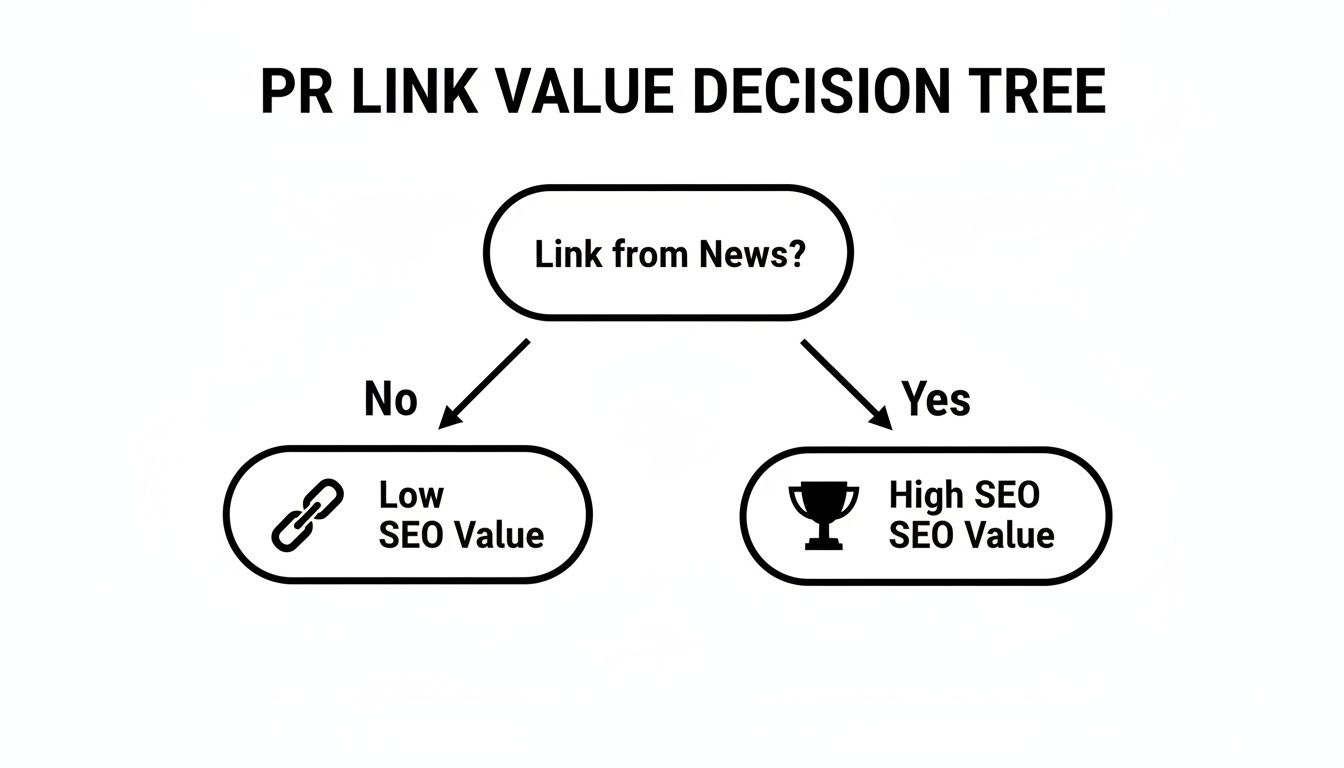
A link from a real news source, even if it's "nofollow," sends strong brand signals to Google and drives real people—referral traffic—to your site. Those are the links you really want.
Here’s a quick guide to managing links and media:
- Link to a Relevant Landing Page: Don't just link to your homepage. Send people to a specific page that’s directly related to the announcement, like a new product page or a dedicated blog post.
- Use Descriptive Anchor Text: Ditch the generic "click here." Use anchor text that tells people where they’re going, like "our new AI-powered platform."
- Embed High-Quality Media: Always include relevant images, infographics, or videos. Make sure to give the files descriptive names and fill out the alt text with keywords.
Solidify Authority with Your Boilerplate
Your boilerplate is the standard "About Us" section that goes at the very end of the release. It’s your last chance to drive home your brand's authority. Make sure it clearly explains who you are, what you do, and includes a clean link to your homepage. A key part of E-E-A-T is building audience trust through content marketing, and your boilerplate helps cement that trust.
When you put this all together, the payoff can be huge. Historically, press releases have been shown to drive over 1,000% more traffic than social media organically. Since organic channels account for 53.3% of all traffic, getting your news syndicated on indexed sites that rank for millions of keywords is a massive win. You can discover more insights about these SEO statistics and see for yourself how PR backlinks often have a much longer shelf life than other types, making this a strategy that keeps on giving.
Choosing the Right Press Release Distribution Strategy

So you've crafted a brilliant, SEO-rich press release. That's a great start, but it's only half the job. Without a smart distribution strategy, even the most groundbreaking announcement will just gather dust. How you get your release out into the world is everything—it determines who sees it, whether real journalists pick it up, and what it ultimately does for your brand.
Think of it like this: your press release is a hot tip. You could whisper it directly into the ear of a few influential people—a targeted, personal approach. Or, you could broadcast it over a massive network, ensuring thousands hear it instantly. Each path has its own rules, costs, and results, especially when we're talking about the impact of a press release in seo.
The Three Tiers of Distribution
When it's time to send your news out, you've got three main roads you can take. Each serves a different purpose and will get you different results, from surgically targeting specific editors to blanketing the web with your announcement. Knowing the difference is crucial for hitting your campaign goals.
- Direct Media Outreach: This is old-school PR. You build a curated list of journalists, editors, and bloggers who actually cover your industry and send your release to them one by one. It’s a ton of work, but it’s the absolute best way to build real relationships and earn genuine media coverage.
- Free Distribution Platforms: These services post your release on their site for free. The catch? The reach is usually tiny. They rarely get picked up by legitimate news outlets and offer next to no SEO benefit.
- Premium Wire Services: These are the paid powerhouses. They guarantee your release hits a massive network of newsrooms, media sites, and online portals. This is, without a doubt, the fastest way to get widespread syndication.
The most effective strategies usually mix direct outreach with a paid wire service. The wire gives you the broad reach and important brand signals, while your direct outreach goes after the high-value publications that can turn your announcement into a real, in-depth story.
Comparing Wire Services for Maximum SEO Impact
Heads up: not all paid distribution services are the same. You have to look past the shiny promises of "hundreds of placements" and dig into the quality of their network. For a press release in seo, the authority of the sites where your release lands is what really moves the needle.
You want services that guarantee inclusion in major news hubs like Google News and Yahoo News. These placements are gold because they create authoritative brand signals that Google’s algorithm notices and respects. Even if the links are nofollow, just having your brand name on these trusted platforms helps build your E-E-A-T (Experience, Expertise, Authoritativeness, and Trustworthiness).
To help you choose, let's break down how different types of platforms usually perform. If you want to go even deeper, you can find detailed reviews in our guide on the best press release distribution services.
Press Release Distribution Platform Comparison
This table gives you a quick look at the different service tiers, helping you match a platform to your budget and what you hope to achieve for your SEO.
| Platform Type | Typical SEO Benefit | Best For | Cost Estimate |
|---|---|---|---|
| Direct Outreach | Potential for high-authority, dofollow links and authentic coverage. | Building long-term media relationships and landing feature stories. | Primarily time and effort. |
| Free Platforms | Very minimal; may provide a single backlink from a low-authority site. | Brands with zero budget, testing a release's basic format. | Free. |
| Basic Wire Services | Syndication to a few dozen local or regional online news sites. | Local announcements or businesses with a very limited budget. | $99 – $250 per release. |
| Premium Wire Services | Broad syndication to hundreds of top-tier media outlets, including Google News. | Major company news, product launches, and building national brand authority. | $400 – $1,200+ per release. |
At the end of the day, your choice comes down to your objective. If your main goal is to land a feature story in a top industry magazine, direct outreach is your best bet. But if you need to generate widespread brand signals and get your news indexed fast for SEO, a premium wire service is an investment you'll need to make.
So, you've sent your press release out into the world. You’ve invested the time, the budget, and the creative energy. Now what? How do you actually prove it did anything for your SEO?
Just counting how many sites picked up your release is a vanity metric. It looks nice on a report, but it doesn't tell you the real story. To show a true return on your investment, you need to dig deeper into the results that matter.
Think of it like a post-treatment check-up. You need to look at specific, tangible signs to know if your strategy actually worked. It’s all about moving past the surface-level numbers and focusing on data that shows a real impact on your website's health and authority.
Tracking Your Backlink Profile
One of the biggest SEO wins from a press release comes from earned backlinks. Sure, most syndicated links will be nofollow, but the real gold is in the genuine media pickups from journalists—those can result in powerful, dofollow links. You have to keep a close eye on these.
Fire up tools like Ahrefs or Semrush to track new backlinks pointing to your domain. After your release goes live, set up alerts so you get a notification every time a new site links to you. Pay special attention to the Domain Rating (DR) or Authority Score (AS) of these sites. A single link from a high-authority news outlet is worth its weight in gold.
This also helps you keep your backlink profile healthy. If you see a sudden flood of low-quality links from spammy sites, that's a red flag. But if you see earned links from reputable sources, you know your strategy is hitting the mark.
Monitoring Referral Traffic and Branded Search
Beyond just links, a great press release should drive actual people to your site and get them talking about your brand. These two indicators are critical for measuring success.
Check for Referral Traffic Spikes
Jump into Google Analytics and head to your traffic acquisition reports. Filter by "Source/Medium" and look for an increase in visitors coming from news sites or media outlets that ran your story. A clear jump in referral traffic is proof that your announcement didn't just get published—it got read.
Monitor Branded Search Volume
When people see your brand mentioned in the news, their next stop is often Google. Use Google Search Console to watch for an increase in impressions and clicks for searches that include your brand name. A significant lift in branded search volume right after a release is a fantastic sign that your brand awareness is growing.
Increased branded search is a huge signal to Google. It tells the algorithm that your brand is gaining authority and becoming a recognized name in your space, which can give you a boost in rankings for your other keywords, too.
Uncovering Unlinked Brand Mentions
Not every media pickup will include a link, but that doesn't make them worthless. Unlinked brand mentions are still powerful brand signals that Google's algorithm can pick up on and connect to your brand's entity.
You can use tools like BuzzSumo or BrandMentions to find these. When you spot an unlinked mention on a quality news site, you've got a golden opportunity. Reach out to the writer or editor, thank them for the coverage, and politely ask if they'd be willing to add a link back to your site. It’s a simple way to turn a brand signal into a direct SEO win.
By focusing on these core metrics, you'll get a clear, data-driven picture of how your campaign really performed. For an even deeper dive, you might want to explore our guide on the essential press release KPIs and how to measure them. This approach not only justifies your investment but also gives you the insights you need to make your next campaign even better.
Press Release Examples and Proven Templates
Theory is one thing, but seeing how a press release for SEO works in the wild is what really makes the concepts click. Let's look at a few real-world scenarios to see how different businesses use press releases to hit specific, measurable goals.
These examples show that a great announcement is more than just news—it’s a precision tool for boosting your search visibility and authority.
Tech Startup Launching a New Feature
Imagine a SaaS startup rolling out a new AI-powered analytics feature. Their goal wasn't just to tell current users about it. They wanted to grab the attention of new customers actively searching for AI analytics tools.
- The Strategy: They wrote a press release with a killer headline: "InnovateTech Launches AI Analytics Suite to Predict Customer Churn for E-commerce Brands." The body was packed with data, a quote from the lead developer, and a clear link to the new product page.
- The Keywords: They focused on long-tail keywords people would actually search for, like "AI tool to predict churn" and "ecommerce customer analytics platform."
- The Result: A handful of tech blogs picked up the story. One major publication even wrote a feature on them, landing a high-authority backlink. Within a month, they saw a 40% jump in organic traffic to the feature page and started ranking on page one for their main keywords.
B2B Service Firm Announcing a Partnership
A mid-sized consulting firm partners up with a big name in the software industry. The goal here is to borrow some of that partner's brand authority, build credibility, and tap into a new audience.
A partnership announcement is a fantastic way to borrow authority. When you tie your brand to an established leader, you're sending a powerful E-E-A-T signal to potential clients and search engines.
Their press release was all about the win-win. The headline got straight to the point: "Acme Consulting and SolutionCorp Partner to Offer Integrated Digital Transformation Services." Quotes from both CEOs drove home the shared vision and customer benefits.
This example from Wikipedia shows the classic, rigid format journalists expect. It's all about clarity and getting the facts across quickly.
Notice the standard structure: a clear headline, a dateline, and a boilerplate. It’s built for function, not flair.
Local Business Opening a New Location
A beloved local restaurant is expanding to a second location in a new city. Their objective is to nail their local SEO from the start and get people through the door on opening day.
- The Strategy: They sent out a geo-targeted press release aimed at local media. The headline made it personal: "Cityville's Favorite Eatery, The Corner Bistro, Opens New Location in Oakwood."
- The Keywords: The release was optimized for local searches like "new restaurant in Oakwood" and "best lunch spots Cityville."
- The Result: Local news sites and food bloggers ran with the story. This created local citations and backlinks that shot their Google Business Profile ranking up for the new spot. They were packed on opening week, with tons of customers saying they read about it online.
These examples prove that a successful press release for SEO is always tied to a clear business goal. To give you a head start, we've put together templates for these exact scenarios. You can grab our template for a product launch or a new partnership announcement and start building your own campaign.
Frequently Asked Questions About Press Releases and SEO
Let's be honest, the relationship between press releases and SEO can be confusing. It’s a field littered with outdated advice and lingering myths from a decade ago.
We’re here to cut through the noise. This section tackles the most common questions we hear, giving you straight answers so you can build a press release SEO strategy that actually works today.
Can a Press Release Hurt My SEO?
Absolutely. A press release can definitely backfire and harm your SEO if you don't know what you're doing. The biggest mistake is using cheap, low-quality distribution services that blast your announcement across hundreds of spammy, irrelevant websites.
This was a popular tactic back in the early 2010s for stuffing keywords and building mass links. Today, Google sees it for what it is: a manipulative scheme. A poorly run campaign can earn you a manual penalty or get flagged by an algorithm update, tanking the rankings you worked so hard to build. Quality and genuine news value should always trump the quantity of links.
Are Press Release Links Nofollow?
Yes, the overwhelming majority of links you get from a syndicated press release will be tagged as “nofollow.” This is an automatic setting news outlets and wire services use to tell search engines not to pass any ranking authority, or "link juice," through that link.
They do this to stop people from exploiting their sites for easy link-building. But don't be discouraged—a nofollow link from a major news site is still incredibly valuable. It drives real people to your site, builds massive brand awareness, and sends powerful signals to Google about your credibility and expertise (E-E-A-T).
Think of a "nofollow" link on a major news site as a valuable public endorsement. It may not directly pass SEO authority, but it tells both Google and potential customers that your brand is credible and newsworthy.
How Often Should I Send a Press Release?
There's no magic number here. The answer is simple: only send a press release when you have something genuinely newsworthy to share. If you bombard journalists and your audience with minor updates, you'll quickly develop a reputation for crying wolf, and your important announcements will get ignored.
Focus on milestones that an outside audience would actually care about. Great reasons for a press release include:
- A major product launch or game-changing update.
- A new C-suite hire or significant company expansion.
- A strategic partnership with another well-known brand.
- The release of original research or compelling data.
Always aim for quality over quantity. A single, powerful announcement once a quarter is infinitely more effective than a weak, forgettable one every week.
Ready to create a press release that gets real results? Press Release Zen offers free templates, expert guides, and in-depth comparisons to help you plan, write, and distribute announcements that build authority and drive growth. Visit us at https://pressreleasezen.com to get started.