Using a press release for SEO is one of the most misunderstood but powerful tools in your arsenal. It’s a classic move for getting high-quality backlinks, stamping your brand’s authority on a topic, and climbing the search rankings. A well-optimized press release isn't just a fleeting announcement; it's a permanent digital asset that turns your news into a story that both journalists and Google want to see.
Why Press Releases Are a Powerhouse for SEO
Let's get one thing straight: anyone who tells you press releases are "dead" is thinking about the fax machine era. The old spray-and-pray approach of spamming wire services is definitely over. But the strategic press release? It's more critical to a smart SEO plan than ever before. This isn't just about shouting your news from the rooftops; it’s about signaling your relevance and authority directly to search engines.
When a solid press release gets picked up by real media outlets, it creates incredibly powerful backlinks. These aren't just any links—they're editorial links from trusted domains. In Google's eyes, that’s like getting a glowing recommendation from a respected expert. It’s a foundational piece of any effective link building strategy, and it’s why PR remains a secret weapon for so many savvy marketers.
The Shift Toward SEO Integration
The industry is catching on. A successful press release today has to do double duty: it needs to grab a journalist's attention and satisfy search algorithms. This change is forcing a merger between traditional PR and technical SEO, and the smartest teams are already combining their efforts.
The numbers back this up. In 2026, 43% of PR teams are actively planning to bring SEO tools into their workflow because they see the impact. When optimized correctly, a single release can give organic search rankings a serious boost and pull in highly targeted traffic. You can dig into more of the data on why press releases are more important than ever on ereleases.com.
The takeaway is simple: brands that get this dual value—mixing old-school PR benefits with modern SEO needs—are setting themselves up to win. They’re gaining visibility in traditional search and positioning themselves for the new wave of AI-powered search.
Core SEO Benefits of a Strategic Press Release
So, how does a press release actually translate into SEO wins? It’s not just one thing, but a handful of connected perks that build on each other to boost your online presence. From backlinks to brand authority, each piece of the puzzle serves a purpose.
This table breaks down the main advantages you get from a well-planned press release campaign.
| SEO Benefit | How It Works | Primary Goal |
|---|---|---|
| High-Authority Backlinks | Media outlets link to your site as a source, passing valuable "link equity" or authority. | Improve domain authority and SERP rankings. |
| Topical Authority | Consistent, relevant news coverage signals to Google that you are an expert in your niche. | Rank for a wider range of related keywords. |
| Increased Referral Traffic | Readers of news articles click through the links in your press release to visit your website. | Drive qualified leads and potential customers. |
| Brand Signal & Trust | Mentions on credible news sites build brand recognition and trust with search engines and users. | Enhance brand credibility and search visibility. |
| Content for AI Overviews | Well-structured, factual releases can be used as sources for AI-generated search summaries. | Gain prominent placement in AI Overviews. |
In the end, a press release for SEO isn't just an announcement—it's a strategic play. By crafting a story that’s genuinely newsworthy and optimizing it for search, you’re creating a powerful asset that delivers value long after the initial buzz fades. You're turning a moment into a lasting digital footprint.
Finding Your Newsworthy Angle for SEO Success
Before you write a single word, you need to get one thing straight. A killer press release for SEO isn't built on good writing; it's built on a genuinely newsworthy story. Without that, you’re just shouting into the void.
Too many companies fall into the trap of thinking their internal updates are front-page news. A new hire or a minor product tweak might be a big deal in your weekly meeting, but journalists—and by extension, search engines—couldn't care less.
The real trick is to connect your announcement to a bigger conversation happening outside your office walls. It’s about finding an angle that offers real value, sparks curiosity, or solves a problem for a wider audience.
What Actually Counts as Newsworthy?
So, what makes the cut? A story is generally newsworthy if it’s timely, relevant, and has a real impact. It has to grab the attention of both the media and the people you’re trying to reach. Think less "We launched a new feature" and more "Our new feature helps small businesses slash costs by 30% during record inflation."
You need a hook that makes your story impossible to ignore. Here are a few angles that almost always work:
- Groundbreaking Data or Research: Got a unique industry report or survey data? Releasing stats that reveal a new trend is gold. A cybersecurity firm, for example, could publish a report on the spike in phishing scams targeting remote workers.
- Major Company Milestones: This includes significant funding rounds, hitting a massive user count (like one million users), or a major acquisition. These events signal momentum and industry clout.
- Big-Name Partnerships: Teaming up with a well-known brand gives you instant credibility and exposes your story to their audience, too.
- Human Interest Stories: People connect with people. Highlight a unique company culture program, a major community project, or a powerful story about how your product changed a customer's life.
- Responding to Current Events: Tie your news into a trending topic by offering an expert opinion, a unique solution, or relevant data. For instance, a logistics company could share data on supply chain bottlenecks during the holiday rush.
The secret is to frame your announcement not around what you did, but why it matters to someone else. If your story doesn't pass this "so what?" test, you need to dig deeper for a better angle.
Weaving in Your SEO Keywords
Once you’ve locked down a newsworthy topic, it’s time to sync it up with your SEO strategy. This isn’t about stuffing keywords; it’s about finding the phrases journalists and potential customers are actually searching for.
Put on your reporter hat. If you were covering a story on a new AI-powered marketing tool, what would you Google? "AI marketing automation stats"? "New MarTech platforms"? "AI tools for small business"? These are the types of terms you want to work naturally into your headline and opening paragraph.
For instance, ditch a boring headline like this:
"InnovateCorp Launches Version 2.0 of Its Platform"
And go for something that packs a punch and hits your keywords:
"InnovateCorp's New AI Platform Helps Retailers Predict Consumer Trends with 95% Accuracy"
The second one is far more compelling. It also targets valuable keywords like "AI platform," "retailers," and "consumer trends," telling a journalist exactly what the story is about and why people will search for it.
The Newsworthy Checklist
Before you invest time and money into a campaign, run your idea through this quick checklist. It’s a simple way to see if your story has enough media appeal and SEO potential.
| Evaluation Point | Description | Example |
|---|---|---|
| Is it Timely? | Does it connect to a current event, trend, or season? | A travel app releasing data on booking trends right before summer. |
| Is it Impactful? | Does it affect a large group of people or an entire industry? | A fintech company launching a tool that simplifies taxes for freelancers. |
| Is it Unique? | Does it offer a new perspective, exclusive data, or a first-of-its-kind product? | A solar company announcing a major breakthrough in battery efficiency. |
| Does it have a Human Element? | Can you tie the news to a relatable human experience or problem? | A health tech startup sharing a powerful patient success story. |
| Does it Align with Keywords? | Can you naturally embed relevant, searchable terms into the story? | A real estate firm’s report on "affordable housing markets in 2024." |
Answering these questions honestly helps you separate a self-serving announcement from a truly strategic piece of content. When you nail the newsworthy angle and pair it with smart keyword research, your press release becomes a powerful tool for earning media pickups and high-authority backlinks that drive real SEO growth.
Crafting and Optimizing Your Press Release for Search
Writing a press release for SEO is a bit of a tightrope walk. You need to sound professional enough for a journalist to take you seriously, but also structure your content so a search engine crawler understands exactly what you're about. Get this hybrid format right, and your announcement becomes a powerful link-building machine.
It all starts with your headline. This isn't just a title—it's your one and only shot to grab attention from a busy editor and signal your relevance to Google. A weak headline is a dead end. A powerful one earns clicks, shares, and media pickups.
Write a Headline That Works for People and Bots
Your headline has to do double duty: summarize your news in a compelling way while naturally working in your main keyword. Ditch the dry, corporate-speak headlines that put everyone to sleep. Instead, get right to the impact of your news.
Think about it this way:
The old way:
"TechSolutions Announces New Software Update"
This is a total snooze-fest. It’s generic, tells the reader nothing of value, and will be forgotten instantly.
The optimized way:
"TechSolutions Launches New AI Accounting Software to Cut Invoicing Time for Freelancers by 40%"
Now that's a headline. It’s better for two big reasons. First, a journalist immediately sees a story: a specific product ("AI accounting software"), a target audience ("freelancers"), and a quantifiable benefit ("cut invoicing time by 40%"). Second, Google sees a descriptive, keyword-rich title that clearly communicates the topic.
Hook Them with a Powerful Lead Paragraph
Once you've nailed the headline, your first paragraph is the next most valuable piece of digital real estate. You have maybe one or two sentences to convince a busy person to keep reading. This is where you have to deliver the goods upfront by answering the classic "who, what, when, where, and why."
For SEO, this paragraph is also the perfect spot to include your primary keyword again, this time hyperlinked to your most relevant product or landing page. Front-loading the most important info helps search engines quickly grasp the core subject of your release.
Expert Tip: Don't forget the dateline (e.g., "NEW YORK, NY – October 26, 2026 –") right before your lead paragraph. This is a standard press release convention that instantly signals to journalists that they're reading a formal announcement, adding a layer of professionalism.
Your lead should be a mini-version of your entire story. If someone only reads your headline and this first paragraph, they should still walk away knowing exactly what you've announced.
Weave in Links and Anchor Text Naturally
This is where so many people get a press release for SEO wrong. They cram their release full of exact-match keyword links, which just screams "spam" to both news outlets and search engines. A more subtle, strategic approach works far better.
Here’s a simple framework I stick to for placing links:
- Primary Keyword Link: Early in the body of the release, include one link using a relevant—but not overly optimized—anchor text. This should point to the most important landing page for your campaign.
- Brand Name Link: Somewhere in the middle, link your company name directly to your homepage. This is a very natural way to build brand-associated links and is a common practice.
- Boilerplate Link: Your final "About [Company Name]" section should always contain a clean link to your homepage. This is standard practice and completely expected by editors.
This three-step process helps you find a genuinely newsworthy story before you even start writing.
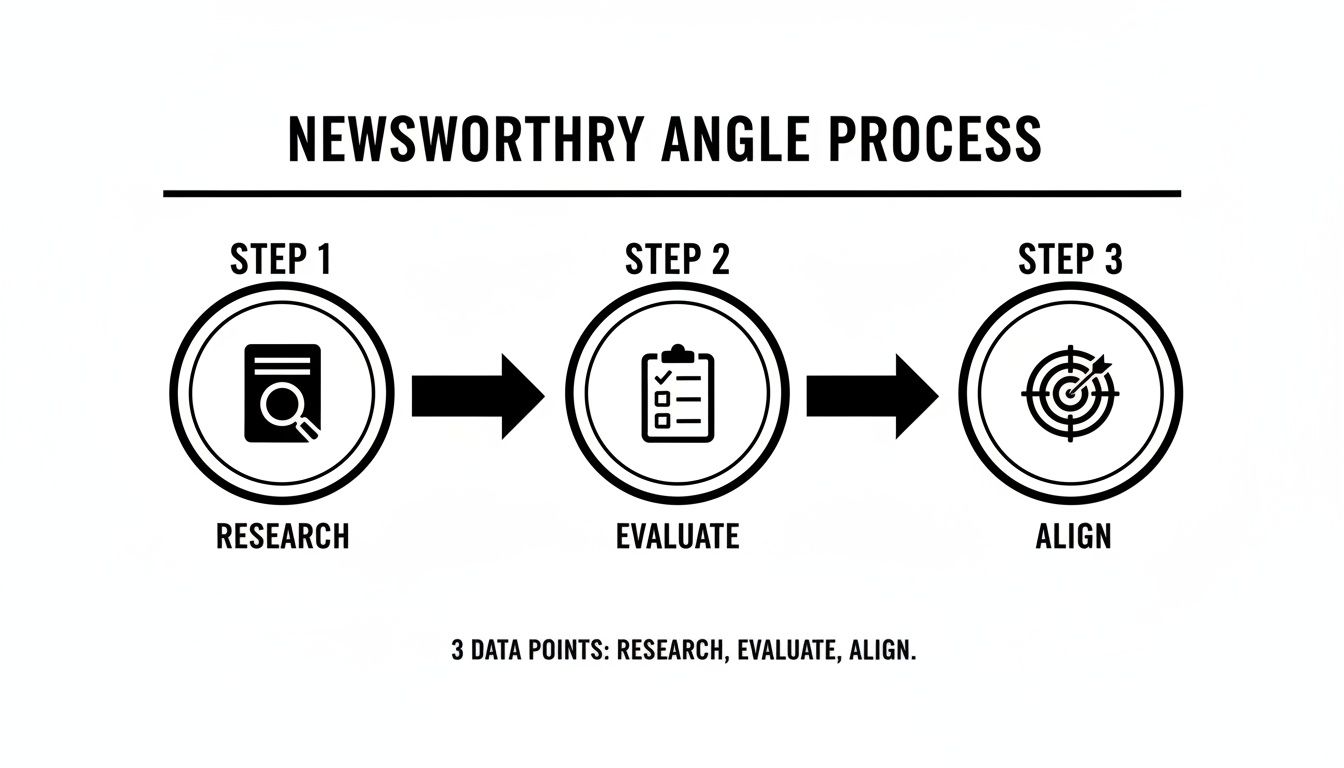
Moving from research to evaluation and then alignment ensures your press release has the substance needed to attract media attention and succeed in search.
Optimize Multimedia and Your Boilerplate
Don't stop at the text. Every single part of your press release can be fine-tuned to improve its search performance and make it more appealing to the media.
Image Optimization
Never just upload a file named "photo1.jpg." Rename your image file to include your keyword before you upload it (e.g., ai-accounting-software-dashboard.jpg). Even more important, write descriptive alt text that explains what the image shows and naturally incorporates your keywords. This is crucial for accessibility and helps search engines index your images.
Boilerplate Perfection
The boilerplate is your "About Us" paragraph at the very end of the release. It's prime real estate for reinforcing your brand identity and topical authority. Keep it concise, clearly state what your company does, and include a simple link back to your homepage. Think of it as your evergreen brand statement that gets distributed with every single release.
For a deeper look, check out our complete guide on optimizing press release keywords and metadata for some more advanced techniques.
When you pair a genuinely newsworthy story with this kind of meticulous on-page optimization, you create a document that serves both your PR and SEO goals. You end up with something that respects journalistic standards while giving search engines the clear signals they need to rank your content and reward your site with valuable authority.
Choosing Your Distribution Channel for Maximum Link Equity
You’ve done the hard work. Your press release is newsworthy, perfectly optimized, and ready to make a splash. But now comes the real moment of truth: getting it into the right hands. How you distribute your story will make the difference between earning powerful backlinks that supercharge your SEO and watching your announcement fizzle out.
There are two main roads you can take, and they couldn’t be more different. You have the old-school, broad-net approach of paid wire services. Then you have the surgical precision of direct, manual outreach to a hand-picked list of journalists. From an SEO perspective, this choice is everything.
The Paid Wire Service Approach
Wire services like PR Newswire or Business Wire offer a pretty sweet deal on the surface: instant, massive distribution. You pay a fee, and they blast your release out to a huge network of news sites, media portals, and databases. This guarantees hundreds, sometimes thousands, of "pickups."
But here’s the rub for your SEO. The overwhelming majority of these pickups happen on syndicated sites, which are often just low-quality news aggregators. More importantly, the links you get are almost always nofollow. That means they don't pass any direct link equity or "SEO juice" back to your site. They can generate some referral traffic and create brand signals, but they won’t be the thing that bumps up your domain authority.
Think of it like this: wire services are a public announcement system. They're fantastic for getting your news officially "on the record" and making sure it's everywhere at once. But they are not a precision tool for building the kind of powerful, authority-passing backlinks that truly matter for SEO.
These services definitely have their place. For publicly traded companies making financial disclosures or huge brands that need to blanket the market with an announcement, they are standard operating procedure. For most businesses trying to get a tangible SEO return, though, the high cost often doesn't justify the limited results.
The Power of Direct Manual Outreach
Direct outreach is the polar opposite of the wire service model. Instead of casting a wide net, you’re using a spear. This is all about building a hyper-targeted list of specific journalists, editors, and bloggers who actually cover your niche and have an audience that will genuinely care about your news.
I won't lie, this approach takes serious upfront effort. You have to:
- Research and identify the right people.
- Find their email addresses and learn how they like to be pitched.
- Craft a personalized pitch for every single person, explaining exactly why your story is a perfect fit for their readers.
It's intensive work, but the potential payoff is enormous. A great pitch doesn't just get you a quick mention; it can earn you a real, editorial backlink from a high-authority publication. These are the dofollow links that Google adores—the kind that act as a true third-party endorsement and directly boost your search rankings.
I once worked with a SaaS startup launching a new AI tool. Instead of a wire service, we spent a week building a list of just 50 tech bloggers who had recently written about AI and productivity. Our personalized pitches landed us only four articles, but three of them contained dofollow links from highly respected industry blogs. The SEO impact from those three links was more powerful than what 1,000 syndicated nofollow links could ever deliver.
Wire Service vs. Direct Outreach: An SEO Comparison
So, which path should you choose? It really comes down to your specific goals, budget, and resources. To help you decide which distribution method best fits your campaign for achieving tangible SEO results, here’s a practical comparison.
| Factor | Wire Service Distribution | Direct Manual Outreach |
|---|---|---|
| Primary Goal | Broad visibility and brand mentions. | High-authority, dofollow backlinks. |
| Link Quality | Mostly nofollow, low authority. | Potentially high-authority, dofollow. |
| Cost | High (hundreds to thousands of dollars). | Low (mostly time and effort). |
| Effort | Low (upload and pay). | High (research, personalization, follow-up). |
| Best For | Major corporate announcements, public companies. | SEO-focused campaigns, building relationships. |
Ultimately, for a robust press release for SEO strategy, a hybrid model often works best. You can use a lower-cost wire service for broad indexing and brand signaling, but pour the bulk of your energy into direct, personalized outreach. That’s how you turn a simple announcement into a powerful asset that builds real link equity and drives long-term search visibility.
If you are leaning towards a service, our guide on the best press release distribution services can help you weigh the pros and cons of specific platforms to find one that fits your budget.
Measuring Your SEO Impact in an AI-Driven World
So you've sent your perfectly crafted press release out into the world. Now what? It’s time to prove your efforts actually moved the needle.
To do that, you have to look past fluffy vanity metrics like "potential reach" and focus on tangible outcomes that directly boost search performance. It's no longer enough to just count how many times your release was syndicated. You need to connect your press release for SEO campaign to hard data that shows real value.
Moving Beyond Vanity Metrics
The first step is a mental shift. You need to stop obsessing over the big, often misleading numbers and start tracking the key performance indicators (KPIs) that truly matter for search. A massive "reach" number from a wire service report looks impressive on paper, but it tells you nothing about link equity or referral traffic.
Instead, zero in on these core metrics:
- New Referring Domains: This is a huge one. How many new, unique websites are now linking back to you because of your press release? A single link from a high-authority, relevant site is worth more than a hundred syndicated links from low-quality aggregators.
- Backlink Quality and Authority: Fire up tools like Ahrefs or Moz to check the Domain Authority (DA) or Domain Rating (DR) of the sites linking to you. Are these from respected news outlets or just obscure directories? Quality over quantity is the name of the game.
- Keyword Ranking Shifts: Did your target keywords see a positive jump in the search results after your campaign went live? Track the rankings for the specific terms you optimized in your headline and body copy. This is direct evidence of SEO impact.
- Referral Traffic: Dive into your Google Analytics. Are you seeing an uptick in visitors coming from the news sites that picked up your story? This is direct proof your release is not only earning links but also driving qualified traffic.
These metrics paint a much clearer picture of your PR's true return on investment. For a deeper look, check out our guide on crucial press release KPIs and how to track them effectively.
The New Frontier: AI Overviews
Just when we got comfortable, the measurement game evolved again. The rise of AI-powered search has fundamentally changed how press releases contribute to SEO. In this new world, getting your brand cited directly within an AI Overview is quickly becoming a critical success metric.
A citation here means your content is being recognized as a foundational, authoritative source on a topic.
This isn't some far-off change. The latest data shows that AI citation mentions now represent a major success metric for 55.4% of digital PR campaigns. While building backlinks remains the top goal at 85.8%, the landscape is clearly shifting. One study found that while organic click-through rates dropped a staggering 61% on search queries with AI Overviews, brands cited within those summaries got 35% more clicks than those that weren't. You can find more on the state of digital PR in 2026 on buzzstream.com.
This evolution means that crafting newsworthy, citation-worthy content has never been more critical. An AI citation can be more valuable than a traditional click, placing your brand's authority front and center in a zero-click search environment.
Tools for Tracking Modern SEO Impact
To measure these new and traditional metrics, you need the right set of tools. Relying on a single platform just won't cut it anymore; you won't get the full story.
Here’s a breakdown of the essential toolkit for measuring your campaign's success:
- Backlink Analysis Tools (Ahrefs, Semrush, Moz): These are your go-to platforms for monitoring new referring domains, checking the authority of linking sites, and analyzing the anchor text being used. Set up alerts to get notified of new backlinks in real time.
- Rank Tracking Software (AccuRanker, SERPWatcher): Use these to track daily movements for your target keywords. This helps you correlate ranking improvements directly with your press release distribution date.
- Google Analytics (GA4): This is non-negotiable for tracking referral traffic. I recommend creating custom segments to isolate traffic coming from specific publications to see how engaged those visitors are.
- AI Overview Tracking Tools: New tools are popping up that specifically track when and where your brand gets cited in AI-generated search results. Investigating these tools, and getting a handle on what is AI SEO, is becoming essential.
By combining insights from these different platforms, you can build a comprehensive report that demonstrates the true, multi-faceted value of your press release. You'll be able to show not just how many people saw your news, but how it directly contributed to better search rankings, higher-quality traffic, and authoritative placement in the new era of AI search.
Even with a solid game plan, you're bound to run into some tricky questions when using a press release for SEO. Let's clear the air on a few common myths and practical challenges that trip up even seasoned marketers and PR pros. Nailing these details is what separates a good strategy from a great one.
Are Nofollow Links from Press Releases Worthless?
Absolutely not. This is probably one of the most persistent myths out there. The idea that nofollow links have zero SEO value is just plain wrong. While they don't pass direct authority or "link equity" like their dofollow cousins, they are far from useless.
Think about it this way: nofollow links from reputable news sites and wire services are powerful brand signals for Google. They prove your brand is being talked about in credible places, which builds trust and legitimacy. These links also drive highly relevant referral traffic, bringing real, potential customers straight to your digital doorstep.
On top of that, a story that gets picked up with nofollow links can easily be discovered by other journalists and bloggers. They might then turn around and cover your news, giving you a high-value dofollow link in their own piece.
Think of nofollow links as an essential part of a healthy, natural-looking backlink profile. They deliver visibility, traffic, and brand validation—even if they don't directly pump up your domain authority score.
How Many Links Should I Put in a Press Release?
When it comes to links in a press release, less is always more. It’s a rookie mistake to cram a release full of links, hoping to squeeze out every last drop of SEO juice. This approach almost always backfires. It looks spammy to editors and search engines alike, which can get your release tossed in the bin or even flagged.
A solid, safe rule of thumb is to stick to 2-3 strategic links throughout the entire release. Here’s a simple formula that works every time:
- One contextual link early in the body copy. This should point to your most relevant page, like a new product or landing page. Make sure the anchor text sounds natural.
- One brand link somewhere in the middle. This is a great spot to link your company name directly to your homepage.
- One boilerplate link at the very end. In your "About Us" section, link your company name to your homepage again.
This structure gives you the SEO benefits you're after without raising any red flags. It puts the focus squarely on quality and relevance, which is exactly what editors and algorithms want to see.
Is a Press Release Better Than a Blog Post for Links?
This question sets up a false choice—they’re different tools for different jobs. A press release is your official megaphone, formatted for mass distribution to the media. A blog post is an asset you own, living on your site and designed to speak directly to your audience.
For link building, each has its own unique strengths.
- Press Release: Best for generating broad brand signals and a high volume of links (mostly nofollow) in a short amount of time through syndication. It’s also your ticket to reaching journalists who can provide those powerful, high-authority dofollow links.
- Blog Post: Perfect for earning high-quality, dofollow links over the long haul through organic search and outreach. A genuinely useful blog post can become a cornerstone asset that people link to as a resource for years to come.
The most effective strategies don't choose one over the other—they use both. You can publish a press release to announce your news and then write a more detailed blog post on your site that dives deeper into the story. Then, you simply link from the press release to that blog post, creating a powerful one-two punch for your SEO efforts.
At Press Release Zen, we provide the expert guides and templates you need to master every step of this process. Get the clarity and tools to turn your news into a powerful SEO asset by visiting https://pressreleasezen.com.