A press release embargo is basically a handshake deal between you and a journalist. You're giving them a story ahead of schedule, with the rock-solid understanding that they won't publish a single word until a specific date and time. It’s a powerful tool that gives reporters the runway they need to craft a truly great piece.
Decoding the Press Release Embargo

Think about it. You're about to launch a game-changing new product. If you just blast the news out for immediate release, you force reporters into a mad dash. They’ll scramble to rewrite your announcement, and what you’ll likely get are shallow, rushed articles that barely scratch the surface.
This is exactly where a press release embargo shines. It turns a potential media free-for-all into a coordinated, high-impact event.
By giving journalists a head start—usually 24 to 72 hours—you’re handing them the most valuable resource of all: time. This simple act of professional courtesy lets them do their best work. They can finally:
- Dig in and do real research to understand the story's nuances.
- Schedule interviews with your CEO or key experts.
- Write a compelling, original story, not just a rehashed summary.
- Line up their own assets, like custom graphics or video packages.
This strategic pause is all built on a foundation of mutual trust. You're trusting the journalist to honor the deadline, and they're trusting you to provide news that’s actually worth the special treatment.
A Tool Forged by Trust
Let’s be clear: a press release embargo isn't a legally binding contract. It's an honor system, and it has been a cornerstone of media relations for decades. Breaking an embargo is a huge professional foul in the journalism world. It can torch a reporter's reputation and get them blacklisted from receiving advance news from you—and other companies—for good.
A successful embargo helps you control how and when your story breaks. It helps you coordinate news outlets and set up friendly journalists with exclusives without torpedoing additional coverage.
This controlled environment is the secret to creating a massive, synchronized wave of high-quality media coverage. When multiple outlets publish well-researched, thoughtful stories at the exact same time, it generates a groundswell of attention that an immediate release just can't compete with.
Evolving with the Times
While the concept feels a bit old-school, the embargo has adapted right alongside the modern media cycle. The practice dates back to the 1920s, but it has since been refined into a precision instrument.
Today, you’ll see government agencies using embargoes with tight security to manage economic data releases. You’ll also see public companies avoid them for market-moving financial news but embrace them for major product launches. This evolution just goes to show their lasting strategic value when used the right way. You can discover more insights about how embargoes have adapted on the Reuters Institute website.
Ultimately, using an embargo is a sign of respect for the journalistic process. It tells reporters you value quality storytelling over a quick hit, and that’s a gesture that builds the strong, long-lasting media relationships you need. If you're new to this world, it’s a good idea to first understand the fundamental purpose of any media release before adding this extra layer of strategy.
The Strategic Advantages of Using an Embargo
Thinking of an embargo as just a scheduling tool is missing the bigger picture. It's actually a strategic play to orchestrate a major media moment. Instead of just firing your news out into the world and hoping it sticks, you’re giving journalists the one thing they crave most: time.
This head start allows them to go way beyond a simple copy-and-paste of your announcement. It gives them the breathing room to actually dig in, set up interviews, and write a compelling story that gives your news the authority and context it deserves.
When reporters have a chance to prepare, you often get a coordinated wave of high-quality, in-depth coverage that all breaks at the exact same time. This creates a powerful, synchronized buzz that’s almost impossible to get with a standard, immediate release.
Maximizing Accuracy and Depth
For anything complex—think new scientific data, a dense financial report, or a big policy shift—getting the details right is non-negotiable. An embargo gives reporters the window they need to really digest the material, ask smart questions, and get their facts straight.
This dramatically cuts down on the risk of misinterpretations or flat-out errors that happen when reporters are scrambling against a tight deadline. When a journalist can chat with your experts beforehand, they can clear up any confusion and make sure their final piece is spot-on.
The payoff? Coverage that doesn't just announce your news but actually educates the public correctly. This is absolutely critical for building credibility, especially around complicated subjects.
By giving advance notice under embargo, you’re not just managing timing. You’re making an investment in the quality and accuracy of the media coverage your announcement will get.
This proactive approach to accuracy is a win for everyone. You get your message out exactly as intended, journalists get to produce more authoritative work, and the public gets a clearer, more reliable story. You can boost your odds even further by learning the right strategies for getting your press release picked up by the media.
Building Stronger Media Relationships
Let's be honest: the journalism world is under constant pressure. Newsrooms are shrinking, and deadlines are relentless, making a reporter's job tougher than ever. Offering an embargo is a clear signal that you respect their process and value their work.
This simple professional courtesy goes a long way in building goodwill and fostering solid, long-term relationships with key media contacts. You're no longer just another company blasting out a release; you become a trusted, reliable source who actually helps them do their job better.
That kind of relationship is priceless. Journalists are far more likely to prioritize news from sources they trust and who make their chaotic workflow a little bit easier.
The economic strain on global journalism has only made this more relevant. A UNESCO report on media development from 2021-2022 found that 85% of the world's population saw a drop in press freedom, often linked to economic pressures. While reporters will always appreciate having more time, these challenges mean a strategic embargo is vital for enabling thoughtful reporting instead of panicked, half-baked stories. You can find more on these global media trends on the UNESCO website.
Ultimately, a well-played embargo delivers a few key wins:
- Deeper Storytelling: It gives journalists the runway to write rich, nuanced articles instead of just surface-level rewrites.
- Coordinated Buzz: It orchestrates a synchronized media wave for maximum impact on your launch day.
- Improved Accuracy: It provides crucial time for fact-checking and clarification, especially for complex news.
- Relationship Building: It shows professional respect for journalists, strengthening your most important media connections.
When you use this strategy thoughtfully, you can turn a simple news announcement into a well-managed, high-impact media event that keeps paying dividends for your brand long after launch day.
When to Use an Embargo and When to Avoid It
Deciding whether to use a press release embargo is a serious strategic call, not something you should do automatically. Think of it as a specialized tool in your PR toolbox; it’s brilliant when used correctly, but it can absolutely blow up in your face if you’re careless.
Get it right, and you can coordinate a huge media splash. Get it wrong, and you risk torching your credibility with the very journalists you need on your side.
The main question you have to ask yourself is this: does my news need extra time to be fully understood and reported well? If the answer is a clear yes, an embargo is probably your best bet. That strategic pause gives reporters the breathing room they need to do their best work, which means your announcement gets the thoughtful, detailed coverage it deserves.
This decision tree gives you a simple visual for thinking through whether to embargo your news or send it for immediate release.
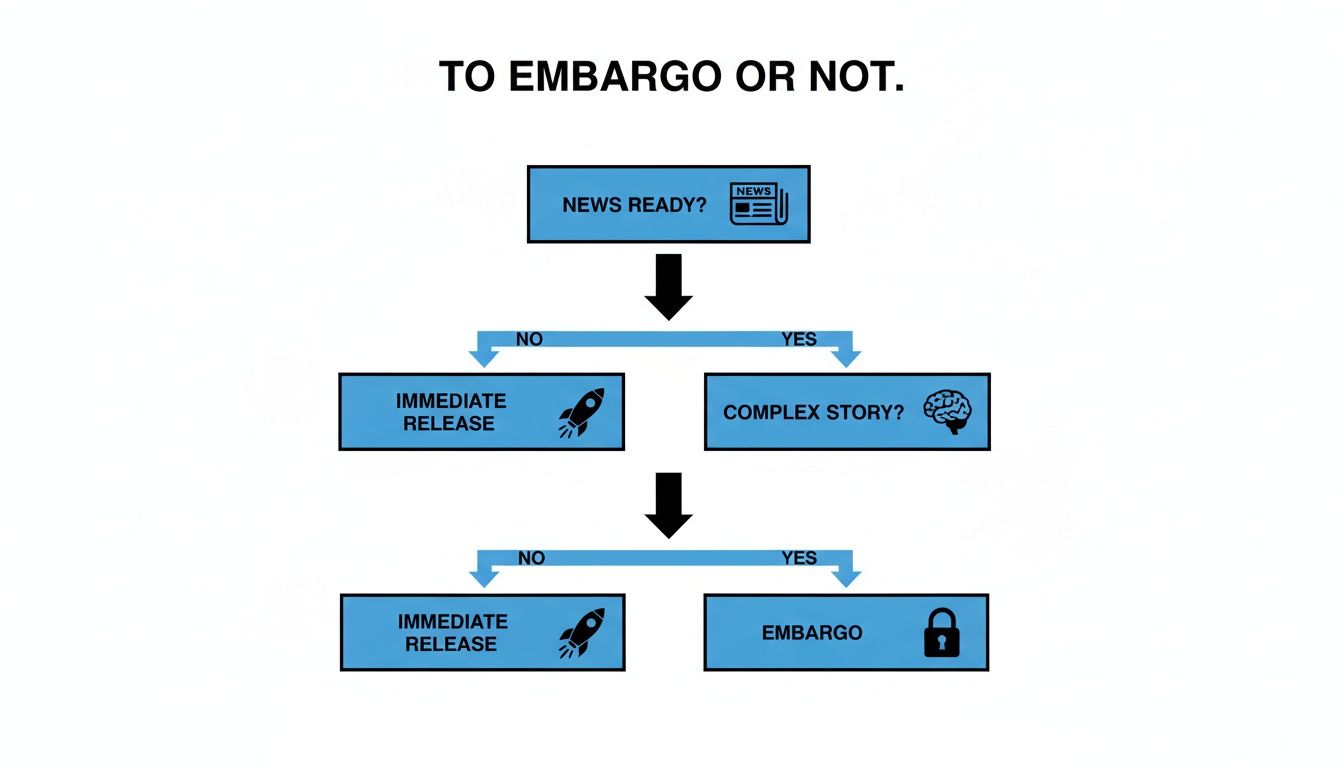
As the flowchart illustrates, the deciding factor is usually complexity. Simple, straightforward news is better off sent immediately, while more complicated stories benefit from the lead time an embargo provides.
To help you make the call, use this simple checklist. It will help you weigh the key factors and decide if an embargo is the right move for your announcement.
Embargo Decision-Making Checklist
| Checklist Question | Yes (Consider Embargo) | No (Consider Immediate Release) |
|---|---|---|
| Is my news complex (e.g., data-heavy, technical)? | The story requires time for journalists to digest and explain. | The news is straightforward and easy to understand at a glance. |
| Does the story require interviews or external quotes? | Reporters will need time to schedule calls and gather input. | The release contains all necessary information and quotes. |
| Am I providing exclusive assets (e.g., product demos, reports)? | Journalists need time to review the materials thoroughly. | The news is simple and doesn't require extra assets. |
| Is the news market-sensitive (for a public company)? | N/A | Critical: Must be released to everyone simultaneously. |
| Is this a crisis or breaking news situation? | Never. An embargo will be seen as an attempt to hide information. | Information must be released immediately to maintain transparency. |
If you find yourself ticking "Yes" to the first few questions (and "No" to the last two), an embargo is likely a strong strategic choice for you.
Prime Scenarios for an Embargo
Some announcements are practically tailor-made for an embargo. We’re talking about stories that are loaded with information, have a lot of moving parts, or require reporters to line up interviews to tell the full story.
You should definitely consider an embargo for these situations:
- Major Product Launches: When you’re rolling out a flagship product, the last thing you want is a quick one-sentence mention. An embargo gives journalists time to really dig into the specs, talk to your engineers, and write a proper feature.
- Significant Partnership Announcements: A strategic alliance between two big players is major news. Giving reporters advance notice lets them get quotes from both CEOs and really explore what the deal means for the market.
- In-Depth Research or Data Reports: If you're dropping a study packed with juicy statistics or new findings, reporters need time. They have to analyze the data, understand your methodology, and maybe even create a few charts. A 24-48 hour lead time is pretty standard here.
The goal of a press release embargo is not to control journalists, but to empower them. By providing information in advance, you are facilitating deeper, more accurate storytelling that benefits everyone involved—your brand, the media outlet, and the public.
In every one of these cases, giving that extra time directly translates into better, more meaningful coverage that starts a much bigger conversation.
When to Absolutely Avoid an Embargo
Knowing when not to use an embargo is just as crucial as knowing when to use one. Getting this wrong can make you look amateurish or, even worse, untrustworthy. When in doubt, let speed and transparency be your guide.
Never, ever use an embargo in these circumstances:
- Crisis Communications: In a crisis, your only job is to get accurate information out to the public as fast as humanly possible. Slapping an embargo on bad news will look like you’re trying to spin or delay the narrative, and it will obliterate trust. Speed and total transparency are your only friends here.
- Breaking News: If your company is suddenly part of a fast-developing story, an embargo is completely pointless. Reporters are already on it, and you need to be responding in real time, not planning a future announcement.
- Minor Updates or Trivial News: An embargo is fundamentally a request for a journalist's time and attention. Using it for a minor staff promotion or a tiny feature update is a fantastic way to get your future emails sent straight to the trash. It tells them you don’t respect their time.
- Market-Sensitive Information (for Public Companies): Publicly traded companies operate under strict disclosure rules. Any information that could materially impact a stock price must be released to all investors at the exact same time. Using an embargo is not only unethical but legally dangerous.
How to Set Up an Embargo Correctly
![A document with 'EMBARGO' and 'Do not publish before [Date Time TZ]' text, an alarm clock, and a pen on a desk.](https://pressreleasezen.com/wp-content/uploads/2026/03/press-release-embargo-embargo-document.jpg)
When you're executing a press release embargo, there's one principle that trumps all others: unmistakable clarity. There can be zero room for confusion. Every single journalist who gets your story has to know, without a shred of doubt, that the information is time-sensitive and under a strict publication hold.
Think of it as putting up a velvet rope at an exclusive event. The rope isn't a physical wall, but it sends a clear, universally understood signal: "Do not cross until the designated time." Your embargo notice serves the exact same purpose for your news.
The instructions must be so glaringly obvious that they're impossible to miss. That means placing the embargo details in the two most visible spots: your email subject line and the very top of the press release itself.
Crafting the Perfect Embargo Notice
Your embargo statement needs to be short, direct, and formatted to grab attention. It has to contain three critical pieces of information: the word "EMBARGO," the release date, and the specific time—including the time zone.
Here’s what makes a notice crystal clear:
- Bold and Capitalized: Always write "EMBARGO" or "EMBARGOED FOR RELEASE" in bold, all-caps letters. This is the universal sign that flags the document as sensitive.
- Specific Date and Time: State the full date and the exact time of release. Being vague with instructions like "embargoed until tomorrow morning" is just asking for trouble.
- Crucial Time Zone: Always, always include the time zone (e.g., ET, PT, GMT). Journalists are scattered across the globe, and forgetting the time zone is one of the most common—and avoidable—reasons for accidental breaches.
For instance, a rock-solid embargo statement placed right at the top of your press release, even before the headline, should look like this:
EMBARGOED: FOR IMMEDIATE RELEASE AT 9:00 AM ET ON TUESDAY, OCTOBER 26, 2024.
DO NOT PUBLISH, BROADCAST, OR POST ONLINE BEFORE THIS TIME.
This two-line punch leaves absolutely no room for misinterpretation. The first line delivers the hard facts, and the second reinforces the command in plain, simple English.
Email Subject Line Best Practices
A journalist's inbox is a warzone for attention. Your subject line is the very first signal they see, and it's your most important one. Putting the embargo info here is non-negotiable.
A great formula to follow is: [EMBARGO: TIME, DATE] – [Your Press Release Headline]
Here’s how that looks in the real world:
- Subject: [EMBARGO: 9 AM ET, OCT 26] – InnovateCorp Launches Groundbreaking AI-Powered Analytics Platform
This format instantly alerts the reporter that the email contains time-sensitive news before they even open it. It shows you respect their workflow and helps them slot your story into their schedule.
Confirming the Agreement
For your most sensitive news, many PR pros take one extra, crucial step: getting their agreement before sending the goods. This is all about sending a quick, preliminary email to your trusted contacts.
You could write something as simple as: "Hi [Journalist Name], I have a significant, embargoed announcement about [Your Company/Topic]. The embargo lifts next Tuesday at 9 AM ET. Can I send the details over under that agreement?"
This simple move transforms an implicit understanding into an explicit promise. It creates a personal commitment and dramatically lowers the risk of a breach. Once they say yes, you can send the full press release with confidence.
Following these clear, structured steps builds a framework of trust and professionalism. For more tips on scheduling your communications, you might find our guide on creating a press release calendar helpful. It's how you ensure your story lands with the maximum, coordinated impact you're aiming for.
Responding to a Broken Embargo

It’s a moment that makes any PR pro’s heart sink. You’ve done everything right, but there it is—your embargoed news, published ahead of schedule. Your first instinct might be to panic, but don't. How you handle a broken press release embargo is a true test of your professionalism and can make or break your media relationships.
Before you fire off an angry email, take a breath. The immediate goal is to gather the facts, not assign blame. Was it an honest mistake or a deliberate leak? Acting on assumptions can permanently damage a relationship that could have easily been saved.
Your Immediate Action Plan
Once you've confirmed the breach, it’s time to act—swiftly, but with a cool head. Your response should be measured and focused on containing the situation, all while protecting the journalists who followed the rules.
Assess the Breach: First, figure out what happened. Was it a simple time zone mix-up? This is a surprisingly common and usually accidental error. Or did the publication intentionally jump the gun to get a scoop? The intent behind the breach is everything; it dictates your entire response.
Contact the Journalist and Editor: Get on the phone with the reporter who published the story. A polite call is far more effective and less accusatory than an email. Calmly explain the situation and ask what went wrong. In most cases, especially if it was an accident, they’ll be apologetic and ready to cooperate.
Request a Takedown: If the breach was accidental, politely ask the journalist or their editor to take the article down until the embargo lifts. Reputable publications value their credibility and their relationship with you, so most will honor this request without hesitation.
This calm, professional approach resolves the problem the vast majority of the time. It acknowledges that mistakes happen and keeps the door open for future collaboration.
Handling a Deliberate Breach
A deliberate breach is a different beast entirely. It’s a serious violation of trust that undermines the system and puts every journalist who honored the agreement at a disadvantage. It’s tempting to react angrily, but a strategic, proportional response is much more powerful.
The objective in responding to a broken embargo is not revenge. It’s about upholding the integrity of the process and protecting the journalists who respected your agreement.
If your polite takedown request is ignored or you've confirmed the breach was intentional, you have a couple of moves. Think of these not as punishment, but as necessary steps to protect your other media partners.
- Lifting the Embargo for Everyone: If a major outlet breaks the story and won't pull it, you may need to level the playing field. Immediately notify your entire press list that the embargo has been broken and they are all now free to publish. This is fair to those who waited and nullifies the advantage of the outlet that broke the rules.
- Removing the Contact from Your List: For a flagrant, unapologetic violation, the standard consequence is removing the journalist and their publication from your list for future embargoed news. This is a serious step, but it sends a clear message that professional courtesy is a two-way street.
Ultimately, your best defense against a broken press release embargo is building strong relationships from the start. When journalists know you, trust you, and see you as a professional partner, they are far more likely to respect the agreements you make together.
Essential Embargo Language and Templates
When it comes to a press release embargo, there’s no room for misinterpretation. Any hint of confusion can lead to an accidental leak, so your language has to be crystal clear, direct, and impossible to miss.
Success here is all about putting the right notices in the right places—specifically, where a journalist is guaranteed to see them. This means placing the embargo terms in two critical spots: the subject line of your email and the very top of the press release itself. Think of it as putting up a bright red stop sign right at the entrance.
Crafting the Perfect Email Subject Line
A reporter’s inbox is a crowded place. Your subject line is the very first signal you send, and it has to immediately flag the email as containing time-sensitive news.
The best formula is simple and effective: [EMBARGO: TIME, DATE, TZ] – Your Press Release Headline
Let's look at how that plays out in a couple of real-world scenarios:
- Standard Launch:
[EMBARGO: 9:00 AM ET, OCT 26] - Nexus Corp Unveils a New Generation of Smart Home Devices - Data Report:
[EMBARGO: 12:01 AM GMT, NOV 5] - New Study Reveals a 30% Shift in Consumer Spending Habits
This structure tells journalists everything they need to know at a glance. They can instantly see what it is, when it goes live, and can slot it into their schedule without having to even open the email.
The Unmistakable Press Release Notice
Once they open the document, the embargo notice needs to be the very first thing they see. I mean it—before your company logo, before the headline, before anything else. Make it pop with bold, all-caps text.
EMBARGOED FOR RELEASE: Do not publish, post, or broadcast before 9:00 AM Eastern Time on Tuesday, October 26, 2024.
This single line leaves no doubt. It’s authoritative and precise. One pro tip: always spell out the time zone (e.g., "Eastern Time" or "Pacific Time") instead of just using abbreviations like ET or PT. It’s a small detail that eliminates any potential for confusion.
A Full Template for Your Embargoed Press Release
Here’s a simple template you can copy and paste for your next announcement. Notice how the embargo information sits right at the top, formatted for maximum visibility so no one can claim they missed it.
EMBARGOED FOR RELEASE: Do not publish, post, or broadcast before 9:00 AM Eastern Time on Tuesday, October 26, 2024.
FOR IMMEDIATE RELEASE (This goes below the headline, ready for when the embargo lifts)
[Your Compelling Press Release Headline Here]
CITY, State – (Month Day, Year) – Your introductory paragraph starts here…
Confirmation and Follow-Up Language
For truly sensitive news, it’s always a good idea to get an explicit "yes" from the journalist before you send the full release. This little extra step creates a firm agreement and dramatically reduces the risk of accidental breaches.
Initial Outreach Example:
- Subject: Confidential Story from [Your Company Name]
- Body: Hi [Journalist Name], I have a significant announcement from [Your Company Name] regarding [Topic] that is embargoed until Tuesday, October 26, at 9:00 AM ET. Please let me know if you agree to the embargo, and I will send the press release and assets right over.
Using clear, consistent language like this removes all the guesswork from the process. Of course, mistakes can still happen. If an embargo breaks despite your best efforts, having a solid crisis communication planning framework is essential for managing the fallout. But getting your communication right from the start is always your best line of defense.
Frequently Asked Questions About Press Release Embargoes
Even with a solid plan, embargoes can throw some curveballs. You're bound to run into "what if" scenarios that don't have a textbook answer. We get it.
This section tackles the most common questions we hear from PR pros and founders. Think of it as a quick reference guide to help you handle those tricky situations and use embargoes with total confidence.
Can I Send an Embargo to a Journalist I Don't Know?
This is a big one, and the short answer is: you're playing with fire. The entire embargo system runs on trust, and you haven't built any with a cold contact. Sending your biggest news to a complete stranger is a huge gamble.
If you absolutely must reach out to a new journalist, don't just attach the press release and hope for the best. Send a brief, preliminary email first. Let them know you have a story under embargo and ask if they agree to the terms before you share a single detail. This little step shifts the dynamic from a risky assumption to a clear, mutual agreement.
How Much Lead Time Is Appropriate?
Timing is everything. Too little lead time, and you're rushing the reporter. Too much, and your story gets buried in their inbox or feels stale by the time it can go live. You have to find that sweet spot.
For most news, a lead time of 24 to 72 hours is the gold standard. This gives a journalist enough runway to do their homework, schedule an interview, and write a quality story. If your announcement is incredibly complex—like a new scientific study—you might stretch that to a week, but that's the exception, not the rule.
A few timing tips from the trenches:
- Avoid the Friday Afternoon Drop: This is a classic rookie mistake. Pitching an embargoed story as the week winds down is a great way to have it completely forgotten by Monday morning.
- Target Mid-Week: A Tuesday or Wednesday pitch often works best. You’ll catch journalists as they're actively planning their content for the rest of the week.
- The 00:01 Lift: This is a classic PR move for a reason. Setting your embargo to lift one minute past midnight (e.g., 00:01 ET) lets online outlets schedule their stories to publish overnight. Your news is then waiting for everyone in their morning media roundups.
Do I Need Special Software for Embargoes?
Absolutely not. You don't need expensive or complicated software to manage a press release embargo. Your most powerful tools are simple: clarity, a well-organized media list, and strong communication.
Your everyday email client is all you need. The magic is in how you use it. Be meticulous with your formatting. Use bold, all-caps text for your embargo notice in the subject line and at the very top of your release. Clearly state the date, time, and time zone. That’s it.
An embargo is fundamentally a human-to-human agreement. Your success depends on the strength of your media relationships and the clarity of your instructions, not on a particular software platform.
Instead of hunting for a new tool, pour that energy into building real relationships with journalists. A reporter who knows and trusts you is far more likely to respect your embargo than one who just sees you as another email in a crowded inbox.
At Press Release Zen, we provide the guides and templates you need to manage every aspect of your media communications with confidence. From crafting the perfect headline to distributing your news for maximum impact, find all the resources you need at https://pressreleasezen.com.