A press release embargo is a mutual agreement with a news outlet not to publish a story until a specific date and time. It’s a powerful PR tool that gives journalists a heads-up, letting them craft a more thoughtful story before your news officially drops.
What Is a Press Release Embargo and When to Use It
Think of an embargo as a gentleman's agreement between you and the media. You're giving a top-tier journalist an exclusive preview of a complex story, allowing them the time to do it justice. It's the difference between handing a chef a new five-course menu minutes before dinner service versus a day in advance.
That lead time lets a reporter truly dig in, conduct interviews, and write a well-researched piece. Instead of a rushed, bare-bones report, you get comprehensive and accurate coverage. When your news finally breaks, it hits with maximum impact across multiple outlets at once, letting your story dominate the news cycle.
When an Embargo Is Your Strongest Tool
An embargo isn't for your run-of-the-mill company news. You save it for announcements that are genuinely complex and newsworthy. Using one signals to journalists that this story is significant and requires some time to unpack properly.
Here are the key times when an embargo makes perfect sense:
- Intricate Product Launches: Your new product has groundbreaking technology or features that need a detailed explanation.
- Detailed Financial Reports: Think quarterly earnings or annual reports packed with data that reporters need time to analyze.
- Major Research Findings: You’re releasing a scientific study or survey with significant data points and wide-reaching implications.
- Significant Partnerships or Mergers: The deal has complex terms and will have a ripple effect across the market.
This isn't a new trick. The news embargo has been a staple in PR for over a century, becoming a cornerstone of science journalism back in the 1920s. It gave reporters the runway they needed for deep analysis before a public release. The practice is just as critical today, as seen with the UN's 2024 Global Report on Trafficking in Persons. An embargo ensured media worldwide could digest complex data from 156 countries before its coordinated launch. To dig deeper, you can explore more about how news embargoes have evolved in this research from the Reuters Institute.
Knowing When to Avoid an Embargo
Just as important as knowing when to use an embargo is knowing when not to. Slapping an embargo on minor news is a quick way to annoy journalists and make your announcement look less important than it is. It comes across as if you're overstating the story’s significance.
Steer clear of embargoes for these kinds of updates:
- Routine company news or staff promotions.
- Simple event invitations or save-the-dates.
- Minor product updates or small feature tweaks.
- Crisis communications that need to get out immediately.
For these situations, a standard press release marked "For Immediate Release" is the only way to go. It’s professional, direct, and what journalists expect.
To make this crystal clear, we've created a simple table to help you decide when an embargo is the right move.
Embargo Decision-Making Framework
This framework is your quick-glance guide to determining if an embargo strategy will help or hinder your announcement.
| Announcement Type | Use Embargo? | Reasoning & Best Practice |
|---|---|---|
| Complex Product Launch | Yes | Gives reporters time to understand technical specs and market impact. |
| Quarterly Earnings Report | Yes | Allows for in-depth financial analysis before the market reacts. |
| New Executive Hire | No | Simple news. An embargo makes it seem more important than it is. |
| Crisis or Recall | Absolutely Not | Information must be disseminated immediately for public safety and transparency. |
| Major Scientific Study | Yes | Provides time for journalists to consult experts and explain complex findings. |
| Local Event Invitation | No | A standard "For Immediate Release" is sufficient and more appropriate. |
Ultimately, the goal is to build trust with the media. Using an embargo correctly shows you respect their time and understand what makes a story truly newsworthy.
This flowchart breaks the decision down to its simplest form.
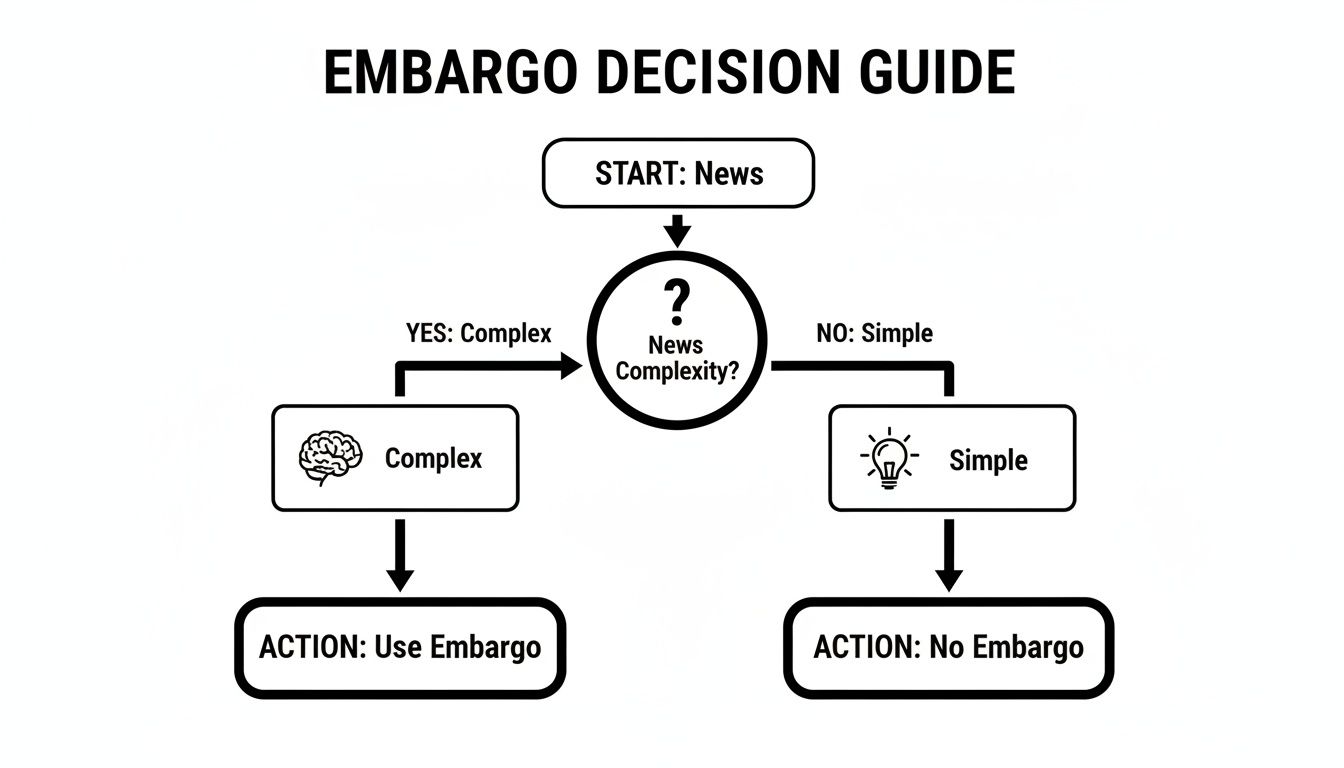
As you can see, complexity is the defining factor. If your news has layers that need to be peeled back and analyzed, an embargo is a powerful asset. Master this simple rule, and you'll know exactly when to pull this strategic lever to amplify your announcement's impact.
How Embargoes Are Evolving in the Digital News Era

The 24/7 news cycle didn't kill the press release embargo—it just made it a whole lot more strategic. What used to be a straightforward tool for managing print deadlines is now a crucial device for cutting through the noise of instant alerts and real-time social media feeds. The constant hunger for new content puts tremendous pressure on journalists and newsrooms.
This intense environment makes the lead time from an embargo more valuable than ever. It gives reporters the breathing room they need to produce high-quality, in-depth content that rises above the sea of recycled headlines and surface-level posts. Instead of just racing to be first, they can be first with the best story.
For a modern newsroom facing economic fragility, a well-planned embargo is a gift of time. It allows them to allocate resources effectively, conduct interviews, and craft a unique angle—all elements that drive clicks and engagement in a competitive field.
Knowing how to use an embargo today means seeing it for what it is: a precision instrument, not a one-size-fits-all solution. Its success hinges on having a clear strategy based on the kind of news you're breaking.
Distinguishing Hard News from Soft News
The power of your press release embargo really depends on whether you're dealing with "hard" or "soft" news. Getting this distinction right is key to setting expectations with the media and picking the best release strategy.
- Hard News: This is your breaking, time-sensitive stuff. Think major financial announcements, government policy changes, or urgent public safety information. These stories are all about immediacy and facts.
- Soft News: This bucket holds your feature stories, product launches, human-interest pieces, and research findings that aren't tied to a specific, urgent deadline. These stories win with compelling narratives and rich detail.
For hard news, the value of an embargo gets a bit more complicated. Many publicly traded companies, for instance, now shy away from them for market-moving news in the age of Twitter, choosing immediate release to ensure everyone gets the information at the same time.
Still, embargoes have found a new purpose as precision tools for managing complex data. Financial groups like the IMF use them for dense reports to prevent market panic, giving analysts time to digest everything uniformly. A major shift happened in 2024 when Italy's ISTAT stopped giving journalists early access to economic data. This move boosted its compliance with the European Statistics Code by guaranteeing total fairness. Discover more insights about how economic fragility is a leading threat to press freedom on rsf.org.
Building Stronger Media Relationships
On the flip side, for "soft news," the embargo is an outstanding relationship-building tool. When you give a trusted journalist an exclusive preview of a new product or a deep-dive study, you're not just sending data; you're offering a partnership. You're giving them the assets they need to create a piece that truly stands out.
This simple act builds massive goodwill and shows you respect their craft. A reporter with a week to play with your new software is far more likely to write a detailed review than a quick blurb. It all comes down to knowing what kind of news you have and tailoring your embargo strategy to match.
If you're still weighing the overall value of this tactic, you can dig deeper in our guide on whether press releases are still worth it today.
How to Format and Distribute Your Embargoed Release
When it comes to a press release embargo, how you handle the details makes all the difference. A sloppy format or a poorly planned distribution can cause confusion, lead to accidental leaks, and burn bridges with the very journalists you’re trying to build relationships with.
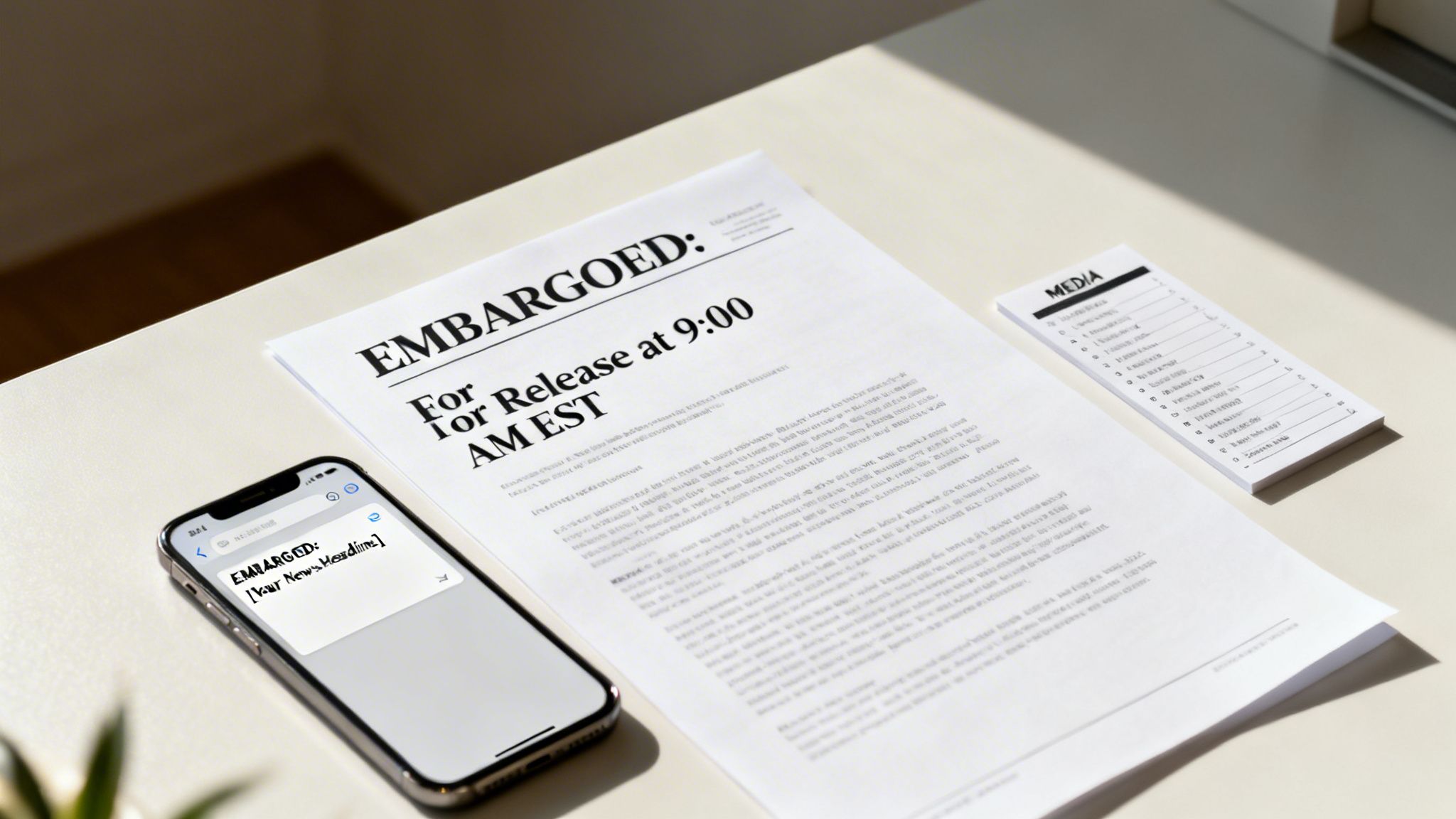
The single most important part is the embargo notice itself. You have to make it impossible for a busy reporter to miss. Place it right at the top of your document—before the headline—in bold, all-caps text. Being crystal clear is your best protection against slip-ups.
Crafting the Embargo Notice
Your embargo notice needs to be specific, leaving zero room for interpretation. Always, always include the exact release date, the precise time, and the time zone (e.g., EST, PST, GMT). Vague instructions are a recipe for disaster, especially when you're working with journalists scattered across the globe.
Here are a few rock-solid examples you can use:
- EMBARGOED: FOR RELEASE AT 9:00 AM EST ON WEDNESDAY, OCTOBER 28, 2026.
- EMBARGOED UNTIL MONDAY, NOVEMBER 16, 2026, AT 12:01 AM PST.
- STRICTLY EMBARGOED. NOT FOR PUBLICATION OR BROADCAST BEFORE 7:00 AM GMT ON FRIDAY, DECEMBER 4, 2026.
This formatting is an industry-standard signal. It immediately tells a reporter they’re holding time-sensitive information that needs special handling.
Smart Distribution Strategies
What you do with the release is just as critical as how it looks. For really sensitive news, forget the wide-net approach of a wire service blast. A targeted, hand-picked media list gives you total control over who gets the scoop.
Start building a list of journalists who actually cover your beat and have a track record of respecting embargoes. These relationships are your PR career's gold standard. Sending a juicy, exclusive story to a reporter you trust is a surefire way to strengthen that bond.
When you hit send, your email's subject line needs to shout "embargo" just as loudly as the notice in the release itself.
Pro Tip: A clear subject line is your first line of defense against a journalist accidentally breaking the news. Structure it to be instantly recognizable in a crowded inbox.
Use a format that’s impossible to ignore:
- EMBARGOED: [Your Company] Announces Groundbreaking AI Integration
- UNDER EMBARGO: [Your Research Institute] Releases Landmark Study on Remote Work Trends
This simple tag flags the email's contents before it's even opened. When reaching out to new contacts, knowing how to write cold emails that get replies is a game-changer for getting your embargoed pitch noticed and securing that crucial coverage.
Final Checks Before Hitting Send
Before that press release leaves your outbox, take a minute to run through a final checklist. It’s a simple step that can save you from a massive headache. You also need to think about the file format. While a PDF locks in your beautiful formatting, many journalists prefer a Word doc they can easily copy and paste from. If you're on the fence, our guide on whether a press release should be a PDF or Word document breaks down the pros and cons.
To make sure you've got all your bases covered, here’s a quick-and-dirty checklist to run through.
Embargoed Press Release Checklist
This simple table will help you make sure every part of your embargoed release is ready to go, maximizing your impact while minimizing your risk.
| Step | Action Item | Why It Matters |
|---|---|---|
| 1. Verify Notice | Double-check the EMBARGOED notice is at the top, bold, and has the right date, time, and time zone. | This is non-negotiable. One typo here can cause a premature leak and torpedo your whole strategy. |
| 2. Confirm Recipient List | Review your media list. Are you only sending this to trusted, relevant journalists who get how embargoes work? | A targeted list shrinks your risk of leaks and gets your story to the outlets that will make the biggest splash. |
| 3. Proofread Subject Line | Make sure your email subject line kicks off with "EMBARGOED" or "UNDER EMBARGO" in all caps. | This tag is a stop sign. It prevents a reporter from mistaking your sensitive news for an immediate story and publishing it early. |
| 4. Check Attachments | Is the final version of the release attached? Are all your supporting assets (images, data) included? | Sending the wrong draft or forgetting key files makes you look amateurish and creates a messy cleanup job. |
There you have it. By getting these formatting and distribution steps right, you turn the press release embargo from a high-stakes gamble into one of the most powerful tools in your PR toolkit for controlling your story.
The Unwritten Rules of Trust and Professionalism
At the end of the day, a press release embargo isn't about legal documents—it's a professional handshake built on trust. This is the unwritten code that separates experienced PR pros from the rookies. And while you probably won't get sued for breaking one, the stakes are sky-high because your reputation is the only currency that matters.
Think of it like this: you're giving a journalist a key to a room filled with valuable news. You're trusting them not to unlock the door until the exact time you’ve both agreed on. This is what makes the whole system work. Journalists get the time they need to write a thoughtful, high-quality story, and you get the coordinated, high-impact coverage you’re aiming for.
The Real Cost of a Broken Embargo
The fallout from breaking that trust is fast and brutal, often way more damaging than any legal slap on the wrist. The biggest threat isn't a lawsuit; it's the instant—and often permanent—destruction of your professional standing. When this delicate agreement gets shattered, everyone involved feels the pain.
For a journalist or publication, the immediate consequence is usually getting blacklisted. A PR agency or company will simply cut them off from all future news, period. In today’s competitive media world, losing access to a source can be a career-killer.
For your company, a leak torches the trust you've built with your entire media network. The reporters who played by the rules will feel completely blindsided, and they'll start questioning if you can handle sensitive information. Good luck getting them to trust you with an exclusive next time.
Reputational Damage Is the Ultimate Consequence
While legal action is incredibly rare, it’s not totally off the table. This is especially true if a broken embargo causes direct financial harm—like if premature news about a merger sends stock prices tumbling. But honestly, your focus should be on the reputational hit.
A strong professional reputation is your most valuable asset in public relations. Honoring a press release embargo demonstrates reliability and respect, fostering the kind of long-term relationships that lead to consistent, high-quality media coverage for years to come.
Imagine you’ve spent months planning a major product launch. You share the embargoed details with ten of your most trusted journalists. If one of them jumps the gun and publishes early, the other nine who respected your rules are now at a huge disadvantage. They've been scooped, and all their work is undermined. Your next announcement will be met with skepticism, and those key contacts might refuse to work with you on an embargo ever again.
Cultivating Partners Not Just Contacts
The bottom line is that every successful embargo makes your media relationships stronger. It turns a simple exchange of information into a true partnership. Reporters learn they can count on you for credible, well-managed news, which makes them way more likely to listen to your future pitches.
Consider this real-world scenario:
- The Announcement: A tech company is planning a complex, multi-part launch for a new service.
- The Embargo: They give key journalists the full timeline and all the juicy details under a strict embargo.
- The Result: Every single outlet honors the agreement. At the designated time, a wave of coordinated, in-depth articles hits the web, creating a powerful media moment that dominates the news cycle.
That success builds a rock-solid foundation of trust. The next time that company has big news, those same journalists will be eager to get the inside scoop, knowing it will be handled like clockwork. This is how you stop thinking about "media contacts" and start building a network of genuine partners who will champion your brand.
What to Do When Your Press Release Embargo Breaks
It’s a gut-punch moment for any PR pro: despite your best efforts, your press release embargo breaks. Seeing your carefully guarded news leak early is stressful, but the absolute worst thing you can do is panic. How you respond shows the journalists who did honor the embargo what kind of professional you are.
Think of it like a plumbing leak. You don't just stand there yelling about the water damage—you find the source and shut off the main valve. The same logic applies here. You need to act fast, but methodically, to get your story back under control and make things as fair as possible for everyone else.
First, Assess the Damage
Before you can fix anything, you need to understand just how bad the leak is. Take a deep breath and start gathering intel. The first few minutes are critical for figuring out your next steps.
Get answers to these three questions, and fast:
- Who broke the embargo? Pinpoint the exact journalist and publication that jumped the gun.
- How did it happen? Was it an honest mistake, like mixing up time zones, or a deliberate play to scoop the competition?
- How far has it spread? Is the story on one small blog, or is it already trending on a major news site? Use your social monitoring tools and Google Alerts to see where it’s popping up.
The answers will tell you everything. A small leak on a low-traffic site is one thing; a front-page story on a national outlet is a whole different ballgame.
Next, Contact the Leaker
Once you've identified the source, it's time to reach out directly to the journalist and their editor. Keep your tone firm but professional. An angry email tirade will only make things worse.
Stick to the facts. Remind them of the embargo agreement, including the specific date and time they agreed to. Politely but firmly request that they take the story down immediately. If it was a genuine accident, sometimes they'll comply.
Be ready for a "no," though. Once the cat's out of the bag, many publications won't pull a story. Even if they refuse, you’ve officially documented the breach, which is crucial for maintaining your relationships with the other journalists who played by the rules.
A broken embargo can unleash a wave of misinformation or half-baked stories. If the negative publicity starts to tarnish your company's image, you might need professional online reputation management to set the record straight and rebuild trust.
Finally, Decide Whether to Lift the Embargo
This is the big one. If a major news outlet broke the embargo and the story is spreading like wildfire, you’ve lost the luxury of waiting. Forcing the other journalists to keep holding their stories is unfair and will torpedo your credibility.
If the leak is significant, your best move is to lift the embargo for everyone. It’s the only way to level the playing field and let the rest of your media contacts publish their own articles.
Fire off a clear email to your entire press list with a subject line like: “URGENT: Embargo on [Your News Headline] Lifted Immediately.” Explain briefly that another outlet broke the embargo and you’re giving everyone the green light to publish now. It shows you respect their partnership and are committed to fairness. It’s frustrating, sure, but taking this step can turn a crisis into a chance to build even stronger trust with the reporters who did the right thing.
Managing International Embargoes and Time Zones
Taking your news global is a whole different ball game. A press release embargo that works perfectly for a New York launch is ancient history by the time Sydney wakes up. When your story has to hit with a coordinated bang across the world, nailing the time zones isn't just a tiny detail—it's everything.
The slightest bit of confusion can derail your entire launch. Just imagine sending out a release marked for "9:00 AM" with no time zone specified. It’s a recipe for disaster. A journalist in London could publish hours before their counterpart in Los Angeles, breaking the embargo and leaving everyone who played by the rules feeling burned.
The Non-Negotiable Rule of Time Zone Clarity
To sidestep that chaos, every international embargo needs to be crystal clear. The gold standard is using Coordinated Universal Time (UTC) or Greenwich Mean Time (GMT) as your baseline. This gives every single journalist one universal point of reference, no matter where they are.
After you’ve set the UTC/GMT time, it’s a smart move to list a few key regional times for your most important markets.
A rock-solid embargo notice looks something like this:
EMBARGOED: For immediate release at 14:00 GMT on Thursday, November 5, 2026 (9:00 AM EST / 6:00 AM PST).
This simple line removes all the guesswork. It’s a small touch that shows you’re a pro and helps you avoid a very expensive mistake.
Building a Strategic Global Release Timeline
A successful global launch is about more than just getting the time right; it's about strategic scheduling. You have to think about when journalists are actually at their desks and when your audience is most likely to be paying attention in each region. Dropping a story at 3:00 AM local time in your biggest market is a guaranteed way to get ignored.
Here’s a simple framework for planning a launch that needs to make waves in both the US and Europe:
- Pinpoint Peak Hours: Figure out the core working hours for journalists in your key markets. In the US, that's typically morning to early afternoon EST. For European hubs like London (GMT) or Berlin (CET), it’s their morning and early afternoon.
- Find the Sweet Spot: The magic window is often the European afternoon, which lines up perfectly with the US morning. A release time of 14:00 GMT is incredibly popular for this reason—it hits at 3:00 PM in Central Europe and 9:00 AM on the US East Coast.
- Factor in Cultural Nuances: Don't forget to check for local holidays, different work weeks (like Sunday-Thursday schedules in some parts of the world), and media habits. Cultural context is just as crucial as what the clock says.
Juggling a global launch can feel like a massive headache. That’s why many PR pros turn to the best press release distribution services to handle the nitty-gritty logistics. These platforms have the tools and experience to manage complex international timelines and ensure everything goes out in perfect sync.
At the end of the day, an international embargo is a test of precision and foresight. By being obsessively clear with time zones, thinking strategically about your launch time, and respecting cultural differences, you make sure your news doesn't just get released—it makes a powerful, coordinated impact across the globe.
Frequently Asked Questions About Embargoes

When you’re dealing with a press release embargo, a lot of questions can pop up. Let's tackle some of the most common ones I hear from PR pros and clear the air with some straightforward, practical advice.
Can I Send an Embargoed Release to Influencers?
Yes, but tread very, very carefully. You should only share embargoed news with influencers you already have a solid, trusting relationship with. Most professional journalists are trained to respect embargoes, but many creators simply aren’t familiar with the protocol.
Before you even think about sending the details, get their explicit agreement to honor the embargo in writing. A quick email confirmation is all you need to set clear expectations and prevent your big announcement from leaking out early.
Is an Embargo Necessary for Simple News?
For the most part, no. An embargo is a special tool you pull out for news that’s complex, packed with data, or could move markets. Think of it as a precision instrument, not a sledgehammer.
For simple announcements like a new hire or a local company event, a standard "For Immediate Release" notice is the professional way to go. Slapping an embargo on minor news can send the wrong signal to reporters—that the story isn’t a big deal—which can completely backfire. Save it for when you genuinely need to give journalists a head start.
What Is the Ideal Lead Time for an Embargo?
Finding the sweet spot for an embargo lead time is an art. It’s all about giving journalists enough time to do their job well without letting your news get lost in a crowded inbox or, worse, leaked.
Send it too early, and you risk it being forgotten. Send it too late, and you defeat the whole purpose of the embargo.
The right lead time really hinges on how complex your news is. For a standard announcement, 24-48 hours is a good rule of thumb. But for a highly detailed report, a scientific study, or a major product launch, giving journalists 3-7 days allows them to dig in, do their research, and talk to experts.
Planning and executing a flawless press release is easier with the right resources. At Press Release Zen, we provide free guides, checklists, and templates to help you master every aspect of media communications. Check out our tools at https://pressreleasezen.com.