Let's cut right to the chase: how long should your press release be? The sweet spot is between 300 and 500 words. Think of it as the digital equivalent of a single, scannable page—just enough to tell your story without overwhelming a busy journalist.
The Ideal Press Release Length for Busy Journalists
Picture a journalist buried under an avalanche of emails. They don’t have time for a novel; they need the core of your story in seconds. That 300-500 word count isn't some arbitrary rule—it’s a practical limit born from the reality of the modern newsroom.
When you stick to this length, you’re sending a clear signal: you respect a reporter’s time. It forces you to ditch the fluff and get straight to the newsworthy details. Honestly, this simple act of self-editing is one of the fastest ways to show you're a professional source who won't waste their time.
Why Brevity Builds Bridges
A tight, focused press release makes a journalist's job a whole lot easier. They can spot the critical "who, what, where, when, and why" immediately, without having to hack through dense paragraphs of corporate-speak. Anything longer often gets tossed in the trash folder before the second paragraph.
And it’s not just a hunch; the data backs this up. The average press release hovers right around 400 words for a reason. Plus, we know that 77% of journalists prefer releases that include multimedia, and those visuals land with much more impact when they support a short, powerful story.
A focused announcement doesn't demand attention—it invites it. That small shift in perspective is what gets your story noticed and dramatically boosts your chances of getting coverage.
To help you nail this, here’s a quick-reference table that breaks down the ideal targets for your next press release. Of course, knowing how to structure the body of a press release is key to fitting your message neatly within these guardrails.
Press Release Length Quick Reference Guide
This table breaks down the ideal length into simple, actionable metrics. Keep these numbers in mind as you write.
| Metric | Ideal Target | Rationale |
|---|---|---|
| Word Count | 300-500 words | The perfect balance of detail and brevity for a busy journalist. |
| Paragraphs | 4-6 paragraphs | Keeps the content scannable and avoids intimidating walls of text. |
| Reading Time | ~2 minutes | A quick read that fits easily into a reporter's packed schedule. |
| Pages | 1 page | Sticks to the classic "one-page rule" that has guided media pitches for decades. |
Use this guide as your North Star, and you'll craft a press release that’s not just read, but respected.
Why 400 Words Is Your Strategic Advantage
Knowing the "what" is one thing, but understanding the "why" is what gives you a real edge. Think of your press release not as a company history, but as a strategic elevator pitch for a journalist who is always short on time. A reporter’s inbox is a battlefield for attention, and a sharp, 400-word announcement is your best weapon.
The second a journalist opens your email, they aren't reading—they're scanning. Their eyes are hunting for the essential "who, what, where, when, and why." A tight, well-structured release lets them grab these facts in seconds. This isn't just about being polite; it's about making their job fundamentally easier.
When you hit them with a dense, 800-word document, you’re not giving them more information. You’re giving them more work. That immediately signals you don't get their world, and it often leads to one swift action: hitting the delete key.
Respecting Time Builds Trust
Every single interaction with the media is a chance to build your reputation as a professional, reliable source. By delivering a focused message, you show that you value their time as much as your own. This simple act of respect goes a long way in building rapport.
A journalist who knows your announcements are consistently clear and to the point is far more likely to open your emails in the future. You become a known quantity—a source that provides real news without the friction of digging through a corporate essay.
This approach turns your press release from a simple announcement into a relationship-building tool. You're not just asking for coverage; you're proving you are a worthy partner in the news-gathering process.
The goal isn’t to tell the journalist everything. The goal is to tell them just enough to make them want to know everything. A 400-word press release is the perfect catalyst for that curiosity.
A well-crafted press release also slots perfectly into a broader content marketing strategy, acting as a targeted entry point that can lead to much bigger media opportunities.
Clarity and a Call to Action
Sticking to a strict word count forces you to distill your message down to its most potent form. This is where the magic happens. You have to cut the jargon, kill the fluffy quotes, and focus only on what makes your story genuinely newsworthy.
Consider the benefits of being concise:
- It Magnifies Your Core Message: With no room for fluff, your key announcement stands out. The most important information isn't watered down.
- It Drives Journalists to Act: A brief summary encourages reporters to take the next step, whether that's visiting your media kit, booking an interview, or asking for a product demo.
- It Reduces the Risk of Misinterpretation: Fewer words mean fewer chances for your message to get twisted. You control the narrative by being direct.
Ultimately, knowing how long should a press release be is about more than just a number. It's about understanding the psychology of the media and using it to your advantage. A 400-word release isn't a limitation; it's a strategic choice that makes it effortless for journalists to see your story's value and share it with the world.
How Press Release Length Drives SEO and Digital Reach
Your press release isn’t just a one-off memo for journalists. Think of it as a hard-working digital asset, a powerful search engine optimization tool that keeps working for you around the clock. Long after the initial news cycle ends, a well-crafted release lives on the internet, pulling in organic traffic and building up your brand’s authority.
But here’s the catch: its SEO power is directly tied to its length.
Search engines, much like busy journalists, value content that gets straight to the point. They’re looking for relevance and clarity. An overly long, rambling document gets ignored in both worlds. A release that sticks to the sweet spot of 300-500 words is perfectly tuned for digital success.
This tight word count helps search crawlers instantly zero in on your core topic, index your keywords, and understand the news value. In Google's eyes, a focused document signals high-quality, authoritative content—exactly what it wants to serve up in search results and Google News.
Securing Backlinks and Building Authority
One of the most valuable SEO prizes a press release can win is a high-quality backlink. When a news outlet, blogger, or industry publication covers your story, they often link back to your website. These backlinks are essentially votes of confidence, telling search engines that your site is a credible and important source.
A concise, 400-word release makes earning that link almost effortless. It allows a journalist to quickly grab a quote or a key statistic and point their readers to your site for the full story. If they have to sift through 1,000 words of dense text, they're far more likely to skip the link—or worse, skip the story entirely.
A press release that is easy to cover is a press release that is easy to link to. By keeping your announcement short and sharp, you are actively removing barriers for journalists and making it simple for them to pass valuable link equity to your website.
Every backlink you earn from a reputable site strengthens your domain authority. This helps your entire website rank higher for your target keywords, turning a single announcement into a long-term SEO workhorse.
Optimizing for Keywords Without Stuffing
Knowing how long a press release should be is also the secret to smart keyword optimization. Within a 300-500 word frame, it’s much easier to hit the right keyword density without accidentally "keyword stuffing"—an outdated practice that will get your content penalized.
Your primary keyword should pop up naturally in a few key places:
- The Headline: This is the most critical spot for both readers and search engines.
- The First Paragraph: Immediately reinforce what the announcement is about.
- The Body Text: Weave it in once or twice where it makes sense.
- A Quote or Boilerplate: A final touch to keep the focus tight.
This structure allows you to naturally integrate your main keyword and a few related terms. A longer document tempts you to repeat keywords over and over, which hurts readability and can trigger search engine spam filters. The tight format forces you to write for humans first, which is exactly what modern algorithms are built to reward.
For a deeper dive, check out our complete guide on optimizing your press releases with SEO keywords and metadata.
Gaining Visibility in Google News
Getting your announcement into Google News can unleash a wave of immediate traffic and brand exposure. Google's news algorithm has a clear preference for content that is factual, timely, and follows a standard news format—a perfect description of a well-written press release.
The ideal 400-word length fits perfectly with how news aggregators scan and serve up information. Short, scannable articles are much more likely to be picked up and featured. A concise release is quickly parsed by the algorithm, which recognizes it as a legitimate news item and shows it to users searching for your topic. This is how your announcement becomes a true digital asset that keeps delivering value long after you hit "send."
Adapting Your Word Count for Different Announcements
While the 300-500 word count is a solid rule of thumb, it’s not a straitjacket. Think of it as a base recipe. A master chef knows exactly when to add a little more of a key ingredient to perfect a dish. In the same way, you need to feel out your announcement’s substance and adapt its length.
Not all news is created equal. A massive product launch packed with technical specs naturally needs more room than a simple new hire announcement. If you try to cram a complex story into a 300-word box, you’ll strip it of its power. On the flip side, padding a minor update just to hit a word count adds fluff that journalists will see right through. The weight of the story should always dictate its final length.
Tailoring Length to Announcement Type
The single most important factor is the nature of your news. Is it a simple, factual update or a complex story with multiple moving parts? The first should be lean and direct, while the second needs more space to provide context and compelling details.
Here’s how you can adjust your approach for different scenarios:
- Major Product Launches or Mergers: These bigger stories often justify a word count closer to 500 words. You need that space to detail key features, drop in quotes from leadership, and explain the market impact. This gives journalists the rich material they need to write a much deeper story.
- Event Announcements or New Hires: Keep it tight. Aim for the lower end, around 300-350 words. The core information—who, what, when, where—can be delivered quickly and efficiently.
- Financial Reports or Research Findings: These can be tricky. Stick to a 400-500 word summary that pulls out the most critical takeaways. Instead of trying to cram in all the data, just embed links to the full report or investor deck for anyone who wants to do a deep dive.
Understanding where your announcement falls on this spectrum is crucial for maximizing your reach. For more on this, check out this great experiment on long-form vs. short-form content and how it impacts growth.
Channel-Specific Word Count Strategies
Where you send your press release also changes the game. A savvy PR pro knows that a single announcement will be repurposed for different channels, and they adjust the content for each one. What works for a wire service won't be a perfect fit for your company blog.
Your press release isn't a static document; it's a flexible communication tool. Adjusting its length and depth for different platforms is the mark of a sophisticated PR strategy that respects both the medium and its audience.
Think about these two primary channels:
- News Wire Services: When you’re sending your release over services like PR Newswire or Business Wire, brevity is your best friend. Get as close as you can to the 400-word target. These platforms feed directly into hectic newsrooms where reporters are scanning headlines at lightning speed. A concise format gives you the best shot at getting picked up.
- Your Company Blog or Newsroom: Here, you’ve got more legroom. You can publish a slightly longer, more narrative version—maybe 500-600 words. This version can include more background, richer quotes, and extra multimedia. It becomes a comprehensive resource for journalists who click through for more detail and a killer piece of SEO content for your own site.
This flowchart shows just how critical word count is for getting seen on platforms like Google News.
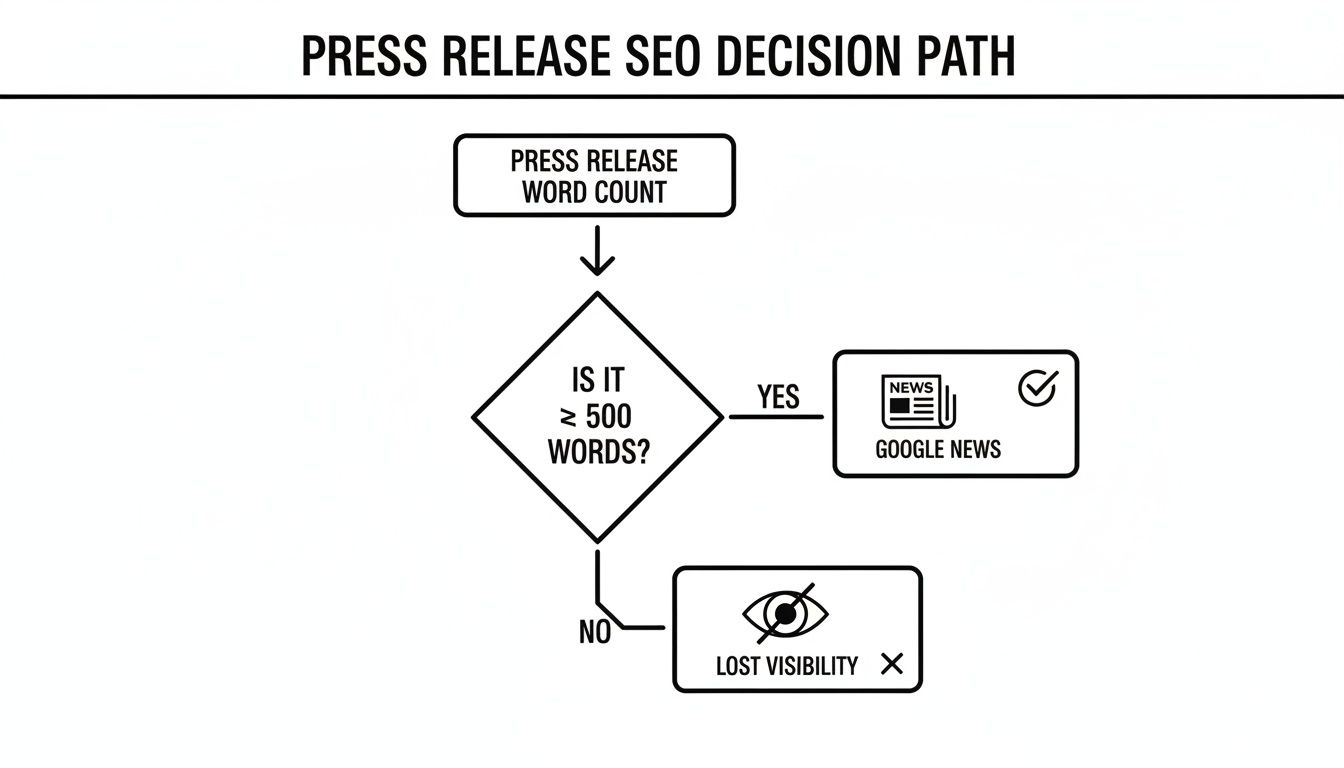
The takeaway is crystal clear: keeping your release concise is a direct path to better digital placement. The table below breaks this down even further, giving you a practical guide for choosing the right word count for your specific news.
Recommended Press Release Length by Announcement Type
This table is your quick-reference guide for matching word count to your news. Use it to make sure you’re giving your story just enough room to breathe without bogging it down.
| Announcement Type | Recommended Word Count | Key Focus Element |
|---|---|---|
| New Product Launch | 450-500 Words | Detailed specifications, user benefits, and executive quotes. |
| Company Merger/Acquisition | 400-500 Words | Strategic rationale, leadership vision, and market implications. |
| Partnership Announcement | 350-450 Words | Mutual benefits, joint goals, and quotes from both partners. |
| New Hire/Promotion | 300-350 Words | The individual's background, new role, and a welcoming quote. |
| Event Announcement | 300-350 Words | Essential event details (date, location, purpose) and registration info. |
| Crisis Communication | 300-400 Words | Factual, direct information, and clear next steps. |
By aligning your press release length with both the story and the channel, you’re not just sending out information—you’re crafting a message that’s built to be seen and shared.
Common Word Count Mistakes and How to Fix Them
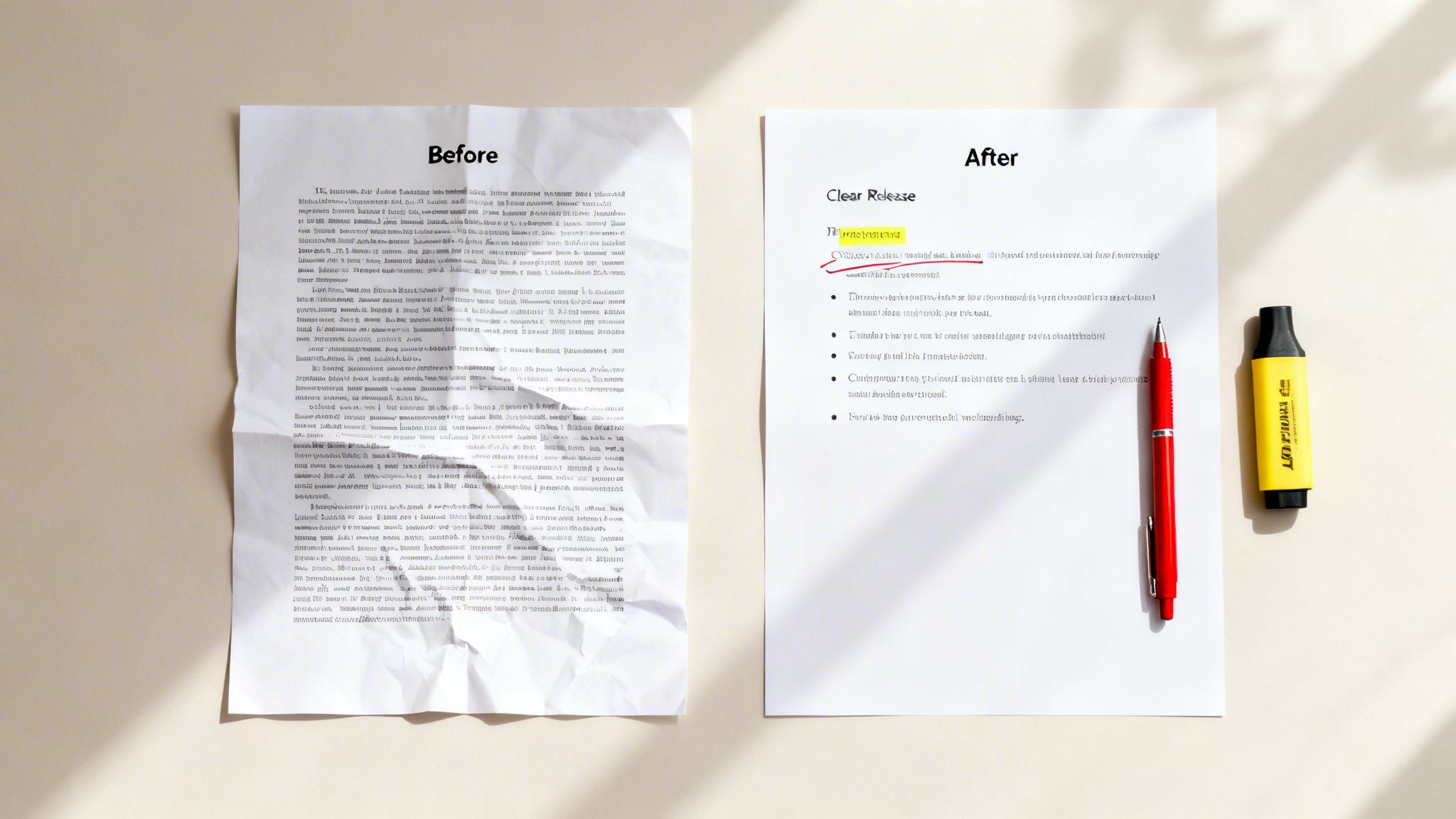
It’s one thing to know the ideal length for a press release; it’s another to actually hit that target. If you find your drafts are consistently bloated and overwritten, you’re not alone. Most start that way, full of good intentions that end up sinking the message.
The secret is learning to spot and cut the fluff. Think of this as your field guide to trimming your draft down to its fighting weight, ensuring your news is sharp, clear, and impactful.
Mistake 1 Burying the Lead
This is the number one offender. If you spend the first 100 words warming up with company backstory, you've already lost the journalist. They need the core news immediately, not buried three paragraphs down.
A rambling intro forces you to repeat key details later, which just adds unnecessary words. The fix is simple: get straight to the point. Your first paragraph must answer the who, what, when, where, and why.
Before (48 words):
For years, Innovate Inc. has been a leader in the sustainable packaging industry. With a commitment to forward-thinking solutions that benefit our planet, our team has been working tirelessly on our next major project, which we are excited to finally announce to the world today.
After (22 words):
Innovate Inc. today launched the "EcoPouch," a fully compostable packaging solution designed to eliminate 10 tons of plastic waste from landfills annually.
Mistake 2 Adding Fluffy Corporate Jargon
Corporate-speak is the enemy of clarity. Phrases like "synergistic partnerships," "paradigm-shifting solutions," and "value-added propositions" might sound impressive in a boardroom, but they mean very little to a reporter on a deadline.
This kind of language clutters your release and makes it hard to understand. Swap the buzzwords for simple, direct terms that explain what you’re doing and why anyone should care.
A press release is a news document, not a corporate memo. Write like a journalist would—with clarity, precision, and a focus on the facts. This simple shift in mindset will help you slash your word count and increase your impact.
Mistake 3 Including Vague or Generic Quotes
Quotes are your chance to add a human touch and unique insight. All too often, they’re filled with generic, pre-approved statements that are just dead weight. A quote like, "We are thrilled about this opportunity," is a complete waste of space.
Instead, a great quote should deliver a key message, a powerful statistic, or a perspective that adds real depth to the announcement.
Before (35 words):
"We are very excited to announce this new partnership. We believe it will be incredibly beneficial for both companies and look forward to a successful collaboration moving forward," said Jane Doe, CEO.
After (29 words):
"This partnership allows us to immediately scale our distribution to 500 new retail locations, bringing sustainable options directly to communities that have been asking for them," said CEO Jane Doe.
Learning to spot these common pitfalls is the first step toward mastery. For a deeper look, you might be interested in our guide covering other press release mistakes to avoid.
Mistake 4 Providing Excessive Backstory
While your company's history is important to you, it's almost never newsworthy. Dedicating entire paragraphs to when the company was founded, its past awards, or its broad mission statement belongs in one place and one place only: the boilerplate.
The body of your press release should focus exclusively on the new information. Move all that background context to your boilerplate section at the very end. This one simple edit can often slice 100-150 words from a draft instantly, ensuring your real news gets the spotlight it deserves.
Answering Your Press Release Length Questions
Even with clear guidelines, a few tricky questions always seem to pop up right when you’re ready to write. How do you count every last word? And what happens when your news is just too big for the standard format? Let's tackle these common gray areas so you can write with total confidence.
Think of this as your field guide for those "what if" scenarios that can leave you second-guessing your work.
Does Word Count Include the Headline and Boilerplate?
Yes, it absolutely does. That final 300-500 word count should cover everything from your headline all the way down to your contact info. A journalist sees the release as one single document, and keeping the whole thing feeling concise is what makes it work.
This means every single element has to pull its weight. Keep your headline sharp and your boilerplate tight—ideally under 100 words. Every part contributes to that scannable, "one-page" feel that reporters really appreciate.
What if My News Is Genuinely Too Complex for 500 Words?
This is a common one. If you’re announcing something with dense scientific data, complex financial reports, or detailed tech specs, don't even try to cram it all in. Instead, your press release needs to act as the gateway, not the entire library. Your job is to pull out the most important, newsworthy highlights and summarize them within that 400-500 word framework.
Your press release is the hook, not the encyclopedia. Its purpose is to spark a journalist's interest and guide them toward more detailed information, showing respect for their time while still providing depth.
From there, provide obvious, easy-to-find links where they can dig deeper. This could point to a full research report, a technical white paper, an investor deck, or a product brief on your website. This gives journalists exactly what they need: a quick summary to grab their attention and a clear path to the nitty-gritty details.
Is a Very Short 250-Word Release Better Than a 600-Word One?
If you're forced to choose between the two, shorter is almost always the better and safer play. A 600-word press release is a huge red flag for a busy journalist and has a high chance of being deleted on sight. It screams "we don't know what's important" and shows a lack of respect for their schedule.
While a 250-word release can feel a bit thin, it will at least get a quick read if it has the essentials. It's not the goal, though. The real sweet spot is still 300-500 words—it feels substantial enough to be credible but brief enough to be inviting.
Should Length Change if I Include Images or Video?
Nope. The written word count should stick to the 300-500 word guideline. Multimedia elements are fantastic additions and can seriously boost engagement, but they're there to supplement the text, not replace it. A reporter still needs a concise written story to quickly get the context. Your text has to stand on its own, with the visuals serving as powerful, immediate backup for your narrative.
Crafting the perfect press release takes practice, but the right tools can make all the difference. At Press Release Zen, we provide free templates, expert guides, and actionable checklists to help you get your news noticed. https://pressreleasezen.com