An embargoed press release is your secret weapon for making a huge splash. It’s a strategic move where you give trusted journalists a sneak peek at your news before it goes public, with a strict agreement that they won't publish until a specific date and time.
Think of it as giving them a "VIP preview." This allows reporters to craft a detailed, accurate story instead of a rushed, last-minute blurb, ensuring your announcement gets the thoughtful coverage it deserves.
What Are Embargoed Press Releases and Why Do They Work?
Imagine you’re launching a groundbreaking new technology or announcing a major corporate merger. Trying to get a journalist to understand all the nuances in a few short hours is a recipe for disaster. You'll likely end up with shallow reporting that completely misses the point.
This is exactly the problem an embargoed press release solves. It turns a frantic deadline into a valuable head start for the media.
At its core, an embargo is a gentleman's agreement built on trust. You hand over everything a journalist needs—the full press release, supporting data, and access to your key players for interviews—well ahead of the official launch. In return, they promise to hold the story until the embargo lifts. This simple exchange of time for trust is what transforms mediocre coverage into a media home run.
The Power of Preparation
When journalists aren't racing against the clock, they can do what they do best: tell a great story. This advance notice is a game-changer, allowing them to:
- Do their homework: They can dig into the background of your announcement, verify all the facts, and actually understand the context of what you're sharing.
- Line up interviews: This is huge. Reporters can schedule time to speak with your CEO, product managers, or key stakeholders to get those killer quotes that bring a story to life.
- Create high-quality content: Instead of a simple news brief, they have the bandwidth to produce a well-rounded feature article, a polished video segment, or even an in-depth podcast episode.
This controlled timing puts you back in the driver's seat. By providing a complete, well-packaged story, you help shape the initial narrative into something that's both compelling and on-message. It’s a true win-win: journalists get the time they need to do their jobs right, and you get the thoughtful, widespread coverage you’ve been working for.
A Time-Tested Media Strategy
The idea of an embargo isn't some new PR gimmick; it has a long and practical history. Embargoed press releases first appeared in the early 20th century, born out of necessity as journalists struggled with tight print deadlines around World War I. By the 1960s, organizations like NASA were using them masterfully to manage complex scientific announcements, a practice that's only become more refined over time. Discover more about the history of embargoes and their adaptability in modern PR strategies.
An embargoed press release works like a shared secret between you and the media. You're not just blasting out information; you're building a relationship based on mutual respect for timing and accuracy.
Ultimately, the goal is to orchestrate a coordinated wave of high-quality media coverage that all hits at the exact same moment. This sends a powerful signal to the market—and to search engines—that your news is a big deal, creating a burst of attention that a disorganized, immediate release could never achieve.
When to Use an Embargo for Maximum Impact
Deciding to use an embargoed press release isn't a default move—it's a strategic one. If you slap an embargo on every little update, you'll quickly dilute its power and, frankly, start to annoy journalists. The real magic of an embargo is saving it for news that is genuinely substantial, complex, and needs thoughtful, coordinated coverage to land properly.
Think of it like a stage manager with a spotlight. You wouldn't hit the main spotlight for a crew member adjusting a mic stand. You save it for the star's grand entrance. An embargo is that spotlight, making sure all eyes are on your biggest moments, right when they happen. It’s the right tool for announcements that need to be understood, not just mentioned.
So, when do you pull this powerful tool out of your PR toolkit? The simple answer is when your news has so much depth that a reporter on a tight deadline could never do it justice. A rushed story is a recipe for inaccuracies and missed details, which can completely undermine your announcement.
This decision tree can help you visualize whether an embargo is the right path, walking you from the complexity of your story to the potential risks involved.
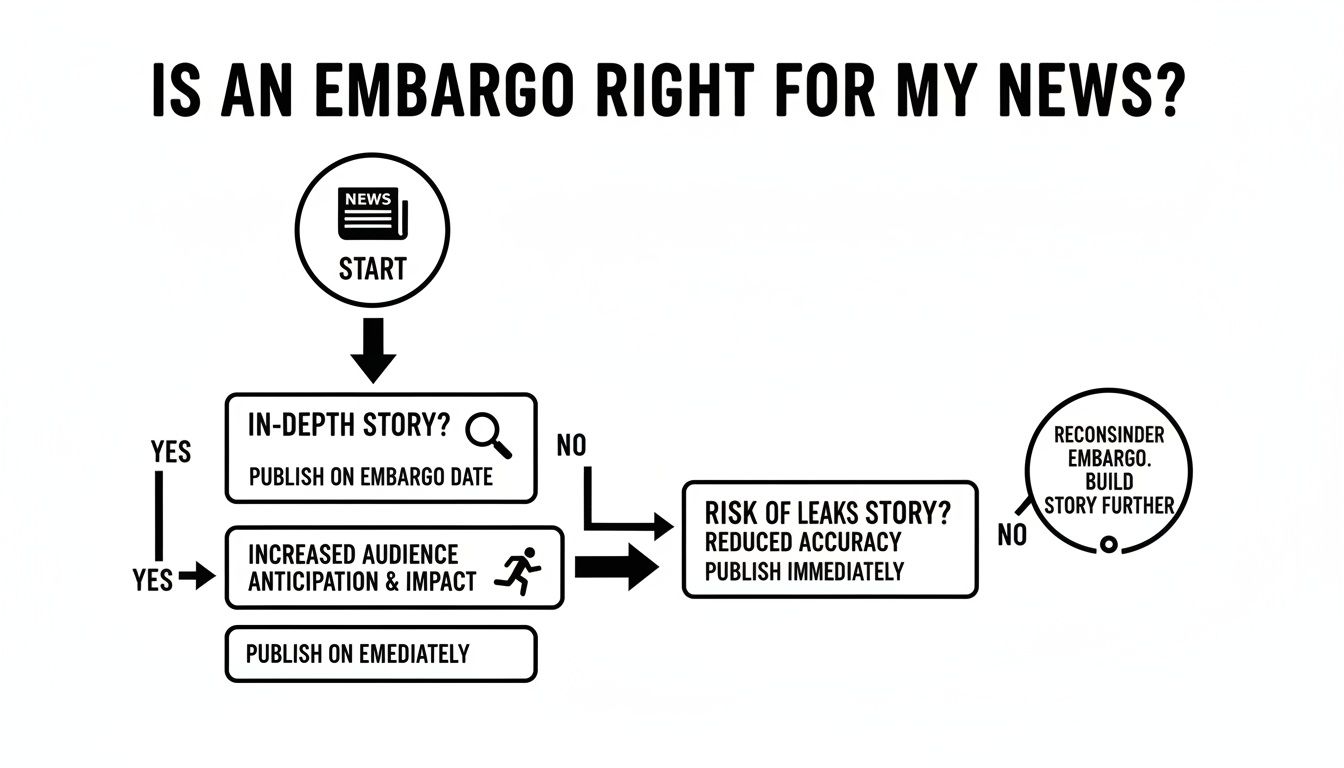
As the flowchart shows, if your story demands real analysis and the risk of a leak is manageable, an embargo is a fantastic strategic choice.
High-Stakes Scenarios That Justify an Embargo
Some types of news are almost always perfect candidates for an embargo. These are the situations where the details are everything, and the potential for a reporter to get it wrong under pressure is just too high.
You should strongly consider using an embargo for announcements like these:
- Complex Product or Service Launches: Does your launch involve new technology, intricate features, or a major shift in your market? Give reporters the time they need. An embargo lets them actually test the product, understand its value, and write a thorough review instead of just a quick summary of your press release.
- Groundbreaking Research or Data Reports: Announcing a major study, survey results, or a scientific discovery needs careful handling. Journalists need to read the full report, talk to the researchers, and maybe even get opinions from outside experts to add context. An embargo makes all of that possible.
- Major Mergers, Acquisitions, or Partnerships: These deals are sensitive and have huge implications for employees, investors, and customers. Giving reporters a heads-up with an embargo allows them to dig into the deal's structure, the strategy behind it, and what it means for the market.
- Sensitive Financial News: Publicly traded companies rely on embargoes to release quarterly earnings or other market-moving data. This ensures every financial journalist gets the information at the same time, preventing the market chaos that can happen with staggered reporting.
To make the choice even clearer, here's a quick reference guide to help you decide if an embargo is the right strategy for your specific announcement.
Embargo vs. Immediate Release Decision Matrix
| Announcement Type | Use Embargo? | Reasoning | Example |
|---|---|---|---|
| New Tech Product | Yes | Allows for in-depth reviews, demos, and expert interviews to explain complex features. | A smartphone company launching a model with a revolutionary camera system. |
| Quarterly Earnings | Yes | Ensures fair and simultaneous access for all financial media, preventing market volatility. | A public company reporting its Q3 financial results. |
| New Hire (Non-C-Suite) | No | The news is straightforward and doesn't require deep analysis or coordination. | A marketing department hiring a new social media manager. |
| Major Scientific Study | Yes | Gives journalists time to understand complex data, interview researchers, and provide context. | A university releasing a 10-year study on climate change. |
| Local Charity Event | No | This is timely, community-focused news that benefits from immediate and broad sharing. | Announcing a fundraising bake sale happening next weekend. |
| Company Acquisition | Yes | The implications are complex and sensitive, requiring careful, coordinated messaging. | A major software firm acquiring a smaller startup. |
This table isn't exhaustive, but it highlights the core principle: use an embargo when complexity and coordination are more important than sheer speed.
A Practical Checklist for Your Decision
Before you commit, run your announcement through these questions. If you find yourself nodding "yes" to even one of them, an embargo is probably your best bet.
An embargo is an investment in quality coverage. You are trading the instant buzz of an immediate release for the promise of more accurate, detailed, and impactful stories when it matters most.
1. Does the story require serious background research? If a journalist needs to get up to speed on industry history, technical specs, or dense data, give them the runway to do it right.
2. Is the timing absolutely critical for market or public reaction? For news tied to a specific event, like the stock market opening or a keynote speech, an embargo ensures everyone publishes at the exact moment you need them to.
3. Would interviews with key executives or experts make the story better? An embargo creates a perfect window for reporters to schedule and conduct meaningful interviews, adding a human element and credibility to their work.
4. Are you coordinating a global announcement across multiple time zones? It’s pretty much the only way to make sure media in London, New York, and Tokyo can all drop their stories simultaneously for a powerful, unified global launch.
The Strategic Benefits of Using an Embargo
Think of an embargoed press release as more than just a scheduling tool. It’s a strategic play designed to get you better quality, more accurate, and wider-reaching coverage for your announcement. By giving journalists a heads-up, you’re giving them the one thing they value most: time.
This single move completely changes the dynamic. Instead of scrambling to push out a quick, surface-level story, a reporter with your embargoed release can actually dig in. It gives them the breathing room to do their research, set up interviews with your key people, and really wrap their heads around the story. This prep work is what allows them to build a comprehensive, thoughtful piece that gets your message right.

Driving Higher Quality and Deeper Coverage
The biggest win from an embargo is the massive jump in the quality of media coverage. A reporter who isn't up against a tight deadline is a much better storyteller. They can go beyond just reprinting your talking points and start adding real context, outside expert opinions, and a compelling narrative.
This naturally leads to richer stories that people actually want to read and share. A well-researched article has a much longer shelf life than a forgettable news blurb. It's a huge reason why learning how to get a press release picked up by media outlets almost always involves mastering the embargo.
The core value of an embargo lies in transforming a media transaction into a collaborative effort. You provide the raw materials and time; journalists build a much better story.
The numbers back this up, too. A landmark 2013 study found that embargoed research announcements pulled in 47% more media coverage than those released immediately. Fast forward to a 2024 analysis, and the results are even more striking: embargoed releases scored 80% more coverage, showing a 73% leap in effectiveness in just over a decade. That’s a real, measurable boost in brand visibility for any business.
Strengthening Relationships and Coordinating Impact
Beyond just better articles, embargoes deliver some key benefits that pay off in the long run. When you trust a select group of journalists with your news early, you're showing them respect and treating them like partners. That simple act of professional courtesy goes a long way in building strong media relationships.
Embargoes also help you sidestep major logistical headaches, especially for big, global announcements. You can coordinate a simultaneous media blitz across every time zone, making sure that outlets in New York, London, and Tokyo all publish at the same time. This creates a powerful, unified wave of news that tells the world your announcement is a big deal.
Finally, that coordinated push gives you a nice SEO bump. When a bunch of high-authority news sites all drop detailed articles about you at once, it sends a massive signal to Google that your news is important. This can boost your search rankings and drive organic traffic long after the initial buzz dies down. Once the embargo lifts, using smart post-release tactics like content repurposing strategies can squeeze even more value out of your announcement.
How to Craft the Perfect Embargo Notice
The success of your entire embargo strategy comes down to one thing: clarity. If your embargo notice is even a little bit ambiguous, you're practically inviting a premature leak.
Crafting the perfect notice isn’t about using dense legal jargon. It's about being direct, explicit, and absolutely impossible to misinterpret. Think of it as the most important instruction you'll ever give. Your goal is to make the embargo terms the very first thing a journalist sees, leaving zero room for error.
This is what a clear, unmissable embargo notice looks like.

This is exactly what you're aiming for—bold, red, all-caps text placed at the very top. It’s the first thing the recipient reads, and it can't be ignored.
The Three Essential Parts of an Embargo Notice
A rock-solid embargo notice has three non-negotiable components. Each one is designed to shut down a potential point of failure and make your agreement with the media crystal clear.
If you want to be sure your notice—and the rest of your press release—is crafted with precision, an AI writing assistant can be a huge help in getting the details right.
The "Embargoed" Declaration: Your notice must lead with the word "EMBARGOED" in all caps. Use a bold red font to make it pop. This visual cue acts like a stop sign, preventing a busy journalist from just skimming and treating it like a standard release.
The Specific Date and Time: Never just say "Tuesday." Be hyper-specific. Write out the full date, like "Tuesday, October 26, 2024," followed by the exact time, such as "9:00 AM EDT." Ambiguity is your worst enemy here.
The Time Zone: This is a surprisingly common—and costly—mistake. In a world of global media, you absolutely must include the time zone (PST, EDT, GMT, etc.). Forgetting it could cause an outlet halfway across the world to publish hours before you planned.
Placement and Formatting Best Practices
Where you put the notice is just as important as what's in it. The rule is simple: make it impossible to miss.
The embargo notice must be the very first thing on the page. Place it at the top of your press release, above the headline and even your company logo.
Here’s a quick checklist to make sure your notice has maximum impact:
- Top of the Page: Always position the full embargo statement at the absolute top of the document. No exceptions.
- Bold and Red: Use bold formatting and a red color. This is a universal sign for "stop" or "warning," and it instantly grabs attention.
- Clear Language: Stick to straightforward phrasing like, "EMBARGOED: For Immediate Release at 9:00 AM EDT on Tuesday, October 26, 2024."
- Email Subject Line: When you send the release, put the embargo right in the subject line. Something like, "EMBARGOED UNTIL 9 AM EDT, 10/26: [Your Company] Announces New Partnership."
A Ready-to-Use Embargo Notice Template
To take out all the guesswork, here’s a simple, industry-standard template you can copy and paste. Just swap out the bracketed information with your specifics.
[BEGIN TEMPLATE]
EMBARGOED: NOT FOR RELEASE BEFORE [Day of Week], [Month] [Date], [Year] AT [Time] [AM/PM] [Time Zone]
[END TEMPLATE]
Here it is in action:
EMBARGOED: NOT FOR RELEASE BEFORE TUESDAY, OCTOBER 26, 2024 AT 9:00 AM EDT
This format is immediately understood by journalists everywhere. By being this clear and direct, you set the stage for a successful media launch and keep your relationships with the press strong.
And don't forget to include clear contact details in the release itself. For a refresher, check out our best practices for adding contact information in press releases.
What to Do When an Embargo Breaks
An embargo is a gentleman's agreement, built on trust. But let's be real—sometimes, things go sideways. Seeing your big news leak before the official time is enough to make any PR pro's stomach drop.
The absolute worst thing you can do is panic. Your first instinct might be to fire off a frantic email to your entire media list, but that just adds fuel to the fire. A calm, strategic response is the only way to get back in the driver's seat.

Your Immediate Action Plan
What you do in the first hour is critical. Acting fast and professionally can stop a small leak from becoming a full-blown flood. Here’s your step-by-step playbook.
Confirm the Breach: First, make sure it’s a real breach. Was the embargo notice crystal clear? Did you specify the time zone correctly? Rule out a simple misunderstanding on your end before you point any fingers.
Contact the Offending Outlet: Pick up the phone. Don't hide behind an email. Call your contact at the publication, calmly explain what happened, and politely—but firmly—request they take the story down immediately. Most of the time, breaches are accidents, and a reputable outlet will usually fix their mistake.
Assess the Situation: Once you've made the call, take a breath. How far did the story travel? If it was only live for a few minutes with minimal social shares, you might be able to get things back on track without too much collateral damage.
Deciding Whether to Lift the Embargo
If the early story has already caught fire and can't be put out, you have a tough call to make: do you lift the embargo for everyone else? This move levels the playing field for all the journalists who played by the rules.
Lifting the embargo for all media contacts after a breach is often the fairest course of action. It prevents reporters who honored the agreement from being punished while the outlet that broke it reaps all the rewards.
Here’s what to weigh in your decision:
- Fairness to Other Journalists: The reporters who respected your terms are now at a serious disadvantage. Lifting the embargo for everyone restores a sense of fairness and shows you value those relationships.
- Controlling the Narrative: Once the news is out, you're no longer in control. By lifting the embargo, you empower all your trusted contacts to publish their own well-researched stories, which can help drown out the first, potentially rushed article.
- Communicating the Decision: If you decide to lift it, send a clear, concise email to your entire media list. Announce that the embargo was broken by another outlet (no need to name and shame) and that you are officially lifting it for everyone, effective immediately.
Managing Long-Term Consequences
After the dust settles, you have to think about the relationship. The journalist or outlet that broke the embargo violated a core professional trust.
The industry-standard consequence is pretty straightforward: remove them from your list for future embargoed press releases. This isn't about being petty; it's about protecting your future launches and the integrity of your process. You can let them know professionally, explaining that you can no longer give them advance information because of the breach.
Keeping track of who respects your terms is a vital part of measuring your PR success. To go deeper, you can learn more about key press release KPIs and how to measure performance.
Your Top Questions About Embargoed Press Releases
Embargoes can feel like a high-wire act. Even when you think you have everything buttoned up, a few nagging questions can pop up.
Let’s tackle some of the most common ones so you can send your next release with total confidence.
Are Embargoes Legally Binding?
This is the big one, and the answer is refreshingly simple: no, an embargo is not a legally binding contract. You can't haul a journalist into court for breaking one.
Think of an embargo as a "gentleman's agreement" built on professional trust. The whole system runs on mutual respect. The penalty for breaking that trust isn't legal, it's reputational. A reporter who jumps the gun will quickly find themselves blacklisted, not just by you, but by the entire industry. Word travels fast, and in media, a ruined reputation is far more damaging than any lawsuit.
How Far in Advance Should I Send an Embargoed Release?
Timing is everything. You need to give journalists enough runway to do great work, but not so much time that the story gets stale or the risk of a leak goes up.
Here’s a good rule of thumb:
- Simple Announcements: For straightforward news, 24 to 48 hours is usually plenty of time for a reporter to pull a story together.
- Complex Stories: For a major product launch, a dense data report, or anything that needs an in-depth review, give them more breathing room. A lead time of one to two weeks is not only appropriate but also greatly appreciated.
Always put yourself in the reporter's shoes. The more complex your story, the more time they need to do it justice.
What Is the Difference Between an Embargo and Off the Record?
These two get mixed up all the time, but confusing them can cause a world of trouble. They mean completely different things.
Embargo: "You can publish this information, but only at the specific date and time I've set."
Off the Record: "This information is for your background knowledge only. It cannot be published or attributed to me, ever."
An embargo is all about setting a future publication date. Off-the-record information is never meant to see the light of day.
Can I Send an Embargoed Release to a Blogger or Influencer?
Yes, but tread very carefully. The trust-based system that makes embargoes work is second nature to professional journalists, but it might be a foreign concept to some independent creators.
Only send embargoed material to bloggers or influencers you already have a solid, trusted relationship with. Before hitting send, reach out personally. Explain what an embargo entails and get their explicit, written agreement to honor the terms. Thoroughly vetting these partners is non-negotiable if you want to prevent a premature leak.
At Press Release Zen, we're committed to helping you master every aspect of media outreach. Explore our extensive library of guides and templates to plan, write, and distribute press releases that get results. Visit Press Release Zen today to get started.